
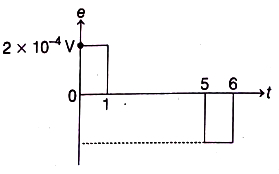
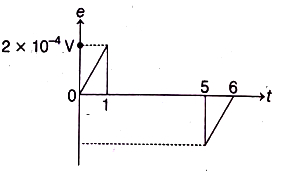
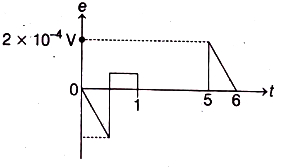
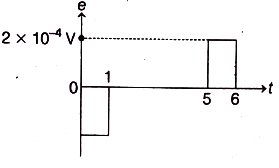
$A$ square loop of side $2 \,cm$ enters a magnetic field with a constant speed of $2 \,cm \,s^{-1}$ as shown. The front edge enters the field at $t=0 \,s$. Which of the following graphs correctly depicts the induced emf in the loop? (Take clockwise direction as positive)
- A
- B
- C
- D
Explore More
Similar Questions
Which of the following is a wrong statement?
Easy
View Solution$A$ flat coil of $500$ turns,each of area $50 \,cm^2$,rotates in a uniform magnetic field of $0.14 \,Wb/m^2$ about an axis normal to the field at an angular speed of $150 \,rad/s$. The coil has a resistance of $5 \,\Omega$. The induced $e.m.f.$ is applied to an external resistance of $10 \,\Omega$. The peak current through the resistance is .......... $A$. (in $.5$)
Easy
View SolutionTwo metallic rings $A$ and $B$,identical in shape and size but having different resistivities $\rho_A$ and $\rho_B$,are kept on top of two identical solenoids as shown in the figure. When current $I$ is switched on in both the solenoids in an identical manner,the rings $A$ and $B$ jump to heights $h_A$ and $h_B$,respectively,with $h_A > h_B$. The possible relation$(s)$ between their resistivities and their masses $m_A$ and $m_B$ is(are):
$(A)$ $\rho_A > \rho_B$ and $m_A = m_B$
$(B)$ $\rho_A < \rho_B$ and $m_A = m_B$
$(C)$ $\rho_A > \rho_B$ and $m_A > m_B$
$(D)$ $\rho_A < \rho_B$ and $m_A < m_B$
$(A)$ $\rho_A > \rho_B$ and $m_A = m_B$
$(B)$ $\rho_A < \rho_B$ and $m_A = m_B$
$(C)$ $\rho_A > \rho_B$ and $m_A > m_B$
$(D)$ $\rho_A < \rho_B$ and $m_A < m_B$
DifficultIIT 2009
View SolutionIn the circuit shown in the figure,a conducting wire $HE$ is moved with a constant speed $V$ towards the left. The complete circuit is placed in a uniform magnetic field $\vec B$ perpendicular to the plane of the circuit and directed inward. The current in $HKDE$ is
$A$ small circular loop of area $A$ and resistance $R$ is fixed on a horizontal $xy$-plane with the center of the loop always on the axis $\hat{n}$ of a long solenoid. The solenoid has $m$ turns per unit length and carries current $I$ counterclockwise as shown in the figure. The magnetic field due to the solenoid is in $\hat{n}$ direction. $List-I$ gives time dependences of $\hat{n}$ in terms of a constant angular frequency $\omega$. $List-II$ gives the torques experienced by the circular loop at time $t=\frac{\pi}{6\omega}$. Let $\alpha=\frac{A^2 \mu_0^2 m^2 I^2 \omega}{2R}$.
$List-I$ $List-II$ $(I)$ $\frac{1}{\sqrt{2}}(\sin \omega t \hat{j}+\cos \omega t \hat{k})$ $(P)$ $0$ $(II)$ $\frac{1}{\sqrt{2}}(\sin \omega t \hat{i}+\cos \omega t \hat{j})$ $(Q)$ $-\frac{\alpha}{4} \hat{i}$ $(III)$ $\frac{1}{\sqrt{2}}(\sin \omega t \hat{i}+\cos \omega t \hat{k})$ $(R)$ $\frac{3\alpha}{4} \hat{i}$ $(IV)$ $\frac{1}{\sqrt{2}}(\cos \omega t \hat{j}+\sin \omega t \hat{k})$ $(S)$ $\frac{\alpha}{4} \hat{j}$
Which one of the following options is correct?
| $List-I$ | $List-II$ |
| $(I)$ $\frac{1}{\sqrt{2}}(\sin \omega t \hat{j}+\cos \omega t \hat{k})$ | $(P)$ $0$ |
| $(II)$ $\frac{1}{\sqrt{2}}(\sin \omega t \hat{i}+\cos \omega t \hat{j})$ | $(Q)$ $-\frac{\alpha}{4} \hat{i}$ |
| $(III)$ $\frac{1}{\sqrt{2}}(\sin \omega t \hat{i}+\cos \omega t \hat{k})$ | $(R)$ $\frac{3\alpha}{4} \hat{i}$ |
| $(IV)$ $\frac{1}{\sqrt{2}}(\cos \omega t \hat{j}+\sin \omega t \hat{k})$ | $(S)$ $\frac{\alpha}{4} \hat{j}$ |
Which one of the following options is correct?
Vedclass Products
For Students
Vedclass Test Series
Mock tests in real JEE/NEET style with performance analysis. 5-day free trial.
Start Free TrialFor Teachers
Exam Paper Generator
Generate Set A/B/C/D exam papers from 7.5L+ questions in 2 minutes. 3 chapters free.
Try FreeFor Institutes
Online Exam Module
Live online exams with unlimited students, 360° analytics & white-label branding.
See Demo