
Medium
$A$ particle is released from a height $h$. The particle is given a constant horizontal velocity. Assuming $g$ remains constant everywhere, which graph correctly represents the kinetic energy $E$ of the particle with respect to time $t$?
- A
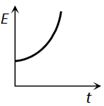
- B
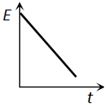
- C
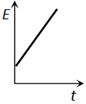
- D
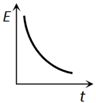
Explore More
Similar Questions
$A$ block moving horizontally on a smooth surface with a speed of $40 \, m/s$ splits into two equal parts. If one of the parts moves at $60 \, m/s$ in the same direction,then the fractional change in the kinetic energy will be $x: 4$ where $x = ..... .$
DifficultJEE MAIN 2021
View Solution$A$ machine which is $75\%$ efficient, uses $12 \, J$ of energy in lifting up a $1 \, kg$ mass through a certain distance. The mass is then allowed to fall through that distance. The velocity at the end of its fall is (in $m \, s^{-1}$):
Medium
View SolutionExplain why total linear momentum is conserved in an elastic collision,and define inelastic collision and perfectly inelastic collision.
Medium
View SolutionIs it possible for the kinetic energy of an object not to increase when work is done on it? If so,when?
Difficult
View SolutionTwo masses $m_1$ and $m_2$ are connected by a string of length $l$. They are held in a horizontal plane at a height $H$ above two heavy plates $A$ and $B$ made of different materials placed on the floor. Initially,the distance between the two masses is $a < l$. When the masses are released under gravity,they collide with $A$ and $B$ with coefficients of restitution $e_1 = 0.8$ and $e_2 = 0.4$ respectively. Find the time after the collision when the string becomes tight. (Assume $H >> l$)
Vedclass Products
For Students
Vedclass Test Series
Mock tests in real JEE/NEET style with performance analysis. 5-day free trial.
Start Free TrialFor Teachers
Exam Paper Generator
Generate Set A/B/C/D exam papers from 7.5L+ questions in 2 minutes. 3 chapters free.
Try FreeFor Institutes
Online Exam Module
Live online exams with unlimited students, 360° analytics & white-label branding.
See Demo