
$A$ bar magnet is passing through a conducting loop of radius $R$ with velocity $v$. The radius of the bar magnet is such that it just passes through the loop. The induced $e.m.f.$ in the loop can be represented by the approximate curve:
- A
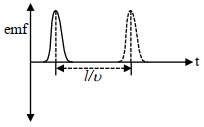
- B
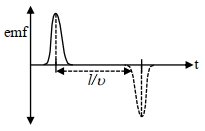
- C
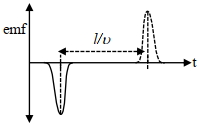
- D
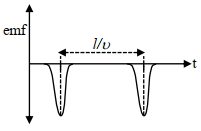
Explore More
Similar Questions
The figure shows certain wire segments joined together to form a coplanar loop. The loop is placed in a perpendicular magnetic field in the direction going into the plane of the figure. The magnitude of the field increases with time. $I_1$ and $I_2$ are the currents in the segments $ab$ and $cd$. Then,
DifficultIIT 2009
View SolutionThe north pole of a magnet is falling towards a metallic ring as shown in the figure. If looked at from above the ring,the direction of the induced current will be:
Assertion $(A):$ The bar magnet falling vertically along the axis of the horizontal coil will have an acceleration less than $g$.
Reason $(R):$ Clockwise current is induced in the coil.
Reason $(R):$ Clockwise current is induced in the coil.
MediumAIIMS 2015
View SolutionIn a closed circuit, there is only a coil of inductance $L$ and resistance $100 \Omega$. The coil is situated in a uniform magnetic field. Suddenly, the magnetic flux linked with the circuit changes by $5 \text{ Wb}$. What amount of charge will flow in the circuit as a result?
Magnetic flux (in weber) in a closed circuit of resistance $20\,\Omega$ varies with time $t(s)$ as $\phi = 8t^2 - 9t + 5$. The magnitude of the induced current at $t = 0.25\,s$ will be $...mA$.
Vedclass Products
For Students
Vedclass Test Series
Mock tests in real JEE/NEET style with performance analysis. 5-day free trial.
Start Free TrialFor Teachers
Exam Paper Generator
Generate Set A/B/C/D exam papers from 7.5L+ questions in 2 minutes. 3 chapters free.
Try FreeFor Institutes
Online Exam Module
Live online exams with unlimited students, 360° analytics & white-label branding.
See Demo