
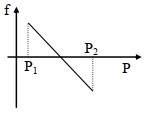
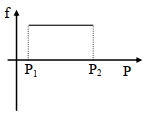
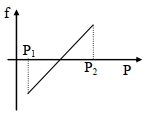
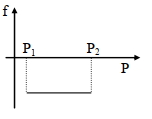
$A$ block of mass $m$ is on an inclined plane of angle $\theta$. The coefficient of friction between the block and the plane is $\mu$ and $\tan \theta > \mu$. The block is held stationary by applying a force $P$ parallel to the plane. The direction of force pointing up the plane is taken to be positive. As $P$ is varied from $P_1 = mg(\sin \theta - \mu \cos \theta)$ to $P_2 = mg(\sin \theta + \mu \cos \theta)$,the frictional force $f$ versus $P$ graph will look like:
- A
- B
- C
- D
Explore More
Similar Questions
$A$ person with a machine gun can fire $50 \ g$ bullets with a velocity of $240 \ m/s$. $A$ $60 \ kg$ tiger moves towards him with a velocity of $12 \ m/s$. In order to stop the tiger in its track,the number of bullets the person must fire towards the tiger is:
In which of the following cases is the contact force between $A$ and $B$ maximum? (Given: $m_A = m_B = 1 \ kg$)
Consider a system of blocks $A$, $B$, and $X$ as shown in the figure. The blocks $A$ and $B$ have equal mass $m$ and are connected by a massless string through a massless pulley. The coefficient of friction between block $A$ and $X$, and between block $B$ and $X$, is $\mu = 0.5$. If block $X$ moves on the horizontal frictionless surface, what should be its minimum acceleration $a$ such that blocks $A$ and $B$ remain stationary relative to $X$? ($g =$ acceleration due to gravity.)
DifficultTS EAMCET 2019
View SolutionTwo blocks of mass $2 \ kg$ and $1 \ kg$ are connected by an ideal spring on a rough surface. The spring is unstretched. The spring constant is $8 \ N/m$. The coefficient of friction is $\mu = 0.8$. Now,the $2 \ kg$ block is imparted a velocity $u$ towards the $1 \ kg$ block. Find the maximum value of velocity $u$ of the $2 \ kg$ block such that the $1 \ kg$ block never moves.
Difficult
View SolutionGive the magnitude and direction of the net force acting on a stone of mass $0.1\; kg$,
$(a)$ just after it is dropped from the window of a stationary train,
$(b)$ just after it is dropped from the window of a train running at a constant velocity of $36\; km/h$,
$(c)$ just after it is dropped from the window of a train accelerating with $1\; m/s^2$,
$(d)$ lying on the floor of a train which is accelerating with $1\; m/s^2$,the stone being at rest relative to the train.
Neglect air resistance throughout.
$(a)$ just after it is dropped from the window of a stationary train,
$(b)$ just after it is dropped from the window of a train running at a constant velocity of $36\; km/h$,
$(c)$ just after it is dropped from the window of a train accelerating with $1\; m/s^2$,
$(d)$ lying on the floor of a train which is accelerating with $1\; m/s^2$,the stone being at rest relative to the train.
Neglect air resistance throughout.
Medium
View SolutionVedclass Products
For Students
Vedclass Test Series
Mock tests in real JEE/NEET style with performance analysis. 5-day free trial.
Start Free TrialFor Teachers
Exam Paper Generator
Generate Set A/B/C/D exam papers from 7.5L+ questions in 2 minutes. 3 chapters free.
Try FreeFor Institutes
Online Exam Module
Live online exams with unlimited students, 360° analytics & white-label branding.
See Demo