
$A$ compound $A$ with molecular formula $C_{10}H_{13}Cl$ gives a white precipitate on adding silver nitrate solution. $A$ on reacting with alcoholic $KOH$ gives compound $B$ as the main product. $B$ on ozonolysis gives $C$ and $D$. $C$ gives Cannizzaro reaction but not aldol condensation. $D$ gives aldol condensation but not Cannizzaro reaction. $A$ is:
- A$C_6H_5-CH_2-CH_2-CH_2-CH_2-Cl$
- B$C_6H_5-CH_2-CH_2-CH(Cl)-CH_3$
- C$C_6H_5-CH_2-C(Cl)(CH_3)_2$
- D
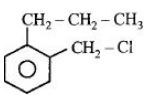
Explore More
Similar Questions
The major product of the following reaction is:
MediumKVPY 2019
View SolutionMatch the items in List-$I$ with the items in List-$II$ and select the correct code:
List-$I$
List-$II$
$A$. Tollen's reagent
$I$. Para-rosaniline + $SO_2$
$B$. Schiff's reagent
$II$. Rochelle salt + $aq. NaOH$
$C$. Rosenmund reduction
$III$. Ammoniacal silver nitrate
$D$. Fehling solution $B$
$IV$. $Pd + BaSO_4$
| List-$I$ | List-$II$ |
| $A$. Tollen's reagent | $I$. Para-rosaniline + $SO_2$ |
| $B$. Schiff's reagent | $II$. Rochelle salt + $aq. NaOH$ |
| $C$. Rosenmund reduction | $III$. Ammoniacal silver nitrate |
| $D$. Fehling solution $B$ | $IV$. $Pd + BaSO_4$ |
Which of the following would undergo aldol condensation?
Difficult
View SolutionWhich of the following compounds undergoes the Cannizzaro reaction?
Which of the following compounds will give a yellow precipitate with iodine and alkali?
MediumAIPMT 2012
View SolutionVedclass Products
For Students
Vedclass Test Series
Mock tests in real JEE/NEET style with performance analysis. 5-day free trial.
Start Free TrialFor Teachers
Exam Paper Generator
Generate Set A/B/C/D exam papers from 7.5L+ questions in 2 minutes. 3 chapters free.
Try FreeFor Institutes
Online Exam Module
Live online exams with unlimited students, 360° analytics & white-label branding.
See Demo