
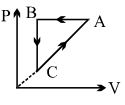
$A$ cyclic process $ABCA$ is shown in the $PT$ diagram. When presented on a $PV$ diagram,it would be:
- A
- B
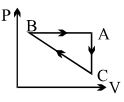
- C
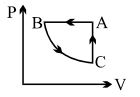
- D
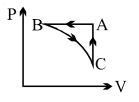
Explore More
Similar Questions
Two samples $A$ and $B$ of a gas,initially at the same pressure and temperature,are compressed from volume $V$ to $V/2$. Sample $A$ is compressed isothermally,and sample $B$ is compressed adiabatically. The final pressure of $A$ is:
Medium
View Solution$A$ soap bubble of radius $r$ contains a monoatomic ideal gas. The gas is heated in such a manner that the bubble remains in mechanical equilibrium. Assuming that the soap material of the bubble has no heat capacity,the molar heat capacity of the gas in the process will be (Neglect atmospheric pressure). (in $R$)
Heat is supplied to a diatomic gas at constant pressure. The ratio of $\Delta Q: \Delta U: \Delta W$ is
[Given $\rightarrow \Delta Q=$ heat supplied,$\Delta U=$ change in internal energy,$\Delta W$ $=$ work done]
[Given $\rightarrow \Delta Q=$ heat supplied,$\Delta U=$ change in internal energy,$\Delta W$ $=$ work done]
Which of the following statement$(s)$ is/are true? "Internal energy of an ideal gas ..........."
One mole of an ideal gas expands adiabatically from an initial state $(T_A, V_0)$ to a final state $(T_f, 5 V_0)$. Another mole of the same gas expands isothermally from a different initial state $(T_B, V_0)$ to the same final state $(T_f, 5 V_0)$. The ratio of the specific heats at constant pressure and constant volume of this ideal gas is $\gamma$. What is the ratio $T_A / T_B$?
Vedclass Products
For Students
Vedclass Test Series
Mock tests in real JEE/NEET style with performance analysis. 5-day free trial.
Start Free TrialFor Teachers
Exam Paper Generator
Generate Set A/B/C/D exam papers from 7.5L+ questions in 2 minutes. 3 chapters free.
Try FreeFor Institutes
Online Exam Module
Live online exams with unlimited students, 360° analytics & white-label branding.
See Demo