
$A$ particle of charge $q$ and mass $m$ is moving along the $x-$ axis with a velocity $v,$ and enters a region of electric field $E$ and magnetic field $B$ as shown in the figures below. For which figure the net force on the charge may be zero?
- A
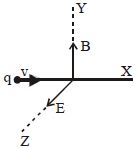
- B
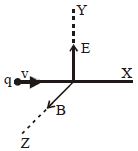
- C
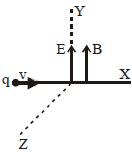
- D
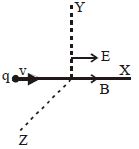
Explore More
Similar Questions
$A$ long thin-walled pipe of radius $R$ carries a current $I$ along its length. The current density is uniform over the circumference of the pipe. The magnetic field at the center of the pipe due to the quarter portion of the pipe shown is:
Pick out the wrong statement.
Match the following:
List-$I$ List-$II$ $a$. Fleming's left-hand rule $e$. Direction of induced current $b$. Fleming's right-hand rule $f$. South pole $c$. Clockwise current $g$. North pole $d$. Anticlockwise current $h$. Direction of force
The correct answer is:
| List-$I$ | List-$II$ |
| $a$. Fleming's left-hand rule | $e$. Direction of induced current |
| $b$. Fleming's right-hand rule | $f$. South pole |
| $c$. Clockwise current | $g$. North pole |
| $d$. Anticlockwise current | $h$. Direction of force |
The correct answer is:
Answer the following questions:
$(a)$ $A$ magnetic field that varies in magnitude from point to point but has a constant direction (east to west) is set up in a chamber. $A$ charged particle enters the chamber and travels undeflected along a straight path with constant speed. What can you say about the initial velocity of the particle?
$(b)$ $A$ charged particle enters an environment of a strong and non-uniform magnetic field varying from point to point both in magnitude and direction,and comes out of it following a complicated trajectory. Would its final speed equal the initial speed if it suffered no collisions with the environment?
$(c)$ An electron travelling west to east enters a chamber having a uniform electrostatic field in north to south direction. Specify the direction in which a uniform magnetic field should be set up to prevent the electron from deflecting from its straight line path.
$(a)$ $A$ magnetic field that varies in magnitude from point to point but has a constant direction (east to west) is set up in a chamber. $A$ charged particle enters the chamber and travels undeflected along a straight path with constant speed. What can you say about the initial velocity of the particle?
$(b)$ $A$ charged particle enters an environment of a strong and non-uniform magnetic field varying from point to point both in magnitude and direction,and comes out of it following a complicated trajectory. Would its final speed equal the initial speed if it suffered no collisions with the environment?
$(c)$ An electron travelling west to east enters a chamber having a uniform electrostatic field in north to south direction. Specify the direction in which a uniform magnetic field should be set up to prevent the electron from deflecting from its straight line path.
Medium
View Solution$A$ charged particle of mass $m$ and charge $q$ moving under the influence of a uniform electric field $E\hat{i}$ and a uniform magnetic field $B\hat{k}$ follows a trajectory from point $P$ to $Q$ as shown in the figure. The velocities at $P$ and $Q$ are respectively $v\hat{i}$ and $-2v\hat{j}$. Which of the following statements $(A, B, C, D)$ are correct? (Trajectory shown is schematic and not to scale)
$(A)$ $E = \frac{3}{4}\left(\frac{mv^{2}}{qa}\right)$
$(B)$ Rate of work done by the electric field at $P$ is $\frac{3}{4}\left(\frac{mv^{3}}{a}\right)$
$(C)$ Rate of work done by both the fields at $Q$ is zero
$(D)$ The difference between the magnitude of angular momentum of the particle at $P$ and $Q$ is $2mav$.
$(A)$ $E = \frac{3}{4}\left(\frac{mv^{2}}{qa}\right)$
$(B)$ Rate of work done by the electric field at $P$ is $\frac{3}{4}\left(\frac{mv^{3}}{a}\right)$
$(C)$ Rate of work done by both the fields at $Q$ is zero
$(D)$ The difference between the magnitude of angular momentum of the particle at $P$ and $Q$ is $2mav$.
DifficultJEE MAIN 2020
View SolutionVedclass Products
For Students
Vedclass Test Series
Mock tests in real JEE/NEET style with performance analysis. 5-day free trial.
Start Free TrialFor Teachers
Exam Paper Generator
Generate Set A/B/C/D exam papers from 7.5L+ questions in 2 minutes. 3 chapters free.
Try FreeFor Institutes
Online Exam Module
Live online exams with unlimited students, 360° analytics & white-label branding.
See Demo