
$A$ series $LR$ circuit is connected to a voltage source with $V(t) = V_0 \sin \omega t$. After a very large time,how does the current $I(t)$ behave? (Given: $t_0 \gg \frac{L}{R}$)
- A
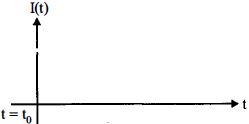
- B
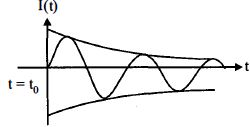
- C
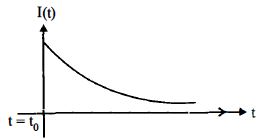
- D
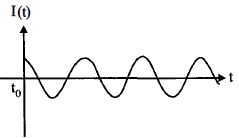
Explore More
Similar Questions
There is a $100\,\Omega$ resistance in an $L-C-R$ $AC$ circuit. An $AC$ $emf$ of $200\,V$ and $\omega = 300\,rad/s$ is applied to this circuit. When only the capacitor is removed,the current lags the voltage by $60^o$. When only the inductor is removed,the current leads the voltage by $60^o$. The current in this $L-C-R$ circuit will be.....$A$
Difficult
View SolutionIs the current distribution shown in the figure possible?
Medium
View SolutionIn a series $LR$ circuit with $X_L = R$. Power factor is $P_1$. If a capacitor of capacitance $C$ with $X_c = X_L$ is added to the circuit the power factor becomes $P_2$. The ratio of $P_1$ to $P_2$ will be :
DifficultMHT CET 2026
View SolutionWhat is the reason we prefer $A.C.$ voltage over $D.C.$ voltage for power transmission?
Easy
View SolutionAn inductor stores $16 \ J$ of magnetic field energy and dissipates $32 \ W$ of thermal energy due to its resistance when an $A.C.$ current of $2 \ A$ $(rms)$ and frequency $50 \ Hz$ flows through it. The ratio of inductive reactance to its resistance is . . . . . . . $(\pi=3.14)$
DifficultJEE MAIN 2026
View SolutionVedclass Products
For Students
Vedclass Test Series
Mock tests in real JEE/NEET style with performance analysis. 5-day free trial.
Start Free TrialFor Teachers
Exam Paper Generator
Generate Set A/B/C/D exam papers from 7.5L+ questions in 2 minutes. 3 chapters free.
Try FreeFor Institutes
Online Exam Module
Live online exams with unlimited students, 360° analytics & white-label branding.
See Demo