
$A$ sphere of mass $m$ and radius $R$ is kept on a rough horizontal surface and pulled with a horizontal force $F = \alpha t$,where $\alpha$ is a constant and $t$ is time. The coefficient of static friction is $\mu_s$ and the coefficient of kinetic friction is $\mu_k$. Which of the following graphs correctly shows the variation of the acceleration of the sphere with time?
- A

- B
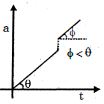
- C
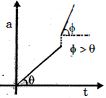
- D
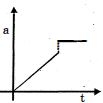
Explore More
Similar Questions
$A$ block of mass $M$ is placed on a horizontal surface and is tied with an inextensible string to a block of mass $m$,as shown in the figure. $A$ block of mass $m_0$ is also placed on $M$. The surface under $M$ is smooth,while the vertical surface under $m$ is rough with a coefficient of friction $\mu$. The minimum value of $\mu$ for which the block $m$ remains stationary is:
Difficult
View SolutionColumn $II$ shows five systems in which two objects are labelled as $X$ and $Y$. Also in each case a point $P$ is shown. Column $I$ gives some statements about $X$ and/or $Y$. Match these statements to the appropriate system$(s)$ from Column $II$.
Column $I$ Column $II$ $(A)$ The force exerted by $X$ on $Y$ has a magnitude $Mg$. $(p)$ Block $Y$ of mass $M$ on a fixed inclined plane $X$,slides on it with a constant velocity. $(B)$ The gravitational potential energy of $X$ is continuously increasing. $(q)$ Two ring magnets $Y$ and $Z$,each of mass $M$,are kept in a frictionless vertical plastic stand. $Y$ rests on base $X$ and $Z$ hangs in equilibrium. The system is in a lift moving up with constant velocity. $(C)$ Mechanical energy of the system $X+Y$ is continuously decreasing. $(r)$ $A$ pulley $Y$ of mass $m_0$ is fixed to a table $X$. $A$ block of mass $M$ hangs from a string over the pulley,fixed at $P$. The system is in a lift moving down with constant velocity. $(D)$ The torque of the weight of $Y$ about point $P$ is zero. $(s)$ $A$ sphere $Y$ of mass $M$ is released in a non-viscous liquid $X$ and moves down. $(t)$ $A$ sphere $Y$ of mass $M$ is falling with terminal velocity in a viscous liquid $X$.
| Column $I$ | Column $II$ |
|---|---|
| $(A)$ The force exerted by $X$ on $Y$ has a magnitude $Mg$. | $(p)$ Block $Y$ of mass $M$ on a fixed inclined plane $X$,slides on it with a constant velocity. |
| $(B)$ The gravitational potential energy of $X$ is continuously increasing. | $(q)$ Two ring magnets $Y$ and $Z$,each of mass $M$,are kept in a frictionless vertical plastic stand. $Y$ rests on base $X$ and $Z$ hangs in equilibrium. The system is in a lift moving up with constant velocity. |
| $(C)$ Mechanical energy of the system $X+Y$ is continuously decreasing. | $(r)$ $A$ pulley $Y$ of mass $m_0$ is fixed to a table $X$. $A$ block of mass $M$ hangs from a string over the pulley,fixed at $P$. The system is in a lift moving down with constant velocity. |
| $(D)$ The torque of the weight of $Y$ about point $P$ is zero. | $(s)$ $A$ sphere $Y$ of mass $M$ is released in a non-viscous liquid $X$ and moves down. |
| $(t)$ $A$ sphere $Y$ of mass $M$ is falling with terminal velocity in a viscous liquid $X$. |
In the given system,if $M_2 = 2M_1$,the tension in the string is $T$. If the positions of the blocks are interchanged,what will be the new tension in the string?
Medium
View SolutionThe figure shows a man standing stationary with respect to a horizontal conveyor belt that is accelerating with $1 \; m/s^2$. What is the net force on the man? If the coefficient of static friction between the man's shoes and the belt is $0.2$,up to what acceleration of the belt can the man continue to be stationary relative to the belt? (Mass of the man $= 65 \; kg.)$
Medium
View SolutionIn the figure,two blocks are connected by a uniform strut attached to each block with frictionless pins. Block $A$ weighs $400 \, N$,block $B$ weighs $300 \, N$,and the strut $AB$ weighs $200 \, N$. If $\mu = 0.25$ under block $B$,determine the minimum coefficient of friction under block $A$ to prevent motion.
Difficult
View SolutionVedclass Products
For Students
Vedclass Test Series
Mock tests in real JEE/NEET style with performance analysis. 5-day free trial.
Start Free TrialFor Teachers
Exam Paper Generator
Generate Set A/B/C/D exam papers from 7.5L+ questions in 2 minutes. 3 chapters free.
Try FreeFor Institutes
Online Exam Module
Live online exams with unlimited students, 360° analytics & white-label branding.
See Demo