
$A$ spherically symmetric gravitational system of particles has a mass density $\rho = \begin{cases} \rho_0 & \text{for } r \leq R \\ 0 & \text{for } r > R \end{cases}$ where $\rho_0$ is a constant. $A$ test mass can undergo circular motion under the influence of the gravitational field of particles. Its speed $V$ as a function of distance $r$ $(0 < r < \infty)$ from the centre of the system is represented by:
- A
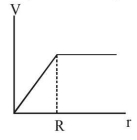
- B
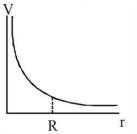
- C
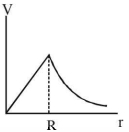
- D
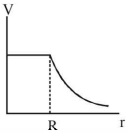
Explore More
Similar Questions
The solution of $\frac{dy}{dx} = \frac{y^2}{xy - x^2}$ is
Which of the following biomolecules acts as specific catalysts in biological reactions?
The epithelial tissue present on the inner surface of bronchioles and fallopian tubes is
Given that,$a \alpha^2+2 b \alpha+c \neq 0$ and that the system of equations
$\begin{aligned} & (a \alpha+b) x+a y+b z=0 \\ & (b \alpha+c) x+b y+c z=0 \\ & (a \alpha+b) y+(b \alpha+c) z=0\end{aligned}$
has a non-trivial solution,then $a, b$ and $c$ lie in
$\begin{aligned} & (a \alpha+b) x+a y+b z=0 \\ & (b \alpha+c) x+b y+c z=0 \\ & (a \alpha+b) y+(b \alpha+c) z=0\end{aligned}$
has a non-trivial solution,then $a, b$ and $c$ lie in
If $BaCl_2$ ionizes to an extent of $80 \ \%$ in aqueous solution,the value of van't Hoff factor is
Vedclass Products
For Students
Vedclass Test Series
Mock tests in real JEE/NEET style with performance analysis. 5-day free trial.
Start Free TrialFor Teachers
Exam Paper Generator
Generate Set A/B/C/D exam papers from 7.5L+ questions in 2 minutes. 3 chapters free.
Try FreeFor Institutes
Online Exam Module
Live online exams with unlimited students, 360° analytics & white-label branding.
See Demo