
$A$ train whistling at a constant frequency $n_0$ is moving towards a station at a constant speed $v$. The train passes a stationary observer on the station. The frequency $n$ of the sound as heard by the observer is plotted as a function of time $t$. Identify the expected curve.
- A
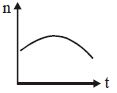
- B
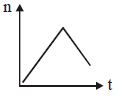
- C
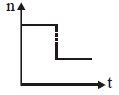
- D
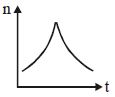
Explore More
Similar Questions
Two men are walking along a horizontal straight line in the same direction. The man in front walks at a speed of $1.0 \,m \,s^{-1}$ and the man behind walks at a speed of $2.0 \,m \,s^{-1}$. $A$ third man is standing at a height of $12 \,m$ above the same horizontal line such that all three men are in a vertical plane. The two walking men are blowing identical whistles which emit a sound of frequency $1430 \,Hz$. The speed of sound in air is $330 \,m \,s^{-1}$. At the instant when the moving men are $10 \,m$ apart,the stationary man is equidistant from them. The frequency of beats in $Hz$ heard by the stationary man at this instant is:
$A$ source $S$ emitting sound of frequency $288 \,Hz$ is fixed on block $B$ which is attached to the free end of a spring $S_2$, and an observer $O$ is on block $A$ which is attached to the free end of spring $S_1$ as shown in the figure. The blocks $A$ and $B$ are simultaneously displaced towards each other through a distance of $0.5 \,m$ and then left to oscillate. If the angular velocity of each block is $40 \,rad/s$, then the maximum frequency observed by the observer is (speed of sound in air is $340 \,m/s$): (in $\,Hz$)
DifficultAP EAMCET 2018
View Solution$A$ source of sound is travelling towards a stationary observer. The frequency of sound heard by the observer is three times the original frequency. If the velocity of sound is $v \ m/s$,the speed of the source will be:
Medium
View Solution$A$ train is moving on a straight track with speed $20 \ ms^{-1}$. It is blowing its whistle at a frequency of $1000 \ Hz$. The percentage change in the frequency heard by a person standing near the track as the train passes him is (speed of sound $= 320 \ ms^{-1}$) close to .... $\%$
When both source and listener are approaching each other,the observed frequency of sound is given by (where $V$ is the speed of sound,$V_L$ and $V_S$ are the velocities of the listener and source respectively,and $n_0$ is the radiated frequency):
Vedclass Products
For Students
Vedclass Test Series
Mock tests in real JEE/NEET style with performance analysis. 5-day free trial.
Start Free TrialFor Teachers
Exam Paper Generator
Generate Set A/B/C/D exam papers from 7.5L+ questions in 2 minutes. 3 chapters free.
Try FreeFor Institutes
Online Exam Module
Live online exams with unlimited students, 360° analytics & white-label branding.
See Demo