
An ideal gas is subjected to a cyclic process $A B C D$ as depicted in the $p-V$ diagram given below. Which of the following curves represents the equivalent cyclic process?
- A
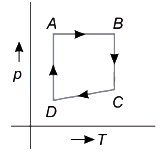
- B
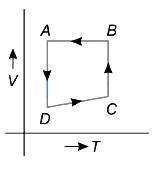
- C
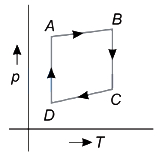
- D
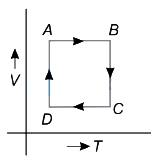
Explore More
Similar Questions
Five moles of an ideal gas has pressure $p_0$, volume $V_0$, and temperature $T_0$. The gas is expanded to volume $3V_0$ along a path such that the pressure $p$ changes as a function of volume $V$ as $p = p_0(V/V_0)$. The pressure is then reduced to $p_0$ while maintaining constant volume. Finally, the gas undergoes an isobaric compression until the volume and temperature return to $V_0$ and $T_0$, respectively. The total work done by the gas during the entire process is:
An ideal gas undergoes a thermodynamic cycle as shown in the figure. Which of the following graphs represents the same cycle?
Difficult
View SolutionHeat energy of $735\,J$ is given to a diatomic gas allowing the gas to expand at constant pressure. Each gas molecule rotates around an internal axis but does not oscillate. The increase in the internal energy of the gas will be $..........\,J$
$A$ real gas within a closed chamber at $27^{\circ} C$ undergoes the cyclic process as shown in the figure. The gas obeys the $PV^3 = RT$ equation for the path $A$ to $B$. The net work done in the complete cycle is (assuming $R = 8 \, J/mol \cdot K$): (in $ \, J$)
DifficultJEE MAIN 2024
View SolutionAn engineer claims to have made an engine delivering $10 \, kW$ power with fuel consumption of $1 \, g \, s^{-1}$. The calorific value of the fuel is $2 \, kcal \, g^{-1}$. His claim:
Easy
View SolutionVedclass Products
For Students
Vedclass Test Series
Mock tests in real JEE/NEET style with performance analysis. 5-day free trial.
Start Free TrialFor Teachers
Exam Paper Generator
Generate Set A/B/C/D exam papers from 7.5L+ questions in 2 minutes. 3 chapters free.
Try FreeFor Institutes
Online Exam Module
Live online exams with unlimited students, 360° analytics & white-label branding.
See Demo