
An ideal gas undergoes a thermodynamic cycle as shown in the figure. Which of the following graphs represents the same cycle?
- A
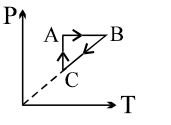
- B
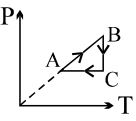
- C
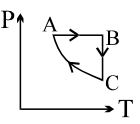
- D
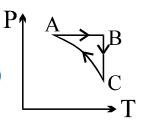
Explore More
Similar Questions
Consider the following volume-temperature $(V-T)$ diagram for the expansion of $5$ moles of an ideal monoatomic gas. Considering only $P-V$ work is involved,the total change in enthalpy (in Joule) for the transformation of state in the sequence $X \rightarrow Y \rightarrow Z$ is $\qquad$ [Use the given data: Molar heat capacity of the gas for the given temperature range,$C_{v,m} = 12 \ J \ K^{-1} \ mol^{-1}$ and gas constant,$R = 8.3 \ J \ K^{-1} \ mol^{-1}$]
$List-I$ describes thermodynamic processes in four different systems. $List-II$ gives the magnitudes (either exactly or as a close approximation) of possible changes in the internal energy of the system due to the process.
$List-I$ $List-II$ $(I)$ $10^{-3} \, kg$ of water at $100^{\circ} C$ is converted to steam at the same temperature, at a pressure of $10^5 \, Pa$. The volume of the system changes from $10^{-6} \, m^3$ to $10^{-3} \, m^3$. Latent heat of water $= 2250 \, kJ/kg$. $(P)$ $2 \, kJ$ $(II)$ $0.2 \, moles$ of a rigid diatomic ideal gas with volume $V$ at temperature $500 \, K$ undergoes an isobaric expansion to volume $3V$. Assume $R = 8.0 \, J \, mol^{-1} \, K^{-1}$. $(Q)$ $7 \, kJ$ $(III)$ One mole of a monatomic ideal gas is compressed adiabatically from volume $V = 1/3 \, m^3$ and pressure $2 \, kPa$ to volume $V/8$. $(R)$ $4 \, kJ$ $(IV)$ Three moles of a diatomic ideal gas whose molecules can vibrate, is given $9 \, kJ$ of heat and undergoes isobaric expansion. $(S)$ $5 \, kJ$ $(T)$ $3 \, kJ$
Which one of the following options is correct?
| $List-I$ | $List-II$ |
| $(I)$ $10^{-3} \, kg$ of water at $100^{\circ} C$ is converted to steam at the same temperature, at a pressure of $10^5 \, Pa$. The volume of the system changes from $10^{-6} \, m^3$ to $10^{-3} \, m^3$. Latent heat of water $= 2250 \, kJ/kg$. | $(P)$ $2 \, kJ$ |
| $(II)$ $0.2 \, moles$ of a rigid diatomic ideal gas with volume $V$ at temperature $500 \, K$ undergoes an isobaric expansion to volume $3V$. Assume $R = 8.0 \, J \, mol^{-1} \, K^{-1}$. | $(Q)$ $7 \, kJ$ |
| $(III)$ One mole of a monatomic ideal gas is compressed adiabatically from volume $V = 1/3 \, m^3$ and pressure $2 \, kPa$ to volume $V/8$. | $(R)$ $4 \, kJ$ |
| $(IV)$ Three moles of a diatomic ideal gas whose molecules can vibrate, is given $9 \, kJ$ of heat and undergoes isobaric expansion. | $(S)$ $5 \, kJ$ |
| $(T)$ $3 \, kJ$ |
Which one of the following options is correct?
Suppose an ideal gas ($n$ moles) undergoes an expansion process $P = f(V)$ which passes through the point $(V_0, P_0)$. If the slope of the curve $P = f(V)$ is greater than the slope of the adiabatic curve passing through $(V_0, P_0)$,show that the gas absorbs heat at $(V_0, P_0)$.
Match the devices in Column-$I$ with their efficiency/coefficient of performance in Column-$II$:
Column-$I$ Column-$II$ $(a)$ Heat engine $(i)$ $\text{COP} = \frac{Q_2}{Q_1 - Q_2}$ $(b)$ Heat pump $(ii)$ $\eta = \frac{Q_1 - Q_2}{Q_1}$ $(iii)$ $\eta = \frac{T_1 - T_2}{T_1}$
| Column-$I$ | Column-$II$ |
|---|---|
| $(a)$ Heat engine | $(i)$ $\text{COP} = \frac{Q_2}{Q_1 - Q_2}$ |
| $(b)$ Heat pump | $(ii)$ $\eta = \frac{Q_1 - Q_2}{Q_1}$ |
| $(iii)$ $\eta = \frac{T_1 - T_2}{T_1}$ |
Medium
View Solution$A$ monatomic gas at a pressure $P$, having a volume $V$, expands isothermally to a volume $2V$ and then adiabatically to a volume $16V$. The final pressure of the gas is (Take $\gamma = 5/3$)
MediumAIPMT 2014
View SolutionVedclass Products
For Students
Vedclass Test Series
Mock tests in real JEE/NEET style with performance analysis. 5-day free trial.
Start Free TrialFor Teachers
Exam Paper Generator
Generate Set A/B/C/D exam papers from 7.5L+ questions in 2 minutes. 3 chapters free.
Try FreeFor Institutes
Online Exam Module
Live online exams with unlimited students, 360° analytics & white-label branding.
See Demo