
Difficult
At time $t=0$, a material is composed of two radioactive atoms $A$ and $B$, where $N_{A}(0)=2 N_{B}(0)$. The decay constant of both kinds of radioactive atoms is $\lambda$. However, $A$ disintegrates to $B$ and $B$ disintegrates to $C$. Which of the following figures represents the evolution of $N_{B}(t) / N_{B}(0)$ with respect to time $t$?
$N_{A}(0) = \text{Number of } A \text{ atoms at } t=0$
$N_{B}(0) = \text{Number of } B \text{ atoms at } t=0$
$N_{A}(0) = \text{Number of } A \text{ atoms at } t=0$
$N_{B}(0) = \text{Number of } B \text{ atoms at } t=0$
- A
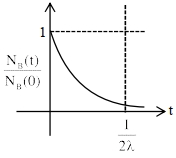
- B
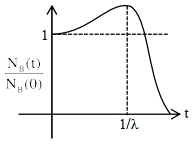
- C
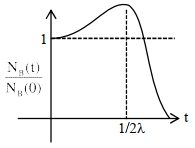
- D
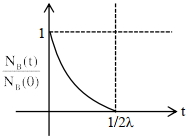
Explore More
Similar Questions
The half-life of a radioactive substance is $12 \text{ minutes}$. The time gap between $28 \%$ decay and $82 \%$ decay of the radioactive substance is
The half-life of a radioactive substance is $30 \text{ minutes}$. The time taken between $40 \%$ decay and $85 \%$ decay of the same radioactive substance is
The decay constant of radium is $4.28 \times 10^{-4}$ per year. Its half-life will be .......... $years$.
Easy
View Solution$A$ $280\, \text{day}$ old radioactive substance shows an activity of $6000\, \text{dps}$. $140\, \text{days}$ later, its activity becomes $3000\, \text{dps}$. What was its initial activity? ......... $\text{dps}$
Difficult
View SolutionTwo radioactive elements $R$ and $S$ disintegrate as:
$R \rightarrow P + \alpha; \lambda_R = 4.5 \times 10^{-3} \, \text{years}^{-1}$
$S \rightarrow P + \beta; \lambda_S = 3 \times 10^{-3} \, \text{years}^{-1}$
Starting with the number of atoms of $R$ and $S$ in the ratio of $2:1$,what will be this ratio after the lapse of three half-lives of $R$?
$R \rightarrow P + \alpha; \lambda_R = 4.5 \times 10^{-3} \, \text{years}^{-1}$
$S \rightarrow P + \beta; \lambda_S = 3 \times 10^{-3} \, \text{years}^{-1}$
Starting with the number of atoms of $R$ and $S$ in the ratio of $2:1$,what will be this ratio after the lapse of three half-lives of $R$?
Vedclass Products
For Students
Vedclass Test Series
Mock tests in real JEE/NEET style with performance analysis. 5-day free trial.
Start Free TrialFor Teachers
Exam Paper Generator
Generate Set A/B/C/D exam papers from 7.5L+ questions in 2 minutes. 3 chapters free.
Try FreeFor Institutes
Online Exam Module
Live online exams with unlimited students, 360° analytics & white-label branding.
See Demo