
Complete removal of both the axial ligands (along the $z-$ axis) from an octahedral complex leads to which of the following splitting patterns? (relative orbital energies not on scale)
- A
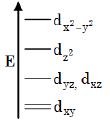
- B
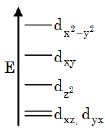
- C
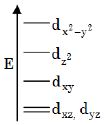
- D
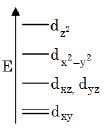
Explore More
Similar Questions
Given below are two statements,one is labelled as Assertion $A$ and the other is labelled as Reason $R$.
Assertion $A$: $[CoCl(NH_3)_5]^{2+}$ absorbs at a lower wavelength of light with respect to $[Co(NH_3)_5(H_2O)]^{3+}$.
Reason $R$: It is because the wavelength of the light absorbed depends on the oxidation state of the metal ion.
In the light of the above statements,choose the correct answer from the options given below:
Assertion $A$: $[CoCl(NH_3)_5]^{2+}$ absorbs at a lower wavelength of light with respect to $[Co(NH_3)_5(H_2O)]^{3+}$.
Reason $R$: It is because the wavelength of the light absorbed depends on the oxidation state of the metal ion.
In the light of the above statements,choose the correct answer from the options given below:
Which of the following complex ions has electrons that are symmetrically filled in both $t_{2g}$ and $e_g$ orbitals?
DifficultJEE MAIN 2015
View SolutionOn the basis of crystal field theory,explain why $Co(III)$ forms a paramagnetic octahedral complex with weak field ligands,whereas it forms a diamagnetic octahedral complex with strong field ligands.
Difficult
View SolutionExplain the color in coordination compounds.
Difficult
View SolutionThe degeneracy of $d-$orbitals is lost under:
$I$. Strong field ligand
$II$. Weak field ligand
$III$. Mixed field ligand
$IV$. Chelated ligand field
Choose the correct code:
$I$. Strong field ligand
$II$. Weak field ligand
$III$. Mixed field ligand
$IV$. Chelated ligand field
Choose the correct code:
Vedclass Products
For Students
Vedclass Test Series
Mock tests in real JEE/NEET style with performance analysis. 5-day free trial.
Start Free TrialFor Teachers
Exam Paper Generator
Generate Set A/B/C/D exam papers from 7.5L+ questions in 2 minutes. 3 chapters free.
Try FreeFor Institutes
Online Exam Module
Live online exams with unlimited students, 360° analytics & white-label branding.
See Demo