
Consider a rubber ball freely falling from a height $h = 4.9 \ m$ onto a horizontal elastic plate. Assume that the duration of collision is negligible and the collision with the plate is totally elastic. Then the velocity as a function of time and the height as a function of time will be represented by which of the following graphs?
- A
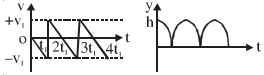
- B
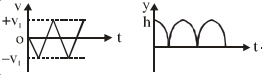
- C
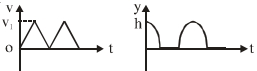
- D
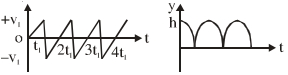
Explore More
Similar Questions
$A$ ball is dropped from a bridge of $122.5 \ m$ above a river. After the ball has been falling for $2 \ s$,a second ball is thrown straight down after it. What is the initial velocity of the second ball so that both hit the water at the same time (in $m/s$)?
MediumAIIMS 2015
View Solution$Assertion$ : Two balls of different masses are thrown vertically upward with the same speed. They will pass through their point of projection in the downward direction with the same speed.
$Reason$ : The maximum height and downward velocity attained at the point of projection are independent of the mass of the ball.
$Reason$ : The maximum height and downward velocity attained at the point of projection are independent of the mass of the ball.
$A$ body falling freely under gravity passes two points $30 \ m$ apart in $1 \ s$. From what point above the upper point did it begin to fall? (Take $g = 10 \ m \ s^{-2}$)
Medium
View Solution$A$ body falls freely from the top of a tower. It covers $36\%$ of the total height in the last second before striking the ground level. The height of the tower is........$m$
Medium
View Solution$A$ boy throws a ball vertically upwards from a bridge with velocity $5 \ m/s$. It strikes the water surface after $2 \ s$. The height of the bridge is (Take $g = 10 \ m/s^2$) (in $m$)
Vedclass Products
For Students
Vedclass Test Series
Mock tests in real JEE/NEET style with performance analysis. 5-day free trial.
Start Free TrialFor Teachers
Exam Paper Generator
Generate Set A/B/C/D exam papers from 7.5L+ questions in 2 minutes. 3 chapters free.
Try FreeFor Institutes
Online Exam Module
Live online exams with unlimited students, 360° analytics & white-label branding.
See Demo