
For a concave mirror,if a real image is formed,the graph between $\frac{1}{u}$ and $\frac{1}{v}$ is of the form:
- A
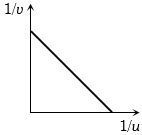
- B
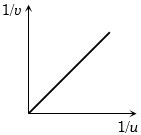
- C
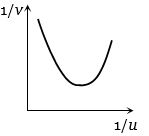
- D
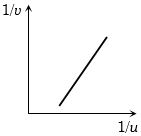
Explore More
Similar Questions
$A$ student measures the focal length of a convex lens by obtaining an image of an object pin at a distance '$v$' from the lens,where the object pin is at a distance '$u$' from the lens. What will the graph between '$u$' and '$v$' look like?
Medium
View SolutionRay optics is valid when characteristic dimensions are:
$A$ beaker of radius $r$ is filled with water (refractive index $\frac{4}{3}$) up to a height $H$ as shown in the figure. The beaker is kept on a horizontal table rotating with angular speed $\omega$. This makes the water surface curved so that the difference in the height of the water level at the center and at the circumference of the beaker is $h$ $(h \ll H, h \ll r)$,as shown in the figure. Take this surface to be approximately spherical with a radius of curvature $R$. Which of the following is/are correct? ($g$ is the acceleration due to gravity)
$(A)$ $R=\frac{h^2+r^2}{2 h}$
$(B)$ $R=\frac{r^2}{2 h}$
$(C)$ Apparent depth of the bottom of the beaker is close to $\frac{3 H}{4}\left(1+\frac{\omega^2 H}{4 g}\right)^{-1}$
$(D)$ Apparent depth of the bottom of the beaker is close to $\frac{3 H}{2}\left(1+\frac{\omega^2 H}{2 g}\right)^{-1}$
$(A)$ $R=\frac{h^2+r^2}{2 h}$
$(B)$ $R=\frac{r^2}{2 h}$
$(C)$ Apparent depth of the bottom of the beaker is close to $\frac{3 H}{4}\left(1+\frac{\omega^2 H}{4 g}\right)^{-1}$
$(D)$ Apparent depth of the bottom of the beaker is close to $\frac{3 H}{2}\left(1+\frac{\omega^2 H}{2 g}\right)^{-1}$
$A$ reflecting surface is represented by the equation $y = \frac{2L}{\pi} \sin \left( \frac{\pi x}{L} \right)$,$0 \leq x \leq L$. $A$ ray travelling horizontally becomes vertical after reflection. The coordinates of the point$(s)$ where this ray is incident is?
Three plane mirrors form an equilateral triangle with each side of length $L$. There is a small hole at a distance $l > 0$ from one of the corners as shown in the figure. $A$ ray of light is passed through the hole at an angle $\theta$ and can only come out through the same hole. The cross section of the mirror configuration and the ray of light lie on the same plane.
Which of the following statement(s) is(are) correct?
$(A)$ The ray of light will come out for $\theta=30^{\circ}$, for $0 < l < L$.
$(B)$ There is an angle for $l=\frac{L}{2}$ at which the ray of light will come out after two reflections.
$(C)$ The ray of light will $NEVER$ come out for $\theta=60^{\circ}$, and $l=\frac{L}{3}$.
$(D)$ The ray of light will come out for $\theta=60^{\circ}$, and $0 < l < \frac{L}{2}$ after six reflections.
Which of the following statement(s) is(are) correct?
$(A)$ The ray of light will come out for $\theta=30^{\circ}$, for $0 < l < L$.
$(B)$ There is an angle for $l=\frac{L}{2}$ at which the ray of light will come out after two reflections.
$(C)$ The ray of light will $NEVER$ come out for $\theta=60^{\circ}$, and $l=\frac{L}{3}$.
$(D)$ The ray of light will come out for $\theta=60^{\circ}$, and $0 < l < \frac{L}{2}$ after six reflections.
Vedclass Products
For Students
Vedclass Test Series
Mock tests in real JEE/NEET style with performance analysis. 5-day free trial.
Start Free TrialFor Teachers
Exam Paper Generator
Generate Set A/B/C/D exam papers from 7.5L+ questions in 2 minutes. 3 chapters free.
Try FreeFor Institutes
Online Exam Module
Live online exams with unlimited students, 360° analytics & white-label branding.
See Demo