
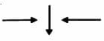
Four particles $A, B, C$ and $D$ are moving with constant speed $v$ each. At the instant shown,the relative velocities of $A$ with respect to $B, C$ and $D$ are in the directions:
- A

- B

- C

- D
Explore More
Similar Questions
An aeroplane executes a horizontal loop at a speed of $720 \text{ km/h}$ with its wings banked at $45^{\circ}$. What is the radius of the loop (in $\text{ km}$)? Take $g = 10 \text{ m/s}^2$.
$A$ particle moves in the $xy$ plane according to the law $x = a \sin \omega t$ and $y = a(1 - \cos \omega t)$,where $a$ and $\omega$ are constants. The particle traces:
Medium
View Solution$A$ ball is projected at an angle of $45^{\circ}$ with the horizontal. It passes through a wall of height $h$ at a horizontal distance $d_1$ from the point of projection and strikes the ground at a distance $d_1+d_2$ from the point of projection. Then $h$ is:
If the radius of the circular path and the frequency of revolution of a particle of mass $m$ are doubled,then the change in its kinetic energy will be ($E_i$ and $E_f$ are the initial and final kinetic energies of the particle respectively). (in $E_i$)
DifficultMHT CET 2019
View Solution$A$ particle moves in a plane along an elliptic path given by $\frac{x^2}{a^2} + \frac{y^2}{b^2} = 1$. At point $(0, b)$,the $x$-component of velocity is $u$. The $y$-component of acceleration at this point is
Vedclass Products
For Students
Vedclass Test Series
Mock tests in real JEE/NEET style with performance analysis. 5-day free trial.
Start Free TrialFor Teachers
Exam Paper Generator
Generate Set A/B/C/D exam papers from 7.5L+ questions in 2 minutes. 3 chapters free.
Try FreeFor Institutes
Online Exam Module
Live online exams with unlimited students, 360° analytics & white-label branding.
See Demo