
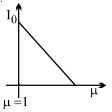
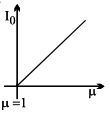
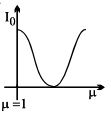
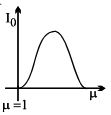
In a $YDSE$ experiment,if a slab whose refractive index can be varied is placed in front of one of the slits,then the variation of resultant intensity at the mid-point of the screen with $\mu$ will be best represented by $(\mu \geq 1)$. [Assume slits of equal width and there is no absorption by the slab]
- A
- B
- C
- D
Explore More
Similar Questions
Young's double slit experiment is first performed in air and then in a medium other than air. It is found that the $8^{th}$ bright fringe in the medium lies where the $5^{th}$ dark fringe lies in air. The refractive index of the medium is nearly:
DifficultNEET 2017
View SolutionIn Young's double-slit experiment,the angular width of the fringes formed on the screen is $\pi / 200$. If light of wavelength $4800 \, \mathring{A}$ is used,find the distance between the slits.
Medium
View SolutionIn a Young's double-slit experiment,the light beam consists of two wavelengths $6500 \, \mathring A$ and $5200 \, \mathring A$. The distance between the slits is $2 \, mm$ and the distance between the plane of the slits and the screen is $120 \, cm$. Find the distance of the third bright fringe from the central maximum for the wavelength $6500 \, \mathring A$ in $mm$.
Medium
View SolutionIn $YDSE$,$16$ fringes occupy a certain region of space with light of wavelength $6000\,\mathring{A}$. If $24$ fringes occupy the same region,the wavelength of the new light is........$\mathring{A}$.
Medium
View SolutionWrite down the formula for the distance between two consecutive bright fringes or two consecutive dark fringes in Young's Double Slit Experiment.
Medium
View SolutionVedclass Products
For Students
Vedclass Test Series
Mock tests in real JEE/NEET style with performance analysis. 5-day free trial.
Start Free TrialFor Teachers
Exam Paper Generator
Generate Set A/B/C/D exam papers from 7.5L+ questions in 2 minutes. 3 chapters free.
Try FreeFor Institutes
Online Exam Module
Live online exams with unlimited students, 360° analytics & white-label branding.
See Demo