
Difficult
In the measurement of viscosity of liquids using terminal velocity experiment, spherical balls of same radius but having different densities are used. The variation of the terminal velocity $(v)$ with the ratio of density of spherical ball $(\sigma)$ to density of the liquid $(\rho)$, is best represented by :
- A
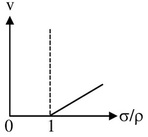
- B
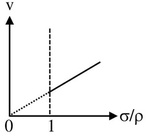
- C
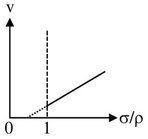
- D
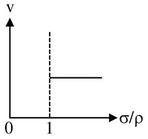
Explore More
Similar Questions
$A$ ball is thrown downward with some initial velocity into a viscous liquid. Which of the following curves represents the correct variation of velocity versus time?
Difficult
View SolutionGive the practical uses of viscosity.
Easy
View SolutionIf the average terminal velocity of a rain drop is $2 \,m/s$, then the energy transferred by rain to each square metre of the surface at a place which receives $100 \,cm$ of rain in a year is
Sixty-four rain drops of radius $1 \ mm$ each, falling down with a terminal velocity of $10 \ cm/s$, coalesce to form a bigger drop. The terminal velocity of the bigger drop is . . . . . . $cm/s$.
DifficultJEE MAIN 2026
View Solution$A$ metal sphere of radius $R$ and density $\rho_1$ is dropped in a liquid of density $\sigma$ and moves with terminal velocity $V$. Another metal sphere of the same radius and density $\rho_2$ is dropped in the same liquid. Its terminal velocity will be:
Vedclass Products
For Students
Vedclass Test Series
Mock tests in real JEE/NEET style with performance analysis. 5-day free trial.
Start Free TrialFor Teachers
Exam Paper Generator
Generate Set A/B/C/D exam papers from 7.5L+ questions in 2 minutes. 3 chapters free.
Try FreeFor Institutes
Online Exam Module
Live online exams with unlimited students, 360° analytics & white-label branding.
See Demo