
Difficult
Photoelectric effect experiments are performed using three different metal plates $p, q$ and $r$ having work functions $\phi_p=2.0 \ eV, \phi_q=2.5 \ eV$ and $\phi_r=3.0 \ eV$,respectively. $A$ light beam containing wavelengths of $550 \ nm, 450 \ nm$ and $350 \ nm$ with equal intensities illuminates each of the plates. The correct $I-V$ graph for the experiment is:
- A
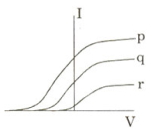
- B
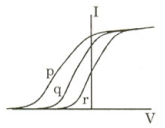
- C
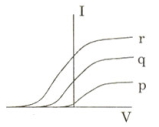
- D
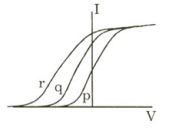
Explore More
Similar Questions
The kinetic energy of emitted cathode rays is dependent on:
Easy
View SolutionWhich of the following effects support the quantum nature of $EM$ radiation? $(1)$ Photoelectric effect $(2)$ Compton effect $(3)$ Doppler effect $(4)$ Field effect
Medium
View SolutionConsider the following statements: $(1)$ Both wave and particle nature are required for a complete understanding of light. $(2)$ Light cannot exhibit both wave and particle nature simultaneously in a single experiment.
Medium
View SolutionFor a body moving with relativistic speed,if the velocity is doubled,then
Easy
View SolutionAn electron is moving through a field. It is moving $(i)$ opposite to an electric field and $(ii)$ perpendicular to a magnetic field as shown. For each situation,determine the de-Broglie wavelength of the electron.
Medium
View SolutionVedclass Products
For Students
Vedclass Test Series
Mock tests in real JEE/NEET style with performance analysis. 5-day free trial.
Start Free TrialFor Teachers
Exam Paper Generator
Generate Set A/B/C/D exam papers from 7.5L+ questions in 2 minutes. 3 chapters free.
Try FreeFor Institutes
Online Exam Module
Live online exams with unlimited students, 360° analytics & white-label branding.
See Demo