
The correct matching of List-$I$ from List-$II$ is:
- A
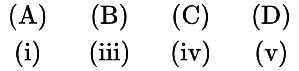
- B
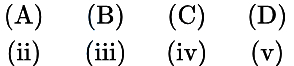
- C
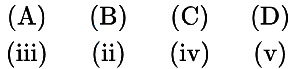
- D
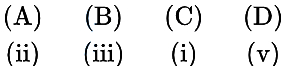
Explore More
Similar Questions
Let $C_{r}$ denote the coefficient of $x^{r}$ in the binomial expansion of $(1+x)^{n}$, $n \in N$, $0 \leq r \leq n$. If $P_{n} = C_{0} - C_{1} + \frac{2^{2}}{3}C_{2} - \frac{2^{3}}{4}C_{3} + \dots + \frac{(-2)^{n}}{n+1}C_{n}$, then the value of $\sum_{n=1}^{25} \frac{1}{P_{2n}}$ equals.
DifficultJEE MAIN 2026
View SolutionSuppose $2-p, p, 2-\alpha, \alpha$ are the coefficients of four consecutive terms in the expansion of $(1+x)^n$. Then the value of $p^2-\alpha^2+6\alpha+2p$ equals
DifficultJEE MAIN 2024
View SolutionLet $M = 2^{30} - 2^{15} + 1$. When $M^2$ is expressed in base $2$,the number of $1$'s in its binary representation is:
The sum of the coefficients of $x^{499}$ and $x^{500}$ in $(1+x)^{1000}+x(1+x)^{999}+x^{2}(1+x)^{998}+.......+x^{1000}$ is
DifficultJEE MAIN 2026
View SolutionThe sum of the coefficients of all even degree terms in $x$ in the expansion of $(x + \sqrt{x^3 - 1})^6 + (x - \sqrt{x^3 - 1})^6$ for $x > 1$ is equal to:
DifficultJEE MAIN 2019
View SolutionVedclass Products
For Students
Vedclass Test Series
Mock tests in real JEE/NEET style with performance analysis. 5-day free trial.
Start Free TrialFor Teachers
Exam Paper Generator
Generate Set A/B/C/D exam papers from 7.5L+ questions in 2 minutes. 3 chapters free.
Try FreeFor Institutes
Online Exam Module
Live online exams with unlimited students, 360° analytics & white-label branding.
See Demo