
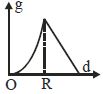
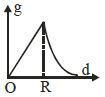
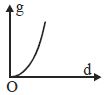
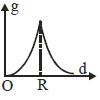
The variation of acceleration due to gravity $g$ with distance $d$ from the centre of the earth is best represented by ($R =$ Earth's radius)
- A
- B
- C
- D
Explore More
Similar Questions
The mass of the moon is $\frac{1}{81}$ of the earth,but the gravitational pull (acceleration due to gravity) is $\frac{1}{6}$ of the earth. This is due to the fact that:
Medium
View SolutionConsider Earth to be a sphere of radius $R_e$ rotating about its own axis with angular speed $\omega$. If $g_{E}$ and $g_{P}$ are the accelerations due to gravity at the equator and the poles respectively,then $(g_{P}-g_{E})$ is given by $\left[\cos (0^{\circ})=\sin (\frac{\pi}{2})=1, \sin (0^{\circ})=\cos (\frac{\pi}{2})=0\right]$
The dependence of acceleration due to gravity $g$ on the distance $r$ from the centre of the earth,assumed to be a sphere of radius $R$ of uniform density,is as shown in the figure below. The correct figure is:
Medium
View SolutionThere is a planet which is $8$ times more massive and $27$ times denser than the Earth. If $g^{\prime}$ and $g$ are the accelerations due to gravity on the surfaces of the planet and the Earth respectively,then:
When a body is taken from the pole to the equator,its weight:
Medium
View SolutionVedclass Products
For Students
Vedclass Test Series
Mock tests in real JEE/NEET style with performance analysis. 5-day free trial.
Start Free TrialFor Teachers
Exam Paper Generator
Generate Set A/B/C/D exam papers from 7.5L+ questions in 2 minutes. 3 chapters free.
Try FreeFor Institutes
Online Exam Module
Live online exams with unlimited students, 360° analytics & white-label branding.
See Demo