
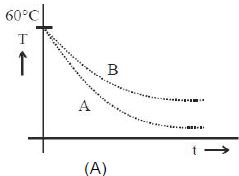
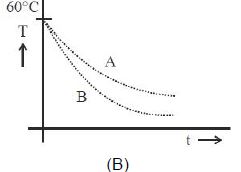
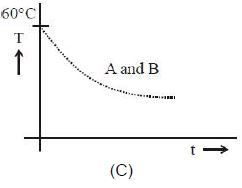
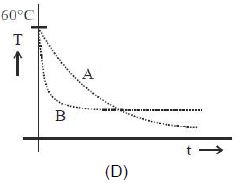
Two identical beakers $A$ and $B$ contain equal volumes of two different liquids at $60\,^oC$ each and are left to cool down. The liquid in $A$ has a density of $8 \times 10^2\, kg/m^3$ and a specific heat of $2000\, Jkg^{-1}K^{-1}$,while the liquid in $B$ has a density of $10^3\, kg/m^3$ and a specific heat of $4000\, Jkg^{-1}K^{-1}$. Which of the following best describes their temperature versus time graph schematically? (Assume the emissivity of both the beakers to be the same.)
- A
- B
- C
- D
Explore More
Similar Questions
The rate of cooling at $600 \ K$ is $R$,given the surrounding temperature is $300 \ K$. What is the rate of cooling at $900 \ K$?
Medium
View Solution$A$ body cools from $60^{\circ} C$ to $40^{\circ} C$ in $6$ minutes. After the next $6$ minutes,its temperature will be (Temperature of the surroundings is $10^{\circ} C$). (in $^{\circ} C$)
An object is cooled from $75^{\circ}C$ to $65^{\circ}C$ in $2$ minutes in a room at $30^{\circ}C$. The time taken to cool another object from $55^{\circ}C$ to $45^{\circ}C$ in the same room in minutes is
Medium
View SolutionIt takes $1 \, min$ for hot water to cool from $80^{\circ}C$ to $60^{\circ}C$. Find the time taken (in $sec$) to cool from $60^{\circ}C$ to $50^{\circ}C$. The temperature of the surroundings is $30^{\circ}C$.
Difficult
View Solution$A$ hot liquid kept in a beaker cools from $80\,^{\circ}C$ to $70\,^{\circ}C$ in $2\, \text{min}$. If the surrounding temperature is $30\,^{\circ}C$,then the time taken for the same liquid to cool from $60\,^{\circ}C$ to $50\,^{\circ}C$ is ........ $\text{sec}$.
Difficult
View SolutionVedclass Products
For Students
Vedclass Test Series
Mock tests in real JEE/NEET style with performance analysis. 5-day free trial.
Start Free TrialFor Teachers
Exam Paper Generator
Generate Set A/B/C/D exam papers from 7.5L+ questions in 2 minutes. 3 chapters free.
Try FreeFor Institutes
Online Exam Module
Live online exams with unlimited students, 360° analytics & white-label branding.
See Demo