
Two identical positive charges are placed on the $y$-axis at $y=-a$ and $y=+a$. The variation of $V$ (electric potential) along the $x$-axis is shown by which graph?
- A
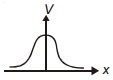
- B
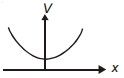
- C
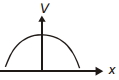
- D
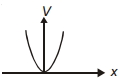
Explore More
Similar Questions
Electric charges having the same magnitude $q$ are placed at $x = 1 \, m, 2 \, m, 4 \, m, 8 \, m, \dots$ and so on. If any two consecutive charges have opposite signs but the first charge is necessarily positive,what will be the potential at $x = 0$?
Medium
View Solution$A$ particle '$A$' has charge '$+q$' and a particle '$B$' has charge '$+4q$'. Each has the same mass '$m$'. When they are allowed to fall from rest through the same potential difference '$V$',the ratio of their speeds will be (particle $A$ to particle $B$):
If a $10 \mu C$ charge exists at the centre of a square,the work done in moving a $2 \mu C$ point charge from corner $A$ to corner $B$ of a square $ABCD$ is
$A$ spherical shell of radius $5 \ cm$ is charged to a potential of $10 \ V$ on its surface. The potential at the center of the shell will be ...... $V$.
Medium
View Solution$A$ proton has a mass $1.67 \times 10^{-27} \,kg$ and charge $+1.6 \times 10^{-19} \,C$. If the proton is accelerated through a potential difference of $1$ million volts,then the kinetic energy is ......... $J$.
Easy
View SolutionVedclass Products
For Students
Vedclass Test Series
Mock tests in real JEE/NEET style with performance analysis. 5-day free trial.
Start Free TrialFor Teachers
Exam Paper Generator
Generate Set A/B/C/D exam papers from 7.5L+ questions in 2 minutes. 3 chapters free.
Try FreeFor Institutes
Online Exam Module
Live online exams with unlimited students, 360° analytics & white-label branding.
See Demo