
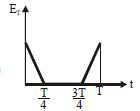
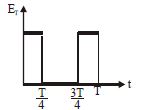
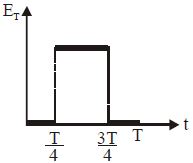
Two pendulums with identical bobs and lengths are suspended from a common support such that in the rest position the two bobs are in contact. After being displaced by $5^o$,the bob $A$ is released from rest at $t = 0$. Subsequently,it collides elastically head-on with the other bob $B$. Identify the graph showing the variation in energy of pendulum $A$ with time for $0 \leqslant t \leqslant T$ (where $T$ is the period of either pendulum).
- A
- B
- C
- D
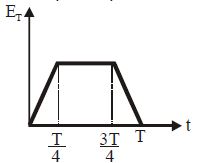
Explore More
Similar Questions
In the figure shown,there is friction between the blocks $P$ and $Q$,but the contact between the block $Q$ and the lower surface is frictionless. Initially,the block $Q$ with block $P$ over it lies at $x=0$,with the spring at its natural length. The block $Q$ is pulled to the right and then released. As the spring-block system undergoes $S.H.M.$ with amplitude $A$,the block $P$ tends to slip over $Q$. $P$ is more likely to slip at:
Medium
View SolutionTwo masses $m$ and $\frac{m}{2}$ are connected at the two ends of a massless rigid rod of length $l$. The rod is suspended by a thin wire of torsional constant $k$ at the centre of mass of the rod-mass system (see figure). Because of the torsional constant $k$,the restoring torque is $\tau = k\theta$ for an angular displacement $\theta$. If the rod is rotated by $\theta_0$ and released,the tension in it when it passes through its mean position will be
DifficultJEE MAIN 2019
View Solution$A$ clock $S$ is based on the oscillations of a spring,and a clock $P$ is based on pendulum motion. Both clocks run at the same rate on Earth. On a planet having the same density as Earth but twice the radius,then:
Medium
View Solution$A$ block of mass $(10 \alpha) \text{ g}$,where $\alpha$ is a constant,is moving with velocity $3 \text{ m/s}$ to the right. It collides inelastically with a block on the right of mass $10 \text{ g}$ and sticks to it. The right block is connected to three springs as shown in the figure. The spring constant of each spring is $k = 2 \text{ N/m}$. If the amplitude of the resulting simple harmonic motion is $A = \frac{1}{2\sqrt{2}} \text{ m}$,then the value of $\alpha$ is:
DifficultTS EAMCET 2018
View Solution$A$ particle of mass $m$ moves in the potential energy $U(x)$ shown in the figure. The potential energy is given by $U = \frac{1}{2}kx^2$ for $x < 0$ and $U = mgx$ for $x > 0$. The period of the motion when the particle has total energy $E$ is
Vedclass Products
For Students
Vedclass Test Series
Mock tests in real JEE/NEET style with performance analysis. 5-day free trial.
Start Free TrialFor Teachers
Exam Paper Generator
Generate Set A/B/C/D exam papers from 7.5L+ questions in 2 minutes. 3 chapters free.
Try FreeFor Institutes
Online Exam Module
Live online exams with unlimited students, 360° analytics & white-label branding.
See Demo