
Which of the following graphs correctly represents the relationship between kinetic energy $(E)$,potential energy $(U)$,and height $(h)$ from the ground for a particle moving vertically?
- A
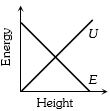
- B
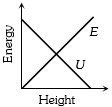
- C
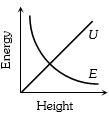
- D
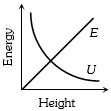
Explore More
Similar Questions
$A$ particle of mass $m$ is moving in a horizontal circle of radius $r$ under a centripetal force equal to $-K/r^2$,where $K$ is a constant. The total energy of the particle is
DifficultIIT 1977
View Solution$A$ sphere of mass $m$ travelling at constant speed $v$ strikes another sphere of the same mass. If the coefficient of restitution is $e$,then the ratio of the velocities of both spheres just after the collision is:
Difficult
View Solution$A$ person trying to lose weight by burning fat lifts a mass of $10 \ kg$ up to a height of $1 \ m$, $1000$ times. Assume that the potential energy lost each time he lowers the mass is dissipated. How much fat will he use up considering the work done only when the weight is lifted up? Fat supplies $3.8 \times 10^7 \ J$ of energy per $kg$, which is converted to mechanical energy with a $20\%$ efficiency rate. Take $g = 9.8 \ m/s^2$.
$A$ ball of mass $m$ is dropped from a height $s$ on a horizontal platform fixed at the top of a vertical spring. The platform is depressed by a distance $h$. The spring constant is ($g=$ acceleration due to gravity):
$A$ block moving horizontally on a smooth surface with a speed of $40\, m/s$ splits into two parts with masses in the ratio of $1:2$. If the smaller part moves at $60\, m/s$ in the same direction,then the fractional change in kinetic energy is:
DifficultJEE MAIN 2021
View SolutionVedclass Products
For Students
Vedclass Test Series
Mock tests in real JEE/NEET style with performance analysis. 5-day free trial.
Start Free TrialFor Teachers
Exam Paper Generator
Generate Set A/B/C/D exam papers from 7.5L+ questions in 2 minutes. 3 chapters free.
Try FreeFor Institutes
Online Exam Module
Live online exams with unlimited students, 360° analytics & white-label branding.
See Demo