
A English
Absorption of Digested Products Questions in English
Class 11 Biology · Digestion and Absorption · Absorption of Digested Products
105+
Questions
English
Language
100%
With Solutions
Showing 50 of 105 questions in English
51
EasyMCQ
Absorption of water,simple sugar and alcohol takes place in
A
Mouth
B
Stomach
C
Small intestine
D
Large intestine
Solution
(B) Absorption of water,simple sugars,and alcohol occurs primarily in the stomach.
While the small intestine is the principal site for the absorption of most nutrients,the stomach lining is capable of absorbing certain substances directly into the bloodstream.
Water,simple sugars (like glucose),and alcohol are absorbed through the gastric mucosa.
While the small intestine is the principal site for the absorption of most nutrients,the stomach lining is capable of absorbing certain substances directly into the bloodstream.
Water,simple sugars (like glucose),and alcohol are absorbed through the gastric mucosa.
0 likes
View Solution52
EasyMCQ
Absorption is the process by which the end products of digestion pass through the.... into the blood or lymph.
A
Intestinal mucosa
B
Serosa of stomach
C
Mucosa of duodenum
D
Sub mucosa of duodenum
Solution
(A) Absorption is defined as the process by which the end products of digestion pass through the intestinal mucosa into the blood or lymph.
It is carried out by passive,active,or facilitated transport mechanisms.
The intestinal mucosa is the innermost layer of the alimentary canal,which is specialized for the absorption of nutrients.
It is carried out by passive,active,or facilitated transport mechanisms.
The intestinal mucosa is the innermost layer of the alimentary canal,which is specialized for the absorption of nutrients.
0 likes
View Solution53
MediumMCQ
Match the following columns:
| Column-$I$ | Column-$II$ |
|---|---|
| $a$. Mouth | $i$. Absorption of water and salt |
| $b$. Stomach | $ii$. Absorption of amino acids |
| $c$. Small intestine | $iii$. Absorption of alcohol |
| $d$. Large intestine | $iv$. Absorption of some drugs |
A
$a-i, b-iii, c-iv, d-ii$
B
$a-iii, b-ii, c-i, d-iv$
C
$a-ii, b-ii, c-iv, d-i$
D
$a-iv, b-iii, c-ii, d-i$
Solution
(D) The correct matching is as follows:
$a$. Mouth: Some drugs are absorbed through the mucous membrane of the mouth (e.g.,sublingual administration),so $a-iv$.
$b$. Stomach: Alcohol and certain drugs like aspirin are absorbed in the stomach,so $b-iii$.
$c$. Small intestine: This is the primary site for the absorption of nutrients like amino acids,glucose,and fatty acids,so $c-ii$.
$d$. Large intestine: The primary function here is the absorption of water,some minerals,and certain drugs,so $d-i$.
Therefore,the correct sequence is $a-iv, b-iii, c-ii, d-i$.
$a$. Mouth: Some drugs are absorbed through the mucous membrane of the mouth (e.g.,sublingual administration),so $a-iv$.
$b$. Stomach: Alcohol and certain drugs like aspirin are absorbed in the stomach,so $b-iii$.
$c$. Small intestine: This is the primary site for the absorption of nutrients like amino acids,glucose,and fatty acids,so $c-ii$.
$d$. Large intestine: The primary function here is the absorption of water,some minerals,and certain drugs,so $d-i$.
Therefore,the correct sequence is $a-iv, b-iii, c-ii, d-i$.
0 likes
View Solution54
MediumMCQ
Fatty acids are first incorporated into small droplets called .......... . They are re-formed into very small protein-coated fat globules called the .......... .
A
Micelles,Chylomicrons
B
Amino acid,micelles
C
Micelles,amino acids
D
None of them
Solution
(A) During the process of fat digestion,fatty acids and glycerol are insoluble in water and cannot be directly absorbed into the blood.
To facilitate absorption,they are first incorporated into small,spherical aggregates called $Micelles$ with the help of bile salts.
These $Micelles$ move into the intestinal mucosa,where they are re-synthesized into triglycerides.
Finally,these triglycerides are coated with proteins to form very small,water-soluble fat globules known as $Chylomicrons$,which are then transported into the lacteals (lymph vessels).
To facilitate absorption,they are first incorporated into small,spherical aggregates called $Micelles$ with the help of bile salts.
These $Micelles$ move into the intestinal mucosa,where they are re-synthesized into triglycerides.
Finally,these triglycerides are coated with proteins to form very small,water-soluble fat globules known as $Chylomicrons$,which are then transported into the lacteals (lymph vessels).
0 likes
View Solution55
MediumMCQ
Which substances are absorbed by simple diffusion?
A
Glucose,$Na^+$
B
Glucose,amino acid
C
Fatty acid,glycerol
D
Glucose,$Na^+$,glycerol
Solution
(C) Simple diffusion is the process by which molecules move from a region of higher concentration to a region of lower concentration without the expenditure of energy.
Small amounts of monosaccharides like glucose,amino acids,and some electrolytes like $Cl^-$ are generally absorbed by simple diffusion.
However,fatty acids and glycerol,being insoluble in water,cannot be absorbed into the blood directly.
They are first incorporated into small droplets called micelles,which move into the intestinal mucosa,where they are re-synthesized into chylomicrons and transported into the lymph vessels (lacteals).
Among the given options,the most accurate representation of substances absorbed via diffusion (often involving facilitated transport or simple diffusion depending on concentration gradients) is typically associated with small molecules.
Note: In standard $NCERT$,fatty acids and glycerol are absorbed via micelles,while glucose and amino acids are absorbed by facilitated transport or active transport. Given the options provided,there is a technical ambiguity; however,simple diffusion is the primary mechanism for substances like certain electrolytes and small non-polar molecules.
Small amounts of monosaccharides like glucose,amino acids,and some electrolytes like $Cl^-$ are generally absorbed by simple diffusion.
However,fatty acids and glycerol,being insoluble in water,cannot be absorbed into the blood directly.
They are first incorporated into small droplets called micelles,which move into the intestinal mucosa,where they are re-synthesized into chylomicrons and transported into the lymph vessels (lacteals).
Among the given options,the most accurate representation of substances absorbed via diffusion (often involving facilitated transport or simple diffusion depending on concentration gradients) is typically associated with small molecules.
Note: In standard $NCERT$,fatty acids and glycerol are absorbed via micelles,while glucose and amino acids are absorbed by facilitated transport or active transport. Given the options provided,there is a technical ambiguity; however,simple diffusion is the primary mechanism for substances like certain electrolytes and small non-polar molecules.
0 likes
View Solution56
MediumMCQ
Lacteals are associated with the transport of..........
A
Glucose
B
Chylomicrons
C
Fructose
D
$Na^+$
Solution
(B) Lacteals are specialized lymphatic capillaries found in the villi of the small intestine.
During the process of fat absorption,fatty acids and glycerol are reformed into triglycerides within the intestinal epithelial cells.
These triglycerides are then coated with proteins to form water-soluble droplets called chylomicrons.
Because chylomicrons are too large to enter the blood capillaries directly,they are transported into the lacteals,which eventually release them into the lymphatic system.
During the process of fat absorption,fatty acids and glycerol are reformed into triglycerides within the intestinal epithelial cells.
These triglycerides are then coated with proteins to form water-soluble droplets called chylomicrons.
Because chylomicrons are too large to enter the blood capillaries directly,they are transported into the lacteals,which eventually release them into the lymphatic system.
0 likes
View Solution57
MediumMCQ
Which of the following statements is incorrect regarding the absorption of digested products?
A
Small amounts of monosaccharides like glucose,amino acids,and some electrolytes like $Na^+$ ions are generally absorbed by simple diffusion.
B
Fatty acids and glycerol,being insoluble,cannot be absorbed directly into the blood.
C
Transport of water depends upon the osmotic gradient.
D
Chylomicrons are transported into the lymph vessels (lacteals) in the villi.
Solution
(A) The correct answer is $A$.
$1$. Small amounts of monosaccharides like glucose,amino acids,and some electrolytes like $Na^+$ ions are absorbed by simple diffusion,but this is not the primary mechanism for most nutrients. However,the statement is technically correct as a general biological fact.
$2$. Fatty acids and glycerol are insoluble in water and cannot be absorbed directly into the blood. They are first incorporated into small droplets called micelles,which move into the intestinal mucosa. They are then re-synthesized into fats and coated with proteins to form chylomicrons.
$3$. The transport of water is indeed dependent on the osmotic gradient.
$4$. Chylomicrons are small,protein-coated fat globules that are transported into the lymph vessels (lacteals) in the villi.
$5$. Upon re-evaluating the options,all statements are biologically accurate descriptions of the absorption process. However,in many textbook contexts,the statement regarding simple diffusion is often contrasted with facilitated transport or active transport,which are the primary modes for glucose and amino acids. If forced to choose the 'most' incorrect or misleading,option $A$ is often cited because glucose and amino acids are primarily absorbed via active transport or facilitated diffusion,not simple diffusion.
$1$. Small amounts of monosaccharides like glucose,amino acids,and some electrolytes like $Na^+$ ions are absorbed by simple diffusion,but this is not the primary mechanism for most nutrients. However,the statement is technically correct as a general biological fact.
$2$. Fatty acids and glycerol are insoluble in water and cannot be absorbed directly into the blood. They are first incorporated into small droplets called micelles,which move into the intestinal mucosa. They are then re-synthesized into fats and coated with proteins to form chylomicrons.
$3$. The transport of water is indeed dependent on the osmotic gradient.
$4$. Chylomicrons are small,protein-coated fat globules that are transported into the lymph vessels (lacteals) in the villi.
$5$. Upon re-evaluating the options,all statements are biologically accurate descriptions of the absorption process. However,in many textbook contexts,the statement regarding simple diffusion is often contrasted with facilitated transport or active transport,which are the primary modes for glucose and amino acids. If forced to choose the 'most' incorrect or misleading,option $A$ is often cited because glucose and amino acids are primarily absorbed via active transport or facilitated diffusion,not simple diffusion.
0 likes
View Solution58
EasyMCQ
In vertebrates,lacteals are found in the ..........
A
Ileum
B
Ischium
C
Intestinal tract
D
Ear
Solution
(A) Lacteals are specialized lymphatic capillaries found in the villi of the small intestine,specifically in the ileum region.
They are responsible for the absorption of dietary fats and fat-soluble vitamins from the digested food in the intestinal tract.
Therefore,the correct location is the ileum.
They are responsible for the absorption of dietary fats and fat-soluble vitamins from the digested food in the intestinal tract.
Therefore,the correct location is the ileum.
0 likes
View Solution59
MediumMCQ
Which one of the following statements is correct regarding digestion and absorption in humans?
A
Fructose and amino acids are absorbed through the intestinal mucosa with the help of carrier ions like $Na^+$.
B
Chylomicrons are small lipoprotein particles that are transported from the intestine into blood capillaries.
C
About $60\%$ of starch is hydrolysed by salivary amylase in our mouth.
D
Oxyntic cells in the stomach secrete the proenzyme pepsinogen.
Solution
(A) The correct answer is $A$.
$1$. Fructose and amino acids are absorbed through the intestinal mucosa via facilitated diffusion or active transport,often involving carrier ions like $Na^+$.
$2$. Chylomicrons are small lipoprotein particles that are transported from the intestine into the lymph vessels (lacteals),not directly into blood capillaries.
$3$. Only about $30\%$ of starch is hydrolysed by salivary amylase in the mouth,not $60\%$.
$4$. Oxyntic cells (parietal cells) secrete $HCl$ and Castle's intrinsic factor,whereas pepsinogen is secreted by the chief cells (peptic cells).
$1$. Fructose and amino acids are absorbed through the intestinal mucosa via facilitated diffusion or active transport,often involving carrier ions like $Na^+$.
$2$. Chylomicrons are small lipoprotein particles that are transported from the intestine into the lymph vessels (lacteals),not directly into blood capillaries.
$3$. Only about $30\%$ of starch is hydrolysed by salivary amylase in the mouth,not $60\%$.
$4$. Oxyntic cells (parietal cells) secrete $HCl$ and Castle's intrinsic factor,whereas pepsinogen is secreted by the chief cells (peptic cells).
0 likes
View Solution60
MediumMCQ
Carrier ions like $Na^+$ facilitate the absorption of which substances?
A
Amino acids and glucose
B
Glucose and fatty acids
C
Fatty acids and glycerol
D
Fructose and some amino acids
Solution
(A) In the process of digestion and absorption,the absorption of glucose and amino acids occurs via secondary active transport.
This mechanism involves the symport of these molecules along with $Na^+$ ions across the intestinal mucosa.
Therefore,$Na^+$ ions act as carrier ions to facilitate the transport of glucose and amino acids into the epithelial cells.
This mechanism involves the symport of these molecules along with $Na^+$ ions across the intestinal mucosa.
Therefore,$Na^+$ ions act as carrier ions to facilitate the transport of glucose and amino acids into the epithelial cells.
0 likes
View Solution61
MediumMCQ
Which of the following pairs is correctly matched regarding the components of digested food,their site of absorption,and the process involved in humans?
A
Cholesterol,Maltose $-$ Large intestine,Active absorption
B
Glycine,Glucose $-$ Small intestine,Active absorption
C
Fructose,$Na^+$ $-$ Small intestine,Passive absorption
D
Glycerol,Fatty acids $-$ Duodenum,Move as chylomicrons
Solution
(B) In humans,the absorption of digested food occurs primarily in the small intestine.
$1$. Glycine (an amino acid) and glucose (a monosaccharide) are absorbed into the blood capillaries of the intestinal villi via active transport,which requires energy $(ATP)$.
$2$. Cholesterol and maltose are not absorbed as such in the large intestine; maltose is broken down into glucose before absorption.
$3$. Fructose is absorbed via facilitated diffusion,not passive absorption.
$4$. Glycerol and fatty acids are absorbed into the lacteals of the villi as chylomicrons,but this occurs in the ileum,not the duodenum.
$1$. Glycine (an amino acid) and glucose (a monosaccharide) are absorbed into the blood capillaries of the intestinal villi via active transport,which requires energy $(ATP)$.
$2$. Cholesterol and maltose are not absorbed as such in the large intestine; maltose is broken down into glucose before absorption.
$3$. Fructose is absorbed via facilitated diffusion,not passive absorption.
$4$. Glycerol and fatty acids are absorbed into the lacteals of the villi as chylomicrons,but this occurs in the ileum,not the duodenum.
0 likes
View Solution62
MediumMCQ
By which mechanism is fructose absorbed in the enterocytes of the small intestine?
A
Active transport
B
Facilitated diffusion
C
Simple diffusion
D
Co-transport mechanism
Solution
(B) Fructose is absorbed into the enterocytes of the small intestine through a process called $Facilitated \ diffusion$.
This process is mediated by specific carrier proteins, such as $GLUT5$, which allow fructose to move across the cell membrane along its concentration gradient without the expenditure of $ATP$ energy.
This process is mediated by specific carrier proteins, such as $GLUT5$, which allow fructose to move across the cell membrane along its concentration gradient without the expenditure of $ATP$ energy.
0 likes
View Solution63
Medium
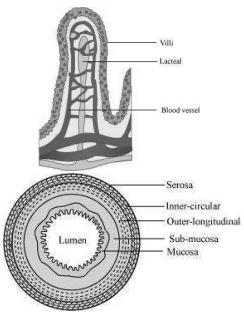
Answer briefly: Why are villi present in the intestine and not in the stomach?
Solution
The mucosal wall of the small intestine forms millions of tiny finger-like projections known as villi. These villi increase the surface area for more efficient food absorption.
Within these villi,there are numerous blood vessels that absorb the digested products of proteins and carbohydrates,carrying them to the blood stream. The villi also contain lymph vessels (lacteals) for absorbing the products of fat digestion. From the blood stream,the absorbed food is finally delivered to each and every cell of the body.
The mucosal walls of the stomach form irregular folds known as rugae. These help increase the surface area to volume ratio of the expanding stomach,allowing it to accommodate food.
Within these villi,there are numerous blood vessels that absorb the digested products of proteins and carbohydrates,carrying them to the blood stream. The villi also contain lymph vessels (lacteals) for absorbing the products of fat digestion. From the blood stream,the absorbed food is finally delivered to each and every cell of the body.
The mucosal walls of the stomach form irregular folds known as rugae. These help increase the surface area to volume ratio of the expanding stomach,allowing it to accommodate food.
0 likes
View Solution64
Medium
How does butter in your food get digested and absorbed in the body?
Solution
(N/A) Digestion of fats:
Butter is a fat product and is primarily digested in the small intestine. The bile juice secreted by the liver contains bile salts that break down large fat globules into smaller globules to increase their surface area for the action of lipase. This process is known as emulsification of fats.
Following this,pancreatic lipase from the pancreatic juice and intestinal lipase from the intestinal juice hydrolyze the fat molecules into triglycerides,diglycerides,monoglycerides,and ultimately into fatty acids and glycerol.
$Fats \xrightarrow{\text{Pancreatic lipase}} \text{Triglycerides} + \text{Diglycerides}$
$\text{Diglycerides and monoglycerides} \xrightarrow{\text{Lipases}} \text{Fatty acids} + \text{Glycerol}$
Absorption of fats:
Fat absorption is a complex process. Since fatty acids and glycerol are water-insoluble,they cannot be directly absorbed into the blood. They are first incorporated into small,spherical droplets called micelles,which transport them to the intestinal mucosa.
In the intestinal cells,they are reformed into small,protein-coated fat globules called chylomicrons. These chylomicrons are transported into the lymph vessels (lacteals) in the villi. From the lymph,the absorbed fats are finally released into the bloodstream to be distributed to the cells of the body.
Butter is a fat product and is primarily digested in the small intestine. The bile juice secreted by the liver contains bile salts that break down large fat globules into smaller globules to increase their surface area for the action of lipase. This process is known as emulsification of fats.
Following this,pancreatic lipase from the pancreatic juice and intestinal lipase from the intestinal juice hydrolyze the fat molecules into triglycerides,diglycerides,monoglycerides,and ultimately into fatty acids and glycerol.
$Fats \xrightarrow{\text{Pancreatic lipase}} \text{Triglycerides} + \text{Diglycerides}$
$\text{Diglycerides and monoglycerides} \xrightarrow{\text{Lipases}} \text{Fatty acids} + \text{Glycerol}$
Absorption of fats:
Fat absorption is a complex process. Since fatty acids and glycerol are water-insoluble,they cannot be directly absorbed into the blood. They are first incorporated into small,spherical droplets called micelles,which transport them to the intestinal mucosa.
In the intestinal cells,they are reformed into small,protein-coated fat globules called chylomicrons. These chylomicrons are transported into the lymph vessels (lacteals) in the villi. From the lymph,the absorbed fats are finally released into the bloodstream to be distributed to the cells of the body.
0 likes
View Solution65
Medium
How are various components absorbed through the process of absorption? Give an explanation.
Solution
(N/A) $(1)$ Monosaccharides like glucose, amino acids, and $Cl^-$ ions are absorbed by simple diffusion.
$(2)$ Fructose and some amino acids are absorbed by facilitated transport using $Na^+$ carrier ions.
$(3)$ Water is absorbed based on the osmotic gradient.
Active transport occurs against the concentration gradient and therefore requires energy. Various nutrients like amino acids, monosaccharides (e.g., glucose), and electrolytes (e.g., $Na^+$) are absorbed into the blood by this mechanism.
Fatty acids and glycerol, being insoluble, cannot be absorbed directly into the blood. They are first incorporated into small droplets called micelles. They are then reformed into very small protein-coated fat globules called chylomicrons, which are transported into the lymph vessels (lacteals) in the villi. These lymph vessels ultimately release the absorbed substances into the bloodstream.
The following table summarizes absorption in different parts of the digestive system:
$(2)$ Fructose and some amino acids are absorbed by facilitated transport using $Na^+$ carrier ions.
$(3)$ Water is absorbed based on the osmotic gradient.
Active transport occurs against the concentration gradient and therefore requires energy. Various nutrients like amino acids, monosaccharides (e.g., glucose), and electrolytes (e.g., $Na^+$) are absorbed into the blood by this mechanism.
Fatty acids and glycerol, being insoluble, cannot be absorbed directly into the blood. They are first incorporated into small droplets called micelles. They are then reformed into very small protein-coated fat globules called chylomicrons, which are transported into the lymph vessels (lacteals) in the villi. These lymph vessels ultimately release the absorbed substances into the bloodstream.
The following table summarizes absorption in different parts of the digestive system:
| Mouth | Stomach | Small Intestine | Large Intestine |
| Certain drugs coming in contact with the mucosa of the mouth and lower side of the tongue are absorbed into the blood capillaries lining them. | Absorption of water, simple sugars, and alcohol, etc., takes place. | Glucose, fructose, fatty acids, glycerol, and amino acids are absorbed through the mucosa into the blood. | Absorption of water, some minerals, and drugs takes place. |
0 likes
View Solution66
Medium
Give an explanation for: $(1)$ Assimilation $(2)$ Egestion
Solution
(N/A) $(1)$ Assimilation: The absorbed food substances finally reach the tissues,which utilize them for their various metabolic activities. This process is known as assimilation.
$(2)$ Egestion: The digestive wastes are solidified into coherent faeces in the rectum,which initiates a neural reflex causing an urge or desire for their removal. The egestion of faeces to the outside through the anal opening is a voluntary process and is carried out by a mass peristaltic movement.
$(2)$ Egestion: The digestive wastes are solidified into coherent faeces in the rectum,which initiates a neural reflex causing an urge or desire for their removal. The egestion of faeces to the outside through the anal opening is a voluntary process and is carried out by a mass peristaltic movement.
0 likes
View Solution67
Easy
If a person is feeling dizzy,glucose or fruit juice is given immediately but not a cheese sandwich,which might have more energy. Explain.
Solution
(N/A) Glucose is a simple sugar that can be absorbed directly into the bloodstream without the need for complex digestion,providing instant energy. In contrast,a cheese sandwich contains complex carbohydrates,proteins,and fats,which require significant time for mechanical and chemical digestion before their nutrients can be absorbed and utilized by the body. Since a dizzy person requires an immediate supply of energy to restore normal physiological function,glucose or fruit juice is preferred over solid food.
0 likes
View Solution68
Medium
Define the following terms:
$(1)$ Absorption
$(2)$ Assimilation
$(1)$ Absorption
$(2)$ Assimilation
Solution
(N/A) $(1)$ Absorption: The process by which the end products of digestion,such as glucose,amino acids,fatty acids,and glycerol,pass through the intestinal mucosa into the blood or lymph is called absorption.
$(2)$ Assimilation: The process by which the absorbed food substances are utilized by the body cells for various activities,such as the synthesis of proteins,lipids,and carbohydrates,is called assimilation.
$(2)$ Assimilation: The process by which the absorbed food substances are utilized by the body cells for various activities,such as the synthesis of proteins,lipids,and carbohydrates,is called assimilation.
0 likes
View Solution69
Medium
Name the part of the alimentary canal where the major absorption of digested food takes place. What are the absorbed forms of different kinds of food materials?
Solution
(N/A) The small intestine, specifically the $Ileum$, is the primary site for the absorption of digested nutrients. The process of digestion is completed here, and the end products of digestion are absorbed by the mucosa and transported into the blood and lymph.
| $Food$ | $Absorbed \text{ } form$ |
| Carbohydrate | Glucose |
| Protein | Amino acid |
| Fat | Fatty acid and Glycerol |
0 likes
View Solution70
EasyMCQ
Correct the statement given below by choosing the right option shown in the bracket against it:
Absorption of amino acid and glycerol takes place in the (small intestine / large intestine).
Absorption of amino acid and glycerol takes place in the (small intestine / large intestine).
A
Small intestine
B
Large intestine
Solution
(A) The absorption of amino acids,glucose,and glycerol occurs primarily in the small intestine. The small intestine is the principal site for the absorption of nutrients due to the presence of villi and microvilli,which significantly increase the surface area for absorption. The large intestine is mainly responsible for the absorption of water,some minerals,and certain drugs.
0 likes
View Solution71
MediumMCQ
Discuss the mechanisms of absorption of nutrients in the human digestive system.
A
Simple diffusion
B
Facilitated transport
C
Active transport
D
All of the above
Solution
(D) Absorption is the process by which the end products of digestion pass through the intestinal mucosa into the blood or lymph.
$1$. Simple Diffusion: Substances like glucose,amino acids,and some electrolytes like $Cl^-$ ions move from higher concentration to lower concentration.
$2$. Facilitated Transport: Substances like fructose and some amino acids are absorbed with the help of carrier proteins.
$3$. Active Transport: This occurs against the concentration gradient and requires energy $(ATP)$. Examples include amino acids,glucose,and $Na^+$ ions.
$4$. Water Transport: Water is absorbed by osmosis based on the osmotic gradient.
$5$. Fatty acids and glycerol: Being insoluble,they are first incorporated into small droplets called micelles,which move into the intestinal mucosa and are reformed into chylomicrons.
$1$. Simple Diffusion: Substances like glucose,amino acids,and some electrolytes like $Cl^-$ ions move from higher concentration to lower concentration.
$2$. Facilitated Transport: Substances like fructose and some amino acids are absorbed with the help of carrier proteins.
$3$. Active Transport: This occurs against the concentration gradient and requires energy $(ATP)$. Examples include amino acids,glucose,and $Na^+$ ions.
$4$. Water Transport: Water is absorbed by osmosis based on the osmotic gradient.
$5$. Fatty acids and glycerol: Being insoluble,they are first incorporated into small droplets called micelles,which move into the intestinal mucosa and are reformed into chylomicrons.
0 likes
View Solution72
MediumMCQ
Epithelial cells of the intestine involved in food absorption have
A
Pinocytic vesicles
B
Microvilli
C
Zymogen granules
D
Phagocytic vesicles
Solution
(B) The epithelial cells of the intestinal mucosa,specifically the enterocytes,are specialized for the absorption of nutrients.
To increase the surface area for absorption,the apical surface of these cells possesses numerous microscopic,finger-like projections known as $Microvilli$.
These structures significantly enhance the efficiency of nutrient uptake from the intestinal lumen.
To increase the surface area for absorption,the apical surface of these cells possesses numerous microscopic,finger-like projections known as $Microvilli$.
These structures significantly enhance the efficiency of nutrient uptake from the intestinal lumen.
0 likes
View Solution73
EasyMCQ
What will happen first,when glucose is administered orally?
A
Excretion
B
Absorption
C
Circulation
D
Respiration
Solution
(B) When glucose is administered orally,it first enters the digestive tract. The primary process that occurs is the absorption of glucose molecules through the intestinal wall into the bloodstream. Only after absorption can it be circulated to cells and subsequently used in respiration.
0 likes
View Solution74
MediumMCQ
Which part of the small intestine absorbs iron,calcium,and amino acids?
A
Duodenum
B
Jejunum
C
Ileum
D
Both $(A)$ and $(B)$
Solution
(D) The small intestine is the principal site for the absorption of nutrients.
$1$. Amino acids are primarily absorbed in the duodenum and jejunum.
$2$. Calcium absorption is highly efficient in the duodenum,where it is actively transported.
$3$. Iron is also primarily absorbed in the duodenum.
Therefore,both the duodenum and jejunum play significant roles in the absorption of these substances,making $(D)$ the correct answer.
$1$. Amino acids are primarily absorbed in the duodenum and jejunum.
$2$. Calcium absorption is highly efficient in the duodenum,where it is actively transported.
$3$. Iron is also primarily absorbed in the duodenum.
Therefore,both the duodenum and jejunum play significant roles in the absorption of these substances,making $(D)$ the correct answer.
0 likes
View Solution75
MediumMCQ
The absorption of glycerol,fatty acids and monoglycerides takes place by the
A
Lymph vessels within the villi
B
Wall of the stomach
C
Colon
D
Capillaries within the villi
Solution
(A) Fatty acids,glycerol,and monoglycerides are insoluble in water,so they cannot reach the bloodstream directly.
In the intestinal lumen,they are first incorporated into small,spherical,water-soluble micelles and then into chylomicrons (very small fat droplets).
Chylomicrons are released from intestinal cells into the lymph present in the lymph vessels (lacteals) within the villi.
In the intestinal lumen,they are first incorporated into small,spherical,water-soluble micelles and then into chylomicrons (very small fat droplets).
Chylomicrons are released from intestinal cells into the lymph present in the lymph vessels (lacteals) within the villi.
0 likes
View Solution76
EasyMCQ
By which process does the absorption of galactose,electrolytes like $Na^{+}$ and $K^{+}$,and some amino acids take place?
A
Active process
B
Passive process
C
Simple diffusion
D
Osmosis
Solution
(A) The absorption of monosaccharides like glucose and galactose occurs via active transport.
These nutrients are primarily absorbed in the small intestine.
Amino acids are also absorbed in the duodenum and jejunum through active transport.
Similarly,most electrolytes,such as $Na^{+}$,$K^{+}$,$Mg^{2+}$,$Fe^{2+}$,and $PO_{4}^{3-}$,are actively absorbed throughout the small intestine against their concentration gradient,requiring energy in the form of $ATP$.
These nutrients are primarily absorbed in the small intestine.
Amino acids are also absorbed in the duodenum and jejunum through active transport.
Similarly,most electrolytes,such as $Na^{+}$,$K^{+}$,$Mg^{2+}$,$Fe^{2+}$,and $PO_{4}^{3-}$,are actively absorbed throughout the small intestine against their concentration gradient,requiring energy in the form of $ATP$.
0 likes
View Solution77
EasyMCQ
The process by which absorbed food is utilised by the tissues in a living being for energy,growth,and maintenance is termed as
A
Absorption
B
Assimilation
C
Catabolism
D
Digestion and absorption
Solution
(B) Assimilation is defined as the process of utilisation of absorbed food nutrients by the tissues in living beings for energy,growth,and maintenance.
When nutrients from the food are absorbed,they are transferred into the blood circulation.
From the blood,these nutrients are transported to different body cells and tissues.
In these cells,the nutrients become an integral part of the living protoplasm.
This process provides energy,stimulates growth,and helps in the repair of injured tissues of the body.
Therefore,the whole process is termed as assimilation.
When nutrients from the food are absorbed,they are transferred into the blood circulation.
From the blood,these nutrients are transported to different body cells and tissues.
In these cells,the nutrients become an integral part of the living protoplasm.
This process provides energy,stimulates growth,and helps in the repair of injured tissues of the body.
Therefore,the whole process is termed as assimilation.
0 likes
View Solution78
EasyMCQ
The lacteals are found in
A
Salivary glands
B
Villi
C
Spleen
D
Mammary glands
Solution
(B) Lacteals are specialized lymphatic capillaries found in the villi of the small intestine.
They play a crucial role in the absorption of dietary fats and fat-soluble vitamins from the digested food in the intestine.
They play a crucial role in the absorption of dietary fats and fat-soluble vitamins from the digested food in the intestine.
0 likes
View Solution79
EasyMCQ
What do you mean by the absorption of food?
A
It is a process by which the end products of digestion pass through the intestinal mucosa into the blood or lymph.
B
It is a process of transportation of digested food from the human alimentary canal to the blood and lymph.
C
It is a process to utilize the absorbed food substances.
D
Absorption is a process by which nutrients are absorbed from the large intestine into the blood and lymph through its mucous membrane.
Solution
(A) Absorption is the process by which the end products of digestion pass through the intestinal mucosa into the blood or lymph.
It involves the movement of nutrients from the lumen of the alimentary canal into the circulatory system (blood or lymph) across the mucosal lining.
Therefore,option $A$ is the most accurate definition.
It involves the movement of nutrients from the lumen of the alimentary canal into the circulatory system (blood or lymph) across the mucosal lining.
Therefore,option $A$ is the most accurate definition.
0 likes
View Solution80
EasyMCQ
Small finger-like projections,which possess numerous microscopic projections,are supplied with a network of:
A
Blood capillaries and lacteal
B
Blood capillaries only
C
Lacteal only
D
$A$ large lymphoid vessel and valves
Solution
(A) Small finger-like projections in the small intestine,known as villi,are responsible for increasing the surface area for the absorption of digested food.
Each villus is supplied with a dense network of blood capillaries and a central lymph vessel known as a lacteal.
The blood capillaries absorb amino acids and monosaccharides,while the lacteal is primarily responsible for the absorption of fats (fatty acids and glycerol).
Each villus is supplied with a dense network of blood capillaries and a central lymph vessel known as a lacteal.
The blood capillaries absorb amino acids and monosaccharides,while the lacteal is primarily responsible for the absorption of fats (fatty acids and glycerol).
0 likes
View Solution81
MediumMCQ
The process of absorption of nutrients is carried out by:
A
Passive transport
B
Facilitated transport
C
Active transport
D
All of the above
Solution
(D) The absorption of different nutrients from the food is carried out by various mechanisms including simple diffusion,osmosis,facilitated transport,and active transport.
Simple diffusion and osmosis are types of passive transport.
Facilitated transport involves the movement of molecules across the membrane with the help of carrier proteins.
Active transport requires energy $(ATP)$ to move substances against their concentration gradient.
Therefore,all the mentioned processes are involved in the absorption of nutrients.
Simple diffusion and osmosis are types of passive transport.
Facilitated transport involves the movement of molecules across the membrane with the help of carrier proteins.
Active transport requires energy $(ATP)$ to move substances against their concentration gradient.
Therefore,all the mentioned processes are involved in the absorption of nutrients.
0 likes
View Solution82
MediumMCQ
By which process are glucose and amino acids absorbed in the small intestine?
A
Active transport
B
Simple diffusion
C
Facilitated diffusion
D
All of these
Solution
(D) The absorption of nutrients in the small intestine occurs through various mechanisms depending on the substance and concentration gradients.
$1$. Simple diffusion: Small amounts of glucose,amino acids,and electrolytes like chloride ions are absorbed by simple diffusion,moving from a higher concentration to a lower concentration.
$2$. Facilitated diffusion: Certain substances like glucose and amino acids are absorbed with the help of carrier proteins,which is known as facilitated transport.
$3$. Active transport: This mechanism occurs against the concentration gradient and requires energy $(ATP)$. Many nutrients,including amino acids,glucose,and electrolytes like $Na^+$,are absorbed into the blood via active transport.
Since glucose and amino acids can be absorbed by all three mechanisms (simple diffusion,facilitated diffusion,and active transport) depending on the physiological conditions,the correct answer is $D$.
$1$. Simple diffusion: Small amounts of glucose,amino acids,and electrolytes like chloride ions are absorbed by simple diffusion,moving from a higher concentration to a lower concentration.
$2$. Facilitated diffusion: Certain substances like glucose and amino acids are absorbed with the help of carrier proteins,which is known as facilitated transport.
$3$. Active transport: This mechanism occurs against the concentration gradient and requires energy $(ATP)$. Many nutrients,including amino acids,glucose,and electrolytes like $Na^+$,are absorbed into the blood via active transport.
Since glucose and amino acids can be absorbed by all three mechanisms (simple diffusion,facilitated diffusion,and active transport) depending on the physiological conditions,the correct answer is $D$.
0 likes
View Solution83
EasyMCQ
The main function of lacteals in the human small intestine is the absorption of
A
Glucose and vitamins
B
Amino acids and glucose
C
Water and vitamins
D
Fatty acids and glycerol
Solution
(D) Lacteals are specialized lymphatic capillaries present in the villi of the small intestine.
They are primarily responsible for the absorption of fat molecules,specifically fatty acids and glycerol,which are too large to enter the blood capillaries directly.
After absorption,these fats are transported through the lymphatic system into the bloodstream.
They are primarily responsible for the absorption of fat molecules,specifically fatty acids and glycerol,which are too large to enter the blood capillaries directly.
After absorption,these fats are transported through the lymphatic system into the bloodstream.
0 likes
View Solution84
MediumMCQ
Choose an incorrect statement regarding the functions of digestive system organs.
A
Large intestine absorbs the products of bacterial digestion.
B
Absorption of electrolytes,water and some amino acids occur mainly in the stomach.
C
Mucous lubricates faecal matter.
D
Feces are temporarily stored in the rectum.
Solution
(B) The absorption of water,electrolytes,and nutrients primarily occurs in the small and large intestines,not the stomach.
Stomach is mainly involved in the digestion of proteins and some fats,with very limited absorption of substances like alcohol and certain drugs.
Large intestine absorbs water,some minerals,drugs,and products of bacterial digestion,such as vitamin $B$-complex and vitamin $K$.
Mucus is secreted by the large intestine to lubricate fecal matter,facilitating its movement into the rectum,where it is stored temporarily until defecation.
Stomach is mainly involved in the digestion of proteins and some fats,with very limited absorption of substances like alcohol and certain drugs.
Large intestine absorbs water,some minerals,drugs,and products of bacterial digestion,such as vitamin $B$-complex and vitamin $K$.
Mucus is secreted by the large intestine to lubricate fecal matter,facilitating its movement into the rectum,where it is stored temporarily until defecation.
0 likes
View Solution85
MediumMCQ
Read carefully the following statements regarding the absorption of nutrients. Find the incorrect statements and choose the correct option from the given below codes.
$I.$ Absorption of carbohydrates takes place in the stomach and jejunum part of intestine.
$II.$ The water-soluble end products of food can reach the blood and lymph directly.
$III.$ Large intestine and buccal cavity do not function as the site of absorption.
$IV.$ Large intestine is the site of absorption of about $90 \%$ of the total water present in the hydrolysed food.
$I.$ Absorption of carbohydrates takes place in the stomach and jejunum part of intestine.
$II.$ The water-soluble end products of food can reach the blood and lymph directly.
$III.$ Large intestine and buccal cavity do not function as the site of absorption.
$IV.$ Large intestine is the site of absorption of about $90 \%$ of the total water present in the hydrolysed food.
A
$I, III$ and $IV$ are incorrect
B
$I, II$ and $IV$ are incorrect
C
$I$ and $II$ are incorrect
D
$III$ and $IV$ are incorrect
Solution
(A) Statement $I$ is incorrect because the absorption of carbohydrates occurs primarily in the small intestine (jejunum and ileum),not in the stomach.
Statement $II$ is correct; water-soluble end products like glucose and amino acids are absorbed into the blood capillaries.
Statement $III$ is incorrect because the buccal cavity and large intestine do act as sites of absorption. Certain drugs are absorbed in the buccal cavity,and water,minerals,and some drugs are absorbed in the large intestine.
Statement $IV$ is incorrect because the small intestine is the primary site for the absorption of water (about $90 \%$),not the large intestine. Therefore,statements $I, III,$ and $IV$ are incorrect.
Statement $II$ is correct; water-soluble end products like glucose and amino acids are absorbed into the blood capillaries.
Statement $III$ is incorrect because the buccal cavity and large intestine do act as sites of absorption. Certain drugs are absorbed in the buccal cavity,and water,minerals,and some drugs are absorbed in the large intestine.
Statement $IV$ is incorrect because the small intestine is the primary site for the absorption of water (about $90 \%$),not the large intestine. Therefore,statements $I, III,$ and $IV$ are incorrect.
0 likes
View Solution86
EasyMCQ
Absorption of substances takes place in different parts of the alimentary canal. However,maximum absorption takes place in:
A
Small intestine
B
Large intestine
C
Transverse colon
D
Ascending colon
Solution
(A) Absorption of substances occurs in various parts of the alimentary canal,including the mouth,stomach,small intestine,and large intestine.
However,the small intestine is the primary site for the digestion and absorption of nutrients.
It possesses structural modifications like villi and microvilli that significantly increase the surface area,facilitating maximum absorption of digested food products.
However,the small intestine is the primary site for the digestion and absorption of nutrients.
It possesses structural modifications like villi and microvilli that significantly increase the surface area,facilitating maximum absorption of digested food products.
0 likes
View Solution87
EasyMCQ
Absorption of water, simple sugars and alcohol etc. takes place in
A
Mouth
B
Stomach
C
Rectum
D
Large intestine
Solution
(B) Absorption of substances occurs in different parts of the alimentary canal:
$Mouth$: Some drugs.
$Stomach$: Water, simple sugars, alcohol, and certain drugs.
$Small \ Intestine$: Water, amino acids, glucose, glycerol, fatty acids, minerals, and vitamins.
$Large \ Intestine$: Water, some minerals, and drugs.
Therefore, the absorption of water, simple sugars, and alcohol primarily takes place in the stomach.
$Mouth$: Some drugs.
$Stomach$: Water, simple sugars, alcohol, and certain drugs.
$Small \ Intestine$: Water, amino acids, glucose, glycerol, fatty acids, minerals, and vitamins.
$Large \ Intestine$: Water, some minerals, and drugs.
Therefore, the absorption of water, simple sugars, and alcohol primarily takes place in the stomach.
0 likes
View Solution88
EasyMCQ
In the intestine,the function of microvilli is to
A
Secrete gastric juice
B
Secrete pancreatic juice
C
Increase absorptive surface area
D
Secrete hormones
Solution
(C) Microvilli are microscopic projections on the surface of the epithelial cells of the intestinal mucosa.
Their primary function is to significantly increase the surface area available for the absorption of digested nutrients.
Their primary function is to significantly increase the surface area available for the absorption of digested nutrients.
0 likes
View Solution89
MediumMCQ
The blood capillaries of intestinal villi cannot absorb:
A
Glucose
B
Salts
C
Fatty acids and glycerides
D
Amino acids
Solution
(C) Fatty acids and glycerides are insoluble in water and cannot be directly absorbed into the blood capillaries of the intestinal villi.
They are first incorporated into small droplets called micelles,which move into the intestinal mucosa.
Inside the intestinal cells,they are re-synthesized into triglycerides and coated with proteins to form chylomicrons.
These chylomicrons are then transported into the lymphatic vessels (lacteals) present in the villi,not directly into the blood capillaries.
Eventually,the lymph vessels release these substances into the bloodstream.
They are first incorporated into small droplets called micelles,which move into the intestinal mucosa.
Inside the intestinal cells,they are re-synthesized into triglycerides and coated with proteins to form chylomicrons.
These chylomicrons are then transported into the lymphatic vessels (lacteals) present in the villi,not directly into the blood capillaries.
Eventually,the lymph vessels release these substances into the bloodstream.
0 likes
View Solution90
EasyMCQ
Amino acids are transported from the intestine to the liver by:
A
Hepatic artery
B
Hepatic portal vein
C
Pulmonary vein
D
Hepatic vein
Solution
(B) The $Hepatic$ $\text{artery}$ supplies oxygenated blood to the liver.
The $Hepatic$ $\text{vein}$ carries deoxygenated blood away from the liver toward the heart.
The $Hepatic$ $\text{portal vein}$ collects nutrient-rich blood (containing amino acids, glucose, etc.) from the digestive tract, including the intestine, and transports it directly to the liver for processing and detoxification before it enters the systemic circulation.
The $Hepatic$ $\text{vein}$ carries deoxygenated blood away from the liver toward the heart.
The $Hepatic$ $\text{portal vein}$ collects nutrient-rich blood (containing amino acids, glucose, etc.) from the digestive tract, including the intestine, and transports it directly to the liver for processing and detoxification before it enters the systemic circulation.
0 likes
View Solution91
EasyMCQ
Which substances are absorbed by active transport?
A
Glucose and amino acids
B
Fatty acids and glycerol
C
Water and alcohol
D
Fructose and some amino acids
Solution
(A) Active transport is the movement of molecules across a cell membrane from a region of lower concentration to a region of higher concentration,requiring energy in the form of $ATP$.
In the human digestive system,specific nutrients such as amino acids,monosaccharides (like glucose),and electrolytes (like $Na^{+}$) are absorbed into the blood via active transport.
In the human digestive system,specific nutrients such as amino acids,monosaccharides (like glucose),and electrolytes (like $Na^{+}$) are absorbed into the blood via active transport.
0 likes
View Solution92
EasyMCQ
What are called micelles?
A
Large fat globules
B
Small droplets of fatty acids and glycerol
C
Protein-coated fat globules
D
Enzyme-substrate complexes
Solution
(B) Fatty acids and glycerol are insoluble in water and cannot be directly absorbed into the blood.
To facilitate absorption,they are first incorporated into small,spherical droplets known as micelles.
These micelles move into the intestinal mucosa,where they are further processed into chylomicrons.
To facilitate absorption,they are first incorporated into small,spherical droplets known as micelles.
These micelles move into the intestinal mucosa,where they are further processed into chylomicrons.
0 likes
View Solution93
Easy
Give the definition of assimilation.
Solution
(N/A) The absorbed substances finally reach the tissues which utilize them for their activities. This process is called assimilation.
0 likes
View Solution94
MediumMCQ
Given below are two statements:
Statement $I:$ Fatty acids and glycerols cannot be absorbed into the blood.
Statement $II:$ Specialized lymphatic capillaries called lacteals carry chylomicrons into lymphatic vessels and ultimately into the blood.
In the light of the above statements,choose the most appropriate answer from the options given below:
Statement $I:$ Fatty acids and glycerols cannot be absorbed into the blood.
Statement $II:$ Specialized lymphatic capillaries called lacteals carry chylomicrons into lymphatic vessels and ultimately into the blood.
In the light of the above statements,choose the most appropriate answer from the options given below:
A
Both Statement $I$ and Statement $II$ are incorrect
B
Statement $I$ is correct but Statement $II$ is incorrect
C
Statement $I$ is incorrect but Statement $II$ is correct
D
Both Statement $I$ and Statement $II$ are correct
Solution
(D) Statement $I$ is correct because fatty acids and glycerol are insoluble in water and cannot be absorbed directly into the blood capillaries. They are first incorporated into small droplets called micelles,which move into the intestinal mucosa. Here,they are re-synthesized into fats and coated with proteins to form chylomicrons.
Statement $II$ is correct because these chylomicrons are transported into the lacteals (specialized lymphatic capillaries) present in the villi. The lymph vessels ultimately release these absorbed substances into the bloodstream.
Statement $II$ is correct because these chylomicrons are transported into the lacteals (specialized lymphatic capillaries) present in the villi. The lymph vessels ultimately release these absorbed substances into the bloodstream.
0 likes
View Solution95
EasyMCQ
The following figure shows a section of the small intestine with villi. Which of the following represents the lacteal (large lymph vessel)?
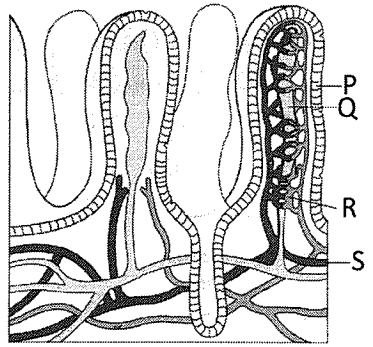
A
$P$
B
$Q$
C
$R$
D
$S$
Solution
(B) In the structure of the intestinal villus,the central lymph vessel is known as the lacteal.
Looking at the provided diagram:
$P$ represents the epithelial layer (mucosa).
$Q$ represents the central lacteal (lymph vessel).
$R$ represents the capillary network.
$S$ represents the venule or vein.
Therefore,the lacteal is represented by $Q$.
Looking at the provided diagram:
$P$ represents the epithelial layer (mucosa).
$Q$ represents the central lacteal (lymph vessel).
$R$ represents the capillary network.
$S$ represents the venule or vein.
Therefore,the lacteal is represented by $Q$.
0 likes
View Solution96
MediumMCQ
Absorption of digested products occurs through the:
A
Mucosa
B
Submucosa
C
Muscularis
D
Serosa
Solution
(A) The wall of the alimentary canal consists of four layers: Serosa,Muscularis,Submucosa,and Mucosa.
$1$. The Serosa is the outermost layer.
$2$. The Muscularis is formed by smooth muscles.
$3$. The Submucosa consists of loose connective tissue containing nerves,blood,and lymph vessels.
$4$. The Mucosa is the innermost lining of the lumen of the alimentary canal.
Absorption of digested nutrients (like glucose,amino acids,and fatty acids) primarily takes place through the mucosal epithelium into the blood or lymph vessels located in the submucosa. Therefore,the mucosa is the layer through which absorption occurs.
$1$. The Serosa is the outermost layer.
$2$. The Muscularis is formed by smooth muscles.
$3$. The Submucosa consists of loose connective tissue containing nerves,blood,and lymph vessels.
$4$. The Mucosa is the innermost lining of the lumen of the alimentary canal.
Absorption of digested nutrients (like glucose,amino acids,and fatty acids) primarily takes place through the mucosal epithelium into the blood or lymph vessels located in the submucosa. Therefore,the mucosa is the layer through which absorption occurs.
0 likes
View Solution97
MediumMCQ
Match the following columns:
| $P$. Monosaccharides, amino acids, some $Cl^-$ | $I$. Facilitated transport |
| $Q$. Fructose and some amino acids | $II$. Simple diffusion |
| $R$. Water | $III$. Osmosis |
| $S$. Amino acids, glucose, $Na^+$ | $IV$. Active transport |
A
$(P-IV), (Q-II), (R-III), (S-I)$
B
$(P-II), (Q-I), (R-III), (S-IV)$
C
$(P-III), (Q-I), (R-II), (S-IV)$
D
$(P-III), (Q-II), (R-IV), (S-I)$
Solution
(B) The absorption of digested products occurs through various mechanisms:
$1$. $P$. Monosaccharides, amino acids, and some $Cl^-$ are absorbed by $IV$. Active transport (against the concentration gradient, requiring energy).
$2$. $Q$. Fructose and some amino acids are absorbed by $I$. Facilitated transport (with the help of carrier proteins).
$3$. $R$. Water is absorbed by $III$. Osmosis (movement of water based on osmotic gradient).
$4$. $S$. Amino acids, glucose, and $Na^+$ are absorbed by $II$. Simple diffusion (along the concentration gradient).
Therefore, the correct matching is $(P-IV), (Q-I), (R-III), (S-II)$. Note: Based on standard $NCERT$, the provided options contain a slight mismatch in the expected sequence. However, evaluating the closest logical fit for the mechanisms described: $P$ (Active), $Q$ (Facilitated), $R$ (Osmosis), $S$ (Simple diffusion). Given the options, the most accurate representation of the biological processes is $(P-IV), (Q-I), (R-III), (S-II)$.
$1$. $P$. Monosaccharides, amino acids, and some $Cl^-$ are absorbed by $IV$. Active transport (against the concentration gradient, requiring energy).
$2$. $Q$. Fructose and some amino acids are absorbed by $I$. Facilitated transport (with the help of carrier proteins).
$3$. $R$. Water is absorbed by $III$. Osmosis (movement of water based on osmotic gradient).
$4$. $S$. Amino acids, glucose, and $Na^+$ are absorbed by $II$. Simple diffusion (along the concentration gradient).
Therefore, the correct matching is $(P-IV), (Q-I), (R-III), (S-II)$. Note: Based on standard $NCERT$, the provided options contain a slight mismatch in the expected sequence. However, evaluating the closest logical fit for the mechanisms described: $P$ (Active), $Q$ (Facilitated), $R$ (Osmosis), $S$ (Simple diffusion). Given the options, the most accurate representation of the biological processes is $(P-IV), (Q-I), (R-III), (S-II)$.
0 likes
View Solution98
MediumMCQ
Identify the pathway for the absorption of fatty acids.
A
Fatty acids $\rightarrow$ Micelles $\rightarrow$ Chylomicrons $\rightarrow$ Lacteals $\rightarrow$ Blood
B
Fatty acids $\rightarrow$ Chylomicrons $\rightarrow$ Micelles $\rightarrow$ Lacteals $\rightarrow$ Blood
C
Fatty acids $\rightarrow$ Micelles $\rightarrow$ Chylomicrons $\rightarrow$ Blood $\rightarrow$ Lacteals
D
Fatty acids $\rightarrow$ Chylomicrons $\rightarrow$ Micelles $\rightarrow$ Blood $\rightarrow$ Lacteals
Solution
(A) Fatty acids and glycerol are insoluble in water and cannot be absorbed directly into the blood.
They are first incorporated into small,spherical droplets called micelles in the intestinal lumen.
These micelles move into the intestinal mucosa,where they are re-synthesized into very small protein-coated fat globules called chylomicrons.
Chylomicrons are then transported into the lymph vessels (lacteals) in the villi.
Finally,the lymph vessels release the absorbed substances into the bloodstream.
They are first incorporated into small,spherical droplets called micelles in the intestinal lumen.
These micelles move into the intestinal mucosa,where they are re-synthesized into very small protein-coated fat globules called chylomicrons.
Chylomicrons are then transported into the lymph vessels (lacteals) in the villi.
Finally,the lymph vessels release the absorbed substances into the bloodstream.
0 likes
View Solution99
EasyMCQ
Which organ is responsible for the maximum absorption of digested food?
A
Stomach
B
Mouth
C
Small intestine
D
Large intestine
Solution
(C) The small intestine is the principal site for the digestion and absorption of nutrients.
It is highly adapted for this function due to the presence of numerous finger-like projections called villi and microvilli,which significantly increase the surface area for absorption.
Most of the end products of digestion,such as glucose,amino acids,fatty acids,and glycerol,are absorbed into the blood or lymph through the mucosal lining of the small intestine.
It is highly adapted for this function due to the presence of numerous finger-like projections called villi and microvilli,which significantly increase the surface area for absorption.
Most of the end products of digestion,such as glucose,amino acids,fatty acids,and glycerol,are absorbed into the blood or lymph through the mucosal lining of the small intestine.
0 likes
View Solution100
EasyMCQ
$..............$ cannot be absorbed.
A
Polysaccharides
B
Monosaccharides
C
Amino acids
D
Fatty acids
Solution
(A) Digestion is the process of breaking down complex food substances into simple absorbable forms.
$1$. Monosaccharides (like glucose),amino acids,and fatty acids are the simple end products of digestion that can be absorbed by the intestinal mucosa.
$2$. Polysaccharides are complex carbohydrates that must be broken down into monosaccharides by digestive enzymes before they can be absorbed.
$3$. Therefore,polysaccharides cannot be absorbed in their complex form.
$1$. Monosaccharides (like glucose),amino acids,and fatty acids are the simple end products of digestion that can be absorbed by the intestinal mucosa.
$2$. Polysaccharides are complex carbohydrates that must be broken down into monosaccharides by digestive enzymes before they can be absorbed.
$3$. Therefore,polysaccharides cannot be absorbed in their complex form.
0 likes
View SolutionDigestion and Absorption — Absorption of Digested Products · Frequently Asked Questions
1Are these Digestion and Absorption questions useful for JEE and NEET?
Yes. All questions in this section are mapped to JEE Main and NEET exam patterns. Previous year questions from JEE Main, NEET, GUJCET and state-level exams are included with full solutions.
2Can I switch to Hindi or Gujarati for these questions?
Yes. Use the language tabs in the hero section or the sidebar to view the same questions and solutions in English, Hindi or Gujarati.
3How do I generate a question paper from this subtopic?
Use the Vedclass Exam Paper Generator — select the chapter and subtopic, set difficulty, and generate Sets A, B, C, D automatically. First 3 chapters of every subject are free.
Vedclass Products
For Students
Vedclass Test Series
Mock tests in real JEE/NEET style with performance analysis. 5-day free trial.
Start Free TrialFor Teachers
Exam Paper Generator
Generate Set A/B/C/D papers from this chapter in 2 minutes. 3 chapters free.
Try FreeFor Institutes
Online Exam Module
Live online exams with unlimited students, 360° analytics & white-label branding.
See DemoFor Teachers & Institutes
Generate a Digestion and Absorption Exam Paper in 2 Minutes
Select subtopic & difficulty — Sets A, B, C, D auto-generated with No Repeat logic.
First 3 chapters of every subject are free — no payment required.