
A English
Glycolysis Questions in English
Class 11 Biology · Respiration in Plants · Glycolysis
215+
Questions
English
Language
100%
With Solutions
Showing 49 of 215 questions in English
101
EasyMCQ
$EMP$ pathway is also known as:
A
Kreb's cycle
B
$RQ$
C
Glycolysis
D
Amphibolic pathway
Solution
(C) The $EMP$ pathway stands for the Embden-Meyerhof-Parnas pathway.
It is the alternative name for $Glycolysis$,which is the process of breaking down glucose into two molecules of pyruvate.
This pathway occurs in the cytoplasm of the cell and is common to both aerobic and anaerobic respiration.
It is the alternative name for $Glycolysis$,which is the process of breaking down glucose into two molecules of pyruvate.
This pathway occurs in the cytoplasm of the cell and is common to both aerobic and anaerobic respiration.
0 likes
View Solution102
EasyMCQ
What is the first product of the phosphorylation phase of glycolysis?
A
Pyruvic acid
B
Glucose$-6-$Phosphate
C
$PEP$
D
$DHAP$
Solution
(B) Glycolysis begins with the phosphorylation of glucose to form Glucose$-6-$Phosphate.
This reaction is catalyzed by the enzyme hexokinase or glucokinase.
In this step,one molecule of $ATP$ is consumed to provide the phosphate group.
Therefore,Glucose$-6-$Phosphate is the first product formed in the phosphorylation phase of glycolysis.
This reaction is catalyzed by the enzyme hexokinase or glucokinase.
In this step,one molecule of $ATP$ is consumed to provide the phosphate group.
Therefore,Glucose$-6-$Phosphate is the first product formed in the phosphorylation phase of glycolysis.
0 likes
View Solution103
MediumMCQ
Select the correct sequence of reactions in glycolysis:
$(a)$ $3$-phosphoglyceraldehyde $\rightarrow$ $1,3$-biphosphoglycerate
$(b)$ $3$-phosphoglyceric acid $\rightarrow$ $2$-phosphoglycerate
$(c)$ $1,3$-biphosphoglyceric acid $\rightarrow$ $3$-phosphoglyceric acid
$(d)$ Splitting of $1,6$-fructose biphosphate to dihydroxyacetone phosphate and $3$-phosphoglyceraldehyde
$(a)$ $3$-phosphoglyceraldehyde $\rightarrow$ $1,3$-biphosphoglycerate
$(b)$ $3$-phosphoglyceric acid $\rightarrow$ $2$-phosphoglycerate
$(c)$ $1,3$-biphosphoglyceric acid $\rightarrow$ $3$-phosphoglyceric acid
$(d)$ Splitting of $1,6$-fructose biphosphate to dihydroxyacetone phosphate and $3$-phosphoglyceraldehyde
A
$d, c, a, b$
B
$b, c, a, d$
C
$a, d, c, b$
D
$d, a, c, b$
Solution
(D) The correct sequence of reactions in glycolysis is as follows:
$1$. First,$1,6$-fructose biphosphate is split into dihydroxyacetone phosphate and $3$-phosphoglyceraldehyde (Step $d$).
$2$. Then,$3$-phosphoglyceraldehyde is oxidized to $1,3$-biphosphoglycerate (Step $a$).
$3$. Next,$1,3$-biphosphoglyceric acid is converted to $3$-phosphoglyceric acid (Step $c$).
$4$. Finally,$3$-phosphoglyceric acid is converted to $2$-phosphoglycerate (Step $b$).
Thus,the correct sequence is $d, a, c, b$.
$1$. First,$1,6$-fructose biphosphate is split into dihydroxyacetone phosphate and $3$-phosphoglyceraldehyde (Step $d$).
$2$. Then,$3$-phosphoglyceraldehyde is oxidized to $1,3$-biphosphoglycerate (Step $a$).
$3$. Next,$1,3$-biphosphoglyceric acid is converted to $3$-phosphoglyceric acid (Step $c$).
$4$. Finally,$3$-phosphoglyceric acid is converted to $2$-phosphoglycerate (Step $b$).
Thus,the correct sequence is $d, a, c, b$.
0 likes
View Solution104
MediumMCQ
Glycolysis is a....
A
Path of $10$ steps to synthesize pyruvic acid from glucose.
B
Path from glucose to lactic acid which occurs in $5$ metabolic steps.
C
Pathway from glucose to glycogen which occurs in $4$ metabolic steps.
D
Pathway from glucose to lactic acid which occurs in $11$ metabolic steps.
Solution
(A) Glycolysis is the partial oxidation of glucose into two molecules of pyruvic acid.
It is a series of $10$ enzyme-catalyzed reactions that occur in the cytoplasm of the cell.
This process is common to both aerobic and anaerobic respiration.
Therefore,the correct description is that it is a path of $10$ steps to synthesize pyruvic acid from glucose.
It is a series of $10$ enzyme-catalyzed reactions that occur in the cytoplasm of the cell.
This process is common to both aerobic and anaerobic respiration.
Therefore,the correct description is that it is a path of $10$ steps to synthesize pyruvic acid from glucose.
0 likes
View Solution105
MediumMCQ
Which of the following statements is true regarding $Dihydroxyacetone$ $phosphate$ $(DHAP)$?
A
It is water insoluble.
B
It cannot pass through the cell membrane.
C
It is bitter in taste.
D
It can pass through the cell membrane.
Solution
(B) $Dihydroxyacetone$ $phosphate$ $(DHAP)$ is a phosphorylated sugar intermediate involved in glycolysis and the Calvin cycle.
Because it carries a negatively charged phosphate group,it is highly polar and hydrophilic.
Biological membranes consist of a lipid bilayer,which is hydrophobic in its interior.
Charged or highly polar molecules like $DHAP$ cannot freely diffuse across the lipid bilayer of the cell membrane.
Therefore,$DHAP$ cannot pass through the cell membrane without specific transport proteins.
Because it carries a negatively charged phosphate group,it is highly polar and hydrophilic.
Biological membranes consist of a lipid bilayer,which is hydrophobic in its interior.
Charged or highly polar molecules like $DHAP$ cannot freely diffuse across the lipid bilayer of the cell membrane.
Therefore,$DHAP$ cannot pass through the cell membrane without specific transport proteins.
0 likes
View Solution106
MediumMCQ
The partial oxidation of glucose into pyruvic acid through a series of intermediate steps is known as?
A
$TCA$ cycle
B
Glycolysis
C
$HMS$ pathway
D
Krebs cycle
Solution
(B) Glycolysis is the process of partial oxidation of glucose into two molecules of pyruvic acid.
It occurs in the cytoplasm of the cell and does not require oxygen.
It involves a series of ten enzyme-catalyzed reactions that convert one molecule of glucose $(C_6H_{12}O_6)$ into two molecules of pyruvate $(CH_3COCOOH)$.
It occurs in the cytoplasm of the cell and does not require oxygen.
It involves a series of ten enzyme-catalyzed reactions that convert one molecule of glucose $(C_6H_{12}O_6)$ into two molecules of pyruvate $(CH_3COCOOH)$.
0 likes
View Solution107
MediumMCQ
What is the total net gain of $ATP$ molecules produced by the $EMP$ pathway (Glycolysis) per glucose molecule (in $, ATP$)?
A
$6$
B
$8$
C
$24$
D
$38$
Solution
(B) The $EMP$ pathway,also known as Glycolysis,involves the breakdown of one molecule of glucose into two molecules of pyruvic acid.
During this process,$4$ molecules of $ATP$ are produced by substrate-level phosphorylation,and $2$ molecules of $ATP$ are consumed in the preparatory phase.
Additionally,$2$ molecules of $NADH + H^+$ are produced.
In aerobic respiration,each $NADH$ molecule yields $3\, ATP$ via the electron transport chain (in most eukaryotic cells),contributing $6\, ATP$.
However,the question specifically asks for the net gain from the $EMP$ pathway itself. The net gain of $ATP$ directly produced in glycolysis is $2\, ATP$ ($4$ produced - $2$ consumed).
Given the options provided,$8\, ATP$ is the standard answer representing the total energy yield ($2\, ATP$ net + $6\, ATP$ from $2\, NADH$) produced during the conversion of glucose to pyruvate in aerobic conditions.
During this process,$4$ molecules of $ATP$ are produced by substrate-level phosphorylation,and $2$ molecules of $ATP$ are consumed in the preparatory phase.
Additionally,$2$ molecules of $NADH + H^+$ are produced.
In aerobic respiration,each $NADH$ molecule yields $3\, ATP$ via the electron transport chain (in most eukaryotic cells),contributing $6\, ATP$.
However,the question specifically asks for the net gain from the $EMP$ pathway itself. The net gain of $ATP$ directly produced in glycolysis is $2\, ATP$ ($4$ produced - $2$ consumed).
Given the options provided,$8\, ATP$ is the standard answer representing the total energy yield ($2\, ATP$ net + $6\, ATP$ from $2\, NADH$) produced during the conversion of glucose to pyruvate in aerobic conditions.
0 likes
View Solution108
MediumMCQ
The end product of glycolysis is:
A
Acetyl $CoA$
B
Pyruvic acid
C
Glucose-$1$-phosphate
D
Fructose-$1$-phosphate
Solution
(B) Glycolysis is the process of the breakdown of glucose into two molecules of pyruvic acid.
It occurs in the cytoplasm of the cell and does not require oxygen.
The overall reaction is: $Glucose + 2NAD^+ + 2ADP + 2\Pi \rightarrow 2 \text{Pyruvic acid} + 2NADH + 2H^+ + 2ATP$.
Therefore, the end product of glycolysis is pyruvic acid.
It occurs in the cytoplasm of the cell and does not require oxygen.
The overall reaction is: $Glucose + 2NAD^+ + 2ADP + 2\Pi \rightarrow 2 \text{Pyruvic acid} + 2NADH + 2H^+ + 2ATP$.
Therefore, the end product of glycolysis is pyruvic acid.
0 likes
View Solution109
MediumMCQ
In which initial stage of animal cells does glucose break down?
A
Krebs cycle
B
Glycolysis
C
Oxidative phosphorylation
D
$E.T.C.$
Solution
(B) The process of breaking down glucose into two molecules of pyruvic acid is known as glycolysis.
This process occurs in the cytoplasm of the cell and is the first step in cellular respiration for both aerobic and anaerobic organisms.
It does not require oxygen and is common to all living cells.
This process occurs in the cytoplasm of the cell and is the first step in cellular respiration for both aerobic and anaerobic organisms.
It does not require oxygen and is common to all living cells.
0 likes
View Solution110
MediumMCQ
During glycolysis,which molecule acts as the electron acceptor during the oxidation of glyceraldehyde$-3-$phosphate?
A
$ATP$
B
Glyceraldehyde$-3-$phosphate
C
$NAD^+$
D
Molecular oxygen
Solution
(C) During the process of glycolysis,the oxidation of glyceraldehyde$-3-$phosphate to $1,3$-bisphosphoglycerate is catalyzed by the enzyme glyceraldehyde$-3-$phosphate dehydrogenase.
In this reaction,$NAD^+$ acts as the electron acceptor (oxidizing agent),which gets reduced to $NADH + H^+$.
Therefore,$NAD^+$ is the molecule that accepts electrons during this oxidation step.
In this reaction,$NAD^+$ acts as the electron acceptor (oxidizing agent),which gets reduced to $NADH + H^+$.
Therefore,$NAD^+$ is the molecule that accepts electrons during this oxidation step.
0 likes
View Solution111
MediumMCQ
Conversion of glucose to glucose-$6$-phosphate,the first irreversible reaction of glycolysis,is catalyzed by
A
Aldolase
B
Hexokinase
C
Enolase
D
Phosphofructokinase
Solution
(B) The process of glycolysis begins with the phosphorylation of glucose to form glucose-$6$-phosphate.
This reaction consumes one molecule of $ATP$ and is catalyzed by the enzyme $Hexokinase$ (or $Glucokinase$ in the liver).
This is the first irreversible step of the glycolytic pathway,which effectively traps glucose inside the cell.
This reaction consumes one molecule of $ATP$ and is catalyzed by the enzyme $Hexokinase$ (or $Glucokinase$ in the liver).
This is the first irreversible step of the glycolytic pathway,which effectively traps glucose inside the cell.
0 likes
View Solution112
EasyMCQ
In glycolysis,a glucose molecule is converted into:
A
$PEP$
B
$RuBP$
C
Acetyl $CoA$
D
Pyruvic acid
Solution
(D) Glycolysis is the process of the breakdown of glucose to pyruvic acid.
In this process,one molecule of glucose $(C_6H_{12}O_6)$ undergoes partial oxidation through a series of ten enzyme-catalyzed reactions to form $2$ molecules of pyruvic acid $(CH_3COCOOH)$.
In this process,one molecule of glucose $(C_6H_{12}O_6)$ undergoes partial oxidation through a series of ten enzyme-catalyzed reactions to form $2$ molecules of pyruvic acid $(CH_3COCOOH)$.
0 likes
View Solution113
MediumMCQ
Pyruvate kinase enzyme catalyses
A
first irreversible step of glycolysis
B
second irreversible step of glycolysis
C
third irreversible step of glycolysis
D
fourth irreversible step of glycolysis
Solution
(C) The enzyme $Pyruvate \ kinase$ catalyzes the third and final irreversible step of glycolysis.
In this reaction,$Phosphoenolpyruvate$ $(PEP)$ is converted into $Pyruvic \ acid$ with the production of $ATP$.
The reaction is as follows:
$Phosphoenolpyruvate + ADP \xrightarrow{Pyruvate \ kinase, Mg^{2+}, K^+} Pyruvic \ acid + ATP$
In this reaction,$Phosphoenolpyruvate$ $(PEP)$ is converted into $Pyruvic \ acid$ with the production of $ATP$.
The reaction is as follows:
$Phosphoenolpyruvate + ADP \xrightarrow{Pyruvate \ kinase, Mg^{2+}, K^+} Pyruvic \ acid + ATP$
0 likes
View Solution114
EasyMCQ
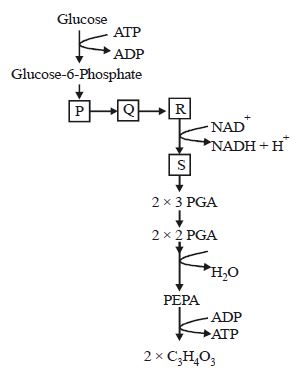
Refer to the figure and answer the question. Choose the correct names of $P$, $Q$, $R$, and $S$.
A
$P - 1,3\text{-bisphosphoglyceric acid (BPGA)}, Q - 3\text{-phosphoglyceraldehyde (PGAL)}, R - \text{Fructose-1,6-bisphosphate}, S - \text{Fructose-6-phosphate}$
B
$P - 3\text{-phosphoglyceraldehyde (PGAL)}, Q - 1,3\text{-bisphosphoglyceric acid (BPGA)}, R - \text{Fructose-1,6-bisphosphate}, S - \text{Fructose-6-phosphate}$
C
$P - \text{Fructose-6-phosphate}, Q - \text{Fructose-1,6-bisphosphate}, R - 3\text{-phosphoglyceraldehyde (PGAL)}, S - 1,3\text{-bisphosphoglyceric acid (BPGA)}$
D
$P - \text{Fructose-1,6-bisphosphate}, Q - \text{Fructose-6-phosphate}, R - 3\text{-phosphoglyceraldehyde (PGAL)}, S - 1,3\text{-bisphosphoglyceric acid (BPGA)}$
Solution
(C) In the process of glycolysis, Glucose is converted into Glucose$-6-$phosphate.
Then, Glucose$-6-$phosphate is isomerized to Fructose$-6-$phosphate $(P)$.
Fructose$-6-$phosphate is then phosphorylated to form Fructose$-1,6-$bisphosphate $(Q)$.
Fructose$-1,6-$bisphosphate splits into two triose phosphates, one of which is $3-$phosphoglyceraldehyde $(R)$.
$3$-phosphoglyceraldehyde is then oxidized to form $1,3-$bisphosphoglyceric acid $(S)$.
Therefore, the correct sequence is $P = \text{Fructose-6-phosphate}$, $Q = \text{Fructose-1,6-bisphosphate}$, $R = 3\text{-phosphoglyceraldehyde}$, and $S = 1,3\text{-bisphosphoglyceric acid}$.
Then, Glucose$-6-$phosphate is isomerized to Fructose$-6-$phosphate $(P)$.
Fructose$-6-$phosphate is then phosphorylated to form Fructose$-1,6-$bisphosphate $(Q)$.
Fructose$-1,6-$bisphosphate splits into two triose phosphates, one of which is $3-$phosphoglyceraldehyde $(R)$.
$3$-phosphoglyceraldehyde is then oxidized to form $1,3-$bisphosphoglyceric acid $(S)$.
Therefore, the correct sequence is $P = \text{Fructose-6-phosphate}$, $Q = \text{Fructose-1,6-bisphosphate}$, $R = 3\text{-phosphoglyceraldehyde}$, and $S = 1,3\text{-bisphosphoglyceric acid}$.
0 likes
View Solution115
MediumMCQ
Which of the following statements ($i$ to $v$) regarding glycolysis are correct?
$(i)$ It is ten enzymatic reactions that convert a six-carbon molecule to a three-carbon pyruvate and result in a net gain of $2\, ATP$ molecules.
$(ii)$ Glucose undergoes partial oxidation to form one molecule of pyruvic acid.
$(iii)$ Glucose is phosphorylated to give rise to glucose-$6$-phosphate by the activity of the enzyme phosphofructokinase.
$(iv)$ The scheme of glycolysis was given by Gustav Embden,Otto Meyerhof,and $J$. Parnas and is often referred to as the $EMP$ pathway.
$(v)$ $ATP$ is utilized at two steps: first in the conversion of glucose into glucose-$6$-phosphate and second in the conversion of fructose-$6$-phosphate to fructose-$1,6$-bisphosphate.
$(i)$ It is ten enzymatic reactions that convert a six-carbon molecule to a three-carbon pyruvate and result in a net gain of $2\, ATP$ molecules.
$(ii)$ Glucose undergoes partial oxidation to form one molecule of pyruvic acid.
$(iii)$ Glucose is phosphorylated to give rise to glucose-$6$-phosphate by the activity of the enzyme phosphofructokinase.
$(iv)$ The scheme of glycolysis was given by Gustav Embden,Otto Meyerhof,and $J$. Parnas and is often referred to as the $EMP$ pathway.
$(v)$ $ATP$ is utilized at two steps: first in the conversion of glucose into glucose-$6$-phosphate and second in the conversion of fructose-$6$-phosphate to fructose-$1,6$-bisphosphate.
A
$(i), (iv)$ and $(v)$
B
$(iii)$ and $(v)$
C
$(iv)$ and $(v)$
D
$(ii)$ and $(iv)$
Solution
(A) Statement $(i)$ is correct: Glycolysis involves ten enzymatic steps converting one molecule of glucose $(6C)$ into two molecules of pyruvate $(3C)$ with a net gain of $2\, ATP$.
Statement $(ii)$ is incorrect: Glucose undergoes partial oxidation to form two molecules of pyruvic acid,not one.
Statement $(iii)$ is incorrect: Glucose is phosphorylated to glucose-$6$-phosphate by the enzyme hexokinase,not phosphofructokinase.
Statement $(iv)$ is correct: The $EMP$ pathway is named after Embden,Meyerhof,and Parnas.
Statement $(v)$ is correct: $ATP$ is consumed during the phosphorylation of glucose to glucose-$6$-phosphate and fructose-$6$-phosphate to fructose-$1,6$-bisphosphate.
Therefore,statements $(i), (iv),$ and $(v)$ are correct.
Statement $(ii)$ is incorrect: Glucose undergoes partial oxidation to form two molecules of pyruvic acid,not one.
Statement $(iii)$ is incorrect: Glucose is phosphorylated to glucose-$6$-phosphate by the enzyme hexokinase,not phosphofructokinase.
Statement $(iv)$ is correct: The $EMP$ pathway is named after Embden,Meyerhof,and Parnas.
Statement $(v)$ is correct: $ATP$ is consumed during the phosphorylation of glucose to glucose-$6$-phosphate and fructose-$6$-phosphate to fructose-$1,6$-bisphosphate.
Therefore,statements $(i), (iv),$ and $(v)$ are correct.
0 likes
View Solution116
MediumMCQ
Assertion : Glycolysis occurs in the cytoplasm.
Reason : Enzymes for glycolysis are found in the cytoplasm. It is common in aerobic and anaerobic respiration.
Reason : Enzymes for glycolysis are found in the cytoplasm. It is common in aerobic and anaerobic respiration.
A
If both Assertion and Reason are correct and the Reason is a correct explanation of the Assertion.
B
If both Assertion and Reason are correct but Reason is not a correct explanation of the Assertion.
C
If the Assertion is correct but Reason is incorrect.
D
If both the Assertion and Reason are incorrect.
Solution
(A) Glycolysis occurs in the cytoplasm because all the necessary enzymes for this metabolic pathway are present there.
This process is common to both aerobic and anaerobic respiration.
In this process,one molecule of glucose is partially oxidized to form $2$ molecules of pyruvic acid.
This process is common to both aerobic and anaerobic respiration.
In this process,one molecule of glucose is partially oxidized to form $2$ molecules of pyruvic acid.
0 likes
View Solution117
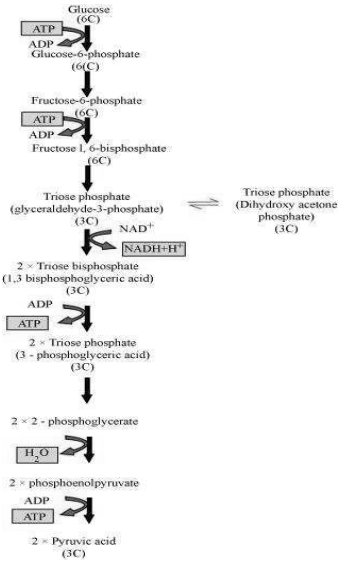
Give the schematic representation of glycolysis.
Solution
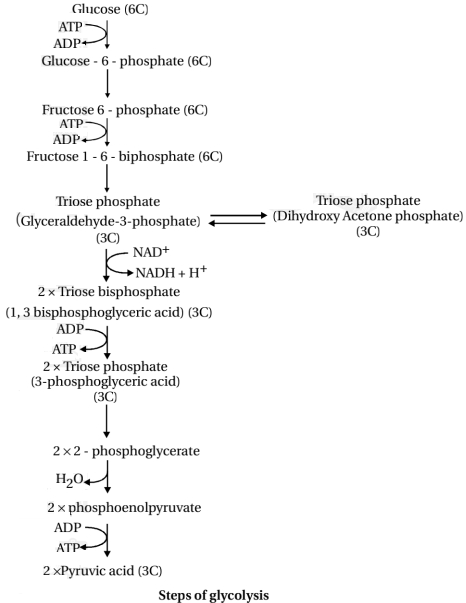
(N/A) Glycolysis is the partial oxidation of glucose into two molecules of pyruvic acid. The process occurs in the cytoplasm of the cell and involves the following steps:
$1$. Glucose $(6C)$ is phosphorylated to Glucose-$6$-phosphate using $ATP$.
$2$. Glucose-$6$-phosphate is isomerized to Fructose-$6$-phosphate.
$3$. Fructose-$6$-phosphate is phosphorylated to Fructose-$1,6$-bisphosphate using another $ATP$.
$4$. Fructose-$1,6$-bisphosphate splits into two $3C$ molecules: Glyceraldehyde-$3$-phosphate $(GAP)$ and Dihydroxyacetone phosphate $(DHAP)$,which are interconvertible.
$5$. $GAP$ is oxidized and phosphorylated to form $1,3$-bisphosphoglyceric acid,producing $NADH + H^+$.
$6$. $1,3$-bisphosphoglyceric acid is converted to $3$-phosphoglyceric acid,generating $ATP$.
$7$. $3$-phosphoglyceric acid is converted to $2$-phosphoglycerate.
$8$. $2$-phosphoglycerate is dehydrated to form phosphoenolpyruvate $(PEP)$,releasing $H_2O$.
$9$. $PEP$ is converted to Pyruvic acid $(3C)$,generating another $ATP$.
$1$. Glucose $(6C)$ is phosphorylated to Glucose-$6$-phosphate using $ATP$.
$2$. Glucose-$6$-phosphate is isomerized to Fructose-$6$-phosphate.
$3$. Fructose-$6$-phosphate is phosphorylated to Fructose-$1,6$-bisphosphate using another $ATP$.
$4$. Fructose-$1,6$-bisphosphate splits into two $3C$ molecules: Glyceraldehyde-$3$-phosphate $(GAP)$ and Dihydroxyacetone phosphate $(DHAP)$,which are interconvertible.
$5$. $GAP$ is oxidized and phosphorylated to form $1,3$-bisphosphoglyceric acid,producing $NADH + H^+$.
$6$. $1,3$-bisphosphoglyceric acid is converted to $3$-phosphoglyceric acid,generating $ATP$.
$7$. $3$-phosphoglyceric acid is converted to $2$-phosphoglycerate.
$8$. $2$-phosphoglycerate is dehydrated to form phosphoenolpyruvate $(PEP)$,releasing $H_2O$.
$9$. $PEP$ is converted to Pyruvic acid $(3C)$,generating another $ATP$.
0 likes
View Solution118
Medium
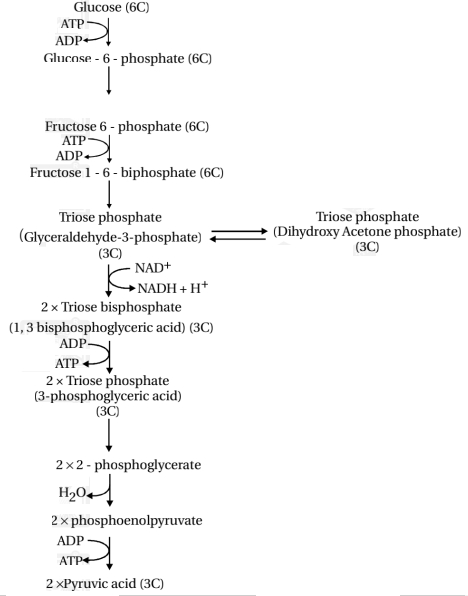
Describe the first stage of respiration.
Solution
(N/A) The first stage of respiration is known as glycolysis.
Definition: Glycolysis is the process in which one molecule of glucose is broken down into two molecules of pyruvic acid.
Origin: The term glycolysis originates from the Greek words 'glycos' (sugar) and 'lysis' (splitting).
History: The scheme of glycolysis was proposed by Gustav Embden,Otto Meyerhof,and $J$. Parnas,and is commonly referred to as the $EMP$ pathway.
Location and Process: Glycolysis occurs in the cytoplasm of the cell. In this process,glucose undergoes partial oxidation to form two molecules of pyruvic acid. In plants,glucose is derived from sucrose (the end product of photosynthesis) or from storage carbohydrates.
Key Steps:
$1$. Phosphorylation: Glucose and fructose are phosphorylated to form $Glucose-6-phosphate$ by the enzyme hexokinase,utilizing $ATP$.
$Glucose + ATP \xrightarrow{\text{Hexokinase}} Glucose-6-Phosphate$
$2$. Isomerization: $Glucose-6-phosphate$ isomerizes to $Fructose-6-phosphate$.
$3$. Second Phosphorylation: $Fructose-6-phosphate$ is converted into $Fructose-1,6-bisphosphate$ in the presence of $ATP$.
$4$. Splitting: $Fructose-1,6-bisphosphate$ is split into two triose phosphates: $Dihydroxyacetone$ $phosphate$ $(DHAP)$ and $3-phosphoglyceraldehyde$ $(PGAL)$.
$5$. Subsequent Steps: Through a series of ten enzymatic reactions,these triose phosphates are eventually converted into two molecules of pyruvic acid,producing $NADH + H^+$ and $ATP$ in the process.
Definition: Glycolysis is the process in which one molecule of glucose is broken down into two molecules of pyruvic acid.
Origin: The term glycolysis originates from the Greek words 'glycos' (sugar) and 'lysis' (splitting).
History: The scheme of glycolysis was proposed by Gustav Embden,Otto Meyerhof,and $J$. Parnas,and is commonly referred to as the $EMP$ pathway.
Location and Process: Glycolysis occurs in the cytoplasm of the cell. In this process,glucose undergoes partial oxidation to form two molecules of pyruvic acid. In plants,glucose is derived from sucrose (the end product of photosynthesis) or from storage carbohydrates.
Key Steps:
$1$. Phosphorylation: Glucose and fructose are phosphorylated to form $Glucose-6-phosphate$ by the enzyme hexokinase,utilizing $ATP$.
$Glucose + ATP \xrightarrow{\text{Hexokinase}} Glucose-6-Phosphate$
$2$. Isomerization: $Glucose-6-phosphate$ isomerizes to $Fructose-6-phosphate$.
$3$. Second Phosphorylation: $Fructose-6-phosphate$ is converted into $Fructose-1,6-bisphosphate$ in the presence of $ATP$.
$4$. Splitting: $Fructose-1,6-bisphosphate$ is split into two triose phosphates: $Dihydroxyacetone$ $phosphate$ $(DHAP)$ and $3-phosphoglyceraldehyde$ $(PGAL)$.
$5$. Subsequent Steps: Through a series of ten enzymatic reactions,these triose phosphates are eventually converted into two molecules of pyruvic acid,producing $NADH + H^+$ and $ATP$ in the process.
0 likes
View Solution119
Medium
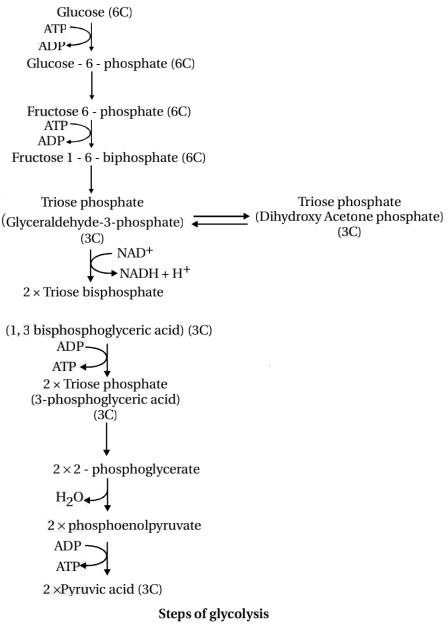
Describe the process of respiration occurring in the cytoplasm,or describe the anaerobic phase of aerobic respiration.
Solution
(N/A) Definition: Glycolysis is the phase of respiration that involves the breakdown of one molecule of glucose into two molecules of pyruvic acid.
Origin: The term 'glycolysis' is derived from the Greek words 'glycos' (sugar) and 'lysis' (splitting).
The scheme of glycolysis was proposed by Gustav Embden,Otto Meyerhof,and $J$. Parnas,and is commonly referred to as the $EMP$ pathway.
In anaerobic organisms,only glycolysis occurs. Glycolysis takes place in the cytoplasm of the cell,where glucose undergoes partial oxidation to form two molecules of pyruvic acid. In plants,this glucose is derived from sucrose (the end product of photosynthesis) or from storage carbohydrates.
Both glucose and fructose are phosphorylated to form Glucose-$6$-phosphate by the enzyme hexokinase.
Glucose + $ATP$ $\xrightarrow{\text{Hexokinase}}$ Glucose-$6$-Phosphate
This phosphorylated glucose then isomerizes to produce Fructose-$6$-phosphate.
Glucose-$6$-Phosphate $\longrightarrow$ Fructose-$6$-Phosphate
Subsequent steps for the metabolism of glucose and fructose are identical.
Glycolysis consists of a chain of ten reactions,controlled by different enzymes,to produce pyruvate from glucose.
Fructose-$6$-phosphate is converted into Fructose-$1,6$-bisphosphate in the presence of $ATP$.
$ATP$ is consumed at two steps: first,in the conversion of glucose to Glucose-$6$-phosphate,and second,in the conversion of Fructose-$6$-phosphate to Fructose-$1,6$-bisphosphate.
Fructose-$1,6$-bisphosphate is then split into Dihydroxyacetone phosphate $(DHAP)$ and $3$-phosphoglyceraldehyde $(PGAL)$.
Fructose-$1,6$-Bisphosphate $\longrightarrow$ $DHAP$ $(3C)$ + $PGAL$ $(3C)$
In one step,$NADH + H^+$ is formed from $NAD^+$ when $3$-phosphoglyceraldehyde is converted to $1,3$-bisphosphoglycerate $(BPGA)$.
$3$-phosphoglyceraldehyde $\longrightarrow$ $1,3$-bisphosphoglycerate + $NADH + H^+$
Two redox-equivalents are removed from $PGAL$ and transferred to a molecule of $NAD^+$.
$PGAL$ is oxidized and combined with inorganic phosphate to form $BPGA$.
The conversion of $BPGA$ to $3$-phosphoglyceric acid $(PGA)$ is an energy-yielding process,where energy is trapped by the formation of $ATP$.
Another $ATP$ is synthesized during the conversion of phosphoenolpyruvate $(PEP)$ to pyruvic acid.
Pyruvic acid is the key product of glycolysis. Its metabolic fate depends on cellular needs. There are three major ways cells handle pyruvic acid:
$(1)$ Lactic acid fermentation
$(2)$ Alcoholic fermentation
$(3)$ Aerobic respiration
Fermentation occurs under anaerobic conditions in many prokaryotes and unicellular eukaryotes. For complete oxidation of glucose to $CO_2$ and $H_2O$,organisms adopt the Krebs cycle (aerobic respiration),which requires $O_2$.
Origin: The term 'glycolysis' is derived from the Greek words 'glycos' (sugar) and 'lysis' (splitting).
The scheme of glycolysis was proposed by Gustav Embden,Otto Meyerhof,and $J$. Parnas,and is commonly referred to as the $EMP$ pathway.
In anaerobic organisms,only glycolysis occurs. Glycolysis takes place in the cytoplasm of the cell,where glucose undergoes partial oxidation to form two molecules of pyruvic acid. In plants,this glucose is derived from sucrose (the end product of photosynthesis) or from storage carbohydrates.
Both glucose and fructose are phosphorylated to form Glucose-$6$-phosphate by the enzyme hexokinase.
Glucose + $ATP$ $\xrightarrow{\text{Hexokinase}}$ Glucose-$6$-Phosphate
This phosphorylated glucose then isomerizes to produce Fructose-$6$-phosphate.
Glucose-$6$-Phosphate $\longrightarrow$ Fructose-$6$-Phosphate
Subsequent steps for the metabolism of glucose and fructose are identical.
Glycolysis consists of a chain of ten reactions,controlled by different enzymes,to produce pyruvate from glucose.
Fructose-$6$-phosphate is converted into Fructose-$1,6$-bisphosphate in the presence of $ATP$.
$ATP$ is consumed at two steps: first,in the conversion of glucose to Glucose-$6$-phosphate,and second,in the conversion of Fructose-$6$-phosphate to Fructose-$1,6$-bisphosphate.
Fructose-$1,6$-bisphosphate is then split into Dihydroxyacetone phosphate $(DHAP)$ and $3$-phosphoglyceraldehyde $(PGAL)$.
Fructose-$1,6$-Bisphosphate $\longrightarrow$ $DHAP$ $(3C)$ + $PGAL$ $(3C)$
In one step,$NADH + H^+$ is formed from $NAD^+$ when $3$-phosphoglyceraldehyde is converted to $1,3$-bisphosphoglycerate $(BPGA)$.
$3$-phosphoglyceraldehyde $\longrightarrow$ $1,3$-bisphosphoglycerate + $NADH + H^+$
Two redox-equivalents are removed from $PGAL$ and transferred to a molecule of $NAD^+$.
$PGAL$ is oxidized and combined with inorganic phosphate to form $BPGA$.
The conversion of $BPGA$ to $3$-phosphoglyceric acid $(PGA)$ is an energy-yielding process,where energy is trapped by the formation of $ATP$.
Another $ATP$ is synthesized during the conversion of phosphoenolpyruvate $(PEP)$ to pyruvic acid.
Pyruvic acid is the key product of glycolysis. Its metabolic fate depends on cellular needs. There are three major ways cells handle pyruvic acid:
$(1)$ Lactic acid fermentation
$(2)$ Alcoholic fermentation
$(3)$ Aerobic respiration
Fermentation occurs under anaerobic conditions in many prokaryotes and unicellular eukaryotes. For complete oxidation of glucose to $CO_2$ and $H_2O$,organisms adopt the Krebs cycle (aerobic respiration),which requires $O_2$.
0 likes
View Solution120
Medium
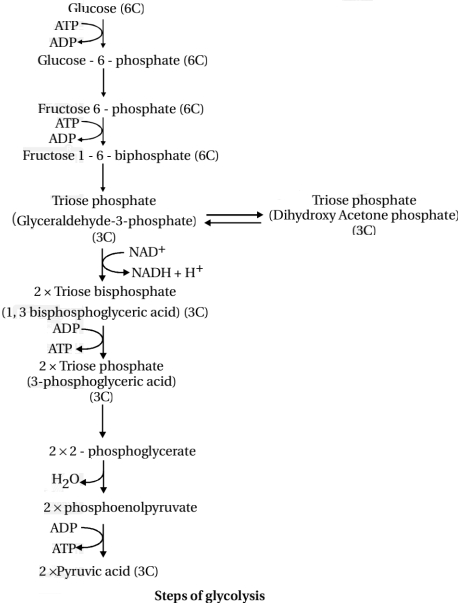
Explain the $EMP$ (Embden,Meyerhof,and Parnas) pathway.
Solution
(N/A) The $EMP$ pathway,commonly known as glycolysis,is the process of breaking down one molecule of glucose into two molecules of pyruvic acid. It occurs in the cytoplasm of the cell.
Key steps of the $EMP$ pathway:
$1$. Phosphorylation: Glucose is phosphorylated to Glucose-$6$-phosphate by the enzyme hexokinase,consuming one $ATP$.
$2$. Isomerization: Glucose-$6$-phosphate isomerizes to Fructose-$6$-phosphate.
$3$. Second Phosphorylation: Fructose-$6$-phosphate is converted to Fructose-$1,6$-bisphosphate,consuming another $ATP$.
$4$. Cleavage: Fructose-$1,6$-bisphosphate splits into two $3$-carbon molecules: Dihydroxyacetone phosphate $(DHAP)$ and $3$-phosphoglyceraldehyde ($PGAL$ or $G3P$).
$5$. Oxidation and Phosphorylation: $PGAL$ is oxidized to $1,3$-bisphosphoglycerate $(BPGA)$,reducing $NAD^+$ to $NADH + H^+$.
$6$. $ATP$ Generation: $BPGA$ is converted to $3$-phosphoglyceric acid $(PGA)$,generating $ATP$.
$7$. Final Steps: Through a series of reactions,$PGA$ is converted to Phosphoenolpyruvate $(PEP)$,and finally to Pyruvic acid,generating another $ATP$ per molecule.
Net yield per glucose molecule: $2$ Pyruvic acid,$2$ $ATP$ (net),and $2$ $NADH + H^+$.
Key steps of the $EMP$ pathway:
$1$. Phosphorylation: Glucose is phosphorylated to Glucose-$6$-phosphate by the enzyme hexokinase,consuming one $ATP$.
$2$. Isomerization: Glucose-$6$-phosphate isomerizes to Fructose-$6$-phosphate.
$3$. Second Phosphorylation: Fructose-$6$-phosphate is converted to Fructose-$1,6$-bisphosphate,consuming another $ATP$.
$4$. Cleavage: Fructose-$1,6$-bisphosphate splits into two $3$-carbon molecules: Dihydroxyacetone phosphate $(DHAP)$ and $3$-phosphoglyceraldehyde ($PGAL$ or $G3P$).
$5$. Oxidation and Phosphorylation: $PGAL$ is oxidized to $1,3$-bisphosphoglycerate $(BPGA)$,reducing $NAD^+$ to $NADH + H^+$.
$6$. $ATP$ Generation: $BPGA$ is converted to $3$-phosphoglyceric acid $(PGA)$,generating $ATP$.
$7$. Final Steps: Through a series of reactions,$PGA$ is converted to Phosphoenolpyruvate $(PEP)$,and finally to Pyruvic acid,generating another $ATP$ per molecule.
Net yield per glucose molecule: $2$ Pyruvic acid,$2$ $ATP$ (net),and $2$ $NADH + H^+$.
0 likes
View Solution121
Medium
Describe the phase until the formation of two molecules of pyruvic acid from glucose takes place.
Solution
(N/A) Definition: Glycolysis is the metabolic pathway that describes the phase until the formation of two molecules of pyruvic acid from one molecule of glucose.
Origin: The term glycolysis originates from the Greek words 'glycos' (sugar) and 'lysis' (splitting).
The scheme of glycolysis was proposed by Gustav Embden,Otto Meyerhof,and $J$. Parnas,and is often referred to as the $EMP$ pathway.
In anaerobic organisms,only glycolysis occurs. Glycolysis takes place in the cytoplasm of the cell,where glucose undergoes partial oxidation to form two molecules of pyruvic acid.
In plants,glucose is derived from sucrose,which is the end product of photosynthesis,or from storage carbohydrates. Both glucose and fructose enter the glycolytic pathway readily.
Glucose and fructose are phosphorylated to form Glucose-$6$-phosphate by the enzyme hexokinase.
Glucose $+$ $ATP$ $\xrightarrow{\text{Hexokinase}}$ Glucose-$6$-Phosphate
This phosphorylated glucose isomerizes to produce Fructose-$6$-phosphate.
Glucose-$6$-Phosphate $\rightleftharpoons$ Fructose-$6$-Phosphate
Subsequent steps for glucose and fructose metabolism are identical.
Glycolysis involves a chain of ten enzyme-controlled reactions to produce pyruvate from glucose.
Fructose-$6$-phosphate is converted into Fructose-$1,6$-bisphosphate in the presence of $ATP$.
$ATP$ is utilized at two steps: first,in the conversion of glucose to Glucose-$6$-phosphate,and second,in the conversion of Fructose-$6$-phosphate to Fructose-$1,6$-bisphosphate.
Fructose-$1,6$-bisphosphate is then split into Dihydroxyacetone phosphate $(DHAP)$ and $3$-phosphoglyceraldehyde $(PGAL)$.
Fructose-$1,6$-bisphosphate $\rightleftharpoons$ $DHAP$ $(3C)$ $+$ $PGAL$ $(3C)$
In one step,$NAD^+$ is reduced to $NADH + H^+$ when $3$-phosphoglyceraldehyde is converted to $1,3$-bisphosphoglycerate $(BPGA)$.
$3$-phosphoglyceraldehyde $+$ $NAD^+$ $+$ $\Pi$ $\longrightarrow$ $1,3$-bisphosphoglycerate $+$ $NADH + H^+$
Two redox-equivalents are removed from $PGAL$ and transferred to $NAD^+$. $PGAL$ is oxidized and combined with inorganic phosphate to form $BPGA$.
The conversion of $BPGA$ to $3$-phosphoglyceric acid $(PGA)$ is an energy-yielding process,where energy is trapped by the formation of $ATP$.
Another $ATP$ is synthesized during the conversion of Phosphoenolpyruvate $(PEP)$ to pyruvic acid.
Pyruvic acid is the key product of glycolysis. Its metabolic fate depends on cellular needs,typically following one of three pathways: $(1)$ Lactic acid fermentation,$(2)$ Alcoholic fermentation,or $(3)$ Aerobic respiration.
Origin: The term glycolysis originates from the Greek words 'glycos' (sugar) and 'lysis' (splitting).
The scheme of glycolysis was proposed by Gustav Embden,Otto Meyerhof,and $J$. Parnas,and is often referred to as the $EMP$ pathway.
In anaerobic organisms,only glycolysis occurs. Glycolysis takes place in the cytoplasm of the cell,where glucose undergoes partial oxidation to form two molecules of pyruvic acid.
In plants,glucose is derived from sucrose,which is the end product of photosynthesis,or from storage carbohydrates. Both glucose and fructose enter the glycolytic pathway readily.
Glucose and fructose are phosphorylated to form Glucose-$6$-phosphate by the enzyme hexokinase.
Glucose $+$ $ATP$ $\xrightarrow{\text{Hexokinase}}$ Glucose-$6$-Phosphate
This phosphorylated glucose isomerizes to produce Fructose-$6$-phosphate.
Glucose-$6$-Phosphate $\rightleftharpoons$ Fructose-$6$-Phosphate
Subsequent steps for glucose and fructose metabolism are identical.
Glycolysis involves a chain of ten enzyme-controlled reactions to produce pyruvate from glucose.
Fructose-$6$-phosphate is converted into Fructose-$1,6$-bisphosphate in the presence of $ATP$.
$ATP$ is utilized at two steps: first,in the conversion of glucose to Glucose-$6$-phosphate,and second,in the conversion of Fructose-$6$-phosphate to Fructose-$1,6$-bisphosphate.
Fructose-$1,6$-bisphosphate is then split into Dihydroxyacetone phosphate $(DHAP)$ and $3$-phosphoglyceraldehyde $(PGAL)$.
Fructose-$1,6$-bisphosphate $\rightleftharpoons$ $DHAP$ $(3C)$ $+$ $PGAL$ $(3C)$
In one step,$NAD^+$ is reduced to $NADH + H^+$ when $3$-phosphoglyceraldehyde is converted to $1,3$-bisphosphoglycerate $(BPGA)$.
$3$-phosphoglyceraldehyde $+$ $NAD^+$ $+$ $\Pi$ $\longrightarrow$ $1,3$-bisphosphoglycerate $+$ $NADH + H^+$
Two redox-equivalents are removed from $PGAL$ and transferred to $NAD^+$. $PGAL$ is oxidized and combined with inorganic phosphate to form $BPGA$.
The conversion of $BPGA$ to $3$-phosphoglyceric acid $(PGA)$ is an energy-yielding process,where energy is trapped by the formation of $ATP$.
Another $ATP$ is synthesized during the conversion of Phosphoenolpyruvate $(PEP)$ to pyruvic acid.
Pyruvic acid is the key product of glycolysis. Its metabolic fate depends on cellular needs,typically following one of three pathways: $(1)$ Lactic acid fermentation,$(2)$ Alcoholic fermentation,or $(3)$ Aerobic respiration.
0 likes
View Solution122
Difficult
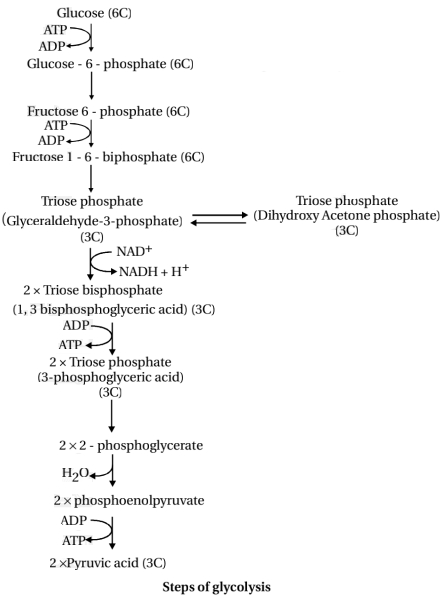
Describe the process represented by the equation: $C_6H_{12}O_6 \to 2CH_3COCOOH + 2ATP + 2NADH + 2H^+$
Solution
(N/A) The equation represents the process of glycolysis,which is the breakdown of glucose into pyruvic acid.
Definition: Glycolysis is the metabolic pathway that converts one molecule of glucose $(6C)$ into two molecules of pyruvic acid $(3C)$.
Origin: The term 'glycolysis' is derived from the Greek words 'glycos' (sugar) and 'lysis' (splitting).
History: The scheme of glycolysis was proposed by Gustav Embden,Otto Meyerhof,and $J$. Parnas,and is commonly known as the $EMP$ pathway.
Process Details:
$1$. Glycolysis occurs in the cytoplasm of the cell and is common to both aerobic and anaerobic respiration.
$2$. In plants,glucose is derived from sucrose (the end product of photosynthesis) or from storage carbohydrates.
$3$. Glucose and fructose are phosphorylated to form Glucose-$6$-phosphate by the enzyme hexokinase,consuming one $ATP$.
$4$. Glucose-$6$-phosphate isomerizes to Fructose-$6$-phosphate.
$5$. Fructose-$6$-phosphate is converted to Fructose-$1,6$-bisphosphate,consuming another $ATP$.
$6$. Fructose-$1,6$-bisphosphate splits into two triose phosphates: Dihydroxyacetone phosphate $(DHAP)$ and $3$-phosphoglyceraldehyde $(PGAL)$.
$7$. $PGAL$ is oxidized to $1,3$-bisphosphoglycerate $(BPGA)$,producing $NADH + H^+$ from $NAD^+$.
$8$. $BPGA$ is converted to $3$-phosphoglyceric acid $(PGA)$,generating $ATP$ via substrate-level phosphorylation.
$9$. Finally,Phosphoenolpyruvate $(PEP)$ is converted to Pyruvic acid,generating another $ATP$.
Net Yield: The net gain of energy in glycolysis is $2ATP$ and $2NADH + 2H^+$ per molecule of glucose.
Definition: Glycolysis is the metabolic pathway that converts one molecule of glucose $(6C)$ into two molecules of pyruvic acid $(3C)$.
Origin: The term 'glycolysis' is derived from the Greek words 'glycos' (sugar) and 'lysis' (splitting).
History: The scheme of glycolysis was proposed by Gustav Embden,Otto Meyerhof,and $J$. Parnas,and is commonly known as the $EMP$ pathway.
Process Details:
$1$. Glycolysis occurs in the cytoplasm of the cell and is common to both aerobic and anaerobic respiration.
$2$. In plants,glucose is derived from sucrose (the end product of photosynthesis) or from storage carbohydrates.
$3$. Glucose and fructose are phosphorylated to form Glucose-$6$-phosphate by the enzyme hexokinase,consuming one $ATP$.
$4$. Glucose-$6$-phosphate isomerizes to Fructose-$6$-phosphate.
$5$. Fructose-$6$-phosphate is converted to Fructose-$1,6$-bisphosphate,consuming another $ATP$.
$6$. Fructose-$1,6$-bisphosphate splits into two triose phosphates: Dihydroxyacetone phosphate $(DHAP)$ and $3$-phosphoglyceraldehyde $(PGAL)$.
$7$. $PGAL$ is oxidized to $1,3$-bisphosphoglycerate $(BPGA)$,producing $NADH + H^+$ from $NAD^+$.
$8$. $BPGA$ is converted to $3$-phosphoglyceric acid $(PGA)$,generating $ATP$ via substrate-level phosphorylation.
$9$. Finally,Phosphoenolpyruvate $(PEP)$ is converted to Pyruvic acid,generating another $ATP$.
Net Yield: The net gain of energy in glycolysis is $2ATP$ and $2NADH + 2H^+$ per molecule of glucose.
0 likes
View Solution123
Medium
Explain the formation of $PEP$ (Phosphoenolpyruvate) during glycolysis.
Solution
(N/A) The formation of $PEP$ occurs during the final stages of glycolysis.
$1$. $2$-phosphoglycerate ($2$-$PGA$) is converted into phosphoenolpyruvate $(PEP)$ by the enzyme enolase.
$2$. This reaction involves the removal of a water molecule $(H_2O)$,which is a dehydration reaction.
$3$. Subsequently,$PEP$ is converted into pyruvic acid by the enzyme pyruvate kinase,a step that generates $ATP$ through substrate-level phosphorylation.
$4$. Pyruvic acid is the key product of glycolysis. Its metabolic fate depends on cellular requirements,leading to three major pathways: $(i)$ Lactic acid fermentation,$(ii)$ Alcoholic fermentation,or $(iii)$ Aerobic respiration.
$1$. $2$-phosphoglycerate ($2$-$PGA$) is converted into phosphoenolpyruvate $(PEP)$ by the enzyme enolase.
$2$. This reaction involves the removal of a water molecule $(H_2O)$,which is a dehydration reaction.
$3$. Subsequently,$PEP$ is converted into pyruvic acid by the enzyme pyruvate kinase,a step that generates $ATP$ through substrate-level phosphorylation.
$4$. Pyruvic acid is the key product of glycolysis. Its metabolic fate depends on cellular requirements,leading to three major pathways: $(i)$ Lactic acid fermentation,$(ii)$ Alcoholic fermentation,or $(iii)$ Aerobic respiration.
0 likes
View Solution124
Medium
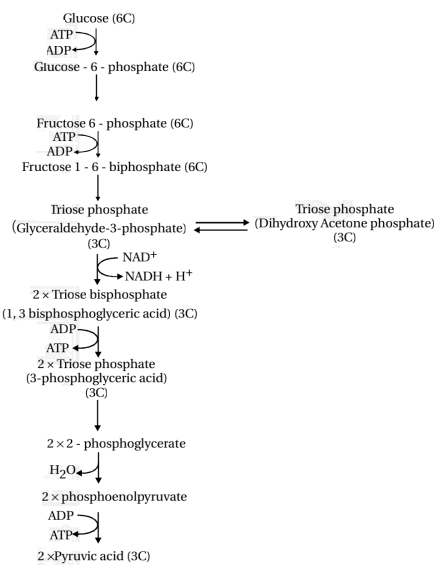
Provide the flowchart of Glycolysis.
Solution
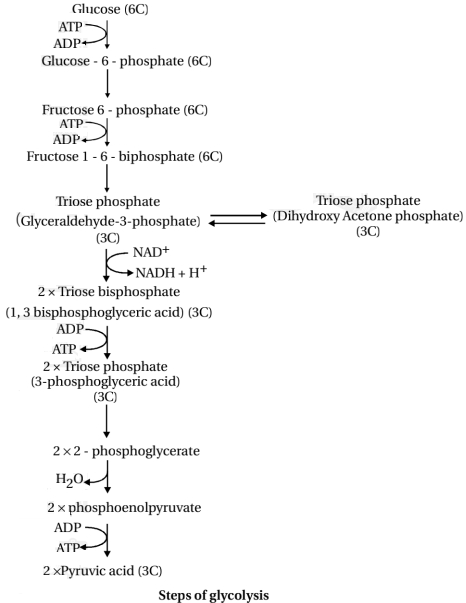
(N/A) Glycolysis is the process of breaking down one molecule of $Glucose$ $(6C)$ into two molecules of $Pyruvic$ $acid$ $(3C)$. The steps are as follows:
$1$. $Glucose$ is phosphorylated to $Glucose-6-phosphate$ using $ATP$.
$2$. $Glucose-6-phosphate$ is isomerized to $Fructose-6-phosphate$.
$3$. $Fructose-6-phosphate$ is phosphorylated to $Fructose-1,6-bisphosphate$ using $ATP$.
$4$. $Fructose-1,6-bisphosphate$ splits into two $3C$ molecules: $Glyceraldehyde-3-phosphate$ $(PGAL)$ and $Dihydroxyacetone$ $phosphate$ $(DHAP)$,which are interconvertible.
$5$. $PGAL$ is oxidized and phosphorylated to form $1,3-bisphosphoglyceric$ $acid$ $(BPGA)$,reducing $NAD^+$ to $NADH + H^+$.
$6$. $BPGA$ is converted to $3-phosphoglyceric$ $acid$ $(PGA)$,producing $ATP$.
$7$. $3-phosphoglyceric$ $acid$ is converted to $2-phosphoglyceric$ $acid$.
$8$. $2-phosphoglyceric$ $acid$ loses a water molecule to form $Phosphoenolpyruvate$ $(PEP)$.
$9$. $PEP$ is converted to $Pyruvic$ $acid$,producing $ATP$.
$1$. $Glucose$ is phosphorylated to $Glucose-6-phosphate$ using $ATP$.
$2$. $Glucose-6-phosphate$ is isomerized to $Fructose-6-phosphate$.
$3$. $Fructose-6-phosphate$ is phosphorylated to $Fructose-1,6-bisphosphate$ using $ATP$.
$4$. $Fructose-1,6-bisphosphate$ splits into two $3C$ molecules: $Glyceraldehyde-3-phosphate$ $(PGAL)$ and $Dihydroxyacetone$ $phosphate$ $(DHAP)$,which are interconvertible.
$5$. $PGAL$ is oxidized and phosphorylated to form $1,3-bisphosphoglyceric$ $acid$ $(BPGA)$,reducing $NAD^+$ to $NADH + H^+$.
$6$. $BPGA$ is converted to $3-phosphoglyceric$ $acid$ $(PGA)$,producing $ATP$.
$7$. $3-phosphoglyceric$ $acid$ is converted to $2-phosphoglyceric$ $acid$.
$8$. $2-phosphoglyceric$ $acid$ loses a water molecule to form $Phosphoenolpyruvate$ $(PEP)$.
$9$. $PEP$ is converted to $Pyruvic$ $acid$,producing $ATP$.
0 likes
View Solution125
Medium
Provide the full names for the following abbreviations:
$(1)$ $DHAP$
$(2)$ $Co-A$
$(1)$ $DHAP$
$(2)$ $Co-A$
Solution
(N/A) $(1)$ $DHAP$ stands for Dihydroxyacetone phosphate. It is a key intermediate in glycolysis and the Calvin cycle.
$(2)$ $Co-A$ stands for Coenzyme $A$. It is a vital cofactor in cellular metabolism, particularly in the citric acid cycle and fatty acid oxidation.
$(2)$ $Co-A$ stands for Coenzyme $A$. It is a vital cofactor in cellular metabolism, particularly in the citric acid cycle and fatty acid oxidation.
0 likes
View Solution126
Medium
Provide the full names for the following abbreviations:
$(1)$ $BPGA$
$(2)$ $PGA$
$(1)$ $BPGA$
$(2)$ $PGA$
Solution
(N/A) $(1)$ $BPGA$ stands for $1,3$-Bisphosphoglyceric acid.
$(2)$ $PGA$ stands for $3$-Phosphoglyceric acid.
$(2)$ $PGA$ stands for $3$-Phosphoglyceric acid.
0 likes
View Solution127
Easy
Provide the full names for the following abbreviations:
$(1)$ $PEP$
$(2)$ $TPP$
$(1)$ $PEP$
$(2)$ $TPP$
Solution
(N/A) $(1)$ $PEP$ stands for Phosphoenol Pyruvate,which is a key intermediate in glycolysis.
$(2)$ $TPP$ stands for Thiamine Pyrophosphate,which acts as a coenzyme in various metabolic reactions,including the decarboxylation of pyruvate.
$(2)$ $TPP$ stands for Thiamine Pyrophosphate,which acts as a coenzyme in various metabolic reactions,including the decarboxylation of pyruvate.
0 likes
View Solution128
Easy
Provide the full forms of the following abbreviations:
$(1)$ $ATPase$
$(2)$ $EMP$
$(1)$ $ATPase$
$(2)$ $EMP$
Solution
(N/A) $(1)$ $ATPase$: Adenosine Triphosphatase.
$(2)$ $EMP$: Embden-Meyerhof-Parnas pathway.
$(2)$ $EMP$: Embden-Meyerhof-Parnas pathway.
0 likes
View Solution129
MediumMCQ
Identify the chemical compounds represented by the following formulas:
$(1)$ $CH_3CH(OH)COOH$
$(2)$ $CH_3COCOOH$
$(1)$ $CH_3CH(OH)COOH$
$(2)$ $CH_3COCOOH$
A
$(1)$ Lactic acid,$(2)$ Pyruvic acid
B
$(1)$ Pyruvic acid,$(2)$ Lactic acid
C
$(1)$ Acetic acid,$(2)$ Citric acid
D
$(1)$ Malic acid,$(2)$ Oxaloacetic acid
Solution
(A) $(1)$ The formula $CH_3CH(OH)COOH$ represents Lactic acid,which is a $3$-carbon hydroxy acid produced during anaerobic respiration in muscle cells.
$(2)$ The formula $CH_3COCOOH$ represents Pyruvic acid,which is a $3$-carbon keto acid and the end product of glycolysis.
$(2)$ The formula $CH_3COCOOH$ represents Pyruvic acid,which is a $3$-carbon keto acid and the end product of glycolysis.
0 likes
View Solution130
Medium
Comment on the statement: 'Respiration is an energy-producing process,but $ATP$ is being used in some steps of the process.'
Solution
(N/A) Respiration is a catabolic process that occurs in a stepwise manner.
Although the primary goal of respiration is to produce energy in the form of $ATP$,energy is initially required to activate certain substrates.
For example,in the initial steps of glycolysis,$ATP$ is consumed to phosphorylate glucose into glucose-$6$-phosphate and fructose-$6$-phosphate into fructose-$1,6$-bisphosphate.
This investment of $ATP$ is necessary to destabilize the glucose molecule,making it reactive for subsequent breakdown.
When one molecule of $ATP$ is hydrolyzed,it releases $ADP + \Pi$ along with approximately $7.3 \ kcal$ of energy.
Therefore,the process involves both an initial investment of energy and a subsequent net gain of energy,ensuring the overall respiratory balance sheet remains positive.
Although the primary goal of respiration is to produce energy in the form of $ATP$,energy is initially required to activate certain substrates.
For example,in the initial steps of glycolysis,$ATP$ is consumed to phosphorylate glucose into glucose-$6$-phosphate and fructose-$6$-phosphate into fructose-$1,6$-bisphosphate.
This investment of $ATP$ is necessary to destabilize the glucose molecule,making it reactive for subsequent breakdown.
When one molecule of $ATP$ is hydrolyzed,it releases $ADP + \Pi$ along with approximately $7.3 \ kcal$ of energy.
Therefore,the process involves both an initial investment of energy and a subsequent net gain of energy,ensuring the overall respiratory balance sheet remains positive.
0 likes
View Solution131
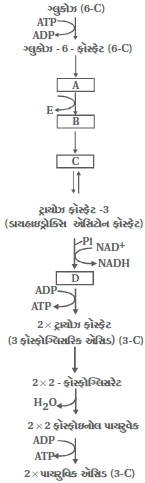
The figure given below shows the steps in glycolysis. Fill in the missing steps $A, B, C, D$ and also indicate whether $ATP$ is being used up or released at step $E$?
Solution
(N/A) : Fructose-$6$-phosphate $(6C)$
$B$: Fructose-$1,6$-bisphosphate $(6C)$
$C$: $PGAL$ (Phosphoglyceraldehyde) and $DHAP$ (Dihydroxyacetone phosphate)
$D$: $1,3$-bisphosphoglyceric acid $(1,3-BPGA)$
At step $E$,$ATP$ is being used up (consumed) to convert Fructose-$6$-phosphate into Fructose-$1,6$-bisphosphate.
$B$: Fructose-$1,6$-bisphosphate $(6C)$
$C$: $PGAL$ (Phosphoglyceraldehyde) and $DHAP$ (Dihydroxyacetone phosphate)
$D$: $1,3$-bisphosphoglyceric acid $(1,3-BPGA)$
At step $E$,$ATP$ is being used up (consumed) to convert Fructose-$6$-phosphate into Fructose-$1,6$-bisphosphate.
0 likes
View Solution132
Easy
$ATP$ produced during glycolysis is a result of substrate-level phosphorylation. Explain.
Solution
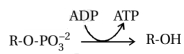
(N/A) Substrate-level phosphorylation is a metabolic process that results in the formation of $ATP$ or $GTP$ by the direct transfer of a phosphate group from a high-energy substrate molecule to $ADP$ or $GDP$.
In glycolysis, substrate-level phosphorylation occurs in two specific steps:
$(a)$ Conversion of $1,3$-bisphosphoglycerate to $3$-phosphoglycerate:
$2$ molecules of $1,3$-bisphosphoglyceric acid react with $2$ molecules of $ADP$ in the presence of the enzyme phosphoglycerate kinase and $Mg^{2+}$ ions to form $2$ molecules of $3$-phosphoglyceric acid and $2$ molecules of $ATP$.
$2(\text{1,3-bisphosphoglyceric acid}) + 2ADP \xrightarrow{Mg^{2+}} 2(\text{3-phosphoglyceric acid}) + 2ATP$
$(b)$ Conversion of phosphoenolpyruvate to pyruvate:
$2$ molecules of phosphoenolpyruvic acid react with $2$ molecules of $ADP$ in the presence of the enzyme pyruvate kinase and $Mg^{2+}$ ions to form $2$ molecules of pyruvic acid and $2$ molecules of $ATP$.
$2(\text{phosphoenolpyruvic acid}) + 2ADP \xrightarrow{Mg^{2+}} 2(\text{pyruvic acid}) + 2ATP$
In glycolysis, substrate-level phosphorylation occurs in two specific steps:
$(a)$ Conversion of $1,3$-bisphosphoglycerate to $3$-phosphoglycerate:
$2$ molecules of $1,3$-bisphosphoglyceric acid react with $2$ molecules of $ADP$ in the presence of the enzyme phosphoglycerate kinase and $Mg^{2+}$ ions to form $2$ molecules of $3$-phosphoglyceric acid and $2$ molecules of $ATP$.
$2(\text{1,3-bisphosphoglyceric acid}) + 2ADP \xrightarrow{Mg^{2+}} 2(\text{3-phosphoglyceric acid}) + 2ATP$
$(b)$ Conversion of phosphoenolpyruvate to pyruvate:
$2$ molecules of phosphoenolpyruvic acid react with $2$ molecules of $ADP$ in the presence of the enzyme pyruvate kinase and $Mg^{2+}$ ions to form $2$ molecules of pyruvic acid and $2$ molecules of $ATP$.
$2(\text{phosphoenolpyruvic acid}) + 2ADP \xrightarrow{Mg^{2+}} 2(\text{pyruvic acid}) + 2ATP$
0 likes
View Solution133
Medium
Write two energy yielding reactions of glycolysis.
Solution
(N/A) In glycolysis, energy is yielded in the form of $ATP$ during the following two substrate-level phosphorylation reactions:
$1$. The conversion of $1,3$-bisphosphoglyceric acid to $3$-phosphoglyceric acid, catalyzed by the enzyme phosphoglycerate kinase. In this step, $ADP$ is phosphorylated to $ATP$.
Reaction: $1,3\text{-bisphosphoglyceric acid} + ADP \rightarrow 3\text{-phosphoglyceric acid} + ATP$
$2$. The conversion of phosphoenolpyruvate to pyruvic acid, catalyzed by the enzyme pyruvate kinase. In this step, $ADP$ is phosphorylated to $ATP$.
Reaction: $\text{phosphoenolpyruvate} + ADP \rightarrow \text{pyruvic acid} + ATP$
$1$. The conversion of $1,3$-bisphosphoglyceric acid to $3$-phosphoglyceric acid, catalyzed by the enzyme phosphoglycerate kinase. In this step, $ADP$ is phosphorylated to $ATP$.
Reaction: $1,3\text{-bisphosphoglyceric acid} + ADP \rightarrow 3\text{-phosphoglyceric acid} + ATP$
$2$. The conversion of phosphoenolpyruvate to pyruvic acid, catalyzed by the enzyme pyruvate kinase. In this step, $ADP$ is phosphorylated to $ATP$.
Reaction: $\text{phosphoenolpyruvate} + ADP \rightarrow \text{pyruvic acid} + ATP$
0 likes
View Solution134
Medium
Name the site$(s)$ of pyruvate synthesis. Also,write the chemical reaction wherein pyruvic acid dehydrogenase acts as a catalyst.
Solution
(N/A) Pyruvate is synthesized in the cytoplasm of the cell during the process of glycolysis.
During glycolysis,one molecule of glucose $(C_6H_{12}O_6)$ is broken down into two molecules of pyruvic acid $(CH_3COCOOH)$.
The enzyme complex pyruvic acid dehydrogenase catalyzes the oxidative decarboxylation of pyruvic acid to form Acetyl $CoA$. This reaction requires $NAD^+$,Coenzyme $A$ $(CoA)$,and $Mg^{2+}$ as cofactors.
The chemical reaction is as follows:
$\text{Pyruvic acid} + CoA + NAD^+ \xrightarrow{Mg^{2+}, \text{Pyruvate dehydrogenase}} \text{Acetyl } CoA + NADH + H^+ + CO_2 \uparrow$
During glycolysis,one molecule of glucose $(C_6H_{12}O_6)$ is broken down into two molecules of pyruvic acid $(CH_3COCOOH)$.
The enzyme complex pyruvic acid dehydrogenase catalyzes the oxidative decarboxylation of pyruvic acid to form Acetyl $CoA$. This reaction requires $NAD^+$,Coenzyme $A$ $(CoA)$,and $Mg^{2+}$ as cofactors.
The chemical reaction is as follows:
$\text{Pyruvic acid} + CoA + NAD^+ \xrightarrow{Mg^{2+}, \text{Pyruvate dehydrogenase}} \text{Acetyl } CoA + NADH + H^+ + CO_2 \uparrow$
0 likes
View Solution135
Medium
Give an account of Glycolysis. Where does it occur? What are the end products? Trace the fate of these products in both aerobic and anaerobic respiration.
Solution
(N/A) Definition: Glycolysis is the process of partial oxidation of glucose into two molecules of pyruvic acid.
Origin: The term glycolysis originates from the Greek words 'glycos' (sugar) and 'lysis' (splitting). The scheme was proposed by Gustav Embden,Otto Meyerhof,and $J$. Parnas,hence it is known as the $EMP$ pathway.
Location: Glycolysis occurs in the cytoplasm of the cell.
Process: In plants,glucose is derived from sucrose (end product of photosynthesis) or storage carbohydrates. Glucose and fructose are phosphorylated to form glucose-$6$-phosphate by the enzyme hexokinase. This is then isomerized to fructose-$6$-phosphate,which is further converted to fructose-$1,6$-bisphosphate using $ATP$. Fructose-$1,6$-bisphosphate splits into dihydroxyacetone phosphate $(DHAP)$ and $3$-phosphoglyceraldehyde $(PGAL)$. $PGAL$ is oxidized to $1,3$-bisphosphoglycerate,producing $NADH + H^+$. Subsequent steps involve the production of $ATP$ through substrate-level phosphorylation,ultimately yielding two molecules of pyruvic acid $(3C)$.
End Products: The primary end product is pyruvic acid. Other products include $2$ molecules of $ATP$ (net gain) and $2$ molecules of $NADH + H^+$.
Fate of Pyruvic Acid:
$1$. Lactic Acid Fermentation: Occurs in some bacteria and muscle cells under anaerobic conditions,converting pyruvate to lactic acid.
$2$. Alcoholic Fermentation: Occurs in yeast under anaerobic conditions,converting pyruvate to ethanol and $CO_2$.
$3$. Aerobic Respiration: In the presence of oxygen,pyruvic acid enters the mitochondria,undergoes oxidative decarboxylation to form Acetyl-$CoA$,and enters the Krebs cycle for complete oxidation into $CO_2$ and $H_2O$.
Origin: The term glycolysis originates from the Greek words 'glycos' (sugar) and 'lysis' (splitting). The scheme was proposed by Gustav Embden,Otto Meyerhof,and $J$. Parnas,hence it is known as the $EMP$ pathway.
Location: Glycolysis occurs in the cytoplasm of the cell.
Process: In plants,glucose is derived from sucrose (end product of photosynthesis) or storage carbohydrates. Glucose and fructose are phosphorylated to form glucose-$6$-phosphate by the enzyme hexokinase. This is then isomerized to fructose-$6$-phosphate,which is further converted to fructose-$1,6$-bisphosphate using $ATP$. Fructose-$1,6$-bisphosphate splits into dihydroxyacetone phosphate $(DHAP)$ and $3$-phosphoglyceraldehyde $(PGAL)$. $PGAL$ is oxidized to $1,3$-bisphosphoglycerate,producing $NADH + H^+$. Subsequent steps involve the production of $ATP$ through substrate-level phosphorylation,ultimately yielding two molecules of pyruvic acid $(3C)$.
End Products: The primary end product is pyruvic acid. Other products include $2$ molecules of $ATP$ (net gain) and $2$ molecules of $NADH + H^+$.
Fate of Pyruvic Acid:
$1$. Lactic Acid Fermentation: Occurs in some bacteria and muscle cells under anaerobic conditions,converting pyruvate to lactic acid.
$2$. Alcoholic Fermentation: Occurs in yeast under anaerobic conditions,converting pyruvate to ethanol and $CO_2$.
$3$. Aerobic Respiration: In the presence of oxygen,pyruvic acid enters the mitochondria,undergoes oxidative decarboxylation to form Acetyl-$CoA$,and enters the Krebs cycle for complete oxidation into $CO_2$ and $H_2O$.
0 likes
View Solution136
DifficultMCQ
Choose the correct option:
$(1)$ Glucose and fructose are phosphorylated by the enzyme transferase/hexokinase to form glucose $6$-phosphate.
$(2)$ In fermentation,yeast converts glucose into ethanol under aerobic/anaerobic conditions.
$(1)$ Glucose and fructose are phosphorylated by the enzyme transferase/hexokinase to form glucose $6$-phosphate.
$(2)$ In fermentation,yeast converts glucose into ethanol under aerobic/anaerobic conditions.
A
$(1)$ Hexokinase,$(2)$ Aerobic
B
$(1)$ Hexokinase,$(2)$ Anaerobic
C
$(1)$ Transferase,$(2)$ Aerobic
D
$(1)$ Transferase,$(2)$ Anaerobic
Solution
(B) $(1)$ The enzyme responsible for the phosphorylation of glucose and fructose to form glucose $6$-phosphate is hexokinase.
$(2)$ Fermentation is a process that occurs in the absence of oxygen,i.e.,under anaerobic conditions,where yeast converts glucose into ethanol and $CO_2$.
$(2)$ Fermentation is a process that occurs in the absence of oxygen,i.e.,under anaerobic conditions,where yeast converts glucose into ethanol and $CO_2$.
0 likes
View Solution137
DifficultMCQ
If mitochondria are absent in mature $RBC$,what will be the source of energy?
A
$TCA$
B
$ETS$
C
Link reaction
D
Glycolysis
Solution
(D) Mitochondria are known as the powerhouses of the cell because they are involved in the synthesis of $ATP$ (the energy currency of the cell).
Since mature $RBCs$ lack mitochondria,they cannot perform aerobic respiration (which includes the link reaction,$TCA$ cycle,and $ETS$).
Therefore,the energy requirement of mature $RBCs$ is met exclusively through the process of glycolysis.
Glycolysis occurs in the cytoplasm and results in the net production of $2$ molecules of $ATP$ per molecule of glucose.
Since mature $RBCs$ lack mitochondria,they cannot perform aerobic respiration (which includes the link reaction,$TCA$ cycle,and $ETS$).
Therefore,the energy requirement of mature $RBCs$ is met exclusively through the process of glycolysis.
Glycolysis occurs in the cytoplasm and results in the net production of $2$ molecules of $ATP$ per molecule of glucose.
0 likes
View Solution138
MediumMCQ
How many pyruvate molecules are produced by the oxidation of $1$ glucose molecule?
A
Two
B
Three
C
One
D
Four
Solution
(A) One molecule of glucose $(C_6H_{12}O_6)$ undergoes glycolysis in the cytoplasm.
During this process,the $6$-carbon glucose molecule is broken down into two molecules of $3$-carbon pyruvic acid (pyruvate).
Therefore,the oxidation of $1$ glucose molecule yields $2$ molecules of pyruvate.
During this process,the $6$-carbon glucose molecule is broken down into two molecules of $3$-carbon pyruvic acid (pyruvate).
Therefore,the oxidation of $1$ glucose molecule yields $2$ molecules of pyruvate.
0 likes
View Solution139
MediumMCQ
The enzyme that catalyses the conversion of glucose-$6$-phosphate into fructose-$6$-phosphate is
A
$A$ ligase
B
An isomerase
C
$A$ lyase
D
$A$ hydrolase
Solution
(B) In the process of glycolysis,the conversion of glucose-$6$-phosphate to fructose-$6$-phosphate is catalyzed by the enzyme phosphoglucose isomerase.
Since both glucose-$6$-phosphate and fructose-$6$-phosphate are isomers of each other,the enzyme belongs to the class of isomerases.
Since both glucose-$6$-phosphate and fructose-$6$-phosphate are isomers of each other,the enzyme belongs to the class of isomerases.
0 likes
View Solution140
MediumMCQ
The phase common in both aerobic and anaerobic respiration is:
A
$TCA$ cycle
B
Glycolysis
C
Glycogenolysis
D
$ETS$
Solution
(B) Glycolysis is the initial and essential pathway of cellular respiration.
It is common to both aerobic and anaerobic respiration.
It occurs in the cytosol of all living cells,including both prokaryotes and eukaryotes.
It is common to both aerobic and anaerobic respiration.
It occurs in the cytosol of all living cells,including both prokaryotes and eukaryotes.
0 likes
View Solution141
MediumMCQ
Glycolysis
A
Takes place in the mitochondria
B
Produces no $ATP$
C
Has no connection with electron transport chain
D
Reduces two molecules of $NAD^+$ for every glucose molecule processed
Solution
(D) In the process of glycolysis,one $6$-carbon molecule of glucose is split into two $3$-carbon molecules of pyruvic acid.
During this process,two molecules of $NAD^+$ are reduced to $NADH$ for each glucose molecule processed.
The energy stored within the $NADH$ is later released in the electron transport chain.
During this process,two molecules of $NAD^+$ are reduced to $NADH$ for each glucose molecule processed.
The energy stored within the $NADH$ is later released in the electron transport chain.
0 likes
View Solution142
MediumMCQ
Glycolysis takes place in
A
All living cells
B
Eukaryotic cells only
C
Prokaryotic cells only
D
None of these
Solution
(A) Glycolysis is a series of reactions that takes place in the cytoplasm of all living cells,including both prokaryotes and eukaryotes.
It is the first step of cellular respiration and does not require oxygen.
The primary role of glycolysis is to produce energy in the form of $ATP$ and $NADH$,and to provide intermediates for other biosynthetic pathways.
It is the first step of cellular respiration and does not require oxygen.
The primary role of glycolysis is to produce energy in the form of $ATP$ and $NADH$,and to provide intermediates for other biosynthetic pathways.
0 likes
View Solution143
MediumMCQ
The intermediate compound common for aerobic and anaerobic respiration is
A
Citric acid
B
Pyruvic acid
C
Acetyl Co-$A$
D
Succinic acid
Solution
(B) Pyruvic acid is an intermediate compound common to both aerobic and anaerobic respiration.
It is the end product of glycolysis,which occurs in the cytoplasm of the cell.
Following glycolysis,pyruvic acid serves as the starting substrate for both aerobic respiration (entering the Krebs cycle after conversion to Acetyl Co-$A$) and anaerobic respiration (fermentation pathways).
It is the end product of glycolysis,which occurs in the cytoplasm of the cell.
Following glycolysis,pyruvic acid serves as the starting substrate for both aerobic respiration (entering the Krebs cycle after conversion to Acetyl Co-$A$) and anaerobic respiration (fermentation pathways).
0 likes
View Solution144
EasyMCQ
Which of the following enzymes is responsible for the formation of glucose-$6$-phosphate from glucose?
A
Kinase
B
Aldolase
C
Dehydrogenase
D
Phosphatase
Solution
(A) During glycolysis,the enzyme $Hexokinase$ catalyzes the phosphorylation of glucose to form glucose-$6$-phosphate. This reaction consumes one $ATP$ molecule and requires $Mg^{2+}$ ions as a cofactor.
0 likes
View Solution145
EasyMCQ
Sucrose is converted into:
A
Glucose and fructose
B
Triose phosphate and pyruvic acid
C
Oxalic acid and citric acid
D
Citric acid and pyruvic acid
Solution
(A) Sucrose is a disaccharide that is converted into glucose and fructose by the enzyme invertase.
These two monosaccharides then readily enter the glycolytic pathway to undergo respiration.
These two monosaccharides then readily enter the glycolytic pathway to undergo respiration.
0 likes
View Solution146
MediumMCQ
The cellular respiration first takes place in the
A
Cytoplasm
B
Golgi bodies
C
$ER$
D
Lysosomes
Solution
(A) Cellular respiration begins with a process called glycolysis. Glycolysis occurs in the cytoplasm of the cell,where glucose is broken down into two molecules of pyruvic acid. This process is common to both aerobic and anaerobic respiration.
0 likes
View Solution147
MediumMCQ
Which of the following scientists proposed the scheme of glycolysis?
A
Gustav Embden et al.
B
Krebs et al.
C
Fritz Lipmann et al.
D
None of these
Solution
(A) The scheme of glycolysis was proposed by Gustav Embden,Otto Meyerhof,and $J$. Parnas.
It is the only process in respiration for anaerobic organisms.
It is often referred to as the $EMP$ pathway.
It is the only process in respiration for anaerobic organisms.
It is often referred to as the $EMP$ pathway.
0 likes
View Solution148
MediumMCQ
The end product of glycolysis is:
A
Citric acid
B
Dihydroxy acetone
C
Pyruvic acid
D
Phosphoenol pyruvate
Solution
(C) Glycolysis is the process of breaking down one molecule of glucose $(C_6H_{12}O_6)$ into two molecules of pyruvic acid $(CH_3COCOOH)$.
This process occurs in the cytoplasm of the cell and does not require oxygen.
This process occurs in the cytoplasm of the cell and does not require oxygen.
0 likes
View Solution149
MediumMCQ
Which one is the correct sequence in glycolysis?
A
$G-6-P \rightarrow PEP \rightarrow 3-PGAL \rightarrow 3-PGA$
B
$G-6-P \rightarrow 3-PGAL \rightarrow 3-PGA \rightarrow PEP$
C
$G-6-P \rightarrow PEP \rightarrow 3-PGA \rightarrow 3-PGAL$
D
$G-6-P \rightarrow 3-PGA \rightarrow 3-PGAL \rightarrow PEP$
Solution
(B) In glycolysis,the process begins with the phosphorylation of glucose to Glucose-$6$-phosphate $(G-6-P)$.
$G-6-P$ is then converted into Fructose-$6$-phosphate and subsequently into Fructose-$1,6$-bisphosphate.
This is cleaved into two triose phosphates: $3$-phosphoglyceraldehyde $(3-PGAL)$ and Dihydroxyacetone phosphate $(DHAP)$.
$3-PGAL$ is then oxidized to $1,3$-bisphosphoglyceric acid,which is converted to $3$-phosphoglyceric acid $(3-PGA)$.
Finally,$3-PGA$ undergoes a series of reactions to form Phosphoenolpyruvate $(PEP)$,which is then converted into Pyruvic acid.
Therefore,the correct sequence among the given options is $G-6-P \rightarrow 3-PGAL \rightarrow 3-PGA \rightarrow PEP$.
$G-6-P$ is then converted into Fructose-$6$-phosphate and subsequently into Fructose-$1,6$-bisphosphate.
This is cleaved into two triose phosphates: $3$-phosphoglyceraldehyde $(3-PGAL)$ and Dihydroxyacetone phosphate $(DHAP)$.
$3-PGAL$ is then oxidized to $1,3$-bisphosphoglyceric acid,which is converted to $3$-phosphoglyceric acid $(3-PGA)$.
Finally,$3-PGA$ undergoes a series of reactions to form Phosphoenolpyruvate $(PEP)$,which is then converted into Pyruvic acid.
Therefore,the correct sequence among the given options is $G-6-P \rightarrow 3-PGAL \rightarrow 3-PGA \rightarrow PEP$.
0 likes
View SolutionRespiration in Plants — Glycolysis · Frequently Asked Questions
1Are these Respiration in Plants questions useful for JEE and NEET?
Yes. All questions in this section are mapped to JEE Main and NEET exam patterns. Previous year questions from JEE Main, NEET, GUJCET and state-level exams are included with full solutions.
2Can I switch to Hindi or Gujarati for these questions?
Yes. Use the language tabs in the hero section or the sidebar to view the same questions and solutions in English, Hindi or Gujarati.
3How do I generate a question paper from this subtopic?
Use the Vedclass Exam Paper Generator — select the chapter and subtopic, set difficulty, and generate Sets A, B, C, D automatically. First 3 chapters of every subject are free.
Vedclass Products
For Students
Vedclass Test Series
Mock tests in real JEE/NEET style with performance analysis. 5-day free trial.
Start Free TrialFor Teachers
Exam Paper Generator
Generate Set A/B/C/D papers from this chapter in 2 minutes. 3 chapters free.
Try FreeFor Institutes
Online Exam Module
Live online exams with unlimited students, 360° analytics & white-label branding.
See DemoFor Teachers & Institutes
Generate a Respiration in Plants Exam Paper in 2 Minutes
Select subtopic & difficulty — Sets A, B, C, D auto-generated with No Repeat logic.
First 3 chapters of every subject are free — no payment required.