
A English
Transverse Stationary Waves and Sonometer Questions in English
Class 11 Physics · Waves and Sound · Transverse Stationary Waves and Sonometer
234+
Questions
English
Language
100%
With Solutions
Showing 26 of 234 questions in English
201
DifficultMCQ
$A$ metallic wire with tension $T$ and at temperature $30^{\circ} C$ vibrates with its fundamental frequency of $1 \ kHz$. The same wire with the same tension but at $10^{\circ} C$ temperature vibrates with a fundamental frequency of $1.001 \ kHz$. The coefficient of linear expansion of the wire is
A
$2 \times 10^{-4} /^{\circ} C$
B
$1.5 \times 10^{-4} /^{\circ} C$
C
$1 \times 10^{-4} /^{\circ} C$
D
$0.5 \times 10^{-4} /^{\circ} C$
Solution
(D) The fundamental frequency of a vibrating wire is given by $n = \frac{1}{2l} \sqrt{\frac{T}{\mu}}$, where $\mu$ is the mass per unit length.
Since the tension $T$ and the mass per unit length $\mu$ (as the wire is the same) remain constant, we have $n \propto \frac{1}{l}$.
Therefore, $\frac{n_1}{n_2} = \frac{l_2}{l_1}$.
Given $n_1 = 1 \ kHz$ and $n_2 = 1.001 \ kHz$, we have $\frac{l_2}{l_1} = \frac{1}{1.001}$.
Using the thermal expansion formula $l_2 = l_1(1 - \alpha \Delta t)$, where $\Delta t = 30^{\circ} C - 10^{\circ} C = 20^{\circ} C$:
$\frac{l_1}{1.001} = l_1(1 - \alpha \times 20)$.
$1 - 20\alpha = \frac{1}{1.001} \approx 1 - 0.001$.
$20\alpha = 0.001$.
$\alpha = \frac{0.001}{20} = 0.5 \times 10^{-4} /^{\circ} C$.
Since the tension $T$ and the mass per unit length $\mu$ (as the wire is the same) remain constant, we have $n \propto \frac{1}{l}$.
Therefore, $\frac{n_1}{n_2} = \frac{l_2}{l_1}$.
Given $n_1 = 1 \ kHz$ and $n_2 = 1.001 \ kHz$, we have $\frac{l_2}{l_1} = \frac{1}{1.001}$.
Using the thermal expansion formula $l_2 = l_1(1 - \alpha \Delta t)$, where $\Delta t = 30^{\circ} C - 10^{\circ} C = 20^{\circ} C$:
$\frac{l_1}{1.001} = l_1(1 - \alpha \times 20)$.
$1 - 20\alpha = \frac{1}{1.001} \approx 1 - 0.001$.
$20\alpha = 0.001$.
$\alpha = \frac{0.001}{20} = 0.5 \times 10^{-4} /^{\circ} C$.
0 likes
View Solution202
EasyMCQ
$A$ string of length $100 \,cm$ has three resonant frequencies, $120 \,Hz, 200 \,Hz$ and $280 \,Hz$. If a node is formed at the end of the string, the speed of the transverse wave on this string is : (in $\,m/s$)
A
$60$
B
$80$
C
$100$
D
$120$
Solution
(B) Given, length of string, $l = 100 \,cm = 1 \,m$.
The resonant frequencies are given as $f_1 = 120 \,Hz, f_2 = 200 \,Hz, f_3 = 280 \,Hz$.
The resonant frequencies of a string fixed at both ends are given by $f_n = n f_0$, where $f_0$ is the fundamental frequency.
The fundamental frequency $f_0$ is the greatest common divisor $(GCD)$ of the given resonant frequencies.
$f_0 = \text{GCD}(120, 200, 280) = 40 \,Hz$.
The fundamental frequency for a string fixed at both ends is $f_0 = \frac{v}{2l}$.
Therefore, the speed of the wave is $v = 2 l f_0$.
Substituting the values, $v = 2 \times 1 \,m \times 40 \,Hz = 80 \,m/s$.
The resonant frequencies are given as $f_1 = 120 \,Hz, f_2 = 200 \,Hz, f_3 = 280 \,Hz$.
The resonant frequencies of a string fixed at both ends are given by $f_n = n f_0$, where $f_0$ is the fundamental frequency.
The fundamental frequency $f_0$ is the greatest common divisor $(GCD)$ of the given resonant frequencies.
$f_0 = \text{GCD}(120, 200, 280) = 40 \,Hz$.
The fundamental frequency for a string fixed at both ends is $f_0 = \frac{v}{2l}$.
Therefore, the speed of the wave is $v = 2 l f_0$.
Substituting the values, $v = 2 \times 1 \,m \times 40 \,Hz = 80 \,m/s$.
0 likes
View Solution203
MediumMCQ
The speed of a transverse wave on a string is $160 \,m/s$. If the three resonant frequencies of this string are $160 \,Hz$, $240 \,Hz$, and $400 \,Hz$ respectively, the length of the string is: (in $\,cm$)
A
$80$
B
$100$
C
$160$
D
$200$
Solution
(B) The resonant frequencies are $160 \,Hz$, $240 \,Hz$, and $400 \,Hz$. The ratio of these frequencies is $160:240:400$, which simplifies to $2:3:5$.
Since the frequencies are harmonics of the fundamental frequency $f_0$, we can write $f_n = n f_0$, where $n$ is an integer.
Given the ratio $2:3:5$, the fundamental frequency $f_0$ must be $160/2 = 80 \,Hz$ (or $240/3 = 80 \,Hz$ or $400/5 = 80 \,Hz$).
The fundamental frequency of a string fixed at both ends is given by $f_0 = \frac{v}{2L}$.
Substituting the values $f_0 = 80 \,Hz$ and $v = 160 \,m/s$:
$80 = \frac{160}{2L}$
$80 = \frac{80}{L}$
$L = 1 \,m = 100 \,cm$.
Since the frequencies are harmonics of the fundamental frequency $f_0$, we can write $f_n = n f_0$, where $n$ is an integer.
Given the ratio $2:3:5$, the fundamental frequency $f_0$ must be $160/2 = 80 \,Hz$ (or $240/3 = 80 \,Hz$ or $400/5 = 80 \,Hz$).
The fundamental frequency of a string fixed at both ends is given by $f_0 = \frac{v}{2L}$.
Substituting the values $f_0 = 80 \,Hz$ and $v = 160 \,m/s$:
$80 = \frac{160}{2L}$
$80 = \frac{80}{L}$
$L = 1 \,m = 100 \,cm$.
0 likes
View Solution204
MediumMCQ
The fundamental frequency of a transverse wave of a stretched string subjected to a tension $T_1$ is $300 \ Hz$. If the length of the string is doubled and subjected to a tension of $T_2$, the fundamental frequency of the transverse wave in the string becomes $100 \ Hz$. Then $T_2: T_1=$ (Linear density of the string is constant)
A
$1: 2$
B
$3: 4$
C
$2: 3$
D
$4: 9$
Solution
(D) The fundamental frequency $f$ of a stretched string is given by the formula: $f = \frac{1}{2L} \sqrt{\frac{T}{\mu}}$, where $L$ is the length, $T$ is the tension, and $\mu$ is the linear mass density.
Given $f_1 = 300 \ Hz$, $L_1 = L$, and $T_1 = T_1$. Thus, $300 = \frac{1}{2L} \sqrt{\frac{T_1}{\mu}}$.
Given $f_2 = 100 \ Hz$, $L_2 = 2L$, and $T_2 = T_2$. Thus, $100 = \frac{1}{2(2L)} \sqrt{\frac{T_2}{\mu}} = \frac{1}{4L} \sqrt{\frac{T_2}{\mu}}$.
Dividing the two equations: $\frac{300}{100} = \frac{\frac{1}{2L} \sqrt{\frac{T_1}{\mu}}}{\frac{1}{4L} \sqrt{\frac{T_2}{\mu}}}$.
$3 = \frac{4L}{2L} \sqrt{\frac{T_1}{T_2}} = 2 \sqrt{\frac{T_1}{T_2}}$.
$1.5 = \sqrt{\frac{T_1}{T_2}}$.
Squaring both sides: $2.25 = \frac{T_1}{T_2}$, which is $\frac{9}{4} = \frac{T_1}{T_2}$.
Therefore, $\frac{T_2}{T_1} = \frac{4}{9}$.
Given $f_1 = 300 \ Hz$, $L_1 = L$, and $T_1 = T_1$. Thus, $300 = \frac{1}{2L} \sqrt{\frac{T_1}{\mu}}$.
Given $f_2 = 100 \ Hz$, $L_2 = 2L$, and $T_2 = T_2$. Thus, $100 = \frac{1}{2(2L)} \sqrt{\frac{T_2}{\mu}} = \frac{1}{4L} \sqrt{\frac{T_2}{\mu}}$.
Dividing the two equations: $\frac{300}{100} = \frac{\frac{1}{2L} \sqrt{\frac{T_1}{\mu}}}{\frac{1}{4L} \sqrt{\frac{T_2}{\mu}}}$.
$3 = \frac{4L}{2L} \sqrt{\frac{T_1}{T_2}} = 2 \sqrt{\frac{T_1}{T_2}}$.
$1.5 = \sqrt{\frac{T_1}{T_2}}$.
Squaring both sides: $2.25 = \frac{T_1}{T_2}$, which is $\frac{9}{4} = \frac{T_1}{T_2}$.
Therefore, $\frac{T_2}{T_1} = \frac{4}{9}$.
0 likes
View Solution205
MediumMCQ
$A$ string vibrates in its fundamental mode when a tension $T_1$ is applied to it. If the length of the string is decreased by $25 \%$ and the tension applied is changed to $T_2$, the fundamental frequency of the string increases by $100 \%$, then $\frac{T_2}{T_1} =$ (Linear density of the string is constant)
A
$\frac{3}{8}$
B
$\frac{2}{3}$
C
$\frac{8}{9}$
D
$\frac{9}{4}$
Solution
(D) The fundamental frequency of a vibrating string is given by $f = \frac{1}{2L} \sqrt{\frac{T}{\mu}}$, where $L$ is the length, $T$ is the tension, and $\mu$ is the linear mass density.
Initially, $f_1 = \frac{1}{2L_1} \sqrt{\frac{T_1}{\mu}}$.
Given that the length is decreased by $25 \%$, the new length $L_2 = L_1 - 0.25L_1 = 0.75L_1 = \frac{3}{4}L_1$.
The new frequency $f_2$ increases by $100 \%$, so $f_2 = f_1 + 1.00f_1 = 2f_1$.
Using the frequency formula for the new state: $f_2 = \frac{1}{2L_2} \sqrt{\frac{T_2}{\mu}}$.
Substituting $L_2$ and $f_2$: $2f_1 = \frac{1}{2(\frac{3}{4}L_1)} \sqrt{\frac{T_2}{\mu}} = \frac{4}{6L_1} \sqrt{\frac{T_2}{\mu}} = \frac{2}{3L_1} \sqrt{\frac{T_2}{\mu}}$.
Dividing the expression for $f_2$ by $f_1$: $\frac{2f_1}{f_1} = \frac{\frac{2}{3L_1} \sqrt{\frac{T_2}{\mu}}}{\frac{1}{2L_1} \sqrt{\frac{T_1}{\mu}}}$.
$2 = \frac{2}{3} \cdot 2 \cdot \sqrt{\frac{T_2}{T_1}} = \frac{4}{3} \sqrt{\frac{T_2}{T_1}}$.
$\sqrt{\frac{T_2}{T_1}} = 2 \cdot \frac{3}{4} = \frac{3}{2}$.
Squaring both sides, $\frac{T_2}{T_1} = (\frac{3}{2})^2 = \frac{9}{4}$.
Initially, $f_1 = \frac{1}{2L_1} \sqrt{\frac{T_1}{\mu}}$.
Given that the length is decreased by $25 \%$, the new length $L_2 = L_1 - 0.25L_1 = 0.75L_1 = \frac{3}{4}L_1$.
The new frequency $f_2$ increases by $100 \%$, so $f_2 = f_1 + 1.00f_1 = 2f_1$.
Using the frequency formula for the new state: $f_2 = \frac{1}{2L_2} \sqrt{\frac{T_2}{\mu}}$.
Substituting $L_2$ and $f_2$: $2f_1 = \frac{1}{2(\frac{3}{4}L_1)} \sqrt{\frac{T_2}{\mu}} = \frac{4}{6L_1} \sqrt{\frac{T_2}{\mu}} = \frac{2}{3L_1} \sqrt{\frac{T_2}{\mu}}$.
Dividing the expression for $f_2$ by $f_1$: $\frac{2f_1}{f_1} = \frac{\frac{2}{3L_1} \sqrt{\frac{T_2}{\mu}}}{\frac{1}{2L_1} \sqrt{\frac{T_1}{\mu}}}$.
$2 = \frac{2}{3} \cdot 2 \cdot \sqrt{\frac{T_2}{T_1}} = \frac{4}{3} \sqrt{\frac{T_2}{T_1}}$.
$\sqrt{\frac{T_2}{T_1}} = 2 \cdot \frac{3}{4} = \frac{3}{2}$.
Squaring both sides, $\frac{T_2}{T_1} = (\frac{3}{2})^2 = \frac{9}{4}$.
0 likes
View Solution206
MediumMCQ
$A$ wire of length $0.4 \,m$ stretched at both ends vibrates $250$ times per second. If the length of the wire is increased by $0.1 \,m$ and the stretching force is reduced to $1/4$ of its original value, then the new frequency is (in $\,Hz$)
A
$50$
B
$75$
C
$100$
D
$150$
Solution
(C) The fundamental frequency of a stretched wire is given by $f = \frac{1}{2L} \sqrt{\frac{T}{\mu}}$, where $L$ is the length, $T$ is the tension, and $\mu$ is the linear mass density.
Initially, $L_1 = 0.4 \,m$, $f_1 = 250 \,Hz$, and tension is $T_1 = T$.
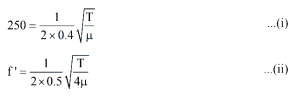
So, $250 = \frac{1}{2 \times 0.4} \sqrt{\frac{T}{\mu}} \quad ...(i)$
Finally, $L_2 = 0.4 + 0.1 = 0.5 \,m$, and the new tension is $T_2 = T/4$.
So, $f_2 = \frac{1}{2 \times 0.5} \sqrt{\frac{T/4}{\mu}} \quad ...(ii)$
Dividing equation $(ii)$ by $(i)$:
$\frac{f_2}{250} = \frac{\frac{1}{2 \times 0.5} \sqrt{\frac{T}{4\mu}}}{\frac{1}{2 \times 0.4} \sqrt{\frac{T}{\mu}}} = \frac{0.4}{0.5} \times \sqrt{\frac{1}{4}} = \frac{4}{5} \times \frac{1}{2} = \frac{2}{5} = 0.4$
$f_2 = 250 \times 0.4 = 100 \,Hz$.
Initially, $L_1 = 0.4 \,m$, $f_1 = 250 \,Hz$, and tension is $T_1 = T$.
So, $250 = \frac{1}{2 \times 0.4} \sqrt{\frac{T}{\mu}} \quad ...(i)$
Finally, $L_2 = 0.4 + 0.1 = 0.5 \,m$, and the new tension is $T_2 = T/4$.
So, $f_2 = \frac{1}{2 \times 0.5} \sqrt{\frac{T/4}{\mu}} \quad ...(ii)$
Dividing equation $(ii)$ by $(i)$:
$\frac{f_2}{250} = \frac{\frac{1}{2 \times 0.5} \sqrt{\frac{T}{4\mu}}}{\frac{1}{2 \times 0.4} \sqrt{\frac{T}{\mu}}} = \frac{0.4}{0.5} \times \sqrt{\frac{1}{4}} = \frac{4}{5} \times \frac{1}{2} = \frac{2}{5} = 0.4$
$f_2 = 250 \times 0.4 = 100 \,Hz$.
0 likes
View Solution207
EasyMCQ
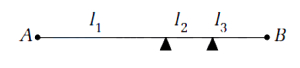
$A$ thin wire of length $99 \ cm$ is fixed at both ends as shown in the figure. The wire is kept under a tension and is divided into three segments of lengths $l_1, l_2$ and $l_3$ as shown in the figure. When the wire is made to vibrate, the segments vibrate respectively with their fundamental frequencies in the ratio $1: 2: 3$. Then, the lengths $l_1, l_2$ and $l_3$ of the segments respectively are (in $cm$):

A
$27, 54, 18$
B
$18, 27, 54$
C
$54, 27, 18$
D
$27, 9, 14$
Solution
(C) The fundamental frequency of a vibrating wire is given by $n = \frac{1}{2l} \sqrt{\frac{T}{\mu}}$.
Since the tension $T$ and mass per unit length $\mu$ are the same for all segments, the frequency $n$ is inversely proportional to the length $l$ of the segment $(n \propto \frac{1}{l})$.
Given the ratio of fundamental frequencies is $n_1 : n_2 : n_3 = 1 : 2 : 3$.
Therefore, the ratio of their lengths is $l_1 : l_2 : l_3 = \frac{1}{n_1} : \frac{1}{n_2} : \frac{1}{n_3} = \frac{1}{1} : \frac{1}{2} : \frac{1}{3} = 6 : 3 : 2$.
The total length of the wire is $L = l_1 + l_2 + l_3 = 99 \ cm$.
Sum of the ratio parts $= 6 + 3 + 2 = 11$.
Calculating individual lengths:
$l_1 = \frac{6}{11} \times 99 = 54 \ cm$
$l_2 = \frac{3}{11} \times 99 = 27 \ cm$
$l_3 = \frac{2}{11} \times 99 = 18 \ cm$
Thus, the lengths are $54 \ cm, 27 \ cm, 18 \ cm$.
Since the tension $T$ and mass per unit length $\mu$ are the same for all segments, the frequency $n$ is inversely proportional to the length $l$ of the segment $(n \propto \frac{1}{l})$.
Given the ratio of fundamental frequencies is $n_1 : n_2 : n_3 = 1 : 2 : 3$.
Therefore, the ratio of their lengths is $l_1 : l_2 : l_3 = \frac{1}{n_1} : \frac{1}{n_2} : \frac{1}{n_3} = \frac{1}{1} : \frac{1}{2} : \frac{1}{3} = 6 : 3 : 2$.
The total length of the wire is $L = l_1 + l_2 + l_3 = 99 \ cm$.
Sum of the ratio parts $= 6 + 3 + 2 = 11$.
Calculating individual lengths:
$l_1 = \frac{6}{11} \times 99 = 54 \ cm$
$l_2 = \frac{3}{11} \times 99 = 27 \ cm$
$l_3 = \frac{2}{11} \times 99 = 18 \ cm$
Thus, the lengths are $54 \ cm, 27 \ cm, 18 \ cm$.
0 likes
View Solution208
EasyMCQ
When a vibrating tuning fork is placed on a sound box of a sonometer, $8$ beats per second are heard when the length of the sonometer wire is kept at $101 \,cm$ or $100 \,cm$. Then the frequency of the tuning fork is (Consider that the tension in the wire is kept constant). (in $\,Hz$)
A
$1616$
B
$1608$
C
$1632$
D
$1600$
Solution
(B) The frequency of a vibrating wire is given by $n = \frac{1}{2l} \sqrt{\frac{T}{\mu}}$. Since tension $T$ and mass per unit length $\mu$ are constant, we have $n \propto \frac{1}{l}$, which implies $nl = \text{constant}$.
Let $n$ be the frequency of the tuning fork.
At length $l_1 = 100 \,cm$, the frequency of the wire is $n_1 = n + 8$ (since beats are heard).
At length $l_2 = 101 \,cm$, the frequency of the wire is $n_2 = n - 8$ (as frequency decreases with increasing length).
Using $n_1 l_1 = n_2 l_2$:
$(n + 8) \times 100 = (n - 8) \times 101$
$100n + 800 = 101n - 808$
$101n - 100n = 800 + 808$
$n = 1608 \,Hz$.
Let $n$ be the frequency of the tuning fork.
At length $l_1 = 100 \,cm$, the frequency of the wire is $n_1 = n + 8$ (since beats are heard).
At length $l_2 = 101 \,cm$, the frequency of the wire is $n_2 = n - 8$ (as frequency decreases with increasing length).
Using $n_1 l_1 = n_2 l_2$:
$(n + 8) \times 100 = (n - 8) \times 101$
$100n + 800 = 101n - 808$
$101n - 100n = 800 + 808$
$n = 1608 \,Hz$.
0 likes
View Solution209
MediumMCQ
Two uniform stretched strings $A$ and $B$, made of steel, are vibrating under the same tension. If the first overtone of $A$ is equal to the second overtone of $B$ and if the radius of $A$ is twice that of $B$, the ratio of the lengths of the strings is
A
$2$ : $3$
B
$1$ : $2$
C
$1$ : $3$
D
$1$ : $4$
Solution
(C) The frequency of the $n$-th harmonic for a string is given by $f_n = \frac{n}{2l} \sqrt{\frac{T}{\mu}}$, where $\mu = \pi r^2 \rho$.
For the first overtone of $A$ $(n=2)$: $f_{A} = \frac{2}{2l_A} \sqrt{\frac{T}{\pi r_A^2 \rho}} = \frac{1}{l_A r_A} \sqrt{\frac{T}{\pi \rho}}$.
For the second overtone of $B$ $(n=3)$: $f_{B} = \frac{3}{2l_B} \sqrt{\frac{T}{\pi r_B^2 \rho}} = \frac{3}{2l_B r_B} \sqrt{\frac{T}{\pi \rho}}$.
Given $f_A = f_B$ and $r_A = 2r_B$:
$\frac{1}{l_A (2r_B)} = \frac{3}{2l_B r_B}$.
Simplifying, $\frac{1}{2l_A} = \frac{3}{2l_B} \Rightarrow \frac{l_A}{l_B} = \frac{1}{3}$.
Thus, the ratio $l_A : l_B = 1 : 3$.
For the first overtone of $A$ $(n=2)$: $f_{A} = \frac{2}{2l_A} \sqrt{\frac{T}{\pi r_A^2 \rho}} = \frac{1}{l_A r_A} \sqrt{\frac{T}{\pi \rho}}$.
For the second overtone of $B$ $(n=3)$: $f_{B} = \frac{3}{2l_B} \sqrt{\frac{T}{\pi r_B^2 \rho}} = \frac{3}{2l_B r_B} \sqrt{\frac{T}{\pi \rho}}$.
Given $f_A = f_B$ and $r_A = 2r_B$:
$\frac{1}{l_A (2r_B)} = \frac{3}{2l_B r_B}$.
Simplifying, $\frac{1}{2l_A} = \frac{3}{2l_B} \Rightarrow \frac{l_A}{l_B} = \frac{1}{3}$.
Thus, the ratio $l_A : l_B = 1 : 3$.
0 likes
View Solution210
MediumMCQ
$A$ sonometer wire has a length of $114 \ cm$, between two fixed ends. Where should two bridges be placed so as to divide the wire into three segments (in $cm$) whose fundamental frequencies are in the ratio $1:3:4$?
A
$l_1, l_2, l_3=18, 24, 72$
B
$l_1, l_2, l_3=24, 18, 72$
C
$l_1, l_2, l_3=72, 18, 24$
D
$l_1, l_2, l_3=72, 24, 18$
Solution
(C) The fundamental frequency of a sonometer wire is given by $n = \frac{1}{2l} \sqrt{\frac{T}{m}}$.
Since $T$ (tension) and $m$ (mass per unit length) are constant for the same wire, $n \propto \frac{1}{l}$.
Given the ratio of frequencies $n_1 : n_2 : n_3 = 1 : 3 : 4$, the lengths of the segments must be in the inverse ratio:
$l_1 : l_2 : l_3 = \frac{1}{1} : \frac{1}{3} : \frac{1}{4}$.
To simplify this ratio, multiply by the least common multiple of $1, 3, 4$, which is $12$:
$l_1 : l_2 : l_3 = 12 : 4 : 3$.
The sum of the parts is $12 + 4 + 3 = 19$.
The total length of the wire is $114 \ cm$.
Therefore, the lengths are:
$l_1 = \frac{12}{19} \times 114 = 12 \times 6 = 72 \ cm$
$l_2 = \frac{4}{19} \times 114 = 4 \times 6 = 24 \ cm$
$l_3 = \frac{3}{19} \times 114 = 3 \times 6 = 18 \ cm$.
Thus, the lengths are $72 \ cm, 24 \ cm, 18 \ cm$.
Since $T$ (tension) and $m$ (mass per unit length) are constant for the same wire, $n \propto \frac{1}{l}$.
Given the ratio of frequencies $n_1 : n_2 : n_3 = 1 : 3 : 4$, the lengths of the segments must be in the inverse ratio:
$l_1 : l_2 : l_3 = \frac{1}{1} : \frac{1}{3} : \frac{1}{4}$.
To simplify this ratio, multiply by the least common multiple of $1, 3, 4$, which is $12$:
$l_1 : l_2 : l_3 = 12 : 4 : 3$.
The sum of the parts is $12 + 4 + 3 = 19$.
The total length of the wire is $114 \ cm$.
Therefore, the lengths are:
$l_1 = \frac{12}{19} \times 114 = 12 \times 6 = 72 \ cm$
$l_2 = \frac{4}{19} \times 114 = 4 \times 6 = 24 \ cm$
$l_3 = \frac{3}{19} \times 114 = 3 \times 6 = 18 \ cm$.
Thus, the lengths are $72 \ cm, 24 \ cm, 18 \ cm$.
0 likes
View Solution211
DifficultMCQ
$A$ segment of wire vibrates with a fundamental frequency of $450 \,Hz$ under a tension of $9 \,kg-wt$. The tension at which the fundamental frequency of the same wire becomes $900 \,Hz$ is:
A
$36 \,kg-wt$
B
$27 \,kg-wt$
C
$18 \,kg-wt$
D
$72 \,kg-wt$
Solution
(A) The fundamental frequency $f$ of a vibrating wire is given by the formula: $f = \frac{1}{2L} \sqrt{\frac{T}{\mu}}$, where $T$ is the tension and $\mu$ is the linear mass density.
Since $L$ and $\mu$ are constant for the same wire, we have $f \propto \sqrt{T}$.
Therefore, the ratio of frequencies is given by: $\frac{f_2}{f_1} = \sqrt{\frac{T_2}{T_1}}$.
Given $f_1 = 450 \,Hz$, $T_1 = 9 \,kg-wt$, and $f_2 = 900 \,Hz$.
Substituting the values: $\frac{900}{450} = \sqrt{\frac{T_2}{9}}$.
$2 = \sqrt{\frac{T_2}{9}}$.
Squaring both sides: $4 = \frac{T_2}{9}$.
$T_2 = 4 \times 9 = 36 \,kg-wt$.
Since $L$ and $\mu$ are constant for the same wire, we have $f \propto \sqrt{T}$.
Therefore, the ratio of frequencies is given by: $\frac{f_2}{f_1} = \sqrt{\frac{T_2}{T_1}}$.
Given $f_1 = 450 \,Hz$, $T_1 = 9 \,kg-wt$, and $f_2 = 900 \,Hz$.
Substituting the values: $\frac{900}{450} = \sqrt{\frac{T_2}{9}}$.
$2 = \sqrt{\frac{T_2}{9}}$.
Squaring both sides: $4 = \frac{T_2}{9}$.
$T_2 = 4 \times 9 = 36 \,kg-wt$.
0 likes
View Solution212
DifficultMCQ
Two strings $A$ and $B$ of lengths $L_A = 80 \text{ cm}$ and $L_B = x \text{ cm}$ respectively are used separately in a sonometer. The ratio of their densities $(d_A / d_B)$ is $0.81$. The diameter of $B$ is one-half that of $A$. If the strings have the same tension and fundamental frequency, the value of $x$ is:
A
$33$
B
$102$
C
$144$
D
$130$
Solution
(C) Given: $T_A = T_B$, $f_A = f_B$, $L_A = 80 \text{ cm}$, $L_B = x \text{ cm}$.
Ratio of densities: $\frac{d_A}{d_B} = 0.81$.
Ratio of diameters: $\frac{D_A}{D_B} = 2$.
Linear mass density $\mu = \text{Area} \times \text{density} = \frac{\pi D^2}{4} \times d$.
Therefore, $\frac{\mu_A}{\mu_B} = \left(\frac{D_A}{D_B}\right)^2 \times \frac{d_A}{d_B} = (2)^2 \times 0.81 = 4 \times 0.81 = 3.24$.
The fundamental frequency of a string is $f = \frac{1}{2L} \sqrt{\frac{T}{\mu}}$.
Since $f_A = f_B$ and $T_A = T_B$, we have $L_A \sqrt{\mu_A} = L_B \sqrt{\mu_B}$.
$\frac{L_B}{L_A} = \sqrt{\frac{\mu_A}{\mu_B}} = \sqrt{3.24} = 1.8$.
$x = 80 \times 1.8 = 144 \text{ cm}$.
Ratio of densities: $\frac{d_A}{d_B} = 0.81$.
Ratio of diameters: $\frac{D_A}{D_B} = 2$.
Linear mass density $\mu = \text{Area} \times \text{density} = \frac{\pi D^2}{4} \times d$.
Therefore, $\frac{\mu_A}{\mu_B} = \left(\frac{D_A}{D_B}\right)^2 \times \frac{d_A}{d_B} = (2)^2 \times 0.81 = 4 \times 0.81 = 3.24$.
The fundamental frequency of a string is $f = \frac{1}{2L} \sqrt{\frac{T}{\mu}}$.
Since $f_A = f_B$ and $T_A = T_B$, we have $L_A \sqrt{\mu_A} = L_B \sqrt{\mu_B}$.
$\frac{L_B}{L_A} = \sqrt{\frac{\mu_A}{\mu_B}} = \sqrt{3.24} = 1.8$.
$x = 80 \times 1.8 = 144 \text{ cm}$.
0 likes
View Solution213
DifficultMCQ
An iron load of $2 \ kg$ is suspended in air from the free end of a sonometer wire of length $1 \ m$. $A$ tuning fork of frequency $256 \ Hz$ is in resonance with $\frac{1}{\sqrt{7}}$ times the length of the sonometer wire. If the load is immersed in water, the length of the wire in metres that will be in resonance with the same tuning fork is (Specific gravity of iron $= 8$).
A
$\sqrt{8}$
B
$\sqrt{6}$
C
$\frac{1}{\sqrt{6}}$
D
$\frac{1}{\sqrt{8}}$
Solution
(D) The frequency of a sonometer wire is given by $f = \frac{1}{2l} \sqrt{\frac{T}{\mu}}$. Since $f$ and $\mu$ are constant, we have $l \propto \sqrt{T}$.
Thus, $\frac{l_{\text{air}}}{l_{\text{water}}} = \sqrt{\frac{T_{\text{air}}}{T_{\text{water}}}}$.
In air, the tension $T_{\text{air}} = mg$. When immersed in water, the buoyant force $F_B$ acts upwards, so $T_{\text{water}} = mg - F_B$.
Given specific gravity $\sigma = 8$, the density of iron $\rho = 8 \rho_w$. The buoyant force $F_B = V \rho_w g = \frac{m}{\rho} \rho_w g = \frac{m}{8 \rho_w} \rho_w g = \frac{mg}{8}$.
Therefore, $T_{\text{water}} = mg - \frac{mg}{8} = \frac{7}{8} mg = \frac{7}{8} T_{\text{air}}$.
Substituting this into the ratio: $\frac{l_{\text{air}}}{l_{\text{water}}} = \sqrt{\frac{T_{\text{air}}}{\frac{7}{8} T_{\text{air}}}} = \sqrt{\frac{8}{7}}$.
Given $l_{\text{air}} = \frac{1}{\sqrt{7}} \times 1 \ m = \frac{1}{\sqrt{7}} \ m$.
Then $l_{\text{water}} = l_{\text{air}} \times \sqrt{\frac{7}{8}} = \frac{1}{\sqrt{7}} \times \sqrt{\frac{7}{8}} = \frac{1}{\sqrt{8}} \ m$.
Thus, $\frac{l_{\text{air}}}{l_{\text{water}}} = \sqrt{\frac{T_{\text{air}}}{T_{\text{water}}}}$.
In air, the tension $T_{\text{air}} = mg$. When immersed in water, the buoyant force $F_B$ acts upwards, so $T_{\text{water}} = mg - F_B$.
Given specific gravity $\sigma = 8$, the density of iron $\rho = 8 \rho_w$. The buoyant force $F_B = V \rho_w g = \frac{m}{\rho} \rho_w g = \frac{m}{8 \rho_w} \rho_w g = \frac{mg}{8}$.
Therefore, $T_{\text{water}} = mg - \frac{mg}{8} = \frac{7}{8} mg = \frac{7}{8} T_{\text{air}}$.
Substituting this into the ratio: $\frac{l_{\text{air}}}{l_{\text{water}}} = \sqrt{\frac{T_{\text{air}}}{\frac{7}{8} T_{\text{air}}}} = \sqrt{\frac{8}{7}}$.
Given $l_{\text{air}} = \frac{1}{\sqrt{7}} \times 1 \ m = \frac{1}{\sqrt{7}} \ m$.
Then $l_{\text{water}} = l_{\text{air}} \times \sqrt{\frac{7}{8}} = \frac{1}{\sqrt{7}} \times \sqrt{\frac{7}{8}} = \frac{1}{\sqrt{8}} \ m$.
0 likes
View Solution214
DifficultMCQ
If the length of a stretched string is shortened by $40 \%$ and the tension is increased by $44 \%$, then the ratio of the final and initial fundamental frequencies is :
A
$2: 1$
B
$3: 2$
C
$3: 4$
D
$1: 3$
Solution
(A) The fundamental frequency of a stretched string is given by $n = \frac{1}{2l} \sqrt{\frac{T}{m}}$, where $l$ is the length, $T$ is the tension, and $m$ is the mass per unit length.
Initial frequency: $n_1 = \frac{1}{2l} \sqrt{\frac{T}{m}}$.
New length: $l' = l - 0.40l = 0.6l$.
New tension: $T' = T + 0.44T = 1.44T$.
New frequency: $n_2 = \frac{1}{2l'} \sqrt{\frac{T'}{m}} = \frac{1}{2(0.6l)} \sqrt{\frac{1.44T}{m}}$.
Taking the ratio: $\frac{n_2}{n_1} = \frac{\frac{1}{2(0.6l)} \sqrt{\frac{1.44T}{m}}}{\frac{1}{2l} \sqrt{\frac{T}{m}}} = \frac{l}{0.6l} \times \sqrt{\frac{1.44T}{T}} = \frac{1}{0.6} \times \sqrt{1.44} = \frac{1.2}{0.6} = 2$.
Therefore, the ratio of the final to initial frequency is $2: 1$.
Initial frequency: $n_1 = \frac{1}{2l} \sqrt{\frac{T}{m}}$.
New length: $l' = l - 0.40l = 0.6l$.
New tension: $T' = T + 0.44T = 1.44T$.
New frequency: $n_2 = \frac{1}{2l'} \sqrt{\frac{T'}{m}} = \frac{1}{2(0.6l)} \sqrt{\frac{1.44T}{m}}$.
Taking the ratio: $\frac{n_2}{n_1} = \frac{\frac{1}{2(0.6l)} \sqrt{\frac{1.44T}{m}}}{\frac{1}{2l} \sqrt{\frac{T}{m}}} = \frac{l}{0.6l} \times \sqrt{\frac{1.44T}{T}} = \frac{1}{0.6} \times \sqrt{1.44} = \frac{1.2}{0.6} = 2$.
Therefore, the ratio of the final to initial frequency is $2: 1$.
0 likes
View Solution215
DifficultMCQ
Two uniform strings $A$ and $B$ made of steel are made to vibrate under the same tension. If the first overtone of $A$ is equal to the second overtone of $B$ and if the radius of $A$ is twice that of $B$, the ratio of the lengths of the strings is :
A
$1: 2$
B
$1: 3$
C
$1: 4$
D
$1: 5$
Solution
(B) The frequency of the $p$-th harmonic (or $(p-1)$-th overtone) for a string of length $l$, radius $r$, density $\rho$, and tension $T$ is given by $f = \frac{p}{2l} \sqrt{\frac{T}{\pi r^2 \rho}} = \frac{p}{2lr} \sqrt{\frac{T}{\pi \rho}}$.
For string $A$, the first overtone is the second harmonic $(p=2)$:
$f_A = \frac{2}{2l_A r_A} \sqrt{\frac{T}{\pi \rho}} = \frac{1}{l_A r_A} \sqrt{\frac{T}{\pi \rho}}$.
For string $B$, the second overtone is the third harmonic $(p=3)$:
$f_B = \frac{3}{2l_B r_B} \sqrt{\frac{T}{\pi \rho}}$.
Given $f_A = f_B$ and $r_A = 2r_B$:
$\frac{1}{l_A r_A} = \frac{3}{2l_B r_B}$.
Substituting $r_A = 2r_B$:
$\frac{1}{l_A (2r_B)} = \frac{3}{2l_B r_B}$.
$\frac{1}{2l_A} = \frac{3}{2l_B}$.
$\frac{l_A}{l_B} = \frac{1}{3}$.
Thus, the ratio of the lengths $l_A : l_B = 1 : 3$.
For string $A$, the first overtone is the second harmonic $(p=2)$:
$f_A = \frac{2}{2l_A r_A} \sqrt{\frac{T}{\pi \rho}} = \frac{1}{l_A r_A} \sqrt{\frac{T}{\pi \rho}}$.
For string $B$, the second overtone is the third harmonic $(p=3)$:
$f_B = \frac{3}{2l_B r_B} \sqrt{\frac{T}{\pi \rho}}$.
Given $f_A = f_B$ and $r_A = 2r_B$:
$\frac{1}{l_A r_A} = \frac{3}{2l_B r_B}$.
Substituting $r_A = 2r_B$:
$\frac{1}{l_A (2r_B)} = \frac{3}{2l_B r_B}$.
$\frac{1}{2l_A} = \frac{3}{2l_B}$.
$\frac{l_A}{l_B} = \frac{1}{3}$.
Thus, the ratio of the lengths $l_A : l_B = 1 : 3$.
0 likes
View Solution216
DifficultMCQ
In order to double the frequency of the fundamental note emitted by a stretched string, the length is reduced to $\frac{3}{4}$ of the original length and the tension is changed. The factor by which the tension is to be changed is
A
$\frac{3}{8}$
B
$\frac{2}{3}$
C
$\frac{8}{9}$
D
$\frac{9}{4}$
Solution
(D) The frequency $n$ of a stretched string is given by the formula $n = \frac{1}{2l} \sqrt{\frac{T}{m}}$, where $l$ is the length, $T$ is the tension, and $m$ is the mass per unit length.
From this, we have the relation $n \propto \frac{\sqrt{T}}{l}$.
Let the initial frequency be $n_1 = n$ and the final frequency be $n_2 = 2n$.
Let the initial length be $l_1 = l$ and the final length be $l_2 = \frac{3}{4}l$.
Using the proportionality, we get $\frac{n_1}{n_2} = \frac{l_2}{l_1} \sqrt{\frac{T_1}{T_2}}$.
Substituting the values: $\frac{n}{2n} = \frac{\frac{3}{4}l}{l} \sqrt{\frac{T_1}{T_2}}$.
$\frac{1}{2} = \frac{3}{4} \sqrt{\frac{T_1}{T_2}}$.
Squaring both sides: $\frac{1}{4} = \frac{9}{16} \frac{T_1}{T_2}$.
$\frac{T_2}{T_1} = \frac{9}{16} \times 4 = \frac{9}{4}$.
Thus, the tension must be changed by a factor of $\frac{9}{4}$.
From this, we have the relation $n \propto \frac{\sqrt{T}}{l}$.
Let the initial frequency be $n_1 = n$ and the final frequency be $n_2 = 2n$.
Let the initial length be $l_1 = l$ and the final length be $l_2 = \frac{3}{4}l$.
Using the proportionality, we get $\frac{n_1}{n_2} = \frac{l_2}{l_1} \sqrt{\frac{T_1}{T_2}}$.
Substituting the values: $\frac{n}{2n} = \frac{\frac{3}{4}l}{l} \sqrt{\frac{T_1}{T_2}}$.
$\frac{1}{2} = \frac{3}{4} \sqrt{\frac{T_1}{T_2}}$.
Squaring both sides: $\frac{1}{4} = \frac{9}{16} \frac{T_1}{T_2}$.
$\frac{T_2}{T_1} = \frac{9}{16} \times 4 = \frac{9}{4}$.
Thus, the tension must be changed by a factor of $\frac{9}{4}$.
0 likes
View Solution217
EasyMCQ
$A$ uniform string of length $L$ and mass $M$ is fixed at both ends while it is subject to a tension $T$. It can vibrate at frequencies $(v)$ given by the formula (where $n=1, 2, 3, \ldots$):
A
$v=\frac{n}{2} \sqrt{\frac{T}{M L}}$
B
$v=\frac{n}{2 L} \sqrt{\frac{T}{M}}$
C
$v=\frac{1}{2 n} \sqrt{\frac{T}{M L}}$
D
$v=\frac{n}{2} \sqrt{\frac{T L}{M}}$
Solution
(A) The fundamental frequency of a string fixed at both ends is given by $v = \frac{n}{2L} \sqrt{\frac{T}{\mu}}$, where $n$ is the harmonic number, $L$ is the length, $T$ is the tension, and $\mu$ is the linear mass density.
Linear mass density $\mu = \frac{M}{L}$.
Substituting $\mu$ into the formula:
$v = \frac{n}{2L} \sqrt{\frac{T}{M/L}} = \frac{n}{2L} \sqrt{\frac{TL}{M}}$.
Wait, let us re-evaluate: $v = \frac{n}{2L} \sqrt{\frac{T}{M/L}} = \frac{n}{2} \sqrt{\frac{T}{M/L \cdot L^2}} = \frac{n}{2} \sqrt{\frac{T}{ML}}$.
Thus, the correct formula is $v = \frac{n}{2} \sqrt{\frac{T}{ML}}$.
Linear mass density $\mu = \frac{M}{L}$.
Substituting $\mu$ into the formula:
$v = \frac{n}{2L} \sqrt{\frac{T}{M/L}} = \frac{n}{2L} \sqrt{\frac{TL}{M}}$.
Wait, let us re-evaluate: $v = \frac{n}{2L} \sqrt{\frac{T}{M/L}} = \frac{n}{2} \sqrt{\frac{T}{M/L \cdot L^2}} = \frac{n}{2} \sqrt{\frac{T}{ML}}$.
Thus, the correct formula is $v = \frac{n}{2} \sqrt{\frac{T}{ML}}$.
0 likes
View Solution218
DifficultMCQ
Two uniform wires of same material are vibrating under the same tension. If the first overtone of the first wire is equal to the second overtone of the second wire and the radius of the first wire is twice the radius of the second wire, then the ratio of the length of the first wire to the second wire is:
A
$1/4$
B
$1/3$
C
$2/3$
D
$1/2$
Solution
(B) The frequency of the $n^{th}$ harmonic for a stretched string is given by $f_n = \frac{n}{2L} \sqrt{\frac{T}{\mu}}$, where $L$ is the length, $T$ is the tension, and $\mu$ is the linear mass density.
Linear mass density $\mu = \rho \cdot A = \rho \cdot \pi r^2$, where $\rho$ is the density of the material and $r$ is the radius.
Thus, $f_n = \frac{n}{2L} \sqrt{\frac{T}{\rho \pi r^2}} = \frac{n}{2Lr} \sqrt{\frac{T}{\rho \pi}}$.
For the first wire: $n_1 = 2$ (first overtone is the second harmonic), $r_1 = 2r_2$, $L_1 = L_1$.
$f_{1, \text{overtone}} = \frac{2}{2L_1 r_1} \sqrt{\frac{T}{\rho \pi}} = \frac{1}{L_1 (2r_2)} \sqrt{\frac{T}{\rho \pi}}$.
For the second wire: $n_2 = 3$ (second overtone is the third harmonic), $r_2 = r_2$, $L_2 = L_2$.
$f_{2, \text{overtone}} = \frac{3}{2L_2 r_2} \sqrt{\frac{T}{\rho \pi}}$.
Given $f_{1, \text{overtone}} = f_{2, \text{overtone}}$:
$\frac{1}{2L_1 r_2} = \frac{3}{2L_2 r_2}$.
$\frac{1}{L_1} = \frac{3}{L_2} \text{ implies } \frac{L_1}{L_2} = \frac{1}{3}$.
Linear mass density $\mu = \rho \cdot A = \rho \cdot \pi r^2$, where $\rho$ is the density of the material and $r$ is the radius.
Thus, $f_n = \frac{n}{2L} \sqrt{\frac{T}{\rho \pi r^2}} = \frac{n}{2Lr} \sqrt{\frac{T}{\rho \pi}}$.
For the first wire: $n_1 = 2$ (first overtone is the second harmonic), $r_1 = 2r_2$, $L_1 = L_1$.
$f_{1, \text{overtone}} = \frac{2}{2L_1 r_1} \sqrt{\frac{T}{\rho \pi}} = \frac{1}{L_1 (2r_2)} \sqrt{\frac{T}{\rho \pi}}$.
For the second wire: $n_2 = 3$ (second overtone is the third harmonic), $r_2 = r_2$, $L_2 = L_2$.
$f_{2, \text{overtone}} = \frac{3}{2L_2 r_2} \sqrt{\frac{T}{\rho \pi}}$.
Given $f_{1, \text{overtone}} = f_{2, \text{overtone}}$:
$\frac{1}{2L_1 r_2} = \frac{3}{2L_2 r_2}$.
$\frac{1}{L_1} = \frac{3}{L_2} \text{ implies } \frac{L_1}{L_2} = \frac{1}{3}$.
0 likes
View Solution219
MediumMCQ
$A$ sonometer wire is vibrating in the third overtone. There are:
A
$5$ nodes and $4$ antinodes
B
$4$ nodes and $5$ antinodes
C
$4$ nodes and $4$ antinodes
D
$5$ nodes and $5$ antinodes
Solution
(A) For a sonometer wire fixed at both ends, the frequency of the $n^{th}$ harmonic is given by $f_n = n f_1$, where $f_1$ is the fundamental frequency.
In a sonometer wire, the harmonics are $1^{st}$ (fundamental), $2^{nd}$, $3^{rd}$, $4^{th}$, etc.
The overtones are defined as frequencies higher than the fundamental frequency.
$1^{st}$ overtone = $2^{nd}$ harmonic $(n=2)$
$2^{nd}$ overtone = $3^{rd}$ harmonic $(n=3)$
$3^{rd}$ overtone = $4^{th}$ harmonic $(n=4)$
For the $n^{th}$ harmonic, the number of nodes is $(n+1)$ and the number of antinodes is $n$.
For the $4^{th}$ harmonic $(n=4)$:
Number of nodes = $4 + 1 = 5$
Number of antinodes = $4$
Therefore, there are $5$ nodes and $4$ antinodes.
In a sonometer wire, the harmonics are $1^{st}$ (fundamental), $2^{nd}$, $3^{rd}$, $4^{th}$, etc.
The overtones are defined as frequencies higher than the fundamental frequency.
$1^{st}$ overtone = $2^{nd}$ harmonic $(n=2)$
$2^{nd}$ overtone = $3^{rd}$ harmonic $(n=3)$
$3^{rd}$ overtone = $4^{th}$ harmonic $(n=4)$
For the $n^{th}$ harmonic, the number of nodes is $(n+1)$ and the number of antinodes is $n$.
For the $4^{th}$ harmonic $(n=4)$:
Number of nodes = $4 + 1 = 5$
Number of antinodes = $4$
Therefore, there are $5$ nodes and $4$ antinodes.
0 likes
View Solution220
DifficultMCQ
The fundamental frequency of a sonometer wire is $50 \text{ Hz}$ for a given length and tension. If the length is increased by $25\%$ while keeping the tension constant, what is the percentage change in the frequency of the second harmonic?
A
Increase by $20\%$
B
Decrease by $20\%$
C
Increase by $40\%$
D
Decrease by $40\%$
Solution
(B) The fundamental frequency of a sonometer wire is given by $f = \frac{1}{2L} \sqrt{\frac{T}{\mu}}$.
Since $T$ and $\mu$ are constant, $f \propto \frac{1}{L}$.
Let the initial length be $L_1 = L$ and the initial frequency be $f_1 = 50 \text{ Hz}$.
The new length is $L_2 = L + 0.25L = 1.25L = \frac{5}{4}L$.
The new fundamental frequency $f_2$ is given by $\frac{f_2}{f_1} = \frac{L_1}{L_2} = \frac{L}{1.25L} = \frac{1}{1.25} = 0.8$.
So, $f_2 = 0.8 \times 50 \text{ Hz} = 40 \text{ Hz}$.
The frequency of the second harmonic is $f'_n = 2f_n$.
Initial second harmonic frequency $f'_1 = 2 \times 50 = 100 \text{ Hz}$.
New second harmonic frequency $f'_2 = 2 \times 40 = 80 \text{ Hz}$.
The change in frequency is $\Delta f' = 80 - 100 = -20 \text{ Hz}$.
The percentage change is $\frac{\Delta f'}{f'_1} \times 100 = \frac{-20}{100} \times 100 = -20\%$.
Thus, the frequency decreases by $20\%$.
Since $T$ and $\mu$ are constant, $f \propto \frac{1}{L}$.
Let the initial length be $L_1 = L$ and the initial frequency be $f_1 = 50 \text{ Hz}$.
The new length is $L_2 = L + 0.25L = 1.25L = \frac{5}{4}L$.
The new fundamental frequency $f_2$ is given by $\frac{f_2}{f_1} = \frac{L_1}{L_2} = \frac{L}{1.25L} = \frac{1}{1.25} = 0.8$.
So, $f_2 = 0.8 \times 50 \text{ Hz} = 40 \text{ Hz}$.
The frequency of the second harmonic is $f'_n = 2f_n$.
Initial second harmonic frequency $f'_1 = 2 \times 50 = 100 \text{ Hz}$.
New second harmonic frequency $f'_2 = 2 \times 40 = 80 \text{ Hz}$.
The change in frequency is $\Delta f' = 80 - 100 = -20 \text{ Hz}$.
The percentage change is $\frac{\Delta f'}{f'_1} \times 100 = \frac{-20}{100} \times 100 = -20\%$.
Thus, the frequency decreases by $20\%$.
0 likes
View Solution221
DifficultMCQ
$A$ sonometer wire resonates with $4$ antinodes between the two bridges for a given tuning fork when a $1 \text{ kg}$ mass is suspended from the wire. Using the same fork, when mass $M$ is suspended, the wire resonates producing $2$ antinodes between the two bridges. (The distance between the bridges remains the same). The value of $M$ is: (in $\text{ kg}$)
A
$2$
B
$3$
C
$4$
D
$5$
Solution
(C) The frequency of a vibrating string is given by $f = \frac{n}{2L} \sqrt{\frac{T}{\mu}}$, where $n$ is the number of loops (antinodes), $L$ is the length, $T$ is the tension, and $\mu$ is the linear mass density.
Since the tuning fork is the same, the frequency $f$ remains constant.
Also, $L$ and $\mu$ are constant, so $n \propto \sqrt{T}$.
Given $T = Mg$, we have $n \propto \sqrt{M}$.
For the first case: $n_1 = 4$ and $M_1 = 1 \text{ kg}$.
For the second case: $n_2 = 2$ and $M_2 = M$.
Thus, $\frac{n_1}{n_2} = \sqrt{\frac{M_1}{M_2}}$.
Substituting the values: $\frac{4}{2} = \sqrt{\frac{1}{M}}$.
$2 = \sqrt{\frac{1}{M}}$.
Squaring both sides: $4 = \frac{1}{M}$.
Therefore, $M = \frac{1}{4} \text{ kg} = 0.25 \text{ kg}$.
Wait, re-evaluating the relationship: $n \propto \sqrt{T} \implies n^2 \propto T \implies n^2 \propto M$.
So, $n_1^2 M_2 = n_2^2 M_1$.
$4^2 \times M = 2^2 \times 1$.
$16M = 4$.
$M = \frac{4}{16} = 0.25 \text{ kg}$.
Given the options provided, there might be a misunderstanding in the question's premise or options. If the number of antinodes decreases, the tension must increase. Let's re-check: $f = \frac{n}{2L} \sqrt{\frac{T}{\mu}}$. If $n$ decreases from $4$ to $2$, then $\sqrt{T}$ must increase by a factor of $2$, meaning $T$ must increase by a factor of $4$. Thus $M = 4 \times 1 \text{ kg} = 4 \text{ kg}$.
Since the tuning fork is the same, the frequency $f$ remains constant.
Also, $L$ and $\mu$ are constant, so $n \propto \sqrt{T}$.
Given $T = Mg$, we have $n \propto \sqrt{M}$.
For the first case: $n_1 = 4$ and $M_1 = 1 \text{ kg}$.
For the second case: $n_2 = 2$ and $M_2 = M$.
Thus, $\frac{n_1}{n_2} = \sqrt{\frac{M_1}{M_2}}$.
Substituting the values: $\frac{4}{2} = \sqrt{\frac{1}{M}}$.
$2 = \sqrt{\frac{1}{M}}$.
Squaring both sides: $4 = \frac{1}{M}$.
Therefore, $M = \frac{1}{4} \text{ kg} = 0.25 \text{ kg}$.
Wait, re-evaluating the relationship: $n \propto \sqrt{T} \implies n^2 \propto T \implies n^2 \propto M$.
So, $n_1^2 M_2 = n_2^2 M_1$.
$4^2 \times M = 2^2 \times 1$.
$16M = 4$.
$M = \frac{4}{16} = 0.25 \text{ kg}$.
Given the options provided, there might be a misunderstanding in the question's premise or options. If the number of antinodes decreases, the tension must increase. Let's re-check: $f = \frac{n}{2L} \sqrt{\frac{T}{\mu}}$. If $n$ decreases from $4$ to $2$, then $\sqrt{T}$ must increase by a factor of $2$, meaning $T$ must increase by a factor of $4$. Thus $M = 4 \times 1 \text{ kg} = 4 \text{ kg}$.
0 likes
View Solution222
DifficultMCQ
To increase the frequency of transverse oscillations of a stretched string by $40\%$, the tension must be increased by (in $\%$)
A
$100$
B
$40$
C
$96$
D
$140$
Solution
(C) The fundamental frequency $f$ of a stretched string is given by the formula $f = \frac{1}{2L} \sqrt{\frac{T}{\mu}}$, where $T$ is the tension and $\mu$ is the linear mass density.
From this relation, we see that $f \propto \sqrt{T}$.
Let the initial frequency be $f_1$ and the final frequency be $f_2 = f_1 + 0.40f_1 = 1.4f_1$.
Let the initial tension be $T_1$ and the final tension be $T_2$.
Since $f \propto \sqrt{T}$, we have $\frac{f_2}{f_1} = \sqrt{\frac{T_2}{T_1}}$.
Substituting the values: $\frac{1.4f_1}{f_1} = \sqrt{\frac{T_2}{T_1}} \implies 1.4 = \sqrt{\frac{T_2}{T_1}}$.
Squaring both sides: $(1.4)^2 = \frac{T_2}{T_1} \implies 1.96 = \frac{T_2}{T_1}$.
Thus, $T_2 = 1.96T_1$.
The percentage increase in tension is $\frac{T_2 - T_1}{T_1} \times 100\% = (1.96 - 1) \times 100\% = 0.96 \times 100\% = 96\%$.
From this relation, we see that $f \propto \sqrt{T}$.
Let the initial frequency be $f_1$ and the final frequency be $f_2 = f_1 + 0.40f_1 = 1.4f_1$.
Let the initial tension be $T_1$ and the final tension be $T_2$.
Since $f \propto \sqrt{T}$, we have $\frac{f_2}{f_1} = \sqrt{\frac{T_2}{T_1}}$.
Substituting the values: $\frac{1.4f_1}{f_1} = \sqrt{\frac{T_2}{T_1}} \implies 1.4 = \sqrt{\frac{T_2}{T_1}}$.
Squaring both sides: $(1.4)^2 = \frac{T_2}{T_1} \implies 1.96 = \frac{T_2}{T_1}$.
Thus, $T_2 = 1.96T_1$.
The percentage increase in tension is $\frac{T_2 - T_1}{T_1} \times 100\% = (1.96 - 1) \times 100\% = 0.96 \times 100\% = 96\%$.
0 likes
View Solution223
MediumMCQ
When a sonometer wire vibrates in the third overtone, the number of antinodes and nodes formed on the wire are respectively
A
$4, 5$
B
$5, 4$
C
$3, 4$
D
$4, 3$
Solution
(A) In a sonometer wire fixed at both ends, the frequency of the $n^{th}$ harmonic is given by $f_n = n f_1$, where $f_1$ is the fundamental frequency.
The $n^{th}$ harmonic corresponds to the $(n-1)^{th}$ overtone.
Given that the wire vibrates in the third overtone, we have $n-1 = 3$, which implies $n = 4$.
For the $n^{th}$ harmonic, the number of loops formed is $n = 4$.
The number of antinodes is equal to the number of loops, which is $4$.
The number of nodes in a string fixed at both ends is $n+1 = 4+1 = 5$.
Therefore, the number of antinodes is $4$ and the number of nodes is $5$.
The $n^{th}$ harmonic corresponds to the $(n-1)^{th}$ overtone.
Given that the wire vibrates in the third overtone, we have $n-1 = 3$, which implies $n = 4$.
For the $n^{th}$ harmonic, the number of loops formed is $n = 4$.
The number of antinodes is equal to the number of loops, which is $4$.
The number of nodes in a string fixed at both ends is $n+1 = 4+1 = 5$.
Therefore, the number of antinodes is $4$ and the number of nodes is $5$.
0 likes
View Solution224
DifficultMCQ
In a sonometer experiment, the fundamental frequency of vibration of a wire is '$n_1$' when the wire is stretched by hanging a metal bob. If the bob is completely immersed in water, the frequency of vibration of the wire becomes '$n_2$'. The relative density of the metal of the bob is
A
$\frac{n_1^2}{n_1^2 - n_2^2}$
B
$\frac{n_1^2}{n_2^2 - n_1^2}$
C
$\frac{n_2^2}{n_1^2 - n_2^2}$
D
$\frac{n_1^2 - n_2^2}{n_1^2}$
Solution
(A) The fundamental frequency of a sonometer wire is given by $n = \frac{1}{2L} \sqrt{\frac{T}{\mu}}$, where $T$ is the tension in the wire.
When the bob is hanging in air, the tension $T_1 = Mg$, so $n_1 \propto \sqrt{Mg}$.
When the bob is immersed in water, the buoyant force acts upwards, so the effective weight (tension) becomes $T_2 = Mg - V\rho_w g = Mg(1 - \frac{V\rho_w}{M}) = Mg(1 - \frac{\rho_w}{\rho_m})$, where $\rho_m$ is the density of the metal and $\rho_w$ is the density of water.
Thus, $n_2 \propto \sqrt{Mg(1 - \frac{\rho_w}{\rho_m})}$.
Taking the ratio: $\frac{n_1}{n_2} = \sqrt{\frac{1}{1 - \frac{\rho_w}{\rho_m}}} = \sqrt{\frac{\rho_m}{\rho_m - \rho_w}}$.
Squaring both sides: $\frac{n_1^2}{n_2^2} = \frac{\rho_m}{\rho_m - \rho_w}$.
Let the relative density $\sigma = \frac{\rho_m}{\rho_w}$. Then $\frac{n_1^2}{n_2^2} = \frac{\sigma}{\sigma - 1}$.
$n_1^2(\sigma - 1) = n_2^2 \sigma \implies \sigma(n_1^2 - n_2^2) = n_1^2$.
Therefore, $\sigma = \frac{n_1^2}{n_1^2 - n_2^2}$.
When the bob is hanging in air, the tension $T_1 = Mg$, so $n_1 \propto \sqrt{Mg}$.
When the bob is immersed in water, the buoyant force acts upwards, so the effective weight (tension) becomes $T_2 = Mg - V\rho_w g = Mg(1 - \frac{V\rho_w}{M}) = Mg(1 - \frac{\rho_w}{\rho_m})$, where $\rho_m$ is the density of the metal and $\rho_w$ is the density of water.
Thus, $n_2 \propto \sqrt{Mg(1 - \frac{\rho_w}{\rho_m})}$.
Taking the ratio: $\frac{n_1}{n_2} = \sqrt{\frac{1}{1 - \frac{\rho_w}{\rho_m}}} = \sqrt{\frac{\rho_m}{\rho_m - \rho_w}}$.
Squaring both sides: $\frac{n_1^2}{n_2^2} = \frac{\rho_m}{\rho_m - \rho_w}$.
Let the relative density $\sigma = \frac{\rho_m}{\rho_w}$. Then $\frac{n_1^2}{n_2^2} = \frac{\sigma}{\sigma - 1}$.
$n_1^2(\sigma - 1) = n_2^2 \sigma \implies \sigma(n_1^2 - n_2^2) = n_1^2$.
Therefore, $\sigma = \frac{n_1^2}{n_1^2 - n_2^2}$.
0 likes
View Solution225
DifficultMCQ
$A$ tuning fork gives $5 \text{ beats per second}$ with a $33 \text{ cm}$ length of sonometer wire. If the length of the wire is shortened by $1 \text{ cm}$, the number of beats is still the same. The frequency of the fork is (in $\text{ Hz}$)
A
$320$
B
$325$
C
$330$
D
$340$
Solution
(B) The frequency of a sonometer wire is given by $n = \frac{1}{2L} \sqrt{\frac{T}{\mu}}$, which implies $n \propto \frac{1}{L}$.
Let the frequency of the tuning fork be $f$. The frequency of the wire is $n = \frac{k}{L}$.
Case $1$: $L_1 = 33 \text{ cm}$, beats = $5$. So, $n_1 = f \pm 5 = \frac{k}{33}$.
Case $2$: $L_2 = 32 \text{ cm}$, beats = $5$. So, $n_2 = f \pm 5 = \frac{k}{32}$.
Since $L$ decreases, $n$ increases. Thus, $n_2 > n_1$.
If $n_1 = f - 5$ and $n_2 = f + 5$, then $\frac{k}{32} = f + 5$ and $\frac{k}{33} = f - 5$.
Subtracting the two equations: $k(\frac{1}{32} - \frac{1}{33}) = 10 \Rightarrow k(\frac{1}{1056}) = 10 \Rightarrow k = 10560$.
Now, $f - 5 = \frac{10560}{33} = 320 \Rightarrow f = 325 \text{ Hz}$.
Let the frequency of the tuning fork be $f$. The frequency of the wire is $n = \frac{k}{L}$.
Case $1$: $L_1 = 33 \text{ cm}$, beats = $5$. So, $n_1 = f \pm 5 = \frac{k}{33}$.
Case $2$: $L_2 = 32 \text{ cm}$, beats = $5$. So, $n_2 = f \pm 5 = \frac{k}{32}$.
Since $L$ decreases, $n$ increases. Thus, $n_2 > n_1$.
If $n_1 = f - 5$ and $n_2 = f + 5$, then $\frac{k}{32} = f + 5$ and $\frac{k}{33} = f - 5$.
Subtracting the two equations: $k(\frac{1}{32} - \frac{1}{33}) = 10 \Rightarrow k(\frac{1}{1056}) = 10 \Rightarrow k = 10560$.
Now, $f - 5 = \frac{10560}{33} = 320 \Rightarrow f = 325 \text{ Hz}$.
0 likes
View Solution226
DifficultMCQ
$A$ wire of length $L$, diameter $d$, and density of material $\rho$ is under tension $T$ and has a fundamental frequency of vibration $n_A$. Another wire of length $2L$, diameter $3d$, and density of material $2\rho$ is vibrated under tension $2T$, and its fundamental frequency of vibration becomes $n_B$. The ratio $n_B : n_A$ is
A
$1 : 2$
B
$1 : 4$
C
$1 : 6$
D
$1 : 8$
Solution
(C) The fundamental frequency of a stretched wire is given by the formula: $n = \frac{1}{2L} \sqrt{\frac{T}{\mu}}$, where $\mu$ is the linear mass density.
Linear mass density $\mu = \text{Area} \times \text{Density} = (\pi r^2) \rho = \pi (d/2)^2 \rho = \frac{\pi d^2 \rho}{4}$.
Substituting $\mu$ into the frequency formula: $n = \frac{1}{2L} \sqrt{\frac{T}{\frac{\pi d^2 \rho}{4}}} = \frac{1}{Ld} \sqrt{\frac{T}{\pi \rho}}$.
For the first wire: $n_A = \frac{1}{Ld} \sqrt{\frac{T}{\pi \rho}}$.
For the second wire: $n_B = \frac{1}{(2L)(3d)} \sqrt{\frac{2T}{\pi (2\rho)}} = \frac{1}{6Ld} \sqrt{\frac{T}{\pi \rho}}$.
Taking the ratio $n_B : n_A = \frac{\frac{1}{6Ld} \sqrt{\frac{T}{\pi \rho}}}{\frac{1}{Ld} \sqrt{\frac{T}{\pi \rho}}} = \frac{1}{6}$.
Thus, the ratio $n_B : n_A$ is $1 : 6$.
Linear mass density $\mu = \text{Area} \times \text{Density} = (\pi r^2) \rho = \pi (d/2)^2 \rho = \frac{\pi d^2 \rho}{4}$.
Substituting $\mu$ into the frequency formula: $n = \frac{1}{2L} \sqrt{\frac{T}{\frac{\pi d^2 \rho}{4}}} = \frac{1}{Ld} \sqrt{\frac{T}{\pi \rho}}$.
For the first wire: $n_A = \frac{1}{Ld} \sqrt{\frac{T}{\pi \rho}}$.
For the second wire: $n_B = \frac{1}{(2L)(3d)} \sqrt{\frac{2T}{\pi (2\rho)}} = \frac{1}{6Ld} \sqrt{\frac{T}{\pi \rho}}$.
Taking the ratio $n_B : n_A = \frac{\frac{1}{6Ld} \sqrt{\frac{T}{\pi \rho}}}{\frac{1}{Ld} \sqrt{\frac{T}{\pi \rho}}} = \frac{1}{6}$.
Thus, the ratio $n_B : n_A$ is $1 : 6$.
0 likes
View SolutionWaves and Sound — Transverse Stationary Waves and Sonometer · Frequently Asked Questions
1Are these Waves and Sound questions useful for JEE and NEET?
Yes. All questions in this section are mapped to JEE Main and NEET exam patterns. Previous year questions from JEE Main, NEET, GUJCET and state-level exams are included with full solutions.
2Can I switch to Hindi or Gujarati for these questions?
Yes. Use the language tabs in the hero section or the sidebar to view the same questions and solutions in English, Hindi or Gujarati.
3How do I generate a question paper from this subtopic?
Use the Vedclass Exam Paper Generator — select the chapter and subtopic, set difficulty, and generate Sets A, B, C, D automatically. First 3 chapters of every subject are free.
Vedclass Products
For Students
Vedclass Test Series
Mock tests in real JEE/NEET style with performance analysis. 5-day free trial.
Start Free TrialFor Teachers
Exam Paper Generator
Generate Set A/B/C/D papers from this chapter in 2 minutes. 3 chapters free.
Try FreeFor Institutes
Online Exam Module
Live online exams with unlimited students, 360° analytics & white-label branding.
See DemoFor Teachers & Institutes
Generate a Waves and Sound Exam Paper in 2 Minutes
Select subtopic & difficulty — Sets A, B, C, D auto-generated with No Repeat logic.
First 3 chapters of every subject are free — no payment required.