
A English
Rate law , Rate constant , Order of Reaction and Molecularity Questions in English
Class 12 Chemistry · Chemical Kinetics · Rate law , Rate constant , Order of Reaction and Molecularity
623+
Questions
English
Language
100%
With Solutions
Showing 23 of 623 questions in English
601
EasyMCQ
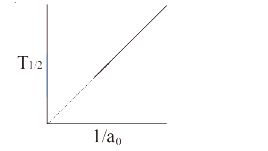
The following graph shows how $T_{1/2}$ (half-life) of a reactant $R$ changes with the initial reactant concentration $a_0$. The order of the reaction will be:
A
$0$
B
$1$
C
$2$
D
$3$
Solution
(C) For a reaction of order $n$, the half-life $T_{1/2}$ is related to the initial concentration $a_0$ by the expression: $T_{1/2} \propto \frac{1}{a_0^{n-1}}$.
From the given graph, $T_{1/2}$ is directly proportional to $\frac{1}{a_0}$.
This means $T_{1/2} \propto (a_0)^{-1}$.
Comparing the exponents of $a_0$, we get $n - 1 = 1$, which implies $n = 2$.
Therefore, the order of the reaction is $2$.
From the given graph, $T_{1/2}$ is directly proportional to $\frac{1}{a_0}$.
This means $T_{1/2} \propto (a_0)^{-1}$.
Comparing the exponents of $a_0$, we get $n - 1 = 1$, which implies $n = 2$.
Therefore, the order of the reaction is $2$.
0 likes
View Solution602
EasyMCQ
For the reaction $A + 2B \longrightarrow C$, the reaction rate is doubled if the concentration of $A$ is doubled. The rate is increased by four times when concentrations of both $A$ and $B$ are increased by four times. The order of the reaction is
A
$3$
B
$0$
C
$1$
D
$2$
Solution
(C) The rate law can be expressed as $Rate = k[A]^x[B]^y$.
When the concentration of $A$ is doubled, the rate doubles, which implies $2^x = 2$, so $x = 1$.
When both concentrations are increased by four times, the rate increases by four times: $4^x \times 4^y = 4$.
Substituting $x = 1$, we get $4^1 \times 4^y = 4$, which means $4^y = 1$, so $y = 0$.
The total order of the reaction is $x + y = 1 + 0 = 1$.
When the concentration of $A$ is doubled, the rate doubles, which implies $2^x = 2$, so $x = 1$.
When both concentrations are increased by four times, the rate increases by four times: $4^x \times 4^y = 4$.
Substituting $x = 1$, we get $4^1 \times 4^y = 4$, which means $4^y = 1$, so $y = 0$.
The total order of the reaction is $x + y = 1 + 0 = 1$.
0 likes
View Solution603
EasyMCQ
In the hydrolysis of an organic chloride in the presence of a large excess of water; $RCl + H_2O \rightarrow ROH + HCl$. What are the molecularity and order of the reaction?
A
Molecularity and order of reaction both are $2$
B
Molecularity is $2$ but order of reaction is $1$
C
Molecularity is $1$ but order of reaction is $2$
D
Molecularity is $1$ and order of reaction is also $1$
Solution
(B) The reaction is $RCl + H_2O \rightarrow ROH + HCl$.
Since water is present in large excess, its concentration remains practically constant during the reaction.
This makes the reaction a pseudo-first-order reaction, where the order of reaction is $1$.
However, the molecularity is determined by the number of reacting species colliding simultaneously in the elementary step, which is $2$ ($RCl$ and $H_2O$).
Therefore, the molecularity is $2$ and the order of reaction is $1$.
Since water is present in large excess, its concentration remains practically constant during the reaction.
This makes the reaction a pseudo-first-order reaction, where the order of reaction is $1$.
However, the molecularity is determined by the number of reacting species colliding simultaneously in the elementary step, which is $2$ ($RCl$ and $H_2O$).
Therefore, the molecularity is $2$ and the order of reaction is $1$.
0 likes
View Solution604
DifficultMCQ
$A \rightarrow$ products ($1^{st}$ order reaction). Three sets of experiment were performed for a reaction under similar experimental conditions. Run $1 \Rightarrow 100 \ mL$ of $10 \ M$ solution of reactant $A$. Run $2 \Rightarrow 200 \ mL$ of $10 \ M$ solution of reactant $A$. Run $3 \Rightarrow 100 \ mL$ of $10 \ M$ solution of reactant $A + 100 \ mL$ of $H_2O$ added. The correct variation of rate of reaction is:
A
Run $1 = $ Run $2 = $ Run $3$
B
Run $3 < $ Run $1 = $ Run $2$
C
Run $3 < $ Run $1 < $ Run $2$
D
Run $1 < $ Run $2 < $ Run $3$
Solution
(B) For a $1^{st}$ order reaction, the rate is given by $Rate = k[A]$.
In Run $1$, the concentration of $A$ is $10 \ M$.
In Run $2$, the volume is doubled, but the concentration of $A$ remains $10 \ M$, so the rate is the same as Run $1$.
In Run $3$, $100 \ mL$ of $H_2O$ is added to $100 \ mL$ of $10 \ M$ solution of $A$, which dilutes the solution to $5 \ M$.
Since the rate depends on the concentration of $A$, the rate in Run $3$ will be lower than in Run $1$ and Run $2$.
Therefore, the correct order is $Run \ 3 < Run \ 1 = Run \ 2$.
In Run $1$, the concentration of $A$ is $10 \ M$.
In Run $2$, the volume is doubled, but the concentration of $A$ remains $10 \ M$, so the rate is the same as Run $1$.
In Run $3$, $100 \ mL$ of $H_2O$ is added to $100 \ mL$ of $10 \ M$ solution of $A$, which dilutes the solution to $5 \ M$.
Since the rate depends on the concentration of $A$, the rate in Run $3$ will be lower than in Run $1$ and Run $2$.
Therefore, the correct order is $Run \ 3 < Run \ 1 = Run \ 2$.
0 likes
View Solution605
MediumMCQ
If the rate constant $k = 4.5 \times 10^{-7} \text{ L}^2 \text{ mol}^{-2} \text{ s}^{-1}$, then what is the order of the reaction?
A
$0$
B
$3$
C
$2$
D
$4$
Solution
(B) The general unit for the rate constant $k$ of an $n^{th}$ order reaction is given by the formula: $\text{mol}^{1-n} \text{L}^{n-1} \text{s}^{-1}$.
Given the unit of the rate constant is $\text{L}^2 \text{mol}^{-2} \text{s}^{-1}$.
Comparing the exponent of $\text{L}$ (liters) in the given unit with the general formula: $n - 1 = 2$.
Solving for $n$, we get $n = 3$.
Therefore, the order of the reaction is $3$.
Given the unit of the rate constant is $\text{L}^2 \text{mol}^{-2} \text{s}^{-1}$.
Comparing the exponent of $\text{L}$ (liters) in the given unit with the general formula: $n - 1 = 2$.
Solving for $n$, we get $n = 3$.
Therefore, the order of the reaction is $3$.
0 likes
View Solution606
MediumMCQ
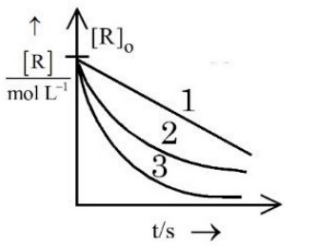
Consider the given graph showing the variation of reactant concentration with time. Three different reactions were started with identical initial concentration of reactants. Which of the following statements is correct?
A
The order of all the three reactions is the same.
B
The rate constant of reaction $3$ is larger than the rate constant of reaction $2$ if the order of reaction is the same for both.
C
The $SI$ unit of the rate constant of reaction $1$ is $s^{-1}$.
D
Thermal decomposition of $HI$ on a gold surface is an example of reaction $2$.
Solution
(B) The graph shows $[R]$ vs $t$. Reaction $1$, $2$, and $3$ represent decreasing concentrations with time.
For zero-order reactions, $[R] = [R]_{0} - kt$, which is a straight line. As the order increases, the curves become more convex.
Reaction $1$ is a straight line (zero-order), Reaction $2$ is first-order, and Reaction $3$ is second-order.
The unit of the rate constant for zero-order is $mol \text{ L}^{-1} \text{ s}^{-1}$. Thus, option $C$ is incorrect.
For a fixed initial concentration, the rate constant order is $k_{3} > k_{2} > k_{1}$ to maintain the decay profiles, as reaction $3$ decays faster than $2$. Therefore, option $B$ is correct.
For zero-order reactions, $[R] = [R]_{0} - kt$, which is a straight line. As the order increases, the curves become more convex.
Reaction $1$ is a straight line (zero-order), Reaction $2$ is first-order, and Reaction $3$ is second-order.
The unit of the rate constant for zero-order is $mol \text{ L}^{-1} \text{ s}^{-1}$. Thus, option $C$ is incorrect.
For a fixed initial concentration, the rate constant order is $k_{3} > k_{2} > k_{1}$ to maintain the decay profiles, as reaction $3$ decays faster than $2$. Therefore, option $B$ is correct.
0 likes
View Solution607
MediumMCQ
Match List-$I$ with List-$II$:
| List-$I$ (Order of Reaction) | List-$II$ (Unit of rate constant) |
| $A$. Zero order | $I$. $mol^{-1} L s^{-1}$ |
| $B$. First order | $II$. $mol^{-2} L^{2} s^{-1}$ |
| $C$. Second order | $III$. $s^{-1}$ |
| $D$. Third order | $IV$. $mol L^{-1} s^{-1}$ |
A
$A-IV, B-III, C-I, D-II$
B
$A-IV, B-III, C-I, D-II$
C
$A-I, B-III, C-II, D-IV$
D
$A-IV, B-II, C-I, D-III$
Solution
(B) The general unit for the rate constant $k$ for a reaction of order $n$ is given by the formula: $k = (mol \text{ } L^{-1})^{1-n} s^{-1}$.
For $n=0$ (Zero order): $k = (mol \text{ } L^{-1})^{1-0} s^{-1} = mol \text{ } L^{-1} s^{-1}$ (Matches $IV$).
For $n=1$ (First order): $k = (mol \text{ } L^{-1})^{1-1} s^{-1} = s^{-1}$ (Matches $III$).
For $n=2$ (Second order): $k = (mol \text{ } L^{-1})^{1-2} s^{-1} = mol^{-1} L s^{-1}$ (Matches $I$).
For $n=3$ (Third order): $k = (mol \text{ } L^{-1})^{1-3} s^{-1} = mol^{-2} L^{2} s^{-1}$ (Matches $II$).
Therefore, the correct matching is $A-IV, B-III, C-I, D-II$.
For $n=0$ (Zero order): $k = (mol \text{ } L^{-1})^{1-0} s^{-1} = mol \text{ } L^{-1} s^{-1}$ (Matches $IV$).
For $n=1$ (First order): $k = (mol \text{ } L^{-1})^{1-1} s^{-1} = s^{-1}$ (Matches $III$).
For $n=2$ (Second order): $k = (mol \text{ } L^{-1})^{1-2} s^{-1} = mol^{-1} L s^{-1}$ (Matches $I$).
For $n=3$ (Third order): $k = (mol \text{ } L^{-1})^{1-3} s^{-1} = mol^{-2} L^{2} s^{-1}$ (Matches $II$).
Therefore, the correct matching is $A-IV, B-III, C-I, D-II$.
0 likes
View Solution608
MediumMCQ
Which of the following statements is $NOT$ true about the rate constant $k$?
A
It is a proportionality constant in the rate law that relates reaction rate to reactant concentrations.
B
It is independent of the concentration of reactants.
C
It varies with temperature.
D
The greater the value of the rate constant, the slower the reaction.
Solution
(D) Step $1$: The rate law is expressed as $\text{Rate} = k[A]^x[B]^y$. Here, $k$ is the rate constant.
Step $2$: $k$ is independent of the initial concentration of reactants, but it depends on temperature (Arrhenius equation: $k = Ae^{-E_a/RT}$).
Step $3$: $A$ larger value of $k$ indicates a faster reaction rate for a given set of concentrations. Therefore, the statement that a greater value of $k$ makes the reaction slower is incorrect.
Step $2$: $k$ is independent of the initial concentration of reactants, but it depends on temperature (Arrhenius equation: $k = Ae^{-E_a/RT}$).
Step $3$: $A$ larger value of $k$ indicates a faster reaction rate for a given set of concentrations. Therefore, the statement that a greater value of $k$ makes the reaction slower is incorrect.
0 likes
View Solution609
MediumMCQ
Identify the correct statement regarding the order of reaction from the following.
A
Rate of a zero order reaction depends on the initial concentration of the reactant.
B
Decomposition of acetaldehyde is a first order reaction.
C
Half-life of a first order reaction is independent of the initial concentration of the reactant.
D
Half-life of a zero order reaction is independent of the initial concentration of the reactant.
Solution
(C) Step $1$: For a zero order reaction, the rate is constant and independent of the initial concentration, so $(A)$ is incorrect.
Step $2$: The decomposition of acetaldehyde $(CH_3CHO \rightarrow CH_4 + CO)$ is a second order reaction, so $(B)$ is incorrect.
Step $3$: For a first order reaction, the half-life is given by $t_{1/2} = \frac{0.693}{k}$, which is independent of the initial concentration $[R]_0$. Thus, $(C)$ is correct.
Step $4$: For a zero order reaction, the half-life is $t_{1/2} = \frac{[R]_0}{2k}$, which depends on the initial concentration. Thus, $(D)$ is incorrect.
Step $2$: The decomposition of acetaldehyde $(CH_3CHO \rightarrow CH_4 + CO)$ is a second order reaction, so $(B)$ is incorrect.
Step $3$: For a first order reaction, the half-life is given by $t_{1/2} = \frac{0.693}{k}$, which is independent of the initial concentration $[R]_0$. Thus, $(C)$ is correct.
Step $4$: For a zero order reaction, the half-life is $t_{1/2} = \frac{[R]_0}{2k}$, which depends on the initial concentration. Thus, $(D)$ is incorrect.
0 likes
View Solution610
EasyMCQ
What is the order of the following reaction: $2H_2O_2(l) \rightarrow 2H_2O(l) + O_2(g)$, given that the rate law is $\text{rate} = k[H_2O_2]^1$?
A
$0$
B
$1$
C
$2$
D
$3$
Solution
(B) The order of a reaction is defined as the sum of the powers of the concentration terms in the rate law expression.
Given rate law: $\text{rate} = k[H_2O_2]^1$.
The power of the concentration term $[H_2O_2]$ is $1$.
Therefore, the order of the reaction is $1$.
Given rate law: $\text{rate} = k[H_2O_2]^1$.
The power of the concentration term $[H_2O_2]$ is $1$.
Therefore, the order of the reaction is $1$.
0 likes
View Solution611
MediumMCQ
Identify the order of reaction for which the unit of the rate constant is $\text{mol dm}^{-3} \text{s}^{-1}$.
A
$0$
B
$1$
C
$2$
D
$3$
Solution
(A) The general unit for the rate constant $k$ of a reaction of order $n$ is given by the formula: $(\text{mol dm}^{-3})^{1-n} \text{s}^{-1}$.
For a zero-order reaction, $n = 0$.
Substituting $n = 0$ into the formula: $(\text{mol dm}^{-3})^{1-0} \text{s}^{-1} = \text{mol dm}^{-3} \text{s}^{-1}$.
Therefore, the reaction is of zero order.
For a zero-order reaction, $n = 0$.
Substituting $n = 0$ into the formula: $(\text{mol dm}^{-3})^{1-0} \text{s}^{-1} = \text{mol dm}^{-3} \text{s}^{-1}$.
Therefore, the reaction is of zero order.
0 likes
View Solution612
DifficultMCQ
For the reaction, $A + B \rightarrow P$, the rate law is $\text{rate} = k[A][B]^2$. The rate of reaction is $0.25 \text{ Ms}^{-1}$ when $[A] = 1 \text{ M}$ and $[B] = 0.2 \text{ M}$ at $25^\circ \text{C}$. Calculate the rate constant $k$ of the reaction at the same temperature.
A
$6.25 \text{ M}^{-2}\text{s}^{-1}$
B
$0.25 \text{ M}^{-2}\text{s}^{-1}$
C
$5.0 \text{ M}^{-2}\text{s}^{-1}$
D
$75.0 \text{ M}^{-2}\text{s}^{-1}$
Solution
(A) Given rate law: $\text{rate} = k[A][B]^2$
Substitute the given values: $0.25 \text{ Ms}^{-1} = k(1 \text{ M})(0.2 \text{ M})^2$
$0.25 = k(1)(0.04)$
$k = \frac{0.25}{0.04}$
$k = 6.25 \text{ M}^{-2}\text{s}^{-1}$
Substitute the given values: $0.25 \text{ Ms}^{-1} = k(1 \text{ M})(0.2 \text{ M})^2$
$0.25 = k(1)(0.04)$
$k = \frac{0.25}{0.04}$
$k = 6.25 \text{ M}^{-2}\text{s}^{-1}$
0 likes
View Solution613
DifficultMCQ
The rate of the reaction $2A + 3B \rightarrow 2C + D$ is $6 \times 10^{-4} \text{ mol dm}^{-3} \text{ s}^{-1}$, when $[A] = [B] = 0.3 \text{ mol dm}^{-3}$. If the reaction is of first order with respect to $A$ and zeroth order with respect to $B$, find the rate constant $k$.
A
$1 \times 10^{-3} \text{ s}^{-1}$
B
$2 \times 10^{-3} \text{ s}^{-1}$
C
$3 \times 10^{-3} \text{ s}^{-1}$
D
$4 \times 10^{-3} \text{ s}^{-1}$
Solution
(B) The rate law for the reaction is given by: $\text{Rate} = k[A]^1[B]^0 = k[A]$.
Given: $\text{Rate} = 6 \times 10^{-4} \text{ mol dm}^{-3} \text{ s}^{-1}$ and $[A] = 0.3 \text{ mol dm}^{-3}$.
Substituting the values into the rate law: $6 \times 10^{-4} = k \times 0.3$.
Solving for $k$: $k = \frac{6 \times 10^{-4}}{0.3} = 20 \times 10^{-4} \text{ s}^{-1} = 2 \times 10^{-3} \text{ s}^{-1}$.
Given: $\text{Rate} = 6 \times 10^{-4} \text{ mol dm}^{-3} \text{ s}^{-1}$ and $[A] = 0.3 \text{ mol dm}^{-3}$.
Substituting the values into the rate law: $6 \times 10^{-4} = k \times 0.3$.
Solving for $k$: $k = \frac{6 \times 10^{-4}}{0.3} = 20 \times 10^{-4} \text{ s}^{-1} = 2 \times 10^{-3} \text{ s}^{-1}$.
0 likes
View Solution614
DifficultMCQ
The rate of reaction $A + B \rightarrow P$ is $4 \times 10^{-2} \text{ mol dm}^{-3} \text{ s}^{-1}$. When $[A] = 0.2 \text{ mol dm}^{-3}$ and $[B] = 0.1 \text{ mol dm}^{-3}$, what is the rate constant of the reaction, if it is first order with respect to $A$ and second order with respect to $B$?
A
$10 \text{ mol}^{-2} \text{ dm}^6 \text{ s}^{-1}$
B
$20 \text{ mol}^{-2} \text{ dm}^6 \text{ s}^{-1}$
C
$25 \text{ mol}^{-2} \text{ dm}^6 \text{ s}^{-1}$
D
$40 \text{ mol}^{-2} \text{ dm}^6 \text{ s}^{-1}$
Solution
(B) The rate law for the reaction is given by: $\text{Rate} = k[A]^1[B]^2$.
Given: $\text{Rate} = 4 \times 10^{-2} \text{ mol dm}^{-3} \text{ s}^{-1}$, $[A] = 0.2 \text{ mol dm}^{-3}$, $[B] = 0.1 \text{ mol dm}^{-3}$.
Substituting the values into the rate law: $4 \times 10^{-2} = k(0.2)^1(0.1)^2$.
$4 \times 10^{-2} = k(0.2)(0.01)$.
$4 \times 10^{-2} = k(0.002)$.
$k = \frac{4 \times 10^{-2}}{2 \times 10^{-3}} = 2 \times 10^1 = 20 \text{ mol}^{-2} \text{ dm}^6 \text{ s}^{-1}$.
Given: $\text{Rate} = 4 \times 10^{-2} \text{ mol dm}^{-3} \text{ s}^{-1}$, $[A] = 0.2 \text{ mol dm}^{-3}$, $[B] = 0.1 \text{ mol dm}^{-3}$.
Substituting the values into the rate law: $4 \times 10^{-2} = k(0.2)^1(0.1)^2$.
$4 \times 10^{-2} = k(0.2)(0.01)$.
$4 \times 10^{-2} = k(0.002)$.
$k = \frac{4 \times 10^{-2}}{2 \times 10^{-3}} = 2 \times 10^1 = 20 \text{ mol}^{-2} \text{ dm}^6 \text{ s}^{-1}$.
0 likes
View Solution615
DifficultMCQ
The rate constant for the reaction $2N_2O_5 \rightarrow 4NO_2 + O_2$ is $3.0 \times 10^{-5} \text{ s}^{-1}$. If the rate of reaction is $2.4 \times 10^{-5} \text{ mol L}^{-1} \text{ s}^{-1}$, then the concentration of $N_2O_5$ in $\text{mol L}^{-1}$ is:
A
$0.4$
B
$0.8$
C
$1.2$
D
$2.0$
Solution
(B) For a first-order reaction, the rate law is given by: $\text{Rate} = k[N_2O_5]$.
Given: $\text{Rate} = 2.4 \times 10^{-5} \text{ mol L}^{-1} \text{ s}^{-1}$ and $k = 3.0 \times 10^{-5} \text{ s}^{-1}$.
Substituting the values into the rate equation: $2.4 \times 10^{-5} = (3.0 \times 10^{-5}) \times [N_2O_5]$.
Solving for $[N_2O_5]$: $[N_2O_5] = \frac{2.4 \times 10^{-5}}{3.0 \times 10^{-5}}$.
$[N_2O_5] = 0.8 \text{ mol L}^{-1}$.
Given: $\text{Rate} = 2.4 \times 10^{-5} \text{ mol L}^{-1} \text{ s}^{-1}$ and $k = 3.0 \times 10^{-5} \text{ s}^{-1}$.
Substituting the values into the rate equation: $2.4 \times 10^{-5} = (3.0 \times 10^{-5}) \times [N_2O_5]$.
Solving for $[N_2O_5]$: $[N_2O_5] = \frac{2.4 \times 10^{-5}}{3.0 \times 10^{-5}}$.
$[N_2O_5] = 0.8 \text{ mol L}^{-1}$.
0 likes
View Solution616
DifficultMCQ
The rate law for the reaction $A + B \rightarrow P$ is given by $\text{rate} = k[A]^2[B]$. The rate constant of the reaction at $300 \text{ K}$ is $6.0 \text{ M}^{-2} \text{s}^{-1}$. Calculate the rate of the reaction when $[A] = 1 \text{ M}$ and $[B] = 0.2 \text{ M}$. (in $\text{ M s}^{-1}$)
A
$0.6$
B
$2$
C
$8$
D
$4$
Solution
(A) Step $1$: Identify the given values.
Rate constant $k = 6.0 \text{ M}^{-2} \text{s}^{-1}$.
Concentration $[A] = 1 \text{ M}$.
Concentration $[B] = 0.2 \text{ M}$.
Step $2$: Use the rate law expression.
$\text{Rate} = k[A]^2[B]$
Step $3$: Substitute the values into the equation.
$\text{Rate} = 6.0 \times (1)^2 \times (0.2)$
$\text{Rate} = 6.0 \times 1 \times 0.2$
$\text{Rate} = 1.2 \text{ M s}^{-1}$.
Note: The calculated value is $1.2 \text{ M s}^{-1}$. Since this is not among the options, the question options are incorrect.
Rate constant $k = 6.0 \text{ M}^{-2} \text{s}^{-1}$.
Concentration $[A] = 1 \text{ M}$.
Concentration $[B] = 0.2 \text{ M}$.
Step $2$: Use the rate law expression.
$\text{Rate} = k[A]^2[B]$
Step $3$: Substitute the values into the equation.
$\text{Rate} = 6.0 \times (1)^2 \times (0.2)$
$\text{Rate} = 6.0 \times 1 \times 0.2$
$\text{Rate} = 1.2 \text{ M s}^{-1}$.
Note: The calculated value is $1.2 \text{ M s}^{-1}$. Since this is not among the options, the question options are incorrect.
0 likes
View Solution617
MediumMCQ
Which of the following is an example of a second-order reaction?
A
$2 H_2O_2(l) \rightarrow 2H_2O(l) + O_2(g)$
B
$CH_3CHO(g) \rightarrow CH_4(g) + CO(g)$
C
$2 NO_2(g) + F_2(g) \rightarrow 2NO_2F(g)$
D
$2 NO(g) + 2H_2(g) \rightarrow N_2(g) + 2H_2O(l)$
Solution
(C) Step $1$: Analyze the rate laws for the given reactions.
Step $2$: The reaction $2 NO_2(g) + F_2(g) \rightarrow 2NO_2F(g)$ follows the rate law $Rate = k[NO_2][F_2]$. This is a second-order reaction (first order with respect to $NO_2$ and first order with respect to $F_2$, total order $1+1=2$).
Step $3$: $2 H_2O_2(l) \rightarrow 2H_2O(l) + O_2(g)$ is a first-order reaction.
Step $4$: $CH_3CHO(g) \rightarrow CH_4(g) + CO(g)$ is a fractional order reaction (order $1.5$).
Step $5$: $2 NO(g) + 2H_2(g) \rightarrow N_2(g) + 2H_2O(l)$ is a third-order reaction.
Step $6$: Therefore, option $C$ is the correct answer.
Step $2$: The reaction $2 NO_2(g) + F_2(g) \rightarrow 2NO_2F(g)$ follows the rate law $Rate = k[NO_2][F_2]$. This is a second-order reaction (first order with respect to $NO_2$ and first order with respect to $F_2$, total order $1+1=2$).
Step $3$: $2 H_2O_2(l) \rightarrow 2H_2O(l) + O_2(g)$ is a first-order reaction.
Step $4$: $CH_3CHO(g) \rightarrow CH_4(g) + CO(g)$ is a fractional order reaction (order $1.5$).
Step $5$: $2 NO(g) + 2H_2(g) \rightarrow N_2(g) + 2H_2O(l)$ is a third-order reaction.
Step $6$: Therefore, option $C$ is the correct answer.
0 likes
View Solution618
DifficultMCQ
For the reaction $2NOBr(g) \rightarrow 2NO(g) + Br_2(g)$, the rate law is $r = k[NOBr]^2$. If the rate constant $k = 1.62 \times 10^{-2} \text{ L mol}^{-1} \text{ s}^{-1}$ and the concentration of $[NOBr] = 2 \times 10^{-3} \text{ mol L}^{-1}$, what is the rate of reaction?
A
$6.48 \times 10^{-8} \text{ mol L}^{-1} \text{ s}^{-1}$
B
$3.24 \times 10^{-8} \text{ mol L}^{-1} \text{ s}^{-1}$
C
$1.62 \times 10^{-8} \text{ mol L}^{-1} \text{ s}^{-1}$
D
$8.10 \times 10^{-8} \text{ mol L}^{-1} \text{ s}^{-1}$
Solution
(A) Step $1$: Identify the given values: $k = 1.62 \times 10^{-2} \text{ L mol}^{-1} \text{ s}^{-1}$ and $[NOBr] = 2 \times 10^{-3} \text{ mol L}^{-1}$.
Step $2$: Use the rate law expression $r = k[NOBr]^2$.
Step $3$: Substitute the values into the equation: $r = (1.62 \times 10^{-2}) \times (2 \times 10^{-3})^2$.
Step $4$: Calculate the square of the concentration: $(2 \times 10^{-3})^2 = 4 \times 10^{-6} \text{ mol}^2 \text{ L}^{-2}$.
Step $5$: Multiply by the rate constant: $r = 1.62 \times 10^{-2} \times 4 \times 10^{-6} = 6.48 \times 10^{-8} \text{ mol L}^{-1} \text{ s}^{-1}$.
Step $2$: Use the rate law expression $r = k[NOBr]^2$.
Step $3$: Substitute the values into the equation: $r = (1.62 \times 10^{-2}) \times (2 \times 10^{-3})^2$.
Step $4$: Calculate the square of the concentration: $(2 \times 10^{-3})^2 = 4 \times 10^{-6} \text{ mol}^2 \text{ L}^{-2}$.
Step $5$: Multiply by the rate constant: $r = 1.62 \times 10^{-2} \times 4 \times 10^{-6} = 6.48 \times 10^{-8} \text{ mol L}^{-1} \text{ s}^{-1}$.
0 likes
View Solution619
MediumMCQ
Which of the following reactions has an overall order of $1.5$?
A
$2H_2O_2(g) \rightarrow 2H_2O(l) + O_2(g)$
B
$H_2(g) + I_2(g) \rightarrow 2HI(g)$
C
$CH_3CHO(g) \rightarrow CH_4(g) + CO(g)$
D
$2NO(g) + 2H_2(g) \rightarrow N_2(g) + 2H_2O(l)$
Solution
(C) Step $1$: Analyze the rate laws for the given reactions.
Step $2$: The decomposition of acetaldehyde, $CH_3CHO(g) \rightarrow CH_4(g) + CO(g)$, follows the rate law $Rate = k[CH_3CHO]^{1.5}$.
Step $3$: The overall order of a reaction is the sum of the powers of the concentration terms in the rate law expression.
Step $4$: For the decomposition of acetaldehyde, the order is $1.5$.
Step $5$: Other reactions listed are typically first or second order. Thus, option $C$ is correct.
Step $2$: The decomposition of acetaldehyde, $CH_3CHO(g) \rightarrow CH_4(g) + CO(g)$, follows the rate law $Rate = k[CH_3CHO]^{1.5}$.
Step $3$: The overall order of a reaction is the sum of the powers of the concentration terms in the rate law expression.
Step $4$: For the decomposition of acetaldehyde, the order is $1.5$.
Step $5$: Other reactions listed are typically first or second order. Thus, option $C$ is correct.
0 likes
View Solution620
DifficultMCQ
For the reaction $2NOBr(g) \rightarrow 2NO(g) + Br_2(g)$, the rate law is $r = k[NOBr]^2$. If the rate constant $k = 1.62 \text{ M}^{-1} \text{ s}^{-1}$ and the concentration of $NOBr$ is $5 \times 10^{-3} \text{ M}$, what is the rate of the reaction?
A
$4.05 \times 10^{-5} \text{ M s}^{-1}$
B
$4.05 \times 10^{-6} \text{ M s}^{-1}$
C
$1.62 \times 10^{-5} \text{ M s}^{-1}$
D
$8.10 \times 10^{-6} \text{ M s}^{-1}$
Solution
(A) Given:
Rate law: $r = k[NOBr]^2$
Rate constant $k = 1.62 \text{ M}^{-1} \text{ s}^{-1}$
Concentration $[NOBr] = 5 \times 10^{-3} \text{ M}$
Substitute the values into the rate law:
$r = (1.62 \text{ M}^{-1} \text{ s}^{-1}) \times (5 \times 10^{-3} \text{ M})^2$
$r = 1.62 \times 25 \times 10^{-6} \text{ M s}^{-1}$
$r = 40.5 \times 10^{-6} \text{ M s}^{-1}$
$r = 4.05 \times 10^{-5} \text{ M s}^{-1}$
Rate law: $r = k[NOBr]^2$
Rate constant $k = 1.62 \text{ M}^{-1} \text{ s}^{-1}$
Concentration $[NOBr] = 5 \times 10^{-3} \text{ M}$
Substitute the values into the rate law:
$r = (1.62 \text{ M}^{-1} \text{ s}^{-1}) \times (5 \times 10^{-3} \text{ M})^2$
$r = 1.62 \times 25 \times 10^{-6} \text{ M s}^{-1}$
$r = 40.5 \times 10^{-6} \text{ M s}^{-1}$
$r = 4.05 \times 10^{-5} \text{ M s}^{-1}$
0 likes
View Solution621
MediumMCQ
Which of the following is an example of a fractional order reaction?
A
$2H_2O_2(g) \rightarrow 2H_2O(l) + O_2(g)$
B
$H_2(g) + I_2(g) \rightarrow 2HI(g)$
C
$CH_3CHO(g) \rightarrow CH_4(g) + CO(g)$
D
$2NO(g) + 2H_2(g) \rightarrow N_2(g) + 2H_2O(l)$
Solution
(C) Step $1$: Analyze the order of the given reactions.
Step $2$: The decomposition of acetaldehyde $(CH_3CHO)$ follows a chain mechanism where the rate law is given by $\text{Rate} = k[CH_3CHO]^{3/2}$.
Step $3$: Since the exponent of the concentration term is $3/2$ (which is $1.5$), this reaction is of fractional order.
Step $4$: The other reactions listed are typically elementary or follow integer order kinetics under standard conditions.
Step $5$: Therefore, option $C$ is the correct example of a fractional order reaction.
Step $2$: The decomposition of acetaldehyde $(CH_3CHO)$ follows a chain mechanism where the rate law is given by $\text{Rate} = k[CH_3CHO]^{3/2}$.
Step $3$: Since the exponent of the concentration term is $3/2$ (which is $1.5$), this reaction is of fractional order.
Step $4$: The other reactions listed are typically elementary or follow integer order kinetics under standard conditions.
Step $5$: Therefore, option $C$ is the correct example of a fractional order reaction.
0 likes
View Solution622
MediumMCQ
Which of the following is an elementary reaction?
A
$O_3(g) \rightarrow O_2(g) + O(g)$
B
$2NO_2Cl(g) \rightarrow 2NO_2(g) + Cl_2(g)$
C
$2NO_2(g) + F_2(g) \rightarrow 2NO_2F(g)$
D
$2NO(g) + Cl_2(g) \rightarrow 2NOCl(g)$
Solution
(A) An elementary reaction is a single-step reaction that occurs in one go without any intermediate.
Option $A$: The decomposition of ozone $O_3(g) \rightarrow O_2(g) + O(g)$ is a single-step unimolecular elementary reaction.
Option $B$, $C$, and $D$ are complex reactions involving multiple steps and intermediates.
Therefore, the correct answer is $A$.
Option $A$: The decomposition of ozone $O_3(g) \rightarrow O_2(g) + O(g)$ is a single-step unimolecular elementary reaction.
Option $B$, $C$, and $D$ are complex reactions involving multiple steps and intermediates.
Therefore, the correct answer is $A$.
0 likes
View Solution623
MediumMCQ
What is the order and molecularity of the following elementary reaction? $2NO_2(g) \rightarrow 2NO(g) + O_2(g)$, rate $= k[NO_2]^2$
A
The reaction is second order and bimolecular.
B
The reaction is first order and bimolecular.
C
The reaction is second order and unimolecular.
D
The reaction is zero order and bimolecular.
Solution
(A) $1$. The order of a reaction is the sum of the powers of the concentration terms in the rate law expression. Here, the rate $= k[NO_2]^2$, so the order is $2$.
$2$. The molecularity of an elementary reaction is the number of reacting species (atoms, ions, or molecules) taking part in the reaction. In the reaction $2NO_2(g) \rightarrow 2NO(g) + O_2(g)$, two molecules of $NO_2$ are involved, so the molecularity is $2$.
$3$. $A$ reaction with molecularity $2$ is called bimolecular.
$4$. Therefore, the reaction is second order and bimolecular.
$2$. The molecularity of an elementary reaction is the number of reacting species (atoms, ions, or molecules) taking part in the reaction. In the reaction $2NO_2(g) \rightarrow 2NO(g) + O_2(g)$, two molecules of $NO_2$ are involved, so the molecularity is $2$.
$3$. $A$ reaction with molecularity $2$ is called bimolecular.
$4$. Therefore, the reaction is second order and bimolecular.
0 likes
View SolutionChemical Kinetics — Rate law , Rate constant , Order of Reaction and Molecularity · Frequently Asked Questions
1Are these Chemical Kinetics questions useful for JEE and NEET?
Yes. All questions in this section are mapped to JEE Main and NEET exam patterns. Previous year questions from JEE Main, NEET, GUJCET and state-level exams are included with full solutions.
2Can I switch to Hindi or Gujarati for these questions?
Yes. Use the language tabs in the hero section or the sidebar to view the same questions and solutions in English, Hindi or Gujarati.
3How do I generate a question paper from this subtopic?
Use the Vedclass Exam Paper Generator — select the chapter and subtopic, set difficulty, and generate Sets A, B, C, D automatically. First 3 chapters of every subject are free.
Vedclass Products
For Students
Vedclass Test Series
Mock tests in real JEE/NEET style with performance analysis. 5-day free trial.
Start Free TrialFor Teachers
Exam Paper Generator
Generate Set A/B/C/D papers from this chapter in 2 minutes. 3 chapters free.
Try FreeFor Institutes
Online Exam Module
Live online exams with unlimited students, 360° analytics & white-label branding.
See DemoFor Teachers & Institutes
Generate a Chemical Kinetics Exam Paper in 2 Minutes
Select subtopic & difficulty — Sets A, B, C, D auto-generated with No Repeat logic.
First 3 chapters of every subject are free — no payment required.