
A English
Adsorption and Adsorption isotherm Questions in English
Class 12 Chemistry · Surface Chemistry · Adsorption and Adsorption isotherm
427+
Questions
English
Language
100%
With Solutions
Showing 22 of 427 questions in English
401
EasyMCQ
Which of the following statements is correct for chemisorption?
A
Chemisorption is reversible.
B
Multilayer adsorption takes place.
C
Adsorption increases with temperature.
D
The heat of adsorption is generally less than $40 \ kJ \ mol^{-1}$.
Solution
(C) Chemisorption involves the formation of chemical bonds between the adsorbate and the adsorbent, which requires an activation energy. Therefore, initially, the rate of adsorption increases with an increase in temperature. The provided graph shows the variation of the extent of adsorption $(x/m)$ with temperature $(T)$ at a constant pressure $(p)$, where the adsorption first increases and then decreases, which is characteristic of chemisorption.
0 likes
View Solution402
EasyMCQ
Which of the following is true for spontaneous adsorption?
A
$ \Delta G > 0, \Delta S > 0, \Delta H < 0 $
B
$ \Delta G > 0, \Delta S > 0, \Delta H > 0 $
C
$ \Delta G < 0, \Delta S < 0, \Delta H < 0 $
D
$ \Delta G < 0, \Delta S > 0, \Delta H < 0 $
Solution
(C) Adsorption is a spontaneous process, so the change in Gibbs free energy must be negative, i.e.,$ \Delta G < 0 $.
Adsorption is an exothermic process, which means heat is released, so the enthalpy change is negative, i.e.,$ \Delta H < 0 $.
As gas molecules are adsorbed on the surface of a solid, their freedom of movement decreases, leading to a decrease in entropy, i.e.,$ \Delta S < 0 $.
According to the Gibbs-Helmholtz equation, $ \Delta G = \Delta H - T \Delta S $, for the process to be spontaneous at a given temperature, $ \Delta G $ must be negative.
Adsorption is an exothermic process, which means heat is released, so the enthalpy change is negative, i.e.,$ \Delta H < 0 $.
As gas molecules are adsorbed on the surface of a solid, their freedom of movement decreases, leading to a decrease in entropy, i.e.,$ \Delta S < 0 $.
According to the Gibbs-Helmholtz equation, $ \Delta G = \Delta H - T \Delta S $, for the process to be spontaneous at a given temperature, $ \Delta G $ must be negative.
0 likes
View Solution403
EasyMCQ
Which of the following is true for spontaneous adsorption of $H_2$ gas without dissociation on a solid surface?
A
Process is exothermic and $\Delta S < 0$
B
Process is endothermic and $\Delta S > 0$
C
Process is exothermic and $\Delta S > 0$
D
Process is endothermic and $\Delta S < 0$
Solution
(A) Adsorption is a spontaneous process where gas molecules are trapped on a solid surface, leading to a decrease in the randomness of the system. Thus, $\Delta S < 0$.
Since the process is spontaneous, the Gibbs free energy change must be negative $(\Delta G < 0)$.
From the equation $\Delta G = \Delta H - T\Delta S$, for $\Delta G$ to be negative when $\Delta S$ is negative, $\Delta H$ must be negative.
Therefore, the process is exothermic $(\Delta H < 0)$.
Since the process is spontaneous, the Gibbs free energy change must be negative $(\Delta G < 0)$.
From the equation $\Delta G = \Delta H - T\Delta S$, for $\Delta G$ to be negative when $\Delta S$ is negative, $\Delta H$ must be negative.
Therefore, the process is exothermic $(\Delta H < 0)$.
0 likes
View Solution404
EasyMCQ
Assertion $(A)$: van der Waals' forces are responsible for chemisorption.
Reason $(R)$: High temperature is favourable for chemisorption.
The correct answer is
Reason $(R)$: High temperature is favourable for chemisorption.
The correct answer is
A
$(A)$ is false, but $(R)$ is true
B
Both $(A)$ and $(R)$ are correct and $(R)$ is the correct explanation of $(A)$
C
Both $(A)$ and $(R)$ are correct and $(R)$ is not the correct explanation of $(A)$
D
$(A)$ is true, but $(R)$ is false
Solution
$(A)$ van der Waals' forces are responsible for physisorption, not chemisorption.
Chemisorption involves the formation of chemical bonds between the adsorbate and the adsorbent.
Therefore, Assertion $(A)$ is false.
Chemisorption is an activated process and generally requires high activation energy.
Thus, high temperature is favourable for chemisorption as it helps in overcoming the activation energy barrier.
Therefore, Reason $(R)$ is true.
Hence, the correct option is $(A)$ is false, but $(R)$ is true.
Chemisorption involves the formation of chemical bonds between the adsorbate and the adsorbent.
Therefore, Assertion $(A)$ is false.
Chemisorption is an activated process and generally requires high activation energy.
Thus, high temperature is favourable for chemisorption as it helps in overcoming the activation energy barrier.
Therefore, Reason $(R)$ is true.
Hence, the correct option is $(A)$ is false, but $(R)$ is true.
0 likes
View Solution405
MediumMCQ
Which one of the following statements is not correct?
A
Physical adsorption decreases with increase in the temperature
B
Physical adsorption is multilayered
C
Activation energy of physical adsorption is very high
D
Enthalpy change of physical adsorption is about $20 \ kJ \ mol^{-1}$
Solution
(C) Physical adsorption (physisorption) is characterized by weak van der Waals forces between the adsorbate and the adsorbent.
Because these forces are weak, the activation energy required for physical adsorption is very low, not high.
Therefore, the statement that 'Activation energy of physical adsorption is very high' is incorrect.
In contrast, chemical adsorption (chemisorption) typically requires a high activation energy due to the formation of chemical bonds.
Because these forces are weak, the activation energy required for physical adsorption is very low, not high.
Therefore, the statement that 'Activation energy of physical adsorption is very high' is incorrect.
In contrast, chemical adsorption (chemisorption) typically requires a high activation energy due to the formation of chemical bonds.
0 likes
View Solution406
MediumMCQ
Which of the following is not correct about Freundlich adsorption isotherm?
A
$\frac{x}{m} = kp^{1/n} \quad (n > 1)$
B
Extent of adsorption of gas is more at high temperature than at low temperature
C
$\frac{1}{n}$ represents the slope of the isotherm
D
$\log \frac{x}{m} = \log k + \frac{1}{n} \log p$ holds good over a limited range of pressures
Solution
(B) The Freundlich adsorption isotherm is given by the equation $\frac{x}{m} = kp^{1/n}$.
Physical adsorption is an exothermic process, which means that the extent of adsorption decreases with an increase in temperature.
Therefore, the statement that the extent of adsorption of gas is more at high temperature than at low temperature is incorrect.
Option $B$ is the correct answer.
Physical adsorption is an exothermic process, which means that the extent of adsorption decreases with an increase in temperature.
Therefore, the statement that the extent of adsorption of gas is more at high temperature than at low temperature is incorrect.
Option $B$ is the correct answer.
0 likes
View Solution407
EasyMCQ
Adsorption of a gas on an adsorbent follows Freundlich adsorption isotherm. The slope and intercept (on $y$-axis) of the isotherm are $0.5$ and $1.0$ respectively. What is the value of $\frac{x}{m}$, when the pressure of the gas $(p)$ is $100 \ atm$?
A
$10$
B
$1$
C
$100$
D
$1000$
Solution
(C) The Freundlich adsorption isotherm equation is given by: $\log \frac{x}{m} = \log k + \frac{1}{n} \log p$.
Comparing this with the equation of a straight line $y = mx + c$, where $y = \log \frac{x}{m}$, $x = \log p$, slope $= \frac{1}{n}$, and intercept $= \log k$.
Given: Slope $(\frac{1}{n}) = 0.5$ and Intercept $(\log k) = 1.0$.
Pressure $(p) = 100 \ atm$.
Substituting the values into the equation: $\log \frac{x}{m} = 1.0 + 0.5 \times \log(100)$.
Since $\log(100) = 2$, we get: $\log \frac{x}{m} = 1.0 + 0.5 \times 2 = 1.0 + 1.0 = 2.0$.
Therefore, $\frac{x}{m} = 10^2 = 100$.
Comparing this with the equation of a straight line $y = mx + c$, where $y = \log \frac{x}{m}$, $x = \log p$, slope $= \frac{1}{n}$, and intercept $= \log k$.
Given: Slope $(\frac{1}{n}) = 0.5$ and Intercept $(\log k) = 1.0$.
Pressure $(p) = 100 \ atm$.
Substituting the values into the equation: $\log \frac{x}{m} = 1.0 + 0.5 \times \log(100)$.
Since $\log(100) = 2$, we get: $\log \frac{x}{m} = 1.0 + 0.5 \times 2 = 1.0 + 1.0 = 2.0$.
Therefore, $\frac{x}{m} = 10^2 = 100$.
0 likes
View Solution408
MediumMCQ
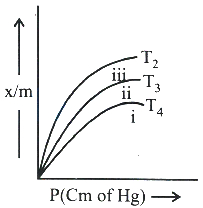
The graph given below shows the relationship between the extent of adsorption $(x / m)$ and pressure at different temperatures. The correct order of temperatures for curves $i$, $ii$, and $iii$ is:
A
$T_4 > T_2 > T_3$
B
$T_4 > T_3 > T_2$
C
$T_2 > T_3 > T_4$
D
$T_2 > T_4 > T_3$
Solution
(B) Adsorption is an exothermic process. According to Le Chatelier's principle, for physical adsorption, the extent of adsorption $(x / m)$ decreases with an increase in temperature at a constant pressure.
From the given graph, at a constant pressure, the extent of adsorption follows the order: $T_2 > T_3 > T_4$.
Since the extent of adsorption is inversely proportional to temperature for physisorption, the correct order of temperatures is $T_4 > T_3 > T_2$.
From the given graph, at a constant pressure, the extent of adsorption follows the order: $T_2 > T_3 > T_4$.
Since the extent of adsorption is inversely proportional to temperature for physisorption, the correct order of temperatures is $T_4 > T_3 > T_2$.
0 likes
View Solution409
EasyMCQ
$10 \ g$ of a gas is adsorbed on $500 \ g$ of solid at $10 \ bar$. If the pressure is increased to $20 \ bar$, $14 \ g$ of the gas is adsorbed by the same solid at the same temperature. What is the slope of Freundlich adsorption isotherm?
A
$1$
B
$\frac{4}{3}$
C
$3$
D
$0.5$
Solution
(D) The Freundlich adsorption isotherm is given by the equation: $\frac{x}{m} = kp^{1/n}$
For the first condition:
$\frac{10}{500} = k(10)^{1/n} \quad ...(i)$
For the second condition:
$\frac{14}{500} = k(20)^{1/n} \quad ...(ii)$
Dividing equation $(ii)$ by equation $(i)$:
$\frac{14/500}{10/500} = \frac{k(20)^{1/n}}{k(10)^{1/n}}$
$\frac{14}{10} = (\frac{20}{10})^{1/n}$
$1.4 = 2^{1/n}$
Taking logarithm on both sides:
$\log(1.4) = \frac{1}{n} \log(2)$
$0.1461 = \frac{1}{n} \times 0.3010$
$\frac{1}{n} = \frac{0.1461}{0.3010} \approx 0.485$
Rounding to the nearest option, the slope $\frac{1}{n}$ is approximately $0.5$.
For the first condition:
$\frac{10}{500} = k(10)^{1/n} \quad ...(i)$
For the second condition:
$\frac{14}{500} = k(20)^{1/n} \quad ...(ii)$
Dividing equation $(ii)$ by equation $(i)$:
$\frac{14/500}{10/500} = \frac{k(20)^{1/n}}{k(10)^{1/n}}$
$\frac{14}{10} = (\frac{20}{10})^{1/n}$
$1.4 = 2^{1/n}$
Taking logarithm on both sides:
$\log(1.4) = \frac{1}{n} \log(2)$
$0.1461 = \frac{1}{n} \times 0.3010$
$\frac{1}{n} = \frac{0.1461}{0.3010} \approx 0.485$
Rounding to the nearest option, the slope $\frac{1}{n}$ is approximately $0.5$.
0 likes
View Solution410
MediumMCQ
Which plot is the adsorption isobar for chemisorption?
A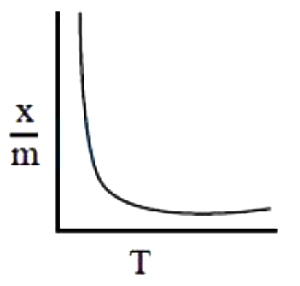
B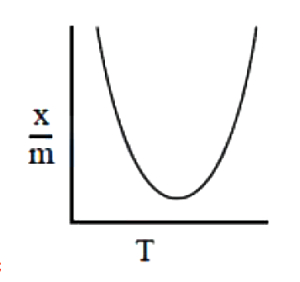
C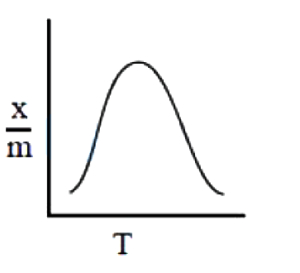
D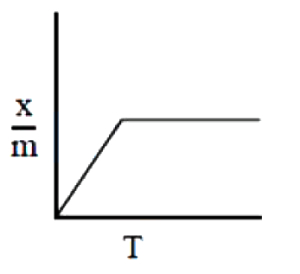
Solution
(C) Chemisorption requires high activation energy, so it is referred to as activated adsorption.
In chemisorption, the extent of adsorption $(x/m)$ first increases and then decreases with an increase in temperature.
When the adsorption isobar is plotted, the graph initially increases because the supplied heat helps molecules overcome the activation energy barrier required for chemisorption.
However, at higher temperatures, the extent of adsorption decreases due to the exothermic nature of the adsorption process at equilibrium.
This behavior is represented by a bell-shaped curve.
Therefore, Option $C$ is correct.
In chemisorption, the extent of adsorption $(x/m)$ first increases and then decreases with an increase in temperature.
When the adsorption isobar is plotted, the graph initially increases because the supplied heat helps molecules overcome the activation energy barrier required for chemisorption.
However, at higher temperatures, the extent of adsorption decreases due to the exothermic nature of the adsorption process at equilibrium.
This behavior is represented by a bell-shaped curve.
Therefore, Option $C$ is correct.
0 likes
View Solution411
EasyMCQ
In an adsorption experiment, a graph between $\log (x/m)$ vs $\log P$ was found to be linear with a slope of $45^{\circ}$. The intercept on the $\log (x/m)$ axis was found to be $0.3$. The amount of the gas adsorbed per gram of charcoal under a pressure of $1 \ atm$ is:
A
$1$
B
$2$
C
$3$
D
$4$
Solution
(B) According to the Freundlich adsorption isotherm: $\frac{x}{m} = kP^{1/n}$.
Taking logarithm on both sides: $\log (x/m) = \log k + \frac{1}{n} \log P$.
This equation represents a straight line $y = mx + c$, where the slope is $\frac{1}{n}$ and the intercept is $\log k$.
Given slope $= \tan 45^{\circ} = 1$, so $\frac{1}{n} = 1$.
Given intercept $= \log k = 0.3$. Since $\log 2 \approx 0.301$, we have $k = 2$.
At $P = 1 \ atm$, the amount adsorbed $\frac{x}{m} = kP^{1/n} = 2 \times (1)^1 = 2$.
Taking logarithm on both sides: $\log (x/m) = \log k + \frac{1}{n} \log P$.
This equation represents a straight line $y = mx + c$, where the slope is $\frac{1}{n}$ and the intercept is $\log k$.
Given slope $= \tan 45^{\circ} = 1$, so $\frac{1}{n} = 1$.
Given intercept $= \log k = 0.3$. Since $\log 2 \approx 0.301$, we have $k = 2$.
At $P = 1 \ atm$, the amount adsorbed $\frac{x}{m} = kP^{1/n} = 2 \times (1)^1 = 2$.
0 likes
View Solution412
MediumMCQ
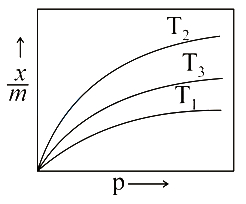
The following graph is obtained for physisorption of a gas as a function of pressure at different temperatures. The correct order of the temperatures is:
A
$T_3 < T_2 < T_1$
B
$T_2 < T_3 < T_1$
C
$T_2 < T_1 < T_3$
D
$T_1 < T_3 < T_2$
Solution
(D) Physical adsorption (physisorption) is an exothermic process. According to Le Chatelier's principle, an increase in temperature decreases the extent of adsorption at a constant pressure.
From the given graph, at a constant pressure $p$, the extent of adsorption $\frac{x}{m}$ follows the order: $T_2 > T_3 > T_1$.
Since $\frac{x}{m}$ is inversely proportional to temperature for physisorption, the temperature order must be the reverse of the adsorption extent order.
Therefore, the correct order of temperatures is $T_1 < T_3 < T_2$.
From the given graph, at a constant pressure $p$, the extent of adsorption $\frac{x}{m}$ follows the order: $T_2 > T_3 > T_1$.
Since $\frac{x}{m}$ is inversely proportional to temperature for physisorption, the temperature order must be the reverse of the adsorption extent order.
Therefore, the correct order of temperatures is $T_1 < T_3 < T_2$.
0 likes
View Solution413
EasyMCQ
If the value of $\frac{1}{n}$ is equal to $1$ in the Freundlich adsorption isotherm, then $\frac{x}{m} = $ (where $x = $ mass of adsorbate, $m = $ mass of the adsorbent, $p = $ pressure of the gas).
A
$\frac{K}{p}$
B
$K p$
C
$K$
D
$0$
Solution
(B) The Freundlich adsorption isotherm is given by the equation: $\frac{x}{m} = K p^{\frac{1}{n}}$.
Here, $\frac{x}{m}$ represents the mass of adsorbate per unit mass of adsorbent, $p$ is the pressure, and $K$ and $n$ are constants depending on the nature of the adsorbent and adsorbate at a particular temperature.
Given that the value of $\frac{1}{n} = 1$.
Substituting this value into the equation, we get: $\frac{x}{m} = K p^{1} = K p$.
Therefore, the correct option is $B$.
Here, $\frac{x}{m}$ represents the mass of adsorbate per unit mass of adsorbent, $p$ is the pressure, and $K$ and $n$ are constants depending on the nature of the adsorbent and adsorbate at a particular temperature.
Given that the value of $\frac{1}{n} = 1$.
Substituting this value into the equation, we get: $\frac{x}{m} = K p^{1} = K p$.
Therefore, the correct option is $B$.
0 likes
View Solution414
MediumMCQ
In the Freundlich isotherm $\frac{x}{m}=k p^{\frac{1}{n}}$ plot of $\log \frac{x}{m}$ vs $\log p$, the intercept is (where, $x$, $m$, $p$ and $k$ are mass of the gas, mass of adsorbent, pressure and constant which depend on the nature of the adsorbent, respectively)
A
$k$
B
$\log k$
C
$e^k$
D
$\ln \frac{1}{k}$
Solution
(B) For the Freundlich adsorption isotherm equation:
$\frac{x}{m} = k p^{\frac{1}{n}}$
Taking the logarithm on both sides:
$\log \frac{x}{m} = \log (k p^{\frac{1}{n}})$
$\log \frac{x}{m} = \log k + \frac{1}{n} \log p$
Comparing this with the linear equation $y = mx + c$, where $y = \log \frac{x}{m}$, $x = \log p$, slope $m = \frac{1}{n}$, and intercept $c = \log k$.
Thus, the intercept of the plot is $\log k$.
$\frac{x}{m} = k p^{\frac{1}{n}}$
Taking the logarithm on both sides:
$\log \frac{x}{m} = \log (k p^{\frac{1}{n}})$
$\log \frac{x}{m} = \log k + \frac{1}{n} \log p$
Comparing this with the linear equation $y = mx + c$, where $y = \log \frac{x}{m}$, $x = \log p$, slope $m = \frac{1}{n}$, and intercept $c = \log k$.
Thus, the intercept of the plot is $\log k$.
0 likes
View Solution415
MediumMCQ
Which one of the following gives a straight line for Freundlich adsorption isotherm?
A
$\log \frac{x}{m} \ vs \ \log p$
B
$\frac{x}{m} \ vs \ \frac{1}{p}$
C
$\log \frac{x}{m} \ vs \ \log \frac{1}{p}$
D
$\frac{x}{m} \ vs \ p$
Solution
(A) The Freundlich adsorption isotherm is given by the equation: $\frac{x}{m} = K p^{1/n}$.
Taking the logarithm on both sides, we get: $\log \frac{x}{m} = \log K + \frac{1}{n} \log p$.
This equation is in the form of a straight line $y = mx + c$, where $y = \log \frac{x}{m}$, $x = \log p$, slope $m = \frac{1}{n}$, and intercept $c = \log K$.
Therefore, plotting a graph between $\log \frac{x}{m}$ and $\log p$ yields a straight line.
Taking the logarithm on both sides, we get: $\log \frac{x}{m} = \log K + \frac{1}{n} \log p$.
This equation is in the form of a straight line $y = mx + c$, where $y = \log \frac{x}{m}$, $x = \log p$, slope $m = \frac{1}{n}$, and intercept $c = \log K$.
Therefore, plotting a graph between $\log \frac{x}{m}$ and $\log p$ yields a straight line.
0 likes
View Solution416
MediumMCQ
Which one of the following graphs represents the Freundlich adsorption isotherm?
A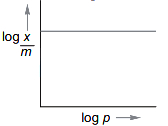
B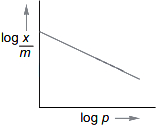
C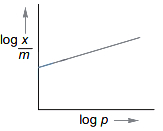
D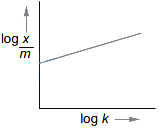
Solution
(C) The Freundlich adsorption isotherm is given by the equation: $\frac{x}{m} = k p^{1/n}$.
Taking the logarithm on both sides, we get: $\log \left( \frac{x}{m} \right) = \log k + \frac{1}{n} \log p$.
This equation is of the form $y = mx + c$, where $y = \log (x / m)$, $x = \log p$, slope $m = 1/n$, and intercept $c = \log k$.
Therefore, plotting $\log (x / m)$ on the $y$-axis and $\log p$ on the $x$-axis yields a straight line with a positive slope of $1/n$ and an intercept of $\log k$ on the $y$-axis.
Taking the logarithm on both sides, we get: $\log \left( \frac{x}{m} \right) = \log k + \frac{1}{n} \log p$.
This equation is of the form $y = mx + c$, where $y = \log (x / m)$, $x = \log p$, slope $m = 1/n$, and intercept $c = \log k$.
Therefore, plotting $\log (x / m)$ on the $y$-axis and $\log p$ on the $x$-axis yields a straight line with a positive slope of $1/n$ and an intercept of $\log k$ on the $y$-axis.
0 likes
View Solution417
EasyMCQ
Which one of the following equations represents the Freundlich adsorption isotherm?
A
$\frac{x}{m} = K p$
B
$\frac{x}{m} = K p^{1/n}$
C
$\log \frac{x}{m} = K p^n$
D
$\log \frac{x}{m} = K n \log p$
Solution
(B) The Freundlich adsorption isotherm is given by the empirical relationship:
$\frac{x}{m} = K p^{1/n}$
where:
$x$ is the mass of the adsorbate,
$m$ is the mass of the adsorbent,
$p$ is the pressure,
$K$ and $n$ are constants that depend on the nature of the adsorbent and adsorbate at a particular temperature.
$\frac{x}{m} = K p^{1/n}$
where:
$x$ is the mass of the adsorbate,
$m$ is the mass of the adsorbent,
$p$ is the pressure,
$K$ and $n$ are constants that depend on the nature of the adsorbent and adsorbate at a particular temperature.
0 likes
View Solution418
MediumMCQ
Which of the following processes has a negative $\Delta S$ (change in entropy)?
A
Dissolving sugar in water
B
Adsorption of a gas on a solid surface
C
$2NH_3(g) \rightarrow N_2(g) + 3H_2(g)$
D
Sublimation of dry ice
Solution
(B) Step $1$: Entropy $(S)$ is a measure of the randomness or disorder of a system. $A$ negative $\Delta S$ implies a decrease in randomness.
Step $2$: Dissolving sugar in water increases disorder as the solid lattice breaks down into solution $(\Delta S > 0)$.
Step $3$: Adsorption of a gas on a solid surface restricts the movement of gas molecules, leading to a decrease in disorder $(\Delta S < 0)$.
Step $4$: The reaction $2NH_3(g) \rightarrow N_2(g) + 3H_2(g)$ increases the number of moles of gas from $2$ to $4$, increasing disorder $(\Delta S > 0)$.
Step $5$: Sublimation of dry ice $(CO_2(s) \rightarrow CO_2(g))$ involves a transition from solid to gas, which significantly increases disorder $(\Delta S > 0)$.
Conclusion: Option $B$ is the correct answer.
Step $2$: Dissolving sugar in water increases disorder as the solid lattice breaks down into solution $(\Delta S > 0)$.
Step $3$: Adsorption of a gas on a solid surface restricts the movement of gas molecules, leading to a decrease in disorder $(\Delta S < 0)$.
Step $4$: The reaction $2NH_3(g) \rightarrow N_2(g) + 3H_2(g)$ increases the number of moles of gas from $2$ to $4$, increasing disorder $(\Delta S > 0)$.
Step $5$: Sublimation of dry ice $(CO_2(s) \rightarrow CO_2(g))$ involves a transition from solid to gas, which significantly increases disorder $(\Delta S > 0)$.
Conclusion: Option $B$ is the correct answer.
0 likes
View Solution419
MediumMCQ
Which of the following assertions about the extent of physisorption is correct?
A
Increases with increase in temperature
B
Decreases with increase in surface area
C
Decreases with increase in the strength of Van der Waals forces
D
Decreases with increase in temperature
Solution
(D) Step $1$: Physisorption is an exothermic process involving weak Van der Waals forces between the adsorbate and the adsorbent.
Step $2$: According to Le Chatelier's principle, for an exothermic process, an increase in temperature shifts the equilibrium in the backward direction, thereby decreasing the extent of adsorption.
Step $3$: Therefore, physisorption decreases with an increase in temperature.
Step $2$: According to Le Chatelier's principle, for an exothermic process, an increase in temperature shifts the equilibrium in the backward direction, thereby decreasing the extent of adsorption.
Step $3$: Therefore, physisorption decreases with an increase in temperature.
0 likes
View Solution420
MediumMCQ
Identify the gas adsorbed by a solid to the largest extent at their respective critical temperatures.
A
$N_2(g)$
B
$O_2(g)$
C
$H_2(g)$
D
$SO_2(g)$
Solution
(D) $1$. The extent of adsorption of a gas on a solid surface depends on the ease of liquefaction of the gas.
$2$. Gases that are easily liquefiable have higher critical temperatures $(T_c)$ and are adsorbed to a greater extent.
$3$. The critical temperatures of the given gases are: $H_2 \approx 33 \text{ K}$, $N_2 \approx 126 \text{ K}$, $O_2 \approx 154 \text{ K}$, and $SO_2 \approx 430 \text{ K}$.
$4$. Since $SO_2$ has the highest critical temperature, it is the most easily liquefiable and thus adsorbed to the largest extent.
$2$. Gases that are easily liquefiable have higher critical temperatures $(T_c)$ and are adsorbed to a greater extent.
$3$. The critical temperatures of the given gases are: $H_2 \approx 33 \text{ K}$, $N_2 \approx 126 \text{ K}$, $O_2 \approx 154 \text{ K}$, and $SO_2 \approx 430 \text{ K}$.
$4$. Since $SO_2$ has the highest critical temperature, it is the most easily liquefiable and thus adsorbed to the largest extent.
0 likes
View Solution421
MediumMCQ
Which of the following statements is correct for the spontaneous adsorption of a gas on a solid surface?
A
$\Delta S$ is negative and, therefore $\Delta H$ should be highly positive
B
$\Delta S$ is negative and therefore, $\Delta H$ should be highly negative.
C
$\Delta S$ is positive and therefore, $\Delta H$ should be negative.
D
$\Delta S$ is positive and therefore, $\Delta H$ should also be highly positive.
Solution
(B) $1$. Adsorption is a spontaneous process, so the Gibbs free energy change $\Delta G$ must be negative $(\Delta G < 0)$.
$2$. The relationship is given by $\Delta G = \Delta H - T\Delta S$.
$3$. During adsorption, gas molecules are trapped on the surface, leading to a decrease in randomness, so $\Delta S$ is negative.
$4$. For $\Delta G$ to be negative when $\Delta S$ is negative, the term $\Delta H$ must be sufficiently negative to overcome the positive value of $-T\Delta S$ (since $-T\Delta S$ becomes positive).
$5$. Thus, $\Delta H$ must be highly negative for the process to be spontaneous.
$2$. The relationship is given by $\Delta G = \Delta H - T\Delta S$.
$3$. During adsorption, gas molecules are trapped on the surface, leading to a decrease in randomness, so $\Delta S$ is negative.
$4$. For $\Delta G$ to be negative when $\Delta S$ is negative, the term $\Delta H$ must be sufficiently negative to overcome the positive value of $-T\Delta S$ (since $-T\Delta S$ becomes positive).
$5$. Thus, $\Delta H$ must be highly negative for the process to be spontaneous.
0 likes
View Solution422
EasyMCQ
Which of the following forces is responsible for physisorption?
A
Coulombic force
B
Electrostatic force
C
London dispersion force
D
Hydrogen bonding
Solution
(C) Physisorption (physical adsorption) arises due to weak van der Waals forces of attraction between the adsorbate and the adsorbent. Among the given options, London dispersion forces are a type of van der Waals force, making them responsible for physisorption.
0 likes
View SolutionSurface Chemistry — Adsorption and Adsorption isotherm · Frequently Asked Questions
1Are these Surface Chemistry questions useful for JEE and NEET?
Yes. All questions in this section are mapped to JEE Main and NEET exam patterns. Previous year questions from JEE Main, NEET, GUJCET and state-level exams are included with full solutions.
2Can I switch to Hindi or Gujarati for these questions?
Yes. Use the language tabs in the hero section or the sidebar to view the same questions and solutions in English, Hindi or Gujarati.
3How do I generate a question paper from this subtopic?
Use the Vedclass Exam Paper Generator — select the chapter and subtopic, set difficulty, and generate Sets A, B, C, D automatically. First 3 chapters of every subject are free.
Vedclass Products
For Students
Vedclass Test Series
Mock tests in real JEE/NEET style with performance analysis. 5-day free trial.
Start Free TrialFor Teachers
Exam Paper Generator
Generate Set A/B/C/D papers from this chapter in 2 minutes. 3 chapters free.
Try FreeFor Institutes
Online Exam Module
Live online exams with unlimited students, 360° analytics & white-label branding.
See DemoFor Teachers & Institutes
Generate a Surface Chemistry Exam Paper in 2 Minutes
Select subtopic & difficulty — Sets A, B, C, D auto-generated with No Repeat logic.
First 3 chapters of every subject are free — no payment required.