
A English
Ampere’s circuital law and its application (Solenoid and Toroid) Questions in English
Class 12 Physics · Moving Charges and Magnetism · Ampere’s circuital law and its application (Solenoid and Toroid)
213+
Questions
English
Language
100%
With Solutions
Showing 13 of 213 questions in English
201
MediumMCQ
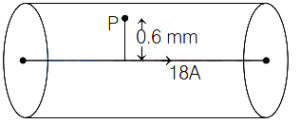
$A$ long wire carrying a current of $18 \,A$ is kept along the axis of a long solenoid of radius $1 \,cm$. The magnetic field due to the solenoid is $8.0 \times 10^{-3} \,T$. The magnitude of the resultant magnetic field at a point $0.6 \,mm$ from the solenoid axis is (Assume $\mu_0 = 4 \pi \times 10^{-7} \,Tm/A$):
A
$6 \times 10^{-3} \,T$
B
$6 \times 10^{-4} \,T$
C
$2 \sqrt{7} \times 10^{-3} \,T$
D
$10 \times 10^{-3} \,T$
Solution
(D) Given:
Current in the long wire, $I = 18 \,A$.
Magnetic field due to the solenoid, $B_1 = 8.0 \times 10^{-3} \,T$ (directed along the axis).
Distance of point $P$ from the axis, $r = 0.6 \,mm = 0.6 \times 10^{-3} \,m$.
The magnetic field due to the long current-carrying wire at a distance $r$ is given by:
$B_2 = \frac{\mu_0 I}{2 \pi r} = \frac{2 \times 10^{-7} \times 18}{0.6 \times 10^{-3}} = \frac{36 \times 10^{-7}}{0.6 \times 10^{-3}} = 60 \times 10^{-4} \,T = 6 \times 10^{-3} \,T$.
The magnetic field $B_1$ due to the solenoid is along the axis, and the magnetic field $B_2$ due to the wire is tangential to the circle of radius $r$ around the wire. Thus, $B_1$ and $B_2$ are perpendicular to each other.
The resultant magnetic field $B$ is:
$B = \sqrt{B_1^2 + B_2^2} = \sqrt{(8 \times 10^{-3})^2 + (6 \times 10^{-3})^2} \,T$
$B = \sqrt{64 \times 10^{-6} + 36 \times 10^{-6}} \,T = \sqrt{100 \times 10^{-6}} \,T = 10 \times 10^{-3} \,T$.
Current in the long wire, $I = 18 \,A$.
Magnetic field due to the solenoid, $B_1 = 8.0 \times 10^{-3} \,T$ (directed along the axis).
Distance of point $P$ from the axis, $r = 0.6 \,mm = 0.6 \times 10^{-3} \,m$.
The magnetic field due to the long current-carrying wire at a distance $r$ is given by:
$B_2 = \frac{\mu_0 I}{2 \pi r} = \frac{2 \times 10^{-7} \times 18}{0.6 \times 10^{-3}} = \frac{36 \times 10^{-7}}{0.6 \times 10^{-3}} = 60 \times 10^{-4} \,T = 6 \times 10^{-3} \,T$.
The magnetic field $B_1$ due to the solenoid is along the axis, and the magnetic field $B_2$ due to the wire is tangential to the circle of radius $r$ around the wire. Thus, $B_1$ and $B_2$ are perpendicular to each other.
The resultant magnetic field $B$ is:
$B = \sqrt{B_1^2 + B_2^2} = \sqrt{(8 \times 10^{-3})^2 + (6 \times 10^{-3})^2} \,T$
$B = \sqrt{64 \times 10^{-6} + 36 \times 10^{-6}} \,T = \sqrt{100 \times 10^{-6}} \,T = 10 \times 10^{-3} \,T$.
0 likes
View Solution202
MediumMCQ
$A$ toroid core has an inner radius of $0.24 \ m$ and an outer radius of $0.26 \ m$. $A$ current of $10 \ A$ flows through the wire having $2500$ turns around it. Find the magnetic field inside the core of the toroid.
A
$\pi \times 10^{-2} \ T$
B
$2 \pi \times 10^{-2} \ T$
C
$2 \times 10^{-2} \ T$
D
$20 \times 10^{-2} \ T$
Solution
(C) The mean radius $r_m$ of the toroid is calculated as:
$r_m = \frac{0.24 + 0.26}{2} = 0.25 \ m$
The magnetic field $B$ inside a toroid is given by the formula:
$B = \mu_0 n I = \frac{\mu_0 N I}{2 \pi r_m}$
Substituting the given values:
$N = 2500$, $I = 10 \ A$, $r_m = 0.25 \ m$, and $\mu_0 = 4 \pi \times 10^{-7} \ T \cdot m/A$
$B = \frac{4 \pi \times 10^{-7} \times 2500 \times 10}{2 \pi \times 0.25}$
$B = \frac{2 \times 10^{-7} \times 25000}{0.25} = \frac{5 \times 10^{-3}}{0.25} = 20 \times 10^{-3} = 2 \times 10^{-2} \ T$
$r_m = \frac{0.24 + 0.26}{2} = 0.25 \ m$
The magnetic field $B$ inside a toroid is given by the formula:
$B = \mu_0 n I = \frac{\mu_0 N I}{2 \pi r_m}$
Substituting the given values:
$N = 2500$, $I = 10 \ A$, $r_m = 0.25 \ m$, and $\mu_0 = 4 \pi \times 10^{-7} \ T \cdot m/A$
$B = \frac{4 \pi \times 10^{-7} \times 2500 \times 10}{2 \pi \times 0.25}$
$B = \frac{2 \times 10^{-7} \times 25000}{0.25} = \frac{5 \times 10^{-3}}{0.25} = 20 \times 10^{-3} = 2 \times 10^{-2} \ T$
0 likes
View Solution203
EasyMCQ
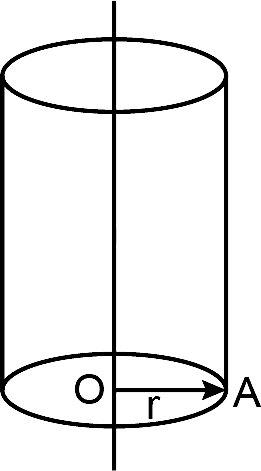
$A$ uniform current is flowing along the length of an infinite, straight, thin, hollow cylinder of radius $R$. The magnetic field $B$ produced at a perpendicular distance $d$ from the axis of the cylinder is plotted in a graph. Which of the following figures looks like the plot?
A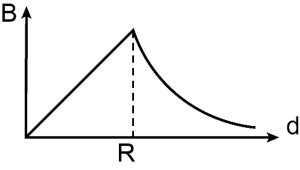
B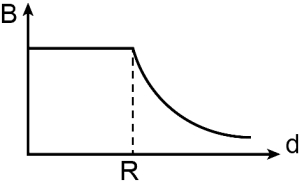
C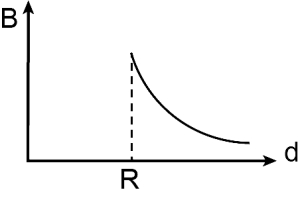
D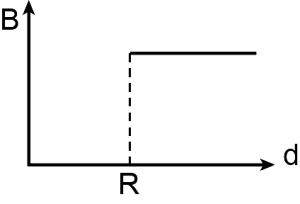
Solution
(C) For a thin hollow cylinder of radius $R$ carrying a uniform current $i$ along its length:
$1$. Inside the cylinder $(d < R)$, the magnetic field $B$ is zero because the enclosed current is zero.
$2$. Outside the cylinder $(d \geq R)$, the magnetic field $B$ is given by Ampere's Law as $B = \frac{\mu_{0} i}{2 \pi d}$. This shows that $B \propto \frac{1}{d}$.
Therefore, the graph of $B$ versus $d$ will show $B = 0$ for $d < R$ and a hyperbolic decay for $d \geq R$. This corresponds to the plot shown in figure $C$.
$1$. Inside the cylinder $(d < R)$, the magnetic field $B$ is zero because the enclosed current is zero.
$2$. Outside the cylinder $(d \geq R)$, the magnetic field $B$ is given by Ampere's Law as $B = \frac{\mu_{0} i}{2 \pi d}$. This shows that $B \propto \frac{1}{d}$.
Therefore, the graph of $B$ versus $d$ will show $B = 0$ for $d < R$ and a hyperbolic decay for $d \geq R$. This corresponds to the plot shown in figure $C$.
0 likes
View Solution204
MediumMCQ
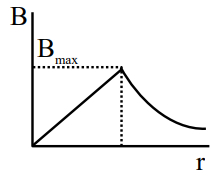
$A$ long cylindrical conductor with a large cross-section carries an electric current distributed uniformly over its cross-section. The magnetic field due to this current is:
A
$A$. maximum at either ends of the conductor and minimum at the midpoint
B
$B$. maximum at the axis of the conductor
C
$C$. minimum at the surface of the conductor
D
$D$. minimum at the axis of the conductor
Solution
(A) For a long cylindrical conductor of radius $R$ carrying a current $I$ distributed uniformly, the magnetic field $B$ at a distance $r$ from the axis is given by Ampere's circuital law:
$1$. Inside the conductor $(r < R)$: $B = \frac{\mu_0 I r}{2 \pi R^2}$. At the axis $(r = 0)$, $B = 0$, which is the minimum value.
$2$. At the surface $(r = R)$: $B = \frac{\mu_0 I}{2 \pi R}$, which is the maximum value.
$3$. Outside the conductor $(r > R)$: $B = \frac{\mu_0 I}{2 \pi r}$, which decreases as $r$ increases.
Thus, the magnetic field is minimum at the axis of the conductor (statement $D$). Statement $A, B, C, E$ are incorrect. Therefore, only statement $D$ is correct.
$1$. Inside the conductor $(r < R)$: $B = \frac{\mu_0 I r}{2 \pi R^2}$. At the axis $(r = 0)$, $B = 0$, which is the minimum value.
$2$. At the surface $(r = R)$: $B = \frac{\mu_0 I}{2 \pi R}$, which is the maximum value.
$3$. Outside the conductor $(r > R)$: $B = \frac{\mu_0 I}{2 \pi r}$, which decreases as $r$ increases.
Thus, the magnetic field is minimum at the axis of the conductor (statement $D$). Statement $A, B, C, E$ are incorrect. Therefore, only statement $D$ is correct.
0 likes
View Solution205
DifficultMCQ
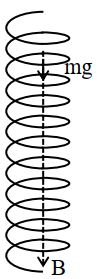
$A$ current-carrying solenoid is placed vertically and a particle of mass $m$ with charge $Q$ is released from rest. The particle moves along the axis of the solenoid. If $g$ is the acceleration due to gravity, then the acceleration $(a)$ of the charged particle will satisfy:
A
$a = g$
B
$a > g$
C
$a = 0$
D
$0 < a < g$
Solution
(A) The magnetic field $\vec{B}$ inside a long solenoid is directed along its axis.
Since the particle is released from rest and moves along the axis of the solenoid, its velocity vector $\vec{v}$ is always parallel or anti-parallel to the magnetic field vector $\vec{B}$.
The magnetic force on a moving charge is given by $\vec{F}_{B} = Q(\vec{v} \times \vec{B})$.
Since $\vec{v}$ is parallel to $\vec{B}$, the cross product $\vec{v} \times \vec{B} = 0$, hence $\vec{F}_{B} = 0$.
The only force acting on the particle is the gravitational force $\vec{F}_{g} = m\vec{g}$ acting downwards.
Therefore, the net force $\vec{F}_{net} = m\vec{g}$.
According to Newton's second law, $m\vec{a} = m\vec{g}$, which gives $\vec{a} = \vec{g}$.
Thus, the acceleration of the particle is $a = g$.
Since the particle is released from rest and moves along the axis of the solenoid, its velocity vector $\vec{v}$ is always parallel or anti-parallel to the magnetic field vector $\vec{B}$.
The magnetic force on a moving charge is given by $\vec{F}_{B} = Q(\vec{v} \times \vec{B})$.
Since $\vec{v}$ is parallel to $\vec{B}$, the cross product $\vec{v} \times \vec{B} = 0$, hence $\vec{F}_{B} = 0$.
The only force acting on the particle is the gravitational force $\vec{F}_{g} = m\vec{g}$ acting downwards.
Therefore, the net force $\vec{F}_{net} = m\vec{g}$.
According to Newton's second law, $m\vec{a} = m\vec{g}$, which gives $\vec{a} = \vec{g}$.
Thus, the acceleration of the particle is $a = g$.
0 likes
View Solution206
DifficultMCQ
$A$ solenoid has a core made of material with relative permeability $400$. The magnetic field produced in the interior of the solenoid is $1.0 \text{ T}$. The magnetic intensity in $SI$ units is $\alpha \times 10^5$. The value of $\alpha$ is . . . . . . . (Free space permeability $\mu_0 = 4\pi \times 10^{-7} \text{ SI units}$.)
A
$\frac{25}{\pi}$
B
$\frac{1}{16\pi}$
C
$\frac{1}{\pi}$
D
$\frac{1}{4\pi}$
Solution
(B) The magnetic field $B$ in a solenoid with a core is given by the formula $B = \mu_r \mu_0 H$, where $H$ is the magnetic intensity.
Given values are $B = 1.0 \text{ T}$, $\mu_r = 400$, and $\mu_0 = 4\pi \times 10^{-7} \text{ T m/A}$.
Rearranging the formula to solve for $H$, we get $H = \frac{B}{\mu_r \mu_0}$.
Substituting the values: $H = \frac{1.0}{400 \times 4\pi \times 10^{-7}} = \frac{1}{1600\pi \times 10^{-7}} = \frac{1}{16\pi \times 10^{-5}}$.
This simplifies to $H = \frac{10^5}{16\pi} = \frac{1}{16\pi} \times 10^5 \text{ A/m}$.
Comparing this with the given expression $\alpha \times 10^5$, we find $\alpha = \frac{1}{16\pi}$.
Given values are $B = 1.0 \text{ T}$, $\mu_r = 400$, and $\mu_0 = 4\pi \times 10^{-7} \text{ T m/A}$.
Rearranging the formula to solve for $H$, we get $H = \frac{B}{\mu_r \mu_0}$.
Substituting the values: $H = \frac{1.0}{400 \times 4\pi \times 10^{-7}} = \frac{1}{1600\pi \times 10^{-7}} = \frac{1}{16\pi \times 10^{-5}}$.
This simplifies to $H = \frac{10^5}{16\pi} = \frac{1}{16\pi} \times 10^5 \text{ A/m}$.
Comparing this with the given expression $\alpha \times 10^5$, we find $\alpha = \frac{1}{16\pi}$.
0 likes
View Solution207
DifficultMCQ
The region inside a current-carrying toroid is filled with a material (Niobium) having magnetic susceptibility $\chi = 2.6 \times 10^{-5}$. The percentage increase in the magnetic field in the presence of Niobium over that without it is:
A
$2.6 \times 10^{-3} \%$
B
$2.6 \times 10^{-4} \%$
C
$2.6 \times 10^{-2} \%$
D
$2.6 \times 10^{-5} \%$
Solution
(A) The magnetic field inside a toroid in vacuum is given by $B_0 = \mu_0 n I$.
When the toroid is filled with a material of magnetic susceptibility $\chi$, the magnetic field becomes $B = \mu_0 (1 + \chi) n I = B_0 (1 + \chi)$.
The increase in the magnetic field is $\Delta B = B - B_0 = B_0 \chi$.
The percentage increase in the magnetic field is given by $\frac{\Delta B}{B_0} \times 100 \% = \chi \times 100 \%$.
Given $\chi = 2.6 \times 10^{-5}$, the percentage increase is $(2.6 \times 10^{-5}) \times 100 \% = 2.6 \times 10^{-3} \%$.
When the toroid is filled with a material of magnetic susceptibility $\chi$, the magnetic field becomes $B = \mu_0 (1 + \chi) n I = B_0 (1 + \chi)$.
The increase in the magnetic field is $\Delta B = B - B_0 = B_0 \chi$.
The percentage increase in the magnetic field is given by $\frac{\Delta B}{B_0} \times 100 \% = \chi \times 100 \%$.
Given $\chi = 2.6 \times 10^{-5}$, the percentage increase is $(2.6 \times 10^{-5}) \times 100 \% = 2.6 \times 10^{-3} \%$.
0 likes
View Solution208
DifficultMCQ
The magnetic flux near the axis and inside the air core solenoid of length $60$ cm carrying current $I$ is $\frac{\pi}{2} \times 10^{-6} \text{ Wb}$. Its magnetic moment will be (cross-sectional area is very small as compared to length of solenoid, $\mu_0 = 4\pi \times 10^{-7} \text{ SI unit}$) (in $\text{ Am}^2$)
A
$0.75$
B
$0.25$
C
$0.50$
D
$1.0$
Solution
(A) The magnetic field inside a long solenoid is given by $B = \mu_0 n I$, where $n = N/L$ is the number of turns per unit length.
The magnetic flux $\phi$ through a cross-sectional area $A$ is $\phi = B \cdot A = \mu_0 \frac{N}{L} I A$.
The magnetic moment $M$ of a solenoid is given by $M = N I A$.
Substituting $M$ into the flux equation: $\phi = \frac{\mu_0 M}{L}$.
Given $\phi = \frac{\pi}{2} \times 10^{-6} \text{ Wb}$, $L = 0.6 \text{ m}$, and $\mu_0 = 4\pi \times 10^{-7} \text{ T m/A}$.
$\frac{\pi}{2} \times 10^{-6} = \frac{4\pi \times 10^{-7} \times M}{0.6}$.
$\frac{1}{2} \times 10^{-6} = \frac{4 \times 10^{-7} \times M}{0.6}$.
$0.5 \times 10^{-6} = \frac{4 \times 10^{-7} \times M}{0.6}$.
$M = \frac{0.5 \times 10^{-6} \times 0.6}{4 \times 10^{-7}} = \frac{0.3 \times 10^{-6}}{4 \times 10^{-7}} = \frac{0.3}{0.4} = 0.75 \text{ Am}^2$.
The magnetic flux $\phi$ through a cross-sectional area $A$ is $\phi = B \cdot A = \mu_0 \frac{N}{L} I A$.
The magnetic moment $M$ of a solenoid is given by $M = N I A$.
Substituting $M$ into the flux equation: $\phi = \frac{\mu_0 M}{L}$.
Given $\phi = \frac{\pi}{2} \times 10^{-6} \text{ Wb}$, $L = 0.6 \text{ m}$, and $\mu_0 = 4\pi \times 10^{-7} \text{ T m/A}$.
$\frac{\pi}{2} \times 10^{-6} = \frac{4\pi \times 10^{-7} \times M}{0.6}$.
$\frac{1}{2} \times 10^{-6} = \frac{4 \times 10^{-7} \times M}{0.6}$.
$0.5 \times 10^{-6} = \frac{4 \times 10^{-7} \times M}{0.6}$.
$M = \frac{0.5 \times 10^{-6} \times 0.6}{4 \times 10^{-7}} = \frac{0.3 \times 10^{-6}}{4 \times 10^{-7}} = \frac{0.3}{0.4} = 0.75 \text{ Am}^2$.
0 likes
View Solution209
MediumMCQ
The magnetic field intensity $(H)$ at the centre of a long solenoid having '$n$' turns per unit length and carrying a current $I$, when no material is kept in it is ($\mu_0$ = permeability of free space)
A
$n/I$
B
$nI$
C
$\mu_0 I$
D
$\mu_0/nI$
Solution
(B) For a long solenoid, the magnetic field induction $(B)$ at its centre is given by the formula: $B = \mu_0 n I$.
By definition, the magnetic field intensity $(H)$ is related to the magnetic field induction $(B)$ in free space by the relation: $H = B / \mu_0$.
Substituting the value of $B$ into the equation for $H$, we get: $H = (\mu_0 n I) / \mu_0$.
Therefore, $H = n I$.
Thus, the correct option is $B$.
By definition, the magnetic field intensity $(H)$ is related to the magnetic field induction $(B)$ in free space by the relation: $H = B / \mu_0$.
Substituting the value of $B$ into the equation for $H$, we get: $H = (\mu_0 n I) / \mu_0$.
Therefore, $H = n I$.
Thus, the correct option is $B$.
0 likes
View Solution210
MediumMCQ
The magnetic induction produced inside an ideal solenoid depends on which of the following quantities?
$(a)$ Number of turns per unit length $(n)$.
$(b)$ Radius of the wire.
$(c)$ Current flowing through it $(I)$.
$(d)$ Permeability of the medium $(\mu)$.
$(a)$ Number of turns per unit length $(n)$.
$(b)$ Radius of the wire.
$(c)$ Current flowing through it $(I)$.
$(d)$ Permeability of the medium $(\mu)$.
A
$(a)$, $(c)$ and $(d)$
B
$(a)$, $(b)$ and $(c)$
C
$(b)$, $(c)$ and $(d)$
D
$(a)$, $(b)$ and $(d)$
Solution
(A) The magnetic field $(B)$ inside an ideal solenoid is given by the formula:
$B = \mu n I$
Where:
- $\mu$ is the permeability of the medium inside the solenoid.
- $n$ is the number of turns per unit length.
- $I$ is the current flowing through the solenoid.
From the formula, it is clear that the magnetic induction depends on the permeability of the medium, the number of turns per unit length, and the current flowing through it. It does not depend on the radius of the wire.
Therefore, the correct quantities are $(a)$, $(c)$, and $(d)$.
$B = \mu n I$
Where:
- $\mu$ is the permeability of the medium inside the solenoid.
- $n$ is the number of turns per unit length.
- $I$ is the current flowing through the solenoid.
From the formula, it is clear that the magnetic induction depends on the permeability of the medium, the number of turns per unit length, and the current flowing through it. It does not depend on the radius of the wire.
Therefore, the correct quantities are $(a)$, $(c)$, and $(d)$.
0 likes
View Solution211
MediumMCQ
$A$ long solenoid carrying a current produces a magnetic field $B$ along its axis. If the current is tripled and the number of turns per cm is halved, then the new value of the magnetic field will be:
A
$B/2$
B
$B$
C
$3B/2$
D
$3B$
Solution
(C) The magnetic field $B$ inside a long solenoid is given by the formula $B = \mu_0 n I$, where $n$ is the number of turns per unit length and $I$ is the current flowing through the solenoid.
Let the initial magnetic field be $B_1 = \mu_0 n I$.
According to the problem, the new current $I' = 3I$ and the new number of turns per unit length $n' = n/2$.
The new magnetic field $B'$ is given by $B' = \mu_0 n' I' = \mu_0 (n/2) (3I) = \frac{3}{2} \mu_0 n I$.
Substituting $B = \mu_0 n I$, we get $B' = \frac{3}{2} B$.
Let the initial magnetic field be $B_1 = \mu_0 n I$.
According to the problem, the new current $I' = 3I$ and the new number of turns per unit length $n' = n/2$.
The new magnetic field $B'$ is given by $B' = \mu_0 n' I' = \mu_0 (n/2) (3I) = \frac{3}{2} \mu_0 n I$.
Substituting $B = \mu_0 n I$, we get $B' = \frac{3}{2} B$.
0 likes
View Solution212
MediumMCQ
$A$ solenoid of $1000$ turns is wound uniformly on a glass tube $4 \text{ m}$ long and $0.3 \text{ m}$ in diameter. The magnetic intensity at the centre of the solenoid when a current of $4 \text{ A}$ flows through it is
A
$2 \times 10^{3} \text{ A/m}$
B
$16 \times 10^{3} \text{ A/m}$
C
$4 \times 10^{3} \text{ A/m}$
D
$10^{3} \text{ A/m}$
Solution
(D) The magnetic intensity $H$ at the centre of a long solenoid is given by the formula $H = nI$, where $n$ is the number of turns per unit length and $I$ is the current flowing through it.
Given:
Total number of turns $N = 1000$
Length of the solenoid $L = 4 \text{ m}$
Current $I = 4 \text{ A}$
First, calculate the number of turns per unit length $n = N / L = 1000 / 4 = 250 \text{ turns/m}$.
Now, substitute the values into the formula:
$H = 250 \times 4 = 1000 \text{ A/m} = 10^{3} \text{ A/m}$.
Therefore, the correct option is $D$.
Given:
Total number of turns $N = 1000$
Length of the solenoid $L = 4 \text{ m}$
Current $I = 4 \text{ A}$
First, calculate the number of turns per unit length $n = N / L = 1000 / 4 = 250 \text{ turns/m}$.
Now, substitute the values into the formula:
$H = 250 \times 4 = 1000 \text{ A/m} = 10^{3} \text{ A/m}$.
Therefore, the correct option is $D$.
0 likes
View Solution213
MediumMCQ
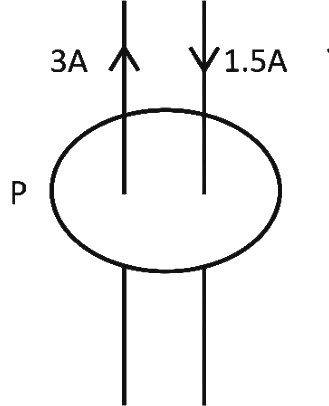
Two wires with currents $3 \text{ A}$ and $1.5 \text{ A}$ are enclosed in a circular loop $P$. $A$ third parallel wire with current $1 \text{ A}$ is situated outside the loop as shown. All the wires are perpendicular to the plane of the circular loop. The value of $\oint \vec{B} \cdot d\vec{l}$ around the loop is ($\mu_0$ = permeability of free space) (in $\mu_0$)
A
$5.5$
B
$2.5$
C
$1.5$
D
$0.5$
Solution
(C) According to Ampere's Circuital Law, the line integral of the magnetic field $\vec{B}$ around a closed loop is given by $\oint \vec{B} \cdot d\vec{l} = \mu_0 I_{\text{enclosed}}$.
Here, $I_{\text{enclosed}}$ is the net current passing through the area enclosed by the loop $P$.
The currents inside the loop are $I_1 = 3 \text{ A}$ (upwards) and $I_2 = 1.5 \text{ A}$ (downwards).
Taking the upward direction as positive, the net enclosed current is $I_{\text{enclosed}} = 3 \text{ A} - 1.5 \text{ A} = 1.5 \text{ A}$.
The current outside the loop does not contribute to the line integral.
Therefore, $\oint \vec{B} \cdot d\vec{l} = \mu_0 (1.5 \text{ A}) = 1.5 \mu_0$.
Here, $I_{\text{enclosed}}$ is the net current passing through the area enclosed by the loop $P$.
The currents inside the loop are $I_1 = 3 \text{ A}$ (upwards) and $I_2 = 1.5 \text{ A}$ (downwards).
Taking the upward direction as positive, the net enclosed current is $I_{\text{enclosed}} = 3 \text{ A} - 1.5 \text{ A} = 1.5 \text{ A}$.
The current outside the loop does not contribute to the line integral.
Therefore, $\oint \vec{B} \cdot d\vec{l} = \mu_0 (1.5 \text{ A}) = 1.5 \mu_0$.
0 likes
View SolutionMoving Charges and Magnetism — Ampere’s circuital law and its application (Solenoid and Toroid) · Frequently Asked Questions
1Are these Moving Charges and Magnetism questions useful for JEE and NEET?
Yes. All questions in this section are mapped to JEE Main and NEET exam patterns. Previous year questions from JEE Main, NEET, GUJCET and state-level exams are included with full solutions.
2Can I switch to Hindi or Gujarati for these questions?
Yes. Use the language tabs in the hero section or the sidebar to view the same questions and solutions in English, Hindi or Gujarati.
3How do I generate a question paper from this subtopic?
Use the Vedclass Exam Paper Generator — select the chapter and subtopic, set difficulty, and generate Sets A, B, C, D automatically. First 3 chapters of every subject are free.
Vedclass Products
For Students
Vedclass Test Series
Mock tests in real JEE/NEET style with performance analysis. 5-day free trial.
Start Free TrialFor Teachers
Exam Paper Generator
Generate Set A/B/C/D papers from this chapter in 2 minutes. 3 chapters free.
Try FreeFor Institutes
Online Exam Module
Live online exams with unlimited students, 360° analytics & white-label branding.
See DemoFor Teachers & Institutes
Generate a Moving Charges and Magnetism Exam Paper in 2 Minutes
Select subtopic & difficulty — Sets A, B, C, D auto-generated with No Repeat logic.
First 3 chapters of every subject are free — no payment required.