
$L$-isomer of a compound $A$ $(C_{4}H_{8}O_{4})$ gives a positive test with $[Ag(NH_{3})_{2}]^{+}$. Treatment of $A$ with acetic anhydride yields a triacetate derivative. Compound $A$ produces an optically active compound $B$ and an optically inactive compound $C$ on treatment with bromine water and $HNO_{3}$ respectively. Compound $A$ is ....
- A
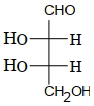
- B
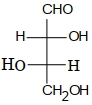
- C
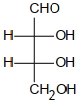
- D
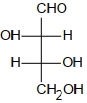
Explore More
Similar Questions
Which of the following is a linear polymer?
Medium
View SolutionWhich among the following is a non-reducing sugar?
Medium
View SolutionWrite a note on Disaccharide compounds.
With which of the following does glucose $NOT$ react?
Medium
View SolutionHow do you explain the absence of aldehyde group in the pentaacetate of $D$-glucose?
Difficult
View SolutionVedclass Products
For Students
Vedclass Test Series
Mock tests in real JEE/NEET style with performance analysis. 5-day free trial.
Start Free TrialFor Teachers
Exam Paper Generator
Generate Set A/B/C/D exam papers from 7.5L+ questions in 2 minutes. 3 chapters free.
Try FreeFor Institutes
Online Exam Module
Live online exams with unlimited students, 360° analytics & white-label branding.
See Demo