
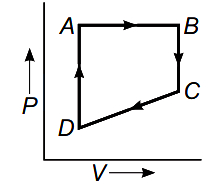
$A$ cyclic process $ABCD$ is shown in the given $P-V$ diagram. Which of the following diagrams represents the same process in a $P-T$ graph?
- A
- B
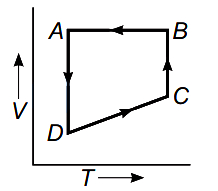
- C
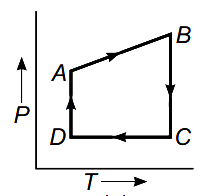
- D
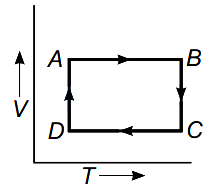
Explore More
Similar Questions
The relation between efficiency $(\eta)$ of a Carnot engine and the coefficient of performance $(\beta)$ of a refrigerator working between the same temperatures is:
Match List-$I$ with List-$II$.
List-$I$ List-$II$ $(A)$ Isothermal $(I)$ $\Delta W = 0$ $(B)$ Adiabatic $(II)$ $\Delta Q = 0$ $(C)$ Isobaric $(III)$ $\Delta U \neq 0$ $(D)$ Isochoric $(IV)$ $\Delta U = 0$
Choose the correct answer from the options given below:
| List-$I$ | List-$II$ |
| $(A)$ Isothermal | $(I)$ $\Delta W = 0$ |
| $(B)$ Adiabatic | $(II)$ $\Delta Q = 0$ |
| $(C)$ Isobaric | $(III)$ $\Delta U \neq 0$ |
| $(D)$ Isochoric | $(IV)$ $\Delta U = 0$ |
Choose the correct answer from the options given below:
$A$ monoatomic gas performs a work of $\frac{Q}{4}$,where $Q$ is the heat supplied to it. The molar heat capacity of the gas during this transformation will be $xR$,where $R$ is the gas constant. Find the value of $x$.
One mole of an ideal gas goes from an initial state $A$ to a final state $B$ via two processes: It first undergoes isothermal expansion from volume $V$ to $3V$ and then its volume is reduced from $3V$ to $V$ at constant pressure. The correct $P-V$ diagram representing the two processes is:
MediumAIPMT 2012
View SolutionConsider the following volume-temperature $(V-T)$ diagram for the expansion of $5$ moles of an ideal monoatomic gas. Considering only $P-V$ work is involved,the total change in enthalpy (in Joule) for the transformation of state in the sequence $X \rightarrow Y \rightarrow Z$ is $\qquad$ [Use the given data: Molar heat capacity of the gas for the given temperature range,$C_{v,m} = 12 \ J \ K^{-1} \ mol^{-1}$ and gas constant,$R = 8.3 \ J \ K^{-1} \ mol^{-1}$]
Vedclass Products
For Students
Vedclass Test Series
Mock tests in real JEE/NEET style with performance analysis. 5-day free trial.
Start Free TrialFor Teachers
Exam Paper Generator
Generate Set A/B/C/D exam papers from 7.5L+ questions in 2 minutes. 3 chapters free.
Try FreeFor Institutes
Online Exam Module
Live online exams with unlimited students, 360° analytics & white-label branding.
See Demo