
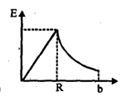
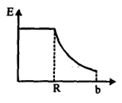
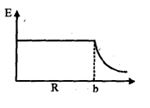
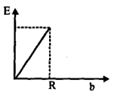
$A$ charge $Q$ is uniformly distributed over the volume of an insulating sphere of radius $R$. $A$ thin metal shell of radius $b$ $(b > R)$ with a charge $-Q$ is placed around the sphere. The space between the sphere and the shell is filled with air. Which of the following graphs correctly represents the electric field $E$ as a function of distance $r$ from the center?
- A
- B
- C
- D
Explore More
Similar Questions
Two metal plates $(A, B)$ are kept horizontally with a separation of $(\frac{12}{\pi}) \text{ cm}$, with plate $A$ on the top. An atomizer jet sprays oil (density $1.5 \text{ g/cm}^3$) droplets of radius $1 \text{ mm}$ horizontally. All oil droplets carry a charge of $5 \text{ nC}$. The potentials $V_A$ and $V_B$ are required on plates $A$ and $B$ respectively in order to ensure the droplets do not descend. The values of $V_A$ and $V_B$ are . . . . . . . (Neglect the air resistance to the droplets and take $g = 10 \text{ m/s}^2$)
DifficultJEE MAIN 2026
View SolutionTwo identical point charges are placed at a separation of $l$. $P$ is a point on the line joining the charges,at a distance $x$ from any one charge. The field at $P$ is $E$. $E$ is plotted against $x$ for values of $x$ from close to zero to slightly less than $l$. Which of the following best represents the resulting curve?
Difficult
View SolutionThe energy density $u$ is plotted against the distance $r$ from the centre of a spherical charge distribution on a $log$-$log$ scale. The slope of the obtained straight line is:
Difficult
View Solution$A$ charge $Q$ of mass $m$ revolves around a charge $q$ due to the electrostatic attraction between them. The time period of its motion can be given by the formula:
Medium
View SolutionTwo identical balls having like charges $Q_1$ and $Q_2$ are placed at a certain distance $r$ apart and repel each other with a force $F_1$. They are brought into contact and then moved apart to a distance equal to half their initial separation $(r/2)$. The force of repulsion between them increases $4.5$ times in comparison with the initial value. The ratio of the initial charges of the balls is
Difficult
View SolutionVedclass Products
For Students
Vedclass Test Series
Mock tests in real JEE/NEET style with performance analysis. 5-day free trial.
Start Free TrialFor Teachers
Exam Paper Generator
Generate Set A/B/C/D exam papers from 7.5L+ questions in 2 minutes. 3 chapters free.
Try FreeFor Institutes
Online Exam Module
Live online exams with unlimited students, 360° analytics & white-label branding.
See Demo