
Difficult
$A$ bacterial infection in an internal wound grows as $N(t) = N_0 \exp(t)$,where the time $t$ is in hours. $A$ dose of antibiotic,taken orally,needs $1 \ hour$ to reach the wound. Once it reaches there,the bacterial population decreases as $\frac{dN}{dt} = -5N^2$. What will be the plot of $\frac{N_0}{N}$ vs. $t$ after $1 \ hour$?
- A
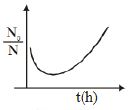
- B
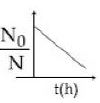
- C
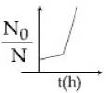
- D
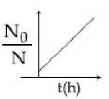
Explore More
Similar Questions
In the reaction $A + B \to \text{Products}$,the initial concentration of both $A$ and $B$ is $0.1 \, M$. When the concentration decreases to $1.0 \times 10^{-2} \, M$,the half-life period increases by ten times. The rate of the reaction is:
Medium
View SolutionWhy can’t molecularity of any reaction be equal to zero?
Easy
View SolutionRate law for a reaction is $r=k[A]^2[B]$. If rate constant is $6.25 \ mol^{-2} \ dm^6 \ s^{-1}$,what is the rate of reaction when $[A]=1 \ mol \ dm^{-3}$ and $[B]=0.2 \ mol \ dm^{-3}$?
The hydrolysis of ethyl acetate is a reaction of $.........$ order.
$CH_3COOEt + H_2O \xrightarrow{H^{+}} CH_3COOH + EtOH$
$CH_3COOEt + H_2O \xrightarrow{H^{+}} CH_3COOH + EtOH$
Medium
View SolutionRate of reaction is $r_1 = k[A]^a[B]^b$. If the concentration of $A$ is doubled and $B$ is halved,the new rate is $r_2$. What is the value of $\frac{r_2}{r_1}$?
Vedclass Products
For Students
Vedclass Test Series
Mock tests in real JEE/NEET style with performance analysis. 5-day free trial.
Start Free TrialFor Teachers
Exam Paper Generator
Generate Set A/B/C/D exam papers from 7.5L+ questions in 2 minutes. 3 chapters free.
Try FreeFor Institutes
Online Exam Module
Live online exams with unlimited students, 360° analytics & white-label branding.
See Demo