
$A$ ball is dropped vertically from a height $d$ above the ground. It hits the ground and bounces up vertically to a height $d/2$. Neglecting subsequent motion and air resistance,its velocity $v$ varies with the height $h$ above the ground as:
- A
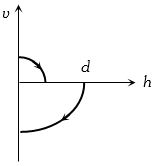
- B
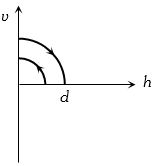
- C
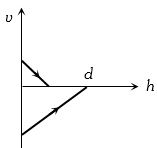
- D
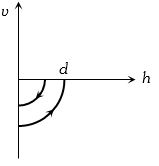
Explore More
Similar Questions
State whether the following statements are true or false:
$(a)$ An object can have acceleration even when its velocity is zero.
$(b)$ If the acceleration of a moving object is constant,the direction of its velocity must remain the same.
$(c)$ The speed of an object can never be zero.
$(a)$ An object can have acceleration even when its velocity is zero.
$(b)$ If the acceleration of a moving object is constant,the direction of its velocity must remain the same.
$(c)$ The speed of an object can never be zero.
Medium
View SolutionDuring the first $18\,min$ of a $60\,min$ trip,a car has an average speed of $11\,m/s$. What should be the average speed for the remaining $42\,min$ so that the car has an average speed of $21\,m/s$ for the entire trip (in $,m/s$)?
Easy
View SolutionTwo stones are thrown up vertically and simultaneously but with different speeds. Which graph correctly represents the time variation of their relative position $\Delta x$? Assume that stones do not bounce after hitting the ground.
Difficult
View SolutionAssertion $(A)$: The angle between acceleration and velocity of a body in one-dimensional motion is always zero. Reason $(R)$: One-dimensional motion is along a straight line.
$A$ car moves towards north at a speed of $54 \,km/h$ for $1 \,h$. Then it moves eastward with the same speed for the same duration. The average speed and velocity of the car for the complete journey is ..........
Medium
View SolutionVedclass Products
For Students
Vedclass Test Series
Mock tests in real JEE/NEET style with performance analysis. 5-day free trial.
Start Free TrialFor Teachers
Exam Paper Generator
Generate Set A/B/C/D exam papers from 7.5L+ questions in 2 minutes. 3 chapters free.
Try FreeFor Institutes
Online Exam Module
Live online exams with unlimited students, 360° analytics & white-label branding.
See Demo