
$A$ particle of charge $q$ and mass $m$ is moving along the $x$-axis with a velocity $v$ and enters a region of electric field $E$ and magnetic field $B$ as shown in the figures below. For which figure may the net force on the charge be zero?
- A
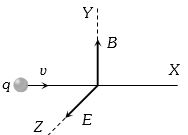
- B
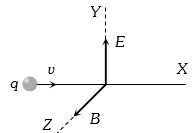
- C
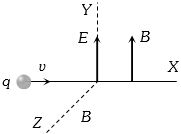
- D
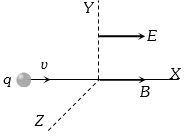
Explore More
Similar Questions
Two long straight parallel wires are a distance $2d$ apart. They carry steady equal currents flowing out of the plane of the paper. The variation of magnetic field $B$ along the line $xx'$ is given by:
MediumKCET 2020
View SolutionTwo parallel beams of electrons moving in the same direction produce a mutual force:
Easy
View SolutionThere exists a uniform magnetic field of magnitude $1\, T$ and a uniform electric field of magnitude $1\, V/m$ along the positive $y-$ axis. $A$ charged particle of mass $1\, kg$ and charge $1\, C$ has an initial velocity of $1\, m/s$ along the $x-$ axis and is at the origin at $t = 0$. Find the coordinates of the particle at time $t = \pi$ seconds.
Difficult
View SolutionTwo concentric loops $A$ and $B$ of same radius $R = 2 \pi \,cm = 2 \pi \times 10^{-2} \,m$ are placed at right angles to each other. If the currents flowing through $A$ and $B$ are $I_A = 3 \,A$ and $I_B = 4 \,A$ respectively, then the net magnetic field at their common centre is:
When a proton is released from rest in a room,it starts with an initial acceleration $a_0$ towards west. When it is projected towards north with a speed $v_0$,it moves with an initial acceleration $3a_0$ towards west. The electric and magnetic fields in the room are
MediumAIPMT 2013
View SolutionVedclass Products
For Students
Vedclass Test Series
Mock tests in real JEE/NEET style with performance analysis. 5-day free trial.
Start Free TrialFor Teachers
Exam Paper Generator
Generate Set A/B/C/D exam papers from 7.5L+ questions in 2 minutes. 3 chapters free.
Try FreeFor Institutes
Online Exam Module
Live online exams with unlimited students, 360° analytics & white-label branding.
See Demo