
The acceleration versus time graph of a body starting from rest is shown in the figure. The velocity versus time graph of the body is given by:
- A
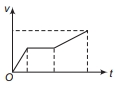
- B
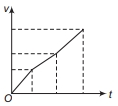
- C
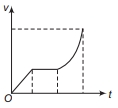
- D
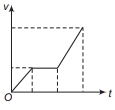
Explore More
Similar Questions
Let $v$ and $a$ denote the velocity and acceleration respectively of a particle in one-dimensional motion. Which of the following statements is correct?
Medium
View SolutionAn object with a mass $10 \, kg$ moves at a constant velocity of $10 \, m/s$. $A$ constant force then acts for $4 \, s$ on the object and gives it a speed of $2 \, m/s$ in the opposite direction. The acceleration produced in it is ........ $m/s^2$.
Easy
View Solution$A$ body in one-dimensional motion has zero speed at an instant. At that instant,it must have:
Easy
View Solution$A$ particle is moving in one dimension (along $x$-axis) under the action of a variable force. Its initial position was $16 \,m$ right of the origin. The variation of its position $(x)$ with time $(t)$ is given as $x = -3t^3 + 18t^2 + 16t$,where $x$ is in $m$ and $t$ is in $s$. The velocity of the particle when its acceleration becomes zero is . . . . . . $m/s$.
DifficultJEE MAIN 2024
View SolutionThe velocity of a particle is given as $\vec{v} = -x\hat{i} + 2y\hat{j} - z\hat{k} \text{ m/s}$. The magnitude of acceleration at point $(1, 2, 4)$ is . . . . . . $\text{m/s}^2$.
DifficultJEE MAIN 2026
View SolutionVedclass Products
For Students
Vedclass Test Series
Mock tests in real JEE/NEET style with performance analysis. 5-day free trial.
Start Free TrialFor Teachers
Exam Paper Generator
Generate Set A/B/C/D exam papers from 7.5L+ questions in 2 minutes. 3 chapters free.
Try FreeFor Institutes
Online Exam Module
Live online exams with unlimited students, 360° analytics & white-label branding.
See Demo