
The curve between the activity $A$ of a radioactive sample and the number of active atoms $N$ is
- A
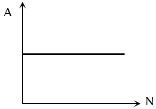
- B
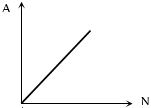
- C
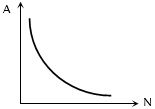
- D
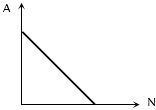
Explore More
Similar Questions
$A$ $16\, g$ sample of a radioactive element is taken from Bombay to Delhi in $2\, hours$ and it is found that $1\, g$ of the element remains (undisintegrated). The half-life of the element is:
Medium
View SolutionThe masses of two radioactive substances are same and their half-lives are $1 \ yr$ and $2 \ yr$ respectively. The ratio of their activities after $4 \ yr$ will be
$A$ radioactive material decays by simultaneous emissions of two particles with half-lives of $1400 \, years$ and $700 \, years$ respectively. What will be the time after which one-third of the material remains? (Take $\ln 3 = 1.1$) (In $years$)
DifficultJEE MAIN 2021
View SolutionThe activity of a radioactive sample is $64 \times 10^{-5} \text{ Ci}$. Its half-life is $3 \text{ days}$. The activity will become $5 \times 10^{-6} \text{ Ci}$ after how many days?
Medium
View SolutionTwo radioactive substances $X$ and $Y$ originally have $N_{1}$ and $N_{2}$ nuclei respectively. The half-life of $X$ is half of the half-life of $Y$. After three half-lives of $Y$,the number of nuclei of both are equal. The ratio $\frac{N_{1}}{N_{2}}$ will be equal to:
DifficultJEE MAIN 2021
View SolutionVedclass Products
For Students
Vedclass Test Series
Mock tests in real JEE/NEET style with performance analysis. 5-day free trial.
Start Free TrialFor Teachers
Exam Paper Generator
Generate Set A/B/C/D exam papers from 7.5L+ questions in 2 minutes. 3 chapters free.
Try FreeFor Institutes
Online Exam Module
Live online exams with unlimited students, 360° analytics & white-label branding.
See Demo