
A English
Pressure and Energy Questions in English
Class 11 Physics · Kinetic Theory of Gases · Pressure and Energy
209+
Questions
English
Language
100%
With Solutions
Showing 9 of 209 questions in English
201
MediumMCQ
Which one of the graphs below best illustrates the relationship between internal energy $U$ of an ideal gas and temperature $T$ of the gas in $K$?
A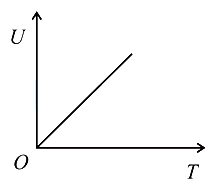
B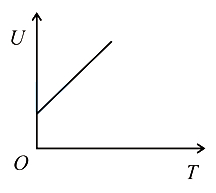
C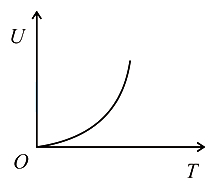
D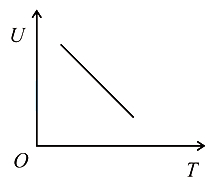
Solution
(A) For an ideal gas,the intermolecular forces are assumed to be negligible,and collisions are perfectly elastic.
Consequently,the internal energy $U$ of an ideal gas is solely a function of its absolute temperature $T$.
According to the kinetic theory of gases,the internal energy of an ideal gas is given by $U = \frac{f}{2} nRT$,where $f$ is the degrees of freedom,$n$ is the number of moles,$R$ is the universal gas constant,and $T$ is the temperature in Kelvin.
Since $U \propto T$,the relationship between internal energy $U$ and temperature $T$ is linear,passing through the origin $(0, 0)$.
Therefore,the graph that best illustrates this relationship is a straight line passing through the origin,which corresponds to Graph $A$.
Consequently,the internal energy $U$ of an ideal gas is solely a function of its absolute temperature $T$.
According to the kinetic theory of gases,the internal energy of an ideal gas is given by $U = \frac{f}{2} nRT$,where $f$ is the degrees of freedom,$n$ is the number of moles,$R$ is the universal gas constant,and $T$ is the temperature in Kelvin.
Since $U \propto T$,the relationship between internal energy $U$ and temperature $T$ is linear,passing through the origin $(0, 0)$.
Therefore,the graph that best illustrates this relationship is a straight line passing through the origin,which corresponds to Graph $A$.
0 likes
View Solution202
EasyMCQ
The ratio of the average translational kinetic energies of hydrogen and oxygen at the same temperature is
A
$1: 8$
B
$1: 4$
C
$1: 1$
D
$1: 16$
Solution
(C) The average translational kinetic energy $(K_{avg})$ of a gas molecule is given by the formula: $K_{avg} = \frac{3}{2} k_B T$, where $k_B$ is the Boltzmann constant and $T$ is the absolute temperature.
Since the temperature $T$ is the same for both hydrogen and oxygen, the average translational kinetic energy depends only on the temperature.
Therefore, the ratio of the average translational kinetic energies of hydrogen and oxygen is $1: 1$.
Since the temperature $T$ is the same for both hydrogen and oxygen, the average translational kinetic energy depends only on the temperature.
Therefore, the ratio of the average translational kinetic energies of hydrogen and oxygen is $1: 1$.
0 likes
View Solution203
MediumMCQ
In an ideal gas, if the masses of all molecules are doubled and their speeds are halved, then the ratio of initial and final pressures of the gas is
A
$2: 1$
B
$1: 2$
C
$4: 1$
D
$1: 4$
Solution
(A) The pressure of an ideal gas is given by the kinetic theory formula:
$p = \frac{1}{3} \frac{M}{V} v_{rms}^2 = \frac{1}{3} \frac{N m}{V} v^2$
where $m$ is the mass of a molecule, $N$ is the number of molecules, $V$ is the volume, and $v$ is the root-mean-square speed.
Let the initial pressure be $p = \frac{1}{3} \frac{N m}{V} v^2$.
When the mass of each molecule is doubled $(m' = 2m)$ and the speed is halved $(v' = v/2)$, the new pressure $p'$ is:
$p' = \frac{1}{3} \frac{N (2m)}{V} \left(\frac{v}{2}\right)^2$
$p' = \frac{1}{3} \frac{N (2m)}{V} \left(\frac{v^2}{4}\right) = \frac{1}{2} \left( \frac{1}{3} \frac{N m}{V} v^2 \right) = \frac{1}{2} p$
Therefore, the ratio of initial pressure to final pressure is:
$\frac{p}{p'} = \frac{p}{p/2} = \frac{2}{1}$
Thus, the ratio is $2: 1$.
$p = \frac{1}{3} \frac{M}{V} v_{rms}^2 = \frac{1}{3} \frac{N m}{V} v^2$
where $m$ is the mass of a molecule, $N$ is the number of molecules, $V$ is the volume, and $v$ is the root-mean-square speed.
Let the initial pressure be $p = \frac{1}{3} \frac{N m}{V} v^2$.
When the mass of each molecule is doubled $(m' = 2m)$ and the speed is halved $(v' = v/2)$, the new pressure $p'$ is:
$p' = \frac{1}{3} \frac{N (2m)}{V} \left(\frac{v}{2}\right)^2$
$p' = \frac{1}{3} \frac{N (2m)}{V} \left(\frac{v^2}{4}\right) = \frac{1}{2} \left( \frac{1}{3} \frac{N m}{V} v^2 \right) = \frac{1}{2} p$
Therefore, the ratio of initial pressure to final pressure is:
$\frac{p}{p'} = \frac{p}{p/2} = \frac{2}{1}$
Thus, the ratio is $2: 1$.
0 likes
View Solution204
EasyMCQ
The total internal energy of $4$ moles of a diatomic gas at a temperature of $27^{\circ} C$ is (Universal gas constant $R = 8.31 \ J \ mol^{-1} \ K^{-1}$) (in $kJ$)
A
$13.47$
B
$4.98$
C
$24.93$
D
$14.96$
Solution
(C) The formula for the total internal energy $U$ of an ideal gas is given by $U = n \frac{f}{2} R T$.
For a diatomic gas, the degrees of freedom $f = 5$.
Given: number of moles $n = 4$, temperature $T = 27^{\circ} C = 27 + 273 = 300 \ K$, and $R = 8.31 \ J \ mol^{-1} \ K^{-1}$.
Substituting these values into the formula:
$U = 4 \times \frac{5}{2} \times 8.31 \times 300$
$U = 2 \times 5 \times 8.31 \times 300$
$U = 10 \times 2493 = 24930 \ J$
$U = 24.93 \ kJ$.
For a diatomic gas, the degrees of freedom $f = 5$.
Given: number of moles $n = 4$, temperature $T = 27^{\circ} C = 27 + 273 = 300 \ K$, and $R = 8.31 \ J \ mol^{-1} \ K^{-1}$.
Substituting these values into the formula:
$U = 4 \times \frac{5}{2} \times 8.31 \times 300$
$U = 2 \times 5 \times 8.31 \times 300$
$U = 10 \times 2493 = 24930 \ J$
$U = 24.93 \ kJ$.
0 likes
View Solution205
DifficultMCQ
The energy of a gas per litre is $600 \text{ J}$. What will be its pressure?
A
$4 \times 10^5 \text{ N/m}^2$
B
$10^5 \text{ N/m}^2$
C
$6 \times 10^5 \text{ N/m}^2$
D
$3 \times 10^5 \text{ N/m}^2$
Solution
(A) For an ideal gas, the internal energy $U$ is related to pressure $P$ and volume $V$ by the formula: $U = \frac{3}{2} PV$.
Given, energy per unit volume (energy density) is $u = \frac{U}{V} = 600 \text{ J/L}$.
Since $1 \text{ L} = 10^{-3} \text{ m}^3$, the energy density in $SI$ units is $u = \frac{600 \text{ J}}{10^{-3} \text{ m}^3} = 6 \times 10^5 \text{ J/m}^3$.
Using the relation $u = \frac{3}{2} P$, we get $P = \frac{2}{3} u$.
Substituting the value of $u$: $P = \frac{2}{3} \times 6 \times 10^5 \text{ N/m}^2 = 4 \times 10^5 \text{ N/m}^2$.
Given, energy per unit volume (energy density) is $u = \frac{U}{V} = 600 \text{ J/L}$.
Since $1 \text{ L} = 10^{-3} \text{ m}^3$, the energy density in $SI$ units is $u = \frac{600 \text{ J}}{10^{-3} \text{ m}^3} = 6 \times 10^5 \text{ J/m}^3$.
Using the relation $u = \frac{3}{2} P$, we get $P = \frac{2}{3} u$.
Substituting the value of $u$: $P = \frac{2}{3} \times 6 \times 10^5 \text{ N/m}^2 = 4 \times 10^5 \text{ N/m}^2$.
0 likes
View Solution206
MediumMCQ
The average force applied on the walls of a closed container depends on temperature $(T)$ as ($T$ is the temperature of an ideal gas).
A
$T^2$
B
$T^3$
C
$T^1$
D
$T^{-1}$
Solution
(C) According to the kinetic theory of gases, the pressure $(P)$ exerted by an ideal gas on the walls of a container is given by the relation $P = \frac{1}{3} \rho v_{rms}^2$, where $\rho$ is the density and $v_{rms}$ is the root mean square velocity.
Since $v_{rms} = \sqrt{\frac{3RT}{M}}$, we have $v_{rms}^2 = \frac{3RT}{M}$.
Substituting this into the pressure equation, we get $P = \frac{1}{3} \rho \left(\frac{3RT}{M}\right) = \frac{\rho RT}{M}$.
Since the density $\rho$ and molar mass $M$ are constant for a fixed amount of gas in a closed container, the pressure $P$ is directly proportional to the temperature $T$ $(P \propto T)$.
Force $(F)$ is defined as pressure multiplied by the area of the wall $(F = P \times A)$.
Since the area of the container walls is constant, the force $F$ is also directly proportional to the pressure, and thus directly proportional to the temperature $(F \propto T^1)$.
Since $v_{rms} = \sqrt{\frac{3RT}{M}}$, we have $v_{rms}^2 = \frac{3RT}{M}$.
Substituting this into the pressure equation, we get $P = \frac{1}{3} \rho \left(\frac{3RT}{M}\right) = \frac{\rho RT}{M}$.
Since the density $\rho$ and molar mass $M$ are constant for a fixed amount of gas in a closed container, the pressure $P$ is directly proportional to the temperature $T$ $(P \propto T)$.
Force $(F)$ is defined as pressure multiplied by the area of the wall $(F = P \times A)$.
Since the area of the container walls is constant, the force $F$ is also directly proportional to the pressure, and thus directly proportional to the temperature $(F \propto T^1)$.
0 likes
View Solution207
MediumMCQ
The translational kinetic energy of the molecules of a gas at absolute temperature $T$ can be doubled by
A
increasing $T$ to $4T$
B
increasing $T$ to $\sqrt{2}T$
C
decreasing $T$ to $T/2$
D
increasing $T$ to $2T$
Solution
(D) The translational kinetic energy $(K)$ of a gas molecule is given by the formula: $K = \frac{3}{2} k_B T$, where $k_B$ is the Boltzmann constant and $T$ is the absolute temperature.
From this relation, it is clear that $K \propto T$.
If the kinetic energy is to be doubled, i.e.,$K' = 2K$, then the new temperature $T'$ must satisfy the relation $K' \propto T'$.
Since $K' = 2K$, we have $T' = 2T$.
Therefore, the absolute temperature must be increased to $2T$ to double the translational kinetic energy of the gas molecules.
From this relation, it is clear that $K \propto T$.
If the kinetic energy is to be doubled, i.e.,$K' = 2K$, then the new temperature $T'$ must satisfy the relation $K' \propto T'$.
Since $K' = 2K$, we have $T' = 2T$.
Therefore, the absolute temperature must be increased to $2T$ to double the translational kinetic energy of the gas molecules.
0 likes
View Solution208
MediumMCQ
The kinetic energy of an ideal gas is $E_0$ at $27^\circ$$C$. When the temperature is increased to $177^\circ$$C$, then the kinetic energy will be
A
$E_0/2$
B
$2E_0/3$
C
$3E_0/2$
D
$2E_0$
Solution
(C) The kinetic energy $(K.E.)$ of an ideal gas is directly proportional to its absolute temperature $(T)$ in Kelvin.
$K.E. \propto T$
Given, initial temperature $T_1 = 27^\circ$$C$ = $27 + 273 = 300$ $K$.
Initial kinetic energy $K_1 = E_0$.
Final temperature $T_2 = 177^\circ$$C$ = $177 + 273 = 450$ $K$.
Using the relation $\frac{K_2}{K_1} = \frac{T_2}{T_1}$:
$\frac{K_2}{E_0} = \frac{450}{300}$
$\frac{K_2}{E_0} = \frac{3}{2}$
$K_2 = \frac{3}{2} E_0$.
$K.E. \propto T$
Given, initial temperature $T_1 = 27^\circ$$C$ = $27 + 273 = 300$ $K$.
Initial kinetic energy $K_1 = E_0$.
Final temperature $T_2 = 177^\circ$$C$ = $177 + 273 = 450$ $K$.
Using the relation $\frac{K_2}{K_1} = \frac{T_2}{T_1}$:
$\frac{K_2}{E_0} = \frac{450}{300}$
$\frac{K_2}{E_0} = \frac{3}{2}$
$K_2 = \frac{3}{2} E_0$.
0 likes
View Solution209
MediumMCQ
Assuming the expression for the pressure exerted by the gas, it can be shown that pressure is
A
$(2/3)$ rd of kinetic energy per unit volume of a gas.
B
$(3/4)$ th of kinetic energy per unit volume of a gas.
C
$(1/3)$ rd of kinetic energy per unit volume of a gas.
D
$(1/2)$ of kinetic energy per unit volume of a gas.
Solution
(A) According to the kinetic theory of gases, the pressure $P$ exerted by an ideal gas is given by the expression:
$P = \frac{1}{3} \rho v_{rms}^2$
where $\rho$ is the density of the gas and $v_{rms}$ is the root mean square velocity.
We know that the kinetic energy per unit volume $E$ is given by:
$E = \frac{1}{2} \rho v_{rms}^2$
From this, we can write $\rho v_{rms}^2 = 2E$.
Substituting this into the pressure expression:
$P = \frac{1}{3} (2E) = \frac{2}{3} E$
Thus, the pressure is $(2/3)$ rd of the kinetic energy per unit volume of the gas.
$P = \frac{1}{3} \rho v_{rms}^2$
where $\rho$ is the density of the gas and $v_{rms}$ is the root mean square velocity.
We know that the kinetic energy per unit volume $E$ is given by:
$E = \frac{1}{2} \rho v_{rms}^2$
From this, we can write $\rho v_{rms}^2 = 2E$.
Substituting this into the pressure expression:
$P = \frac{1}{3} (2E) = \frac{2}{3} E$
Thus, the pressure is $(2/3)$ rd of the kinetic energy per unit volume of the gas.
0 likes
View SolutionKinetic Theory of Gases — Pressure and Energy · Frequently Asked Questions
1Are these Kinetic Theory of Gases questions useful for JEE and NEET?
Yes. All questions in this section are mapped to JEE Main and NEET exam patterns. Previous year questions from JEE Main, NEET, GUJCET and state-level exams are included with full solutions.
2Can I switch to Hindi or Gujarati for these questions?
Yes. Use the language tabs in the hero section or the sidebar to view the same questions and solutions in English, Hindi or Gujarati.
3How do I generate a question paper from this subtopic?
Use the Vedclass Exam Paper Generator — select the chapter and subtopic, set difficulty, and generate Sets A, B, C, D automatically. First 3 chapters of every subject are free.
Vedclass Products
For Students
Vedclass Test Series
Mock tests in real JEE/NEET style with performance analysis. 5-day free trial.
Start Free TrialFor Teachers
Exam Paper Generator
Generate Set A/B/C/D papers from this chapter in 2 minutes. 3 chapters free.
Try FreeFor Institutes
Online Exam Module
Live online exams with unlimited students, 360° analytics & white-label branding.
See DemoFor Teachers & Institutes
Generate a Kinetic Theory of Gases Exam Paper in 2 Minutes
Select subtopic & difficulty — Sets A, B, C, D auto-generated with No Repeat logic.
First 3 chapters of every subject are free — no payment required.