
A English
Carbohydrates Questions in English
Class 12 Chemistry · Biomolecules · Carbohydrates
823+
Questions
English
Language
100%
With Solutions
Showing 23 of 823 questions in English
801
DifficultMCQ
Match List-$I$ with List-$II$:
Choose the correct answer from the options given below:
| List-$I$ (Reaction of glucose with) | List-$II$ (Product formed) |
|---|---|
| $A$. Hydroxylamine | $I$. Gluconic acid |
| $B$. $Br_2$ water | $II$. Glucose pentaacetate |
| $C$. Excess acetic anhydride | $III$. Saccharic acid |
| $D$. Concentrated $HNO_3$ | $IV$. Glucoxime |
Choose the correct answer from the options given below:
A
$A-I, B-III, C-IV, D-II$
B
$A-IV, B-I, C-II, D-III$
C
$A-III, B-I, C-IV, D-II$
D
$A-IV, B-III, C-II, D-I$
Solution
(B) The reactions of glucose are as follows:
$1$. Glucose reacts with hydroxylamine $(NH_2OH)$ to form an oxime, known as Glucoxime $(A-IV)$.
$2$. Glucose reacts with bromine water ($Br_2$ water) to undergo mild oxidation of the aldehyde group to a carboxylic acid, forming Gluconic acid $(B-I)$.
$3$. Glucose reacts with excess acetic anhydride to form Glucose pentaacetate, indicating the presence of five hydroxyl groups $(C-II)$.
$4$. Glucose reacts with concentrated nitric acid $(HNO_3)$ to undergo strong oxidation of both the aldehyde and the primary alcohol group, forming Saccharic acid $(D-III)$.
Thus, the correct matching is $A-IV, B-I, C-II, D-III$.
$1$. Glucose reacts with hydroxylamine $(NH_2OH)$ to form an oxime, known as Glucoxime $(A-IV)$.
$2$. Glucose reacts with bromine water ($Br_2$ water) to undergo mild oxidation of the aldehyde group to a carboxylic acid, forming Gluconic acid $(B-I)$.
$3$. Glucose reacts with excess acetic anhydride to form Glucose pentaacetate, indicating the presence of five hydroxyl groups $(C-II)$.
$4$. Glucose reacts with concentrated nitric acid $(HNO_3)$ to undergo strong oxidation of both the aldehyde and the primary alcohol group, forming Saccharic acid $(D-III)$.
Thus, the correct matching is $A-IV, B-I, C-II, D-III$.
0 likes
View Solution802
DifficultMCQ
Given below are two statements:
Statement $I$: Sucrose is dextrorotatory. However, sucrose upon hydrolysis gives a solution having a mixture of products. This solution shows laevorotation.
Statement $II$: Hydrolysis of sucrose gives glucose and fructose. Since the laevorotation of glucose is more than the dextrorotation of fructose, the resulting solution becomes laevorotatory.
In the light of the above statements, choose the correct answer from the options given below.
Statement $I$: Sucrose is dextrorotatory. However, sucrose upon hydrolysis gives a solution having a mixture of products. This solution shows laevorotation.
Statement $II$: Hydrolysis of sucrose gives glucose and fructose. Since the laevorotation of glucose is more than the dextrorotation of fructose, the resulting solution becomes laevorotatory.
In the light of the above statements, choose the correct answer from the options given below.
A
Statement $I$ is false but Statement $II$ is true.
B
Both Statement $I$ and Statement $II$ are false.
C
Both Statement $I$ and Statement $II$ are true.
D
Statement $I$ is true but Statement $II$ is false.
Solution
(D) Sucrose is dextrorotatory $(+66.5^\circ)$.
Upon hydrolysis, it yields an equimolar mixture of $D-(+)$-glucose $(+52.5^\circ)$ and $D-(-)$-fructose $(-92.4^\circ)$.
Since the magnitude of the laevorotation of fructose $(-92.4^\circ)$ is greater than the dextrorotation of glucose $(+52.5^\circ)$, the resulting mixture is laevorotatory.
This process is known as the inversion of sugar.
Statement $I$ is correct.
Statement $II$ is incorrect because it incorrectly states that glucose is laevorotatory and fructose is dextrorotatory, whereas the opposite is true.
Upon hydrolysis, it yields an equimolar mixture of $D-(+)$-glucose $(+52.5^\circ)$ and $D-(-)$-fructose $(-92.4^\circ)$.
Since the magnitude of the laevorotation of fructose $(-92.4^\circ)$ is greater than the dextrorotation of glucose $(+52.5^\circ)$, the resulting mixture is laevorotatory.
This process is known as the inversion of sugar.
Statement $I$ is correct.
Statement $II$ is incorrect because it incorrectly states that glucose is laevorotatory and fructose is dextrorotatory, whereas the opposite is true.
0 likes
View Solution803
MediumMCQ
With which reagent does glucose form an oxime?
A
$CH_3OH$
B
$NH_2OH$
C
$NH_4OH$
D
$NH_2NH_2$
Solution
(B) Glucose contains an aldehyde group $(-CHO)$.
Aldehydes react with hydroxylamine $(NH_2OH)$ to form oximes.
The general reaction is: $RCHO + NH_2OH \rightarrow RCH=N-OH + H_2O$.
Therefore, glucose reacts with $NH_2OH$ to form glucose oxime.
Thus, option $(B)$ is the correct reagent.
Aldehydes react with hydroxylamine $(NH_2OH)$ to form oximes.
The general reaction is: $RCHO + NH_2OH \rightarrow RCH=N-OH + H_2O$.
Therefore, glucose reacts with $NH_2OH$ to form glucose oxime.
Thus, option $(B)$ is the correct reagent.
0 likes
View Solution804
EasyMCQ
Which of the following is not a polysaccharide?
A
Ribose
B
Starch
C
Gum
D
Glycogen
Solution
(A) polysaccharide is a carbohydrate that consists of a number of sugar molecules bonded together.
$Ribose$ is a simple sugar or a monosaccharide (specifically a pentose sugar).
$Starch$, $Gum$, and $Glycogen$ are all examples of polysaccharides.
Therefore, $Ribose$ is not a polysaccharide.
$Ribose$ is a simple sugar or a monosaccharide (specifically a pentose sugar).
$Starch$, $Gum$, and $Glycogen$ are all examples of polysaccharides.
Therefore, $Ribose$ is not a polysaccharide.
0 likes
View Solution805
DifficultMCQ
$A$ $D$-aldotetrose on oxidation with concentrated $HNO_3$ resulted in an optically inactive dicarboxylic acid. The structure of the $D$-aldotetrose is:
A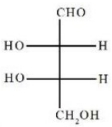
B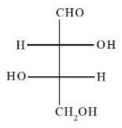
C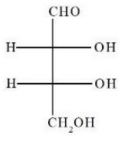
D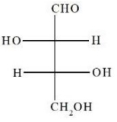
Solution
(C) -aldotetrose has the general structure $CHO-(CHOH)_2-CH_2OH$.
Upon oxidation with concentrated $HNO_3$, the terminal aldehyde $(-CHO)$ and primary alcohol $(-CH_2OH)$ groups are oxidized to carboxylic acid $(-COOH)$ groups, resulting in a tartaric acid derivative $(HOOC-(CHOH)_2-COOH)$.
For this dicarboxylic acid to be optically inactive, it must contain a plane of symmetry, making it a meso compound.
In the Fischer projection of the $D$-aldotetrose, the $D$-configuration implies that the hydroxyl group at the chiral carbon furthest from the aldehyde group (i.e.,$C-3$) is on the right side.
For the resulting dicarboxylic acid to be meso, the hydroxyl groups must be on the same side (erythro configuration) so that a plane of symmetry exists.
Therefore, the $D$-aldotetrose must have both hydroxyl groups on the right side, which corresponds to $D$-erythrose.
Upon oxidation with concentrated $HNO_3$, the terminal aldehyde $(-CHO)$ and primary alcohol $(-CH_2OH)$ groups are oxidized to carboxylic acid $(-COOH)$ groups, resulting in a tartaric acid derivative $(HOOC-(CHOH)_2-COOH)$.
For this dicarboxylic acid to be optically inactive, it must contain a plane of symmetry, making it a meso compound.
In the Fischer projection of the $D$-aldotetrose, the $D$-configuration implies that the hydroxyl group at the chiral carbon furthest from the aldehyde group (i.e.,$C-3$) is on the right side.
For the resulting dicarboxylic acid to be meso, the hydroxyl groups must be on the same side (erythro configuration) so that a plane of symmetry exists.
Therefore, the $D$-aldotetrose must have both hydroxyl groups on the right side, which corresponds to $D$-erythrose.
0 likes
View Solution806
MediumMCQ
Identify the correct statements.
$A$. Glucose exists in two anomeric forms.
$B$. Anomers of glucose differ in configuration at $C-1$ in cyclic hemiacetal structure.
$C$. Melting point of $\alpha$-anomer of glucose is greater than $\beta$-anomer.
$D$. Specific rotation of $\alpha$-anomer is $+19^\circ$ while for $\beta$-anomer is $+112^\circ$.
$E$. $\alpha$ and $\beta$-anomers of glucose are prepared by crystallization of saturated glucose solution at $303 \text{ K}$ and $371 \text{ K}$ respectively.
$A$. Glucose exists in two anomeric forms.
$B$. Anomers of glucose differ in configuration at $C-1$ in cyclic hemiacetal structure.
$C$. Melting point of $\alpha$-anomer of glucose is greater than $\beta$-anomer.
$D$. Specific rotation of $\alpha$-anomer is $+19^\circ$ while for $\beta$-anomer is $+112^\circ$.
$E$. $\alpha$ and $\beta$-anomers of glucose are prepared by crystallization of saturated glucose solution at $303 \text{ K}$ and $371 \text{ K}$ respectively.
A
$A$ and $B$ Only
B
$B$ and $C$ Only
C
$A, B$ and $D$ Only
D
$A, B$ and $E$ Only
Solution
(D) . Glucose exists in $\alpha$ and $\beta$ anomeric forms. (Correct)
$B$. Anomers differ in configuration only at the hemiacetal carbon $(C_1)$. (Correct)
$C$. Melting points: $\alpha$-$D$-glucose is $419 \text{ K}$ and $\beta$-$D$-glucose is $423 \text{ K}$. Thus, the melting point of $\beta$-anomer is greater than $\alpha$-anomer. (Incorrect)
$D$. Specific rotation: $\alpha$-anomer is $+112^\circ$ and $\beta$-anomer is $+19^\circ$. The values are swapped in the statement. (Incorrect)
$E$. Crystallization of glucose from hot saturated aqueous solution at $371 \text{ K}$ yields $\alpha$-$D$-glucose, and below $303 \text{ K}$ yields $\beta$-$D$-glucose. (Correct)
Therefore, statements $A, B$, and $E$ are correct.
$B$. Anomers differ in configuration only at the hemiacetal carbon $(C_1)$. (Correct)
$C$. Melting points: $\alpha$-$D$-glucose is $419 \text{ K}$ and $\beta$-$D$-glucose is $423 \text{ K}$. Thus, the melting point of $\beta$-anomer is greater than $\alpha$-anomer. (Incorrect)
$D$. Specific rotation: $\alpha$-anomer is $+112^\circ$ and $\beta$-anomer is $+19^\circ$. The values are swapped in the statement. (Incorrect)
$E$. Crystallization of glucose from hot saturated aqueous solution at $371 \text{ K}$ yields $\alpha$-$D$-glucose, and below $303 \text{ K}$ yields $\beta$-$D$-glucose. (Correct)
Therefore, statements $A, B$, and $E$ are correct.
0 likes
View Solution807
MediumMCQ
The incorrect statement from the following with respect to carbohydrates is:
A
All monosaccharides are reducing sugars.
B
The monosaccharide units obtained from hydrolysis of oligosaccharides are always the same.
C
Starch and cellulose are typical examples of polysaccharides, which are very high molecular weight compounds of more than ten monosaccharide units.
D
Open chain and cyclic structures co-exist at equilibrium that are responsible for certain properties as in the case of $D-(+)$-glucose.
Solution
(B) Statement $B$ is incorrect because oligosaccharides like sucrose, upon hydrolysis, yield different monosaccharide units (glucose and fructose). Monosaccharides are simple sugars that cannot be hydrolyzed further, and most (including all aldoses) are reducing sugars. Polysaccharides consist of a large number of monosaccharide units linked together, and $D-(+)$-glucose exists in an equilibrium between its open-chain and cyclic forms.
0 likes
View Solution808
DifficultMCQ
Given below are two statements:
Statement $I$: The two cyclic forms of $D-(+)-glucose$ ($\alpha$ and $\beta$ anomers differing at $C1$ hydroxyl orientation) are two anomers of $D-(+)-glucose$.
Statement $II$: The open chain forms of $D-glucose$ and $D-fructose$ contain three similar chiral carbons at $C3$, $C4$, and $C5$.
In the light of the above statements, choose the correct answer from the options given below:
Statement $I$: The two cyclic forms of $D-(+)-glucose$ ($\alpha$ and $\beta$ anomers differing at $C1$ hydroxyl orientation) are two anomers of $D-(+)-glucose$.
Statement $II$: The open chain forms of $D-glucose$ and $D-fructose$ contain three similar chiral carbons at $C3$, $C4$, and $C5$.
In the light of the above statements, choose the correct answer from the options given below:
A
Both Statement $I$ and Statement $II$ are true
B
Both Statement $I$ and Statement $II$ are false
C
Statement $I$ is true but Statement $II$ is false
D
Statement $I$ is false but Statement $II$ is true
Solution
(A) Statement $I$ is true because $\alpha$ and $\beta$ isomers of $D-(+)-glucose$ are indeed anomers, differing only in the configuration at the anomeric carbon $(C1)$.
Statement $II$ is also true; if we look at the Fischer projections of $D-glucose$ and $D-fructose$, the configurations of the chiral carbons at $C3$, $C4$, and $C5$ are identical in both, as both belong to the $D-series$.
Statement $II$ is also true; if we look at the Fischer projections of $D-glucose$ and $D-fructose$, the configurations of the chiral carbons at $C3$, $C4$, and $C5$ are identical in both, as both belong to the $D-series$.
0 likes
View Solution809
EasyMCQ
Identify the glycosidic linkage present in lactose.
A
$\alpha - 1, 4$
B
$\beta - 1, 4$
C
$\alpha - 1, 6$
D
$\beta - 2, 6$
Solution
(B) Lactose is a disaccharide composed of one molecule of $D-(+)$-galactose and one molecule of $D-(+)$-glucose.
The two monosaccharide units are linked together through a $\beta - 1, 4$-glycosidic linkage.
This means the $C-1$ of the galactose unit is connected to the $C-4$ of the glucose unit via an oxygen atom in the $\beta$-configuration.
The two monosaccharide units are linked together through a $\beta - 1, 4$-glycosidic linkage.
This means the $C-1$ of the galactose unit is connected to the $C-4$ of the glucose unit via an oxygen atom in the $\beta$-configuration.
0 likes
View Solution810
EasyMCQ
What type of glycosidic bond is present in maltose?
A
$\beta - 1, 4$
B
$\alpha - 1, 4$
C
$\alpha - 1, 6$
D
$\beta - 2, 4$
Solution
(B) Maltose is a disaccharide formed by the condensation of two molecules of $\alpha - D - \text{glucose}$.
The glycosidic linkage is formed between the $C1$ of one glucose unit and the $C4$ of the other glucose unit.
Since both glucose units are in the $\alpha$ configuration, the bond is an $\alpha - 1, 4 - \text{glycosidic linkage}$.
The glycosidic linkage is formed between the $C1$ of one glucose unit and the $C4$ of the other glucose unit.
Since both glucose units are in the $\alpha$ configuration, the bond is an $\alpha - 1, 4 - \text{glycosidic linkage}$.
0 likes
View Solution811
MediumMCQ
The reaction of glucose with acetic anhydride confirms the:
A
straight chain structure of glucose
B
presence of carbonyl group
C
presence of keto group
D
presence of five hydroxyl groups
Solution
(D) $1$. Glucose reacts with acetic anhydride to form glucose pentaacetate.
$2$. This reaction indicates that there are $5$ hydroxyl $(-OH)$ groups present in the glucose molecule.
$3$. The reaction is: $C_6H_{12}O_6 + 5(CH_3CO)_2O \rightarrow C_6H_7O(OCOCH_3)_5 + 5CH_3COOH$.
$2$. This reaction indicates that there are $5$ hydroxyl $(-OH)$ groups present in the glucose molecule.
$3$. The reaction is: $C_6H_{12}O_6 + 5(CH_3CO)_2O \rightarrow C_6H_7O(OCOCH_3)_5 + 5CH_3COOH$.
0 likes
View Solution812
MediumMCQ
Which of the following is confirmed by the reaction of glucose with hydroxylamine $(NH_2OH)$?
A
Straight chain of six carbon atoms
B
Presence of a carbonyl group
C
Presence of a primary alcoholic group
D
Presence of a secondary alcoholic group
Solution
(B) Glucose reacts with hydroxylamine $(NH_2OH)$ to form an oxime. The formation of an oxime indicates the presence of a carbonyl group (aldehyde or ketone) in the glucose molecule.
Reaction: $CHO(CHOH)_4CH_2OH + NH_2OH \rightarrow CH=NOH(CHOH)_4CH_2OH + H_2O$.
Reaction: $CHO(CHOH)_4CH_2OH + NH_2OH \rightarrow CH=NOH(CHOH)_4CH_2OH + H_2O$.
0 likes
View Solution813
EasyMCQ
Identify the product formed when $D-(+)-glucose$ reacts with bromine water ($Br_2$ water).
A
Saccharic acid
B
Cyanohydrin
C
Gluconic acid
D
Nucleic acid
Solution
(C) Step $1$: Bromine water ($Br_2$ water) is a mild oxidizing agent.
Step $2$: It specifically oxidizes the aldehyde group $(-CHO)$ of $glucose$ to a carboxylic acid group $(-COOH)$.
Step $3$: The reaction is: $CHO(CHOH)_4CH_2OH + [O] \xrightarrow{Br_2/H_2O} COOH(CHOH)_4CH_2OH$.
Step $4$: The resulting product is $Gluconic \ acid$.
Step $2$: It specifically oxidizes the aldehyde group $(-CHO)$ of $glucose$ to a carboxylic acid group $(-COOH)$.
Step $3$: The reaction is: $CHO(CHOH)_4CH_2OH + [O] \xrightarrow{Br_2/H_2O} COOH(CHOH)_4CH_2OH$.
Step $4$: The resulting product is $Gluconic \ acid$.
0 likes
View Solution814
EasyMCQ
What type of saccharide is $maltose$?
A
Polysaccharide
B
Disaccharide
C
Trisaccharide
D
Monosaccharide
Solution
(B) $Maltose$ is a carbohydrate formed by the condensation of two molecules of $D-glucose$. Since it yields two molecules of monosaccharides upon hydrolysis, it is classified as a disaccharide.
0 likes
View Solution815
MediumMCQ
Which carbon atom of glucose, numbered from $1$ to $6$, forms a hemiacetal structure by reacting with the $-CHO$ group to close the ring?
A
$C-2$
B
$C-3$
C
$C-4$
D
$C-5$
Solution
(D) $1$. In the open-chain structure of glucose, the aldehyde group is at $C-1$.
$2$. The hydroxyl $(-OH)$ group at $C-5$ attacks the carbonyl carbon $(C-1)$ to form a stable six-membered pyranose ring.
$3$. This intramolecular reaction between the aldehyde group at $C-1$ and the hydroxyl group at $C-5$ results in the formation of a hemiacetal structure.
$4$. Therefore, the $C-5$ carbon atom is involved in the ring closure.
$2$. The hydroxyl $(-OH)$ group at $C-5$ attacks the carbonyl carbon $(C-1)$ to form a stable six-membered pyranose ring.
$3$. This intramolecular reaction between the aldehyde group at $C-1$ and the hydroxyl group at $C-5$ results in the formation of a hemiacetal structure.
$4$. Therefore, the $C-5$ carbon atom is involved in the ring closure.
0 likes
View Solution816
EasyMCQ
Which of the following compounds forms starch on polymerization?
A
$\alpha-D-glucose$
B
$\beta-D-glucose$
C
$\alpha-L-glucose$
D
$\beta-L-glucose$
Solution
(A) Step $1$: Starch is a polysaccharide composed of glucose units.
Step $2$: Starch consists of two components, amylose and amylopectin, both of which are polymers of $\alpha-D-glucose$.
Step $3$: These units are linked together by $\alpha-glycosidic$ linkages.
Step $4$: Therefore, the monomer unit of starch is $\alpha-D-glucose$.
Step $2$: Starch consists of two components, amylose and amylopectin, both of which are polymers of $\alpha-D-glucose$.
Step $3$: These units are linked together by $\alpha-glycosidic$ linkages.
Step $4$: Therefore, the monomer unit of starch is $\alpha-D-glucose$.
0 likes
View Solution817
EasyMCQ
The letter '$D$' in carbohydrates signifies
A
dextrorotatory
B
configuration
C
diamagnetic nature
D
mode of synthesis
Solution
(B) In the nomenclature of carbohydrates, the prefix '$D$' or '$L$' is used to specify the configuration of the chiral carbon atom furthest from the carbonyl group. It is based on the configuration of glyceraldehyde. Therefore, '$D$' signifies the configuration of the molecule.
0 likes
View Solution818
EasyMCQ
Which carbon atom (numbered from $1'$ to $5'$) of ribose lacks the oxygen to form deoxyribose ?
A
$5'$
B
$3'$
C
$2'$
D
$1'$
Solution
(C) $1$. Ribose is a pentose sugar with the formula $C_5H_{10}O_5$, where each carbon atom is attached to a hydroxyl $(-OH)$ group.
$2$. Deoxyribose is a derivative of ribose with the formula $C_5H_{10}O_4$.
$3$. The prefix 'deoxy' indicates the removal of an oxygen atom.
$4$. In deoxyribose, the hydroxyl group at the $2'$ position of the ribose sugar is replaced by a hydrogen atom, meaning the oxygen atom is missing at the $2'$ carbon.
$5$. Therefore, the $2'$ carbon atom lacks the oxygen atom.
$2$. Deoxyribose is a derivative of ribose with the formula $C_5H_{10}O_4$.
$3$. The prefix 'deoxy' indicates the removal of an oxygen atom.
$4$. In deoxyribose, the hydroxyl group at the $2'$ position of the ribose sugar is replaced by a hydrogen atom, meaning the oxygen atom is missing at the $2'$ carbon.
$5$. Therefore, the $2'$ carbon atom lacks the oxygen atom.
0 likes
View Solution819
DifficultMCQ
What is the total mass of products obtained when one gram mole of sucrose is hydrolysed (in $\text{ g}$)?
A
$180$
B
$342$
C
$170$
D
$360$
Solution
(D) The hydrolysis reaction of sucrose is: $C_{12}H_{22}O_{11} + H_2O \rightarrow C_6H_{12}O_6 (\text{glucose}) + C_6H_{12}O_6 (\text{fructose})$.
One mole of sucrose $(342 \text{ g})$ reacts with one mole of water $(18 \text{ g})$ to produce one mole of glucose $(180 \text{ g})$ and one mole of fructose $(180 \text{ g})$.
Total mass of products = Mass of glucose + Mass of fructose = $180 \text{ g} + 180 \text{ g} = 360 \text{ g}$.
One mole of sucrose $(342 \text{ g})$ reacts with one mole of water $(18 \text{ g})$ to produce one mole of glucose $(180 \text{ g})$ and one mole of fructose $(180 \text{ g})$.
Total mass of products = Mass of glucose + Mass of fructose = $180 \text{ g} + 180 \text{ g} = 360 \text{ g}$.
0 likes
View Solution820
EasyMCQ
Which of the following sugars is an aldohexose?
A
Ribose
B
Fructose
C
Lactose
D
Glucose
Solution
(D) $1$. An aldohexose is a monosaccharide containing six carbon atoms and an aldehyde group $(-CHO)$.
$2$. $Ribose$ is an aldopentose ($5$ carbons).
$3$. $Fructose$ is a ketohexose ($6$ carbons with a ketone group).
$4$. $Lactose$ is a disaccharide.
$5$. $Glucose$ $(C_6H_{12}O_6)$ contains six carbon atoms and an aldehyde group, making it an aldohexose.
$2$. $Ribose$ is an aldopentose ($5$ carbons).
$3$. $Fructose$ is a ketohexose ($6$ carbons with a ketone group).
$4$. $Lactose$ is a disaccharide.
$5$. $Glucose$ $(C_6H_{12}O_6)$ contains six carbon atoms and an aldehyde group, making it an aldohexose.
0 likes
View Solution821
EasyMCQ
Which of the following compounds is classified as an oligosaccharide?
A
Ribose
B
Sucrose
C
Fructose
D
Glucose
Solution
(B) $1$. Carbohydrates are classified based on the number of sugar units produced upon hydrolysis.
$2$. Monosaccharides like $Ribose$, $Fructose$, and $Glucose$ cannot be further hydrolyzed into simpler carbohydrates.
$3$. Oligosaccharides are carbohydrates that yield $2$ to $10$ monosaccharide units upon hydrolysis.
$4$. $Sucrose$ is a disaccharide (a type of oligosaccharide) which on hydrolysis yields one molecule of $Glucose$ and one molecule of $Fructose$ $(C_{12}H_{22}O_{11} + H_2O \rightarrow C_6H_{12}O_6 + C_6H_{12}O_6)$.
$2$. Monosaccharides like $Ribose$, $Fructose$, and $Glucose$ cannot be further hydrolyzed into simpler carbohydrates.
$3$. Oligosaccharides are carbohydrates that yield $2$ to $10$ monosaccharide units upon hydrolysis.
$4$. $Sucrose$ is a disaccharide (a type of oligosaccharide) which on hydrolysis yields one molecule of $Glucose$ and one molecule of $Fructose$ $(C_{12}H_{22}O_{11} + H_2O \rightarrow C_6H_{12}O_6 + C_6H_{12}O_6)$.
0 likes
View Solution822
MediumMCQ
Which of the following pairs of carbohydrates contains $galactose$ in both of them as one of the constituents?
A
$Sucrose$ and $maltose$
B
$Maltose$ and $lactose$
C
$Lactose$ and $Raffinose$
D
$Sucrose$ and $lactose$
Solution
(C) $1$. $Sucrose$ is a disaccharide composed of $glucose$ and $fructose$.
$2$. $Maltose$ is a disaccharide composed of two units of $glucose$.
$3$. $Lactose$ is a disaccharide composed of $glucose$ and $galactose$.
$4$. $Raffinose$ is a trisaccharide composed of $galactose$, $glucose$, and $fructose$.
$5$. Since both $lactose$ and $raffinose$ contain $galactose$ as a constituent, the correct pair is $Lactose$ and $Raffinose$.
$2$. $Maltose$ is a disaccharide composed of two units of $glucose$.
$3$. $Lactose$ is a disaccharide composed of $glucose$ and $galactose$.
$4$. $Raffinose$ is a trisaccharide composed of $galactose$, $glucose$, and $fructose$.
$5$. Since both $lactose$ and $raffinose$ contain $galactose$ as a constituent, the correct pair is $Lactose$ and $Raffinose$.
0 likes
View Solution823
MediumMCQ
Consider the following statements:
Statement $I$: All monosaccharides are reducing sugars.
Statement $II$: Sucrose can reduce ammoniacal silver nitrate solution.
Choose the correct answer from the options given below.
Statement $I$: All monosaccharides are reducing sugars.
Statement $II$: Sucrose can reduce ammoniacal silver nitrate solution.
Choose the correct answer from the options given below.
A
Both Statement $I$ and Statement $II$ are correct.
B
Both Statement $I$ and Statement $II$ are incorrect.
C
Statement $I$ is correct but Statement $II$ is incorrect.
D
Statement $I$ is incorrect but Statement $II$ is correct.
Solution
(C) Step $1$: Monosaccharides contain a free aldehyde or ketone group, which makes them reducing sugars. Thus, Statement $I$ is correct.
Step $2$: Sucrose is a disaccharide composed of glucose and fructose linked by a glycosidic bond between their anomeric carbons. It lacks a free aldehyde or ketone group, making it a non-reducing sugar. Therefore, it cannot reduce ammoniacal silver nitrate solution (Tollens' reagent). Thus, Statement $II$ is incorrect.
Step $2$: Sucrose is a disaccharide composed of glucose and fructose linked by a glycosidic bond between their anomeric carbons. It lacks a free aldehyde or ketone group, making it a non-reducing sugar. Therefore, it cannot reduce ammoniacal silver nitrate solution (Tollens' reagent). Thus, Statement $II$ is incorrect.
0 likes
View SolutionBiomolecules — Carbohydrates · Frequently Asked Questions
1Are these Biomolecules questions useful for JEE and NEET?
Yes. All questions in this section are mapped to JEE Main and NEET exam patterns. Previous year questions from JEE Main, NEET, GUJCET and state-level exams are included with full solutions.
2Can I switch to Hindi or Gujarati for these questions?
Yes. Use the language tabs in the hero section or the sidebar to view the same questions and solutions in English, Hindi or Gujarati.
3How do I generate a question paper from this subtopic?
Use the Vedclass Exam Paper Generator — select the chapter and subtopic, set difficulty, and generate Sets A, B, C, D automatically. First 3 chapters of every subject are free.
Vedclass Products
For Students
Vedclass Test Series
Mock tests in real JEE/NEET style with performance analysis. 5-day free trial.
Start Free TrialFor Teachers
Exam Paper Generator
Generate Set A/B/C/D papers from this chapter in 2 minutes. 3 chapters free.
Try FreeFor Institutes
Online Exam Module
Live online exams with unlimited students, 360° analytics & white-label branding.
See DemoFor Teachers & Institutes
Generate a Biomolecules Exam Paper in 2 Minutes
Select subtopic & difficulty — Sets A, B, C, D auto-generated with No Repeat logic.
First 3 chapters of every subject are free — no payment required.