
A English
Solubility Questions in English
Class 12 Chemistry · Solutions · Solubility
174+
Questions
English
Language
100%
With Solutions
Showing 24 of 174 questions in English
151
MediumMCQ
At $298 \ K$,Henry's law constant for $CO_2$ in water is $1.67 \times 10^8 \ Pa$. At $298 \ K$,the quantity of $CO_2$ in $1000 \ mL$ of soda water when packed at $1.67 \times 10^2 \ kPa$ $CO_2$ pressure in $mol \ L^{-1}$ is: (water density $= 1.0 \ g \ cm^{-3}$)
A
$5.55 \times 10^{-3}$
B
$0.555$
C
$5.55 \times 10^3$
D
$5.55 \times 10^{-2}$
Solution
(D) According to Henry's law,$P = K_H \times \chi$,where $P$ is the partial pressure of the gas,$K_H$ is Henry's law constant,and $\chi$ is the mole fraction of the gas in the solution.
Given: $P = 1.67 \times 10^2 \ kPa = 1.67 \times 10^5 \ Pa$,$K_H = 1.67 \times 10^8 \ Pa$.
Calculating mole fraction $\chi = P / K_H = (1.67 \times 10^5) / (1.67 \times 10^8) = 10^{-3}$.
Since the solution is dilute,the mole fraction $\chi \approx n_{CO_2} / n_{H_2O}$.
For $1000 \ mL$ of water,mass $= 1000 \ g$,so $n_{H_2O} = 1000 / 18 = 55.55 \ mol$.
Thus,$n_{CO_2} = \chi \times n_{H_2O} = 10^{-3} \times 55.55 = 5.555 \times 10^{-2} \ mol$.
Since the volume is $1 \ L$,the concentration is $5.55 \times 10^{-2} \ mol \ L^{-1}$.
Given: $P = 1.67 \times 10^2 \ kPa = 1.67 \times 10^5 \ Pa$,$K_H = 1.67 \times 10^8 \ Pa$.
Calculating mole fraction $\chi = P / K_H = (1.67 \times 10^5) / (1.67 \times 10^8) = 10^{-3}$.
Since the solution is dilute,the mole fraction $\chi \approx n_{CO_2} / n_{H_2O}$.
For $1000 \ mL$ of water,mass $= 1000 \ g$,so $n_{H_2O} = 1000 / 18 = 55.55 \ mol$.
Thus,$n_{CO_2} = \chi \times n_{H_2O} = 10^{-3} \times 55.55 = 5.555 \times 10^{-2} \ mol$.
Since the volume is $1 \ L$,the concentration is $5.55 \times 10^{-2} \ mol \ L^{-1}$.
0 likes
View Solution152
MediumMCQ
$A$ gas '$X$' is dissolved in water at $2 \ bar$ pressure. Its mole fraction is $0.02$ in solution. The mole fraction of water when the pressure of gas is doubled at the same temperature is
A
$0.04$
B
$0.98$
C
$0.96$
D
$0.02$
Solution
(C) According to Henry's law,the partial pressure of a gas is directly proportional to its mole fraction in the solution,given by $P = K_H \times \chi$.
Since the temperature remains constant,$K_H$ is constant.
When the pressure is doubled from $2 \ bar$ to $4 \ bar$,the mole fraction of the gas $(\chi_X)$ also doubles.
New mole fraction of gas $\chi_X' = 0.02 \times 2 = 0.04$.
The sum of mole fractions in a binary solution is $1$.
Therefore,the mole fraction of water $\chi_{H_2O} = 1 - \chi_X' = 1 - 0.04 = 0.96$.
Since the temperature remains constant,$K_H$ is constant.
When the pressure is doubled from $2 \ bar$ to $4 \ bar$,the mole fraction of the gas $(\chi_X)$ also doubles.
New mole fraction of gas $\chi_X' = 0.02 \times 2 = 0.04$.
The sum of mole fractions in a binary solution is $1$.
Therefore,the mole fraction of water $\chi_{H_2O} = 1 - \chi_X' = 1 - 0.04 = 0.96$.
0 likes
View Solution153
MediumMCQ
Henry's law is valid for which of the following cases?
A
$A$ Ammonia gas dissolution in water
B
$B$ $O_2$ gas dissolution in unsaturated blood
C
$C$ $O_2$ dissolution in water
D
$D$ $CO_2$ dissolution in water
Solution
(C) Henry's law states that the partial pressure of a gas in the vapor phase is proportional to the mole fraction of the gas in the solution. This law is valid only when the gas does not undergo any chemical reaction with the solvent.
$1$. Ammonia $(NH_3)$ reacts with water to form ammonium hydroxide $(NH_4OH)$.
$2$. Oxygen $(O_2)$ reacts with hemoglobin in the blood to form oxyhemoglobin.
$3$. Oxygen $(O_2)$ and Carbon dioxide $(CO_2)$ do not react chemically with water.
Therefore, Henry's law is valid for $C$ and $D$.
$1$. Ammonia $(NH_3)$ reacts with water to form ammonium hydroxide $(NH_4OH)$.
$2$. Oxygen $(O_2)$ reacts with hemoglobin in the blood to form oxyhemoglobin.
$3$. Oxygen $(O_2)$ and Carbon dioxide $(CO_2)$ do not react chemically with water.
Therefore, Henry's law is valid for $C$ and $D$.
0 likes
View Solution154
EasyMCQ
Dry air contains $79 \% \,N_2$ and $21 \% \,O_2$. At $T \,K$, if Henry's law constants for $N_2$ and $O_2$ in water are $8.57 \times 10^4 \,atm$ and $4.56 \times 10^4 \,atm$ respectively, the ratio of mole fractions of $N_2$ and $O_2$ dissolved in water at $1 \,atm$ is
A
$4: 1$
B
$1: 4$
C
$2: 1$
D
$1: 2$
Solution
(C) Total pressure of air over water $= 1 \,atm$.
Partial pressure of $N_2$ and $O_2$ are:
$P_{N_2} = \frac{1 \times 79}{100} = 0.79 \,atm$
$P_{O_2} = \frac{1 \times 21}{100} = 0.21 \,atm$
Applying Henry's law $(P = K_H \times X)$:
$X_{N_2} = \frac{P_{N_2}}{K_{H, N_2}} = \frac{0.79}{8.57 \times 10^4} \approx 9.22 \times 10^{-6}$
$X_{O_2} = \frac{P_{O_2}}{K_{H, O_2}} = \frac{0.21}{4.56 \times 10^4} \approx 4.60 \times 10^{-6}$
Ratio of mole fractions of $N_2$ and $O_2$:
$\frac{X_{N_2}}{X_{O_2}} = \frac{9.22 \times 10^{-6}}{4.60 \times 10^{-6}} \approx 2$
Thus, the ratio is $2: 1$.
Partial pressure of $N_2$ and $O_2$ are:
$P_{N_2} = \frac{1 \times 79}{100} = 0.79 \,atm$
$P_{O_2} = \frac{1 \times 21}{100} = 0.21 \,atm$
Applying Henry's law $(P = K_H \times X)$:
$X_{N_2} = \frac{P_{N_2}}{K_{H, N_2}} = \frac{0.79}{8.57 \times 10^4} \approx 9.22 \times 10^{-6}$
$X_{O_2} = \frac{P_{O_2}}{K_{H, O_2}} = \frac{0.21}{4.56 \times 10^4} \approx 4.60 \times 10^{-6}$
Ratio of mole fractions of $N_2$ and $O_2$:
$\frac{X_{N_2}}{X_{O_2}} = \frac{9.22 \times 10^{-6}}{4.60 \times 10^{-6}} \approx 2$
Thus, the ratio is $2: 1$.
0 likes
View Solution155
MediumMCQ
Observe the following data given in the table $(K_H = \text{Henry's law constant})$. The correct order of solubility of these gases is:
| Gas | $K_H$ (kbar at $298 \ K$) |
| $CO_2$ | $1.67$ |
| $Ar$ | $40.3$ |
| $HCHO$ | $1.83 \times 10^{-5}$ |
| $CH_4$ | $0.413$ |
A
$CO_2 > CH_4 > HCHO > Ar$
B
$Ar > HCHO > CH_4 > CO_2$
C
$HCHO > CH_4 > CO_2 > Ar$
D
$CO_2 > HCHO > CH_4 > Ar$
Solution
(C) According to Henry's law, $p = K_H \cdot x$, where $x$ is the mole fraction of the gas in the solution (solubility).
Therefore, solubility $x = \frac{p}{K_H}$.
At a constant pressure, solubility is inversely proportional to the Henry's law constant $(x \propto \frac{1}{K_H})$.
Given $K_H$ values: $HCHO \ (1.83 \times 10^{-5}) < CH_4 \ (0.413) < CO_2 \ (1.67) < Ar \ (40.3)$.
Thus, the order of solubility is: $HCHO > CH_4 > CO_2 > Ar$.
Therefore, solubility $x = \frac{p}{K_H}$.
At a constant pressure, solubility is inversely proportional to the Henry's law constant $(x \propto \frac{1}{K_H})$.
Given $K_H$ values: $HCHO \ (1.83 \times 10^{-5}) < CH_4 \ (0.413) < CO_2 \ (1.67) < Ar \ (40.3)$.
Thus, the order of solubility is: $HCHO > CH_4 > CO_2 > Ar$.
0 likes
View Solution156
DifficultMCQ
The Henry's law constant for the solubility of $N_2$ gas in water at $298 \ K$ is $1 \times 10^{5} \ atm$. The mole fraction of air is $0.8$. The number of moles of $N_2$ from air dissolved in $10 \ mol$ of water at $298 \ K$ and $5 \ atm$ pressure is:
A
$4 \times 10^{-5}$
B
$4 \times 10^{-4}$
C
$5 \times 10^{-4}$
D
$4 \times 10^{-6}$
Solution
(B) At a total pressure of $5 \ atm$, the partial pressure of $N_2$ is $P_{N_2} = 5 \times 0.8 = 4 \ atm$.
According to Henry's Law, $P_{N_2} = K_{H} \times x_{N_2}$, where $x_{N_2}$ is the mole fraction of nitrogen gas dissolved in water.
Substituting the values: $4 \ atm = (1 \times 10^5 \ atm) \times x_{N_2}$.
Therefore, $x_{N_2} = \frac{4}{1 \times 10^5} = 4 \times 10^{-5}$.
Since the amount of dissolved gas is very small, we can approximate the mole fraction as $x_{N_2} \approx \frac{n_{N_2}}{n_{H_2O}}$.
Given $n_{H_2O} = 10 \ mol$, we have $n_{N_2} = x_{N_2} \times n_{H_2O} = (4 \times 10^{-5}) \times 10 = 4 \times 10^{-4} \ mol$.
According to Henry's Law, $P_{N_2} = K_{H} \times x_{N_2}$, where $x_{N_2}$ is the mole fraction of nitrogen gas dissolved in water.
Substituting the values: $4 \ atm = (1 \times 10^5 \ atm) \times x_{N_2}$.
Therefore, $x_{N_2} = \frac{4}{1 \times 10^5} = 4 \times 10^{-5}$.
Since the amount of dissolved gas is very small, we can approximate the mole fraction as $x_{N_2} \approx \frac{n_{N_2}}{n_{H_2O}}$.
Given $n_{H_2O} = 10 \ mol$, we have $n_{N_2} = x_{N_2} \times n_{H_2O} = (4 \times 10^{-5}) \times 10 = 4 \times 10^{-4} \ mol$.
0 likes
View Solution157
MediumMCQ
Calculate the quantity of $CO_2$ required to prepare $1 \,L$ of soda water when the soda water is packed under $2 \,atm$ of $CO_2$. [Henry's law constant for $CO_2$ is $1.67 \times 10^8 \,Pa$] (in $\,g$)
A
$5.98$
B
$1.21$
C
$2.9$
D
$67.1$
Solution
(C) According to Henry's law, $P = K_H \times x$, where $x$ is the mole fraction of $CO_2$.
Given $P = 2 \,atm = 2 \times 1.01325 \times 10^5 \,Pa = 2.0265 \times 10^5 \,Pa$.
$K_H = 1.67 \times 10^8 \,Pa$.
$x = \frac{P}{K_H} = \frac{2.0265 \times 10^5}{1.67 \times 10^8} \approx 1.213 \times 10^{-3}$.
Since the amount of $CO_2$ is small, the number of moles of water in $1 \,L$ $(1000 \,g)$ is $n_{H_2O} = \frac{1000}{18} \approx 55.55 \,mol$.
$x = \frac{n_{CO_2}}{n_{CO_2} + n_{H_2O}} \approx \frac{n_{CO_2}}{n_{H_2O}}$.
$n_{CO_2} = x \times n_{H_2O} = 1.213 \times 10^{-3} \times 55.55 \approx 0.0674 \,mol$.
Mass of $CO_2 = n_{CO_2} \times \text{Molar mass} = 0.0674 \times 44 \approx 2.96 \,g$.
Rounding to the nearest provided option, the correct answer is $2.9 \,g$.
Given $P = 2 \,atm = 2 \times 1.01325 \times 10^5 \,Pa = 2.0265 \times 10^5 \,Pa$.
$K_H = 1.67 \times 10^8 \,Pa$.
$x = \frac{P}{K_H} = \frac{2.0265 \times 10^5}{1.67 \times 10^8} \approx 1.213 \times 10^{-3}$.
Since the amount of $CO_2$ is small, the number of moles of water in $1 \,L$ $(1000 \,g)$ is $n_{H_2O} = \frac{1000}{18} \approx 55.55 \,mol$.
$x = \frac{n_{CO_2}}{n_{CO_2} + n_{H_2O}} \approx \frac{n_{CO_2}}{n_{H_2O}}$.
$n_{CO_2} = x \times n_{H_2O} = 1.213 \times 10^{-3} \times 55.55 \approx 0.0674 \,mol$.
Mass of $CO_2 = n_{CO_2} \times \text{Molar mass} = 0.0674 \times 44 \approx 2.96 \,g$.
Rounding to the nearest provided option, the correct answer is $2.9 \,g$.
0 likes
View Solution158
EasyMCQ
Henry's law constant for $CO_2$ in water is $1.67 \ kbar$ at $25^{\circ} C$. The quantity of $CO_2$ in $1000 \ mL$ of soda water when packed under $5 \ bar$ $CO_2$ pressure at $25^{\circ} C$ is (in $mol$)
A
$0.084$
B
$0.167$
C
$0.252$
D
$0.336$
Solution
(B) According to Henry's law, $p = K_H \times \chi_{CO_2}$.
Given: $p = 5 \ bar$, $K_H = 1.67 \ kbar = 1670 \ bar$.
Since the amount of $CO_2$ is small, the mole fraction $\chi_{CO_2} = \frac{n_{CO_2}}{n_{CO_2} + n_{H_2O}} \approx \frac{n_{CO_2}}{n_{H_2O}}$.
For $1000 \ mL$ of water, the number of moles of water $n_{H_2O} = \frac{1000 \ g}{18 \ g/mol} \approx 55.5 \ mol$.
Substituting the values: $5 = 1670 \times \frac{n_{CO_2}}{55.5}$.
$n_{CO_2} = \frac{5 \times 55.5}{1670} \approx 0.166 \ mol \approx 0.167 \ mol$.
Given: $p = 5 \ bar$, $K_H = 1.67 \ kbar = 1670 \ bar$.
Since the amount of $CO_2$ is small, the mole fraction $\chi_{CO_2} = \frac{n_{CO_2}}{n_{CO_2} + n_{H_2O}} \approx \frac{n_{CO_2}}{n_{H_2O}}$.
For $1000 \ mL$ of water, the number of moles of water $n_{H_2O} = \frac{1000 \ g}{18 \ g/mol} \approx 55.5 \ mol$.
Substituting the values: $5 = 1670 \times \frac{n_{CO_2}}{55.5}$.
$n_{CO_2} = \frac{5 \times 55.5}{1670} \approx 0.166 \ mol \approx 0.167 \ mol$.
0 likes
View Solution159
DifficultMCQ
Which of the following statement$(s)$ is/are correct regarding the solubility of solid $I_2$?
A
Solid $I_2$ is freely soluble in water
B
Solid $I_2$ is freely soluble in water but only in the presence of excess $KI$
C
Solid $I_2$ is freely soluble in $CCl_4$
D
Solid $I_2$ is freely soluble in hot water
Solution
(B, C) The solubility of $I_2$ is governed by the principle of 'like dissolves like'.
$I_2$ is a non-polar covalent molecule, making it poorly soluble in polar solvents like water.
However, $I_2$ dissolves in an aqueous solution of $KI$ due to the formation of the soluble triiodide complex ion: $I_2 + I^- \rightarrow I_3^-$.
Additionally, $I_2$ is freely soluble in non-polar organic solvents like $CCl_4$ because both are non-polar in nature.
Therefore, both statements $B$ and $C$ are correct.
$I_2$ is a non-polar covalent molecule, making it poorly soluble in polar solvents like water.
However, $I_2$ dissolves in an aqueous solution of $KI$ due to the formation of the soluble triiodide complex ion: $I_2 + I^- \rightarrow I_3^-$.
Additionally, $I_2$ is freely soluble in non-polar organic solvents like $CCl_4$ because both are non-polar in nature.
Therefore, both statements $B$ and $C$ are correct.
0 likes
View Solution160
MediumMCQ
The correct solubility order of $AgF$, $AgCl$, $AgBr$, and $AgI$ in water is:
A
$AgF < AgCl > AgBr > AgI$
B
$AgI < AgBr < AgCl < AgF$
C
$AgF < AgI < AgBr < AgCl$
D
$AgCl > AgBr > AgF > AgI$
Solution
(B) The solubility of silver halides in water depends on the lattice energy and hydration energy.
$AgF$ is highly soluble in water due to its high hydration energy.
For the other silver halides ($AgCl$, $AgBr$, $AgI$), the lattice energy decreases as the size of the halide ion increases $(Cl^- < Br^- < I^-)$.
However, the decrease in hydration energy is more significant than the decrease in lattice energy as we move from $Cl^-$ to $I^-$.
Therefore, the solubility decreases in the order: $AgCl > AgBr > AgI$.
Combining these, the overall order of solubility is $AgI < AgBr < AgCl < AgF$.
$AgF$ is highly soluble in water due to its high hydration energy.
For the other silver halides ($AgCl$, $AgBr$, $AgI$), the lattice energy decreases as the size of the halide ion increases $(Cl^- < Br^- < I^-)$.
However, the decrease in hydration energy is more significant than the decrease in lattice energy as we move from $Cl^-$ to $I^-$.
Therefore, the solubility decreases in the order: $AgCl > AgBr > AgI$.
Combining these, the overall order of solubility is $AgI < AgBr < AgCl < AgF$.
0 likes
View Solution161
DifficultMCQ
At $298 \ K$, the mole percentage of $N_{2(g)}$ in air is $80\%$. Water is in equilibrium with air at a pressure of $10 \ atm$. What is the mole fraction of $N_{2(g)}$ in water at $298 \ K$? ($K_H$ for $N_2$ is $6.5 \times 10^7 \ mm \ Hg$)
A
$1.23 \times 10^{-7}$
B
$1.17 \times 10^{-4}$
C
$9.35 \times 10^5$
D
$9.35 \times 10^{-5}$
Solution
(D) According to Henry's Law, $P_{N_2} = K_H \cdot X_{N_2}$.
First, calculate the partial pressure of $N_2$ in air: $P_{N_2} = \text{mole fraction of } N_2 \times \text{Total pressure} = 0.8 \times 10 \ atm = 8 \ atm$.
Convert the partial pressure to $mm \ Hg$: $P_{N_2} = 8 \ atm \times 760 \ mm \ Hg/atm = 6080 \ mm \ Hg$.
Now, use Henry's Law to find the mole fraction $X_{N_2}$ in water: $X_{N_2} = \frac{P_{N_2}}{K_H} = \frac{6080}{6.5 \times 10^7}$.
$X_{N_2} = 9.35 \times 10^{-5}$.
First, calculate the partial pressure of $N_2$ in air: $P_{N_2} = \text{mole fraction of } N_2 \times \text{Total pressure} = 0.8 \times 10 \ atm = 8 \ atm$.
Convert the partial pressure to $mm \ Hg$: $P_{N_2} = 8 \ atm \times 760 \ mm \ Hg/atm = 6080 \ mm \ Hg$.
Now, use Henry's Law to find the mole fraction $X_{N_2}$ in water: $X_{N_2} = \frac{P_{N_2}}{K_H} = \frac{6080}{6.5 \times 10^7}$.
$X_{N_2} = 9.35 \times 10^{-5}$.
0 likes
View Solution162
DifficultMCQ
Given below are two statements:
Statement $I$: The Henry's law constant $K_{H}$ is constant with respect to variations in solution's concentration over the range for which the solution is ideally dilute.
Statement $II$: $K_{H}$ does not differ for the same solute in different solvents.
In the light of the above statements, choose the correct answer from the options.
Statement $I$: The Henry's law constant $K_{H}$ is constant with respect to variations in solution's concentration over the range for which the solution is ideally dilute.
Statement $II$: $K_{H}$ does not differ for the same solute in different solvents.
In the light of the above statements, choose the correct answer from the options.
A
Statement $I$ is false but Statement $II$ is true.
B
Statement $I$ is true but Statement $II$ is false.
C
Both Statement $I$ and Statement $II$ are true.
D
Both Statement $I$ and Statement $II$ are false.
Solution
(B) Statement $I$ is true because Henry's law states that $p = K_{H}x$, where $K_{H}$ is a constant for a given gas-solvent system at a constant temperature, especially in the range where the solution behaves as an ideally dilute solution.
Statement $II$ is false because $K_{H}$ depends on the nature of the gas and the nature of the solvent. Therefore, $K_{H}$ will differ for the same solute in different solvents.
Statement $II$ is false because $K_{H}$ depends on the nature of the gas and the nature of the solvent. Therefore, $K_{H}$ will differ for the same solute in different solvents.
0 likes
View Solution163
DifficultMCQ
Consider a solution of $CO_{2(g)}$ dissolved in water in a closed container. Which one of the following plots correctly represents the variation of $log$ (partial pressure of $CO_2$ in vapour phase above water) [y-axis] with $log$ (mole fraction of $CO_2$ in water) [x-axis] at $25^{\circ}C$?
A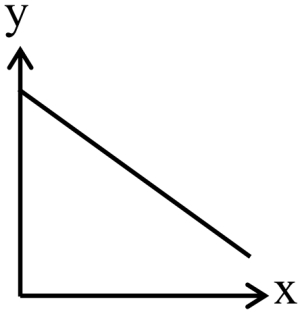
B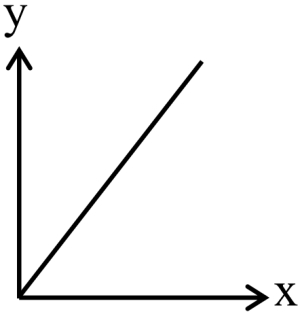
C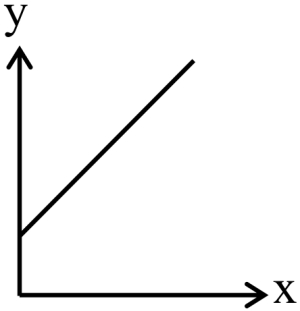
D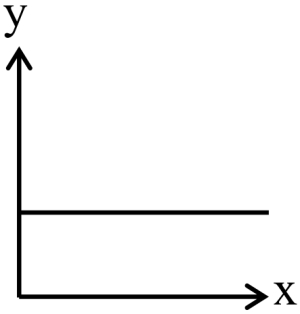
Solution
(C) According to Henry's law, the partial pressure of a gas $(P_g)$ is directly proportional to its mole fraction $(X_g)$ in the solution: $P_g = K_H \cdot X_g$.
Taking the logarithm on both sides: $\log(P_g) = \log(K_H \cdot X_g) = \log(K_H) + \log(X_g)$.
This equation is of the form $y = mx + c$, where $y = \log(P_g)$, $x = \log(X_g)$, the slope $m = 1$, and the intercept $c = \log(K_H)$.
Since the slope is $1$ (positive) and there is a positive intercept $\log(K_H)$, the plot is a straight line with a positive slope that does not pass through the origin. This corresponds to Plot $C$.
Taking the logarithm on both sides: $\log(P_g) = \log(K_H \cdot X_g) = \log(K_H) + \log(X_g)$.
This equation is of the form $y = mx + c$, where $y = \log(P_g)$, $x = \log(X_g)$, the slope $m = 1$, and the intercept $c = \log(K_H)$.
Since the slope is $1$ (positive) and there is a positive intercept $\log(K_H)$, the plot is a straight line with a positive slope that does not pass through the origin. This corresponds to Plot $C$.
0 likes
View Solution164
MediumMCQ
Which is the correct order for the solubility of the following compounds in $n$-octane (at identical conditions)? $I$) Cyclohexane $II$) $KCl$ $III$) $CH_3OH$ $IV$) $CH_3CN$
A
$II < III < IV < I$
B
$II < III < IV < I$ (Note: Corrected sequence based on polarity: $II < III < IV < I$)
C
$I < IV < III < II$
D
$I < III < IV < II$
Solution
(A) $n$-Octane is a non-polar solvent. According to the principle 'like dissolves like',non-polar solutes are more soluble in non-polar solvents.
The polarity order of the given compounds is: $KCl$ (ionic) > $CH_3OH$ (polar) > $CH_3CN$ (polar) > Cyclohexane (non-polar).
Since solubility in a non-polar solvent ($n$-octane) increases as the polarity of the solute decreases, the order of solubility is:
$KCl < CH_3OH < CH_3CN < \text{Cyclohexane}$.
Thus, the correct order is $II < III < IV < I$.
The polarity order of the given compounds is: $KCl$ (ionic) > $CH_3OH$ (polar) > $CH_3CN$ (polar) > Cyclohexane (non-polar).
Since solubility in a non-polar solvent ($n$-octane) increases as the polarity of the solute decreases, the order of solubility is:
$KCl < CH_3OH < CH_3CN < \text{Cyclohexane}$.
Thus, the correct order is $II < III < IV < I$.
0 likes
View Solution165
MediumMCQ
Which of the following gases is least soluble in water at the same temperature and pressure?
A
$NH_3$
B
$CO_2$
C
$HCl$
D
$N_2$
Solution
(D) $1$. Solubility of a gas in water depends on the nature of the gas and its interaction with water.
$2$. $NH_3$ and $HCl$ are polar gases that react with water or form strong hydrogen bonds, making them highly soluble.
$3$. $CO_2$ is slightly polar and reacts to some extent with water to form carbonic acid $(H_2CO_3)$, making it moderately soluble.
$4$. $N_2$ is a non-polar, diatomic molecule with very weak van der Waals forces, resulting in very low solubility in water.
$5$. Therefore, $N_2$ is the least soluble gas among the given options.
$2$. $NH_3$ and $HCl$ are polar gases that react with water or form strong hydrogen bonds, making them highly soluble.
$3$. $CO_2$ is slightly polar and reacts to some extent with water to form carbonic acid $(H_2CO_3)$, making it moderately soluble.
$4$. $N_2$ is a non-polar, diatomic molecule with very weak van der Waals forces, resulting in very low solubility in water.
$5$. Therefore, $N_2$ is the least soluble gas among the given options.
0 likes
View Solution166
MediumMCQ
Which of the following gases is least soluble in water under the same conditions of temperature and pressure?
A
$HCl$
B
$CO_2$
C
$NH_3$
D
$O_2$
Solution
(D) $1$. Solubility of a gas in water depends on the nature of the gas and its interaction with water.
$2$. $HCl$, $NH_3$, and $CO_2$ are polar or capable of reacting with water (e.g., $NH_3$ forms $NH_4OH$, $CO_2$ forms $H_2CO_3$, $HCl$ ionizes).
$3$. $O_2$ is a non-polar diatomic molecule with very weak van der Waals forces, making it the least soluble in water compared to the others.
$4$. Therefore, $O_2$ is the least soluble gas.
$2$. $HCl$, $NH_3$, and $CO_2$ are polar or capable of reacting with water (e.g., $NH_3$ forms $NH_4OH$, $CO_2$ forms $H_2CO_3$, $HCl$ ionizes).
$3$. $O_2$ is a non-polar diatomic molecule with very weak van der Waals forces, making it the least soluble in water compared to the others.
$4$. Therefore, $O_2$ is the least soluble gas.
0 likes
View Solution167
DifficultMCQ
The solubility of $N_2$ gas in water at $25 \text{ }^\circ\text{C}$ and $1 \text{ bar}$ is $6.85 \times 10^{-4} \text{ mol L}^{-1}$. Calculate the solubility of $N_2$ gas in water at the same temperature when the partial pressure of $N_2$ is $0.70 \text{ bar}$.
A
$4.80 \times 10^{-4} \text{ mol L}^{-1}$
B
$6.85 \times 10^{-4} \text{ mol L}^{-1}$
C
$7.95 \times 10^{-4} \text{ mol L}^{-1}$
D
$8.75 \times 10^{-4} \text{ mol L}^{-1}$
Solution
(A) According to Henry's Law, the solubility $(S)$ of a gas is directly proportional to its partial pressure $(P)$: $S = k_H \times P$.
Step $1$: Calculate Henry's constant $(k_H)$ using the initial conditions:
$k_H = \frac{S_1}{P_1} = \frac{6.85 \times 10^{-4} \text{ mol L}^{-1}}{1 \text{ bar}} = 6.85 \times 10^{-4} \text{ mol L}^{-1} \text{ bar}^{-1}$.
Step $2$: Calculate the new solubility $(S_2)$ at $P_2 = 0.70 \text{ bar}$:
$S_2 = k_H \times P_2 = (6.85 \times 10^{-4} \text{ mol L}^{-1} \text{ bar}^{-1}) \times (0.70 \text{ bar}) = 4.795 \times 10^{-4} \text{ mol L}^{-1} \approx 4.80 \times 10^{-4} \text{ mol L}^{-1}$.
Step $1$: Calculate Henry's constant $(k_H)$ using the initial conditions:
$k_H = \frac{S_1}{P_1} = \frac{6.85 \times 10^{-4} \text{ mol L}^{-1}}{1 \text{ bar}} = 6.85 \times 10^{-4} \text{ mol L}^{-1} \text{ bar}^{-1}$.
Step $2$: Calculate the new solubility $(S_2)$ at $P_2 = 0.70 \text{ bar}$:
$S_2 = k_H \times P_2 = (6.85 \times 10^{-4} \text{ mol L}^{-1} \text{ bar}^{-1}) \times (0.70 \text{ bar}) = 4.795 \times 10^{-4} \text{ mol L}^{-1} \approx 4.80 \times 10^{-4} \text{ mol L}^{-1}$.
0 likes
View Solution168
DifficultMCQ
The partial pressure of a gas at $25 \text{ }^\circ\text{C}$ is $0.18 \text{ atm}$. Calculate the concentration of the gas dissolved at the same temperature, if $K_H$ is $0.15 \text{ mol dm}^{-3} \text{atm}^{-1}$. (in $\text{ M}$)
A
$0.027$
B
$8$
C
$5$
D
$0.45$
Solution
(A) According to Henry's Law, the concentration of a dissolved gas is given by the formula: $C = K_H \times P$
Given:
Partial pressure, $P = 0.18 \text{ atm}$
Henry's Law constant, $K_H = 0.15 \text{ mol dm}^{-3} \text{atm}^{-1}$
Calculation:
$C = 0.15 \text{ mol dm}^{-3} \text{atm}^{-1} \times 0.18 \text{ atm}$
$C = 0.027 \text{ mol dm}^{-3}$
Since $1 \text{ mol dm}^{-3} = 1 \text{ M}$, the concentration is $0.027 \text{ M}$.
Given:
Partial pressure, $P = 0.18 \text{ atm}$
Henry's Law constant, $K_H = 0.15 \text{ mol dm}^{-3} \text{atm}^{-1}$
Calculation:
$C = 0.15 \text{ mol dm}^{-3} \text{atm}^{-1} \times 0.18 \text{ atm}$
$C = 0.027 \text{ mol dm}^{-3}$
Since $1 \text{ mol dm}^{-3} = 1 \text{ M}$, the concentration is $0.027 \text{ M}$.
0 likes
View Solution169
MediumMCQ
Identify a pair of gases from the following that does not obey Henry's law.
A
$NH_3$ and $CO_2$
B
$CO_2$ and $O_2$
C
$NH_3$ and $N_2$
D
$N_2$ and $CH_4$
Solution
(A) Henry's law is applicable to gases that do not undergo any chemical reaction with the solvent. $NH_3$ and $CO_2$ react with water to form $NH_4OH$ and $H_2CO_3$ respectively. Therefore, these gases do not obey Henry's law.
0 likes
View Solution170
DifficultMCQ
Calculate the solubility of a gas in a solvent at a pressure of $3 \text{ atm}$ and $25 \text{ }^\circ\text{C}$. (Given: Henry's law constant $K_H = 3.0 \times 10^{-2} \text{ mol dm}^{-3} \text{ atm}^{-1}$) (in $\text{ M}$)
A
$0.07$
B
$0.08$
C
$0.09$
D
$0.1$
Solution
(C) According to Henry's law, the solubility $(S)$ of a gas is given by the formula: $S = K_H \times P$
Given:
$K_H = 3.0 \times 10^{-2} \text{ mol dm}^{-3} \text{ atm}^{-1}$
$P = 3 \text{ atm}$
Substituting the values:
$S = (3.0 \times 10^{-2} \text{ mol dm}^{-3} \text{ atm}^{-1}) \times (3 \text{ atm})$
$S = 9.0 \times 10^{-2} \text{ mol dm}^{-3}$
$S = 0.09 \text{ M}$
Therefore, the solubility is $0.09 \text{ M}$.
Given:
$K_H = 3.0 \times 10^{-2} \text{ mol dm}^{-3} \text{ atm}^{-1}$
$P = 3 \text{ atm}$
Substituting the values:
$S = (3.0 \times 10^{-2} \text{ mol dm}^{-3} \text{ atm}^{-1}) \times (3 \text{ atm})$
$S = 9.0 \times 10^{-2} \text{ mol dm}^{-3}$
$S = 0.09 \text{ M}$
Therefore, the solubility is $0.09 \text{ M}$.
0 likes
View Solution171
MediumMCQ
When a bottle of soft drink is opened, which of the following phenomena occur?
$(A)$ Solubility of dissolved gas decreases.
$(B)$ The bottle releases internal pressure.
$(C)$ Effervescence is observed from the bottle.
$(D)$ Increase in external pressure.
Identify the correct choice.
$(A)$ Solubility of dissolved gas decreases.
$(B)$ The bottle releases internal pressure.
$(C)$ Effervescence is observed from the bottle.
$(D)$ Increase in external pressure.
Identify the correct choice.
A
$(A)$, $(B)$ and $(C)$ only.
B
$(B)$ and $(D)$ only.
C
$(B)$, $(C)$ and $(D)$ only.
D
$(C)$ and $(D)$ only.
Solution
(A) $1$. Soft drinks are bottled under high pressure to increase the solubility of $CO_2$ gas in the liquid (Henry's Law).
$2$. When the bottle is opened, the internal pressure drops to atmospheric pressure.
$3$. Due to the decrease in pressure, the solubility of the dissolved $CO_2$ gas decreases (Statement $A$ is correct).
$4$. The bottle releases the excess internal pressure (Statement $B$ is correct).
$5$. The dissolved gas escapes rapidly, causing effervescence (Statement $C$ is correct).
$6$. External pressure remains constant; it does not increase (Statement $D$ is incorrect).
$7$. Therefore, $(A)$, $(B)$, and $(C)$ are correct.
$2$. When the bottle is opened, the internal pressure drops to atmospheric pressure.
$3$. Due to the decrease in pressure, the solubility of the dissolved $CO_2$ gas decreases (Statement $A$ is correct).
$4$. The bottle releases the excess internal pressure (Statement $B$ is correct).
$5$. The dissolved gas escapes rapidly, causing effervescence (Statement $C$ is correct).
$6$. External pressure remains constant; it does not increase (Statement $D$ is incorrect).
$7$. Therefore, $(A)$, $(B)$, and $(C)$ are correct.
0 likes
View Solution172
MediumMCQ
Identify a solution which contains a solid as the solute and a liquid as the solvent.
A
Hydrogen in Palladium
B
Sea water
C
Gels
D
Amalgam of mercury with metals
Solution
(B) $1$. $A$ solution is a homogeneous mixture of two or more substances.
$2$. In a solution, the component present in a smaller amount is the solute, and the component present in a larger amount is the solvent.
$3$. Sea water is a solution where salts (solids) are dissolved in water (liquid).
$4$. Hydrogen in Palladium is a gas in solid solution.
$5$. Gels are colloids where a liquid is dispersed in a solid.
$6$. Amalgams are solutions of metals (solids) in mercury (liquid), but in common classification, sea water is the standard example of a solid solute in a liquid solvent.
$2$. In a solution, the component present in a smaller amount is the solute, and the component present in a larger amount is the solvent.
$3$. Sea water is a solution where salts (solids) are dissolved in water (liquid).
$4$. Hydrogen in Palladium is a gas in solid solution.
$5$. Gels are colloids where a liquid is dispersed in a solid.
$6$. Amalgams are solutions of metals (solids) in mercury (liquid), but in common classification, sea water is the standard example of a solid solute in a liquid solvent.
0 likes
View Solution173
MediumMCQ
Which of the following statements is $NOT$ true about solubility?
A
The solubility of gases in water usually decreases with increase of temperature.
B
The solubility of gases in water usually increases with increase in pressure.
C
The substances having similar inter-molecular forces are likely to be soluble in each other.
D
Gases like $NH_3$ and $CO_2$ obey Henry's law.
Solution
(D) Step $1$: Henry's law states that the solubility of a gas in a liquid is directly proportional to the partial pressure of the gas above the liquid.
Step $2$: However, Henry's law is only applicable to gases that do not undergo chemical reactions with the solvent.
Step $3$: Gases like $NH_3$ and $CO_2$ react with water (e.g., $NH_3 + H_2O \rightleftharpoons NH_4^+ + OH^-$), therefore they do not strictly obey Henry's law.
Step $4$: Thus, statement $(D)$ is not true.
Step $2$: However, Henry's law is only applicable to gases that do not undergo chemical reactions with the solvent.
Step $3$: Gases like $NH_3$ and $CO_2$ react with water (e.g., $NH_3 + H_2O \rightleftharpoons NH_4^+ + OH^-$), therefore they do not strictly obey Henry's law.
Step $4$: Thus, statement $(D)$ is not true.
0 likes
View Solution174
EasyMCQ
What type of solution is brass?
A
solid in solid
B
liquid in solid
C
gas in solid
D
liquid in gas
Solution
(A) Brass is an alloy of copper and zinc. Since both copper and zinc are solids at room temperature, brass is a homogeneous mixture of two solids. Therefore, it is classified as a solid-in-solid solution.
0 likes
View SolutionSolutions — Solubility · Frequently Asked Questions
1Are these Solutions questions useful for JEE and NEET?
Yes. All questions in this section are mapped to JEE Main and NEET exam patterns. Previous year questions from JEE Main, NEET, GUJCET and state-level exams are included with full solutions.
2Can I switch to Hindi or Gujarati for these questions?
Yes. Use the language tabs in the hero section or the sidebar to view the same questions and solutions in English, Hindi or Gujarati.
3How do I generate a question paper from this subtopic?
Use the Vedclass Exam Paper Generator — select the chapter and subtopic, set difficulty, and generate Sets A, B, C, D automatically. First 3 chapters of every subject are free.
Vedclass Products
For Students
Vedclass Test Series
Mock tests in real JEE/NEET style with performance analysis. 5-day free trial.
Start Free TrialFor Teachers
Exam Paper Generator
Generate Set A/B/C/D papers from this chapter in 2 minutes. 3 chapters free.
Try FreeFor Institutes
Online Exam Module
Live online exams with unlimited students, 360° analytics & white-label branding.
See DemoFor Teachers & Institutes
Generate a Solutions Exam Paper in 2 Minutes
Select subtopic & difficulty — Sets A, B, C, D auto-generated with No Repeat logic.
First 3 chapters of every subject are free — no payment required.