
A English
Rate of Change of Quantities Questions in English
Class 12 Mathematics · Applications of Derivatives · Rate of Change of Quantities
377+
Questions
English
Language
100%
With Solutions
Showing 27 of 377 questions in English
351
EasyMCQ
From a balloon rising vertically with a uniform velocity of $v \ ft/sec$, a stone is dropped. If the stone reaches the ground after $4 \ sec$, what is the height of the balloon above the ground at that moment (in $ft$)? (Take $g = 32 \ ft/sec^2$)
A
$220$
B
$240$
C
$256$
D
$260$
Solution
(C) Let the height of the balloon when the stone is dropped be $h$ and its upward velocity be $v$.
When the stone is dropped, its initial velocity is $u = v$ (upwards).
Using the equation of motion for the stone: $s = ut + \frac{1}{2}at^2$.
Here, $s = -h$ (displacement is downwards), $u = v$, $a = -g = -32 \ ft/sec^2$, and $t = 4 \ sec$.
$-h = v(4) + \frac{1}{2}(-32)(4)^2$.
$-h = 4v - 16(16)$.
$-h = 4v - 256$.
$h = 256 - 4v$.
In $4 \ sec$, the balloon rises further by a distance $d = v \times t = v \times 4 = 4v$.
The total height of the balloon from the ground when the stone hits the ground is $H = h + d$.
$H = (256 - 4v) + 4v = 256 \ ft$.
When the stone is dropped, its initial velocity is $u = v$ (upwards).
Using the equation of motion for the stone: $s = ut + \frac{1}{2}at^2$.
Here, $s = -h$ (displacement is downwards), $u = v$, $a = -g = -32 \ ft/sec^2$, and $t = 4 \ sec$.
$-h = v(4) + \frac{1}{2}(-32)(4)^2$.
$-h = 4v - 16(16)$.
$-h = 4v - 256$.
$h = 256 - 4v$.
In $4 \ sec$, the balloon rises further by a distance $d = v \times t = v \times 4 = 4v$.
The total height of the balloon from the ground when the stone hits the ground is $H = h + d$.
$H = (256 - 4v) + 4v = 256 \ ft$.
0 likes
View Solution352
MediumMCQ
Two particles $A$ and $B$ move from rest along a straight line with constant accelerations $f$ and $f'$ respectively. If $A$ takes $m$ seconds more than that of $B$ and describes $n$ units more than that of $B$ in acquiring the same velocity, then:
A
$\left(f+f^{\prime}\right) m^{2}=f f^{\prime} n$
B
$\left(f-f^{\prime}\right) m^{2}=f f^{\prime} n$
C
$\left(f^{\prime}-f\right) n=\frac{1}{2} f f^{\prime} m^{2}$
D
$\frac{1}{2}\left(f+f^{\prime}\right) m=f f^{\prime} n^{2}$
Solution
(C) Let the final velocity be $v$. For particle $B$, $v = f't$, so $t = \frac{v}{f'}$. The distance covered is $s = \frac{1}{2}f't^2 = \frac{1}{2}f'\left(\frac{v}{f'}\right)^2 = \frac{v^2}{2f'}$.
For particle $A$, $v = f(t+m)$, so $t+m = \frac{v}{f}$, which means $t = \frac{v}{f} - m$. The distance covered is $s+n = \frac{1}{2}f(t+m)^2 = \frac{1}{2}f\left(\frac{v}{f}\right)^2 = \frac{v^2}{2f}$.
From the velocity equations: $f't = f(t+m) \implies t(f'-f) = fm \implies t = \frac{fm}{f'-f}$.
Substituting $t$ into the velocity equation $v = f't$: $v = \frac{f'fm}{f'-f}$.
Now, $n = (s+n) - s = \frac{v^2}{2f} - \frac{v^2}{2f'} = \frac{v^2}{2} \left(\frac{f'-f}{ff'}\right)$.
Substituting $v^2 = \left(\frac{ff'm}{f'-f}\right)^2$:
$n = \frac{1}{2} \left(\frac{ff'm}{f'-f}\right)^2 \left(\frac{f'-f}{ff'}\right) = \frac{1}{2} \frac{(ff')^2 m^2}{(f'-f)^2} \cdot \frac{f'-f}{ff'} = \frac{ff'm^2}{2(f'-f)}$.
Rearranging gives: $(f'-f)n = \frac{1}{2}ff'm^2$.
For particle $A$, $v = f(t+m)$, so $t+m = \frac{v}{f}$, which means $t = \frac{v}{f} - m$. The distance covered is $s+n = \frac{1}{2}f(t+m)^2 = \frac{1}{2}f\left(\frac{v}{f}\right)^2 = \frac{v^2}{2f}$.
From the velocity equations: $f't = f(t+m) \implies t(f'-f) = fm \implies t = \frac{fm}{f'-f}$.
Substituting $t$ into the velocity equation $v = f't$: $v = \frac{f'fm}{f'-f}$.
Now, $n = (s+n) - s = \frac{v^2}{2f} - \frac{v^2}{2f'} = \frac{v^2}{2} \left(\frac{f'-f}{ff'}\right)$.
Substituting $v^2 = \left(\frac{ff'm}{f'-f}\right)^2$:
$n = \frac{1}{2} \left(\frac{ff'm}{f'-f}\right)^2 \left(\frac{f'-f}{ff'}\right) = \frac{1}{2} \frac{(ff')^2 m^2}{(f'-f)^2} \cdot \frac{f'-f}{ff'} = \frac{ff'm^2}{2(f'-f)}$.
Rearranging gives: $(f'-f)n = \frac{1}{2}ff'm^2$.
0 likes
View Solution353
MediumMCQ
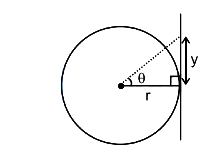
$A$ bulb is placed at the centre of a circular track of radius $10 \ m$. $A$ vertical wall is erected touching the track at a point $P$. $A$ man is running along the track with a speed of $10 \ m/sec$. Starting from $P$, the speed with which his shadow is running along the wall when he is at an angular distance of $60^{\circ}$ from $P$ is: (in $m/sec$)
A
$30$
B
$40$
C
$60$
D
$80$
Solution
(B) Let $r = 10 \ m$ be the radius of the circular track.
The speed of the man along the track is $v = r \frac{d\theta}{dt} = 10 \ m/sec$.
Since $r = 10 \ m$, we have $10 \frac{d\theta}{dt} = 10$, which implies $\frac{d\theta}{dt} = 1 \ rad/sec$.
Let $y$ be the position of the shadow on the wall at an angular distance $\theta$ from $P$.
From the geometry, we have $\tan \theta = \frac{y}{r}$, so $y = r \tan \theta$.
Differentiating with respect to time $t$, we get $\frac{dy}{dt} = r \sec^2 \theta \cdot \frac{d\theta}{dt}$.
At $\theta = 60^{\circ}$, we have $\sec(60^{\circ}) = 2$, so $\sec^2(60^{\circ}) = 4$.
Substituting the values, $\frac{dy}{dt} = 10 \times 4 \times 1 = 40 \ m/sec$.
Thus, the speed of the shadow is $40 \ m/sec$.
The speed of the man along the track is $v = r \frac{d\theta}{dt} = 10 \ m/sec$.
Since $r = 10 \ m$, we have $10 \frac{d\theta}{dt} = 10$, which implies $\frac{d\theta}{dt} = 1 \ rad/sec$.
Let $y$ be the position of the shadow on the wall at an angular distance $\theta$ from $P$.
From the geometry, we have $\tan \theta = \frac{y}{r}$, so $y = r \tan \theta$.
Differentiating with respect to time $t$, we get $\frac{dy}{dt} = r \sec^2 \theta \cdot \frac{d\theta}{dt}$.
At $\theta = 60^{\circ}$, we have $\sec(60^{\circ}) = 2$, so $\sec^2(60^{\circ}) = 4$.
Substituting the values, $\frac{dy}{dt} = 10 \times 4 \times 1 = 40 \ m/sec$.
Thus, the speed of the shadow is $40 \ m/sec$.
0 likes
View Solution354
EasyMCQ
$A$ point is in motion along a hyperbola $y = \frac{10}{x}$ such that its abscissa $x$ increases uniformly at a rate of $1 \text{ unit/s}$. Find the rate of change of its ordinate when the point passes through $(5, 2)$.
A
increases at the rate of $\frac{1}{2} \text{ unit/s}$
B
decreases at the rate of $\frac{1}{2} \text{ unit/s}$
C
decreases at the rate of $\frac{2}{5} \text{ unit/s}$
D
increases at the rate of $\frac{2}{5} \text{ unit/s}$
Solution
(C) Given the equation of the hyperbola is $y = \frac{10}{x}$.
The rate of change of the abscissa is given as $\frac{dx}{dt} = 1 \text{ unit/s}$.
To find the rate of change of the ordinate $\frac{dy}{dt}$, we differentiate $y$ with respect to $t$ using the chain rule:
$\frac{dy}{dt} = \frac{d}{dt} \left( \frac{10}{x} \right) = -\frac{10}{x^2} \cdot \frac{dx}{dt}$.
Substitute the given values $x = 5$ and $\frac{dx}{dt} = 1$ into the derivative:
$\frac{dy}{dt} = -\frac{10}{(5)^2} \cdot (1) = -\frac{10}{25} = -\frac{2}{5} \text{ unit/s}$.
Since the result is negative, the ordinate $y$ decreases at the rate of $\frac{2}{5} \text{ unit/s}$.
The rate of change of the abscissa is given as $\frac{dx}{dt} = 1 \text{ unit/s}$.
To find the rate of change of the ordinate $\frac{dy}{dt}$, we differentiate $y$ with respect to $t$ using the chain rule:
$\frac{dy}{dt} = \frac{d}{dt} \left( \frac{10}{x} \right) = -\frac{10}{x^2} \cdot \frac{dx}{dt}$.
Substitute the given values $x = 5$ and $\frac{dx}{dt} = 1$ into the derivative:
$\frac{dy}{dt} = -\frac{10}{(5)^2} \cdot (1) = -\frac{10}{25} = -\frac{2}{5} \text{ unit/s}$.
Since the result is negative, the ordinate $y$ decreases at the rate of $\frac{2}{5} \text{ unit/s}$.
0 likes
View Solution355
MediumMCQ
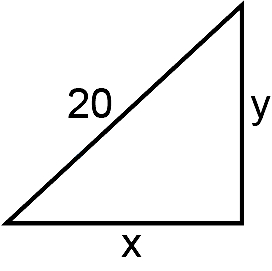
$A$ ladder $20 \ ft$ long leans against a vertical wall. The top end slides downwards at the rate of $2 \ ft/sec$. The rate at which the lower end moves on a horizontal floor when it is $12 \ ft$ from the wall is
A
$\frac{8}{3} \ ft/sec$
B
$\frac{6}{5} \ ft/sec$
C
$\frac{3}{2} \ ft/sec$
D
$\frac{17}{4} \ ft/sec$
Solution
(A) Let $x$ be the distance of the lower end of the ladder from the wall and $y$ be the height of the top end of the ladder from the floor.
Given the length of the ladder is $20 \ ft$, by the Pythagorean theorem, we have:
$x^2 + y^2 = 20^2 = 400$
Differentiating both sides with respect to time $t$, we get:
$2x \frac{dx}{dt} + 2y \frac{dy}{dt} = 0$
$x \frac{dx}{dt} + y \frac{dy}{dt} = 0$
Given that the top end slides downwards at a rate of $2 \ ft/sec$, we have $\frac{dy}{dt} = -2 \ ft/sec$.
When $x = 12 \ ft$, we find $y$ using the equation $x^2 + y^2 = 400$:
$12^2 + y^2 = 400$
$144 + y^2 = 400$
$y^2 = 256 \Rightarrow y = 16 \ ft$
Now, substitute $x = 12$, $y = 16$, and $\frac{dy}{dt} = -2$ into the differentiated equation:
$12 \left(\frac{dx}{dt}\right) + 16(-2) = 0$
$12 \left(\frac{dx}{dt}\right) - 32 = 0$
$12 \left(\frac{dx}{dt}\right) = 32$
$\frac{dx}{dt} = \frac{32}{12} = \frac{8}{3} \ ft/sec$
Thus, the lower end moves away from the wall at a rate of $\frac{8}{3} \ ft/sec$.
Given the length of the ladder is $20 \ ft$, by the Pythagorean theorem, we have:
$x^2 + y^2 = 20^2 = 400$
Differentiating both sides with respect to time $t$, we get:
$2x \frac{dx}{dt} + 2y \frac{dy}{dt} = 0$
$x \frac{dx}{dt} + y \frac{dy}{dt} = 0$
Given that the top end slides downwards at a rate of $2 \ ft/sec$, we have $\frac{dy}{dt} = -2 \ ft/sec$.
When $x = 12 \ ft$, we find $y$ using the equation $x^2 + y^2 = 400$:
$12^2 + y^2 = 400$
$144 + y^2 = 400$
$y^2 = 256 \Rightarrow y = 16 \ ft$
Now, substitute $x = 12$, $y = 16$, and $\frac{dy}{dt} = -2$ into the differentiated equation:
$12 \left(\frac{dx}{dt}\right) + 16(-2) = 0$
$12 \left(\frac{dx}{dt}\right) - 32 = 0$
$12 \left(\frac{dx}{dt}\right) = 32$
$\frac{dx}{dt} = \frac{32}{12} = \frac{8}{3} \ ft/sec$
Thus, the lower end moves away from the wall at a rate of $\frac{8}{3} \ ft/sec$.
0 likes
View Solution356
EasyMCQ
$A$ particle is in motion along a curve $12 y = x^{3}$. The rate of change of its ordinate exceeds that of its abscissa when:
A
$ -2 < x < 2 $
B
$ x = \pm 2 $
C
$ x < -2 $
D
$ x > 2 $
Solution
(D) Given the curve $12 y = x^{3}$.
Let the rate of change of the ordinate be $\frac{dy}{dt}$ and the rate of change of the abscissa be $\frac{dx}{dt}$.
We are given that the rate of change of the ordinate exceeds that of the abscissa, so $\frac{dy}{dt} > \frac{dx}{dt}$.
Differentiating the equation of the curve with respect to $t$, we get $12 \frac{dy}{dt} = 3x^{2} \frac{dx}{dt}$, which implies $\frac{dy}{dt} = \frac{x^{2}}{4} \frac{dx}{dt}$.
Substituting this into the inequality $\frac{dy}{dt} > \frac{dx}{dt}$, we have $\frac{x^{2}}{4} \frac{dx}{dt} > \frac{dx}{dt}$.
Assuming $\frac{dx}{dt} > 0$, we get $\frac{x^{2}}{4} > 1$, which means $x^{2} > 4$.
This inequality $x^{2} - 4 > 0$ factors as $(x - 2)(x + 2) > 0$.
The solution to this inequality is $x \in (-\infty, -2) \cup (2, \infty)$.
Since the question asks for the condition where the rate of change of the ordinate exceeds the abscissa, and considering the provided options, the condition $x > 2$ is a valid subset of the solution set.
Let the rate of change of the ordinate be $\frac{dy}{dt}$ and the rate of change of the abscissa be $\frac{dx}{dt}$.
We are given that the rate of change of the ordinate exceeds that of the abscissa, so $\frac{dy}{dt} > \frac{dx}{dt}$.
Differentiating the equation of the curve with respect to $t$, we get $12 \frac{dy}{dt} = 3x^{2} \frac{dx}{dt}$, which implies $\frac{dy}{dt} = \frac{x^{2}}{4} \frac{dx}{dt}$.
Substituting this into the inequality $\frac{dy}{dt} > \frac{dx}{dt}$, we have $\frac{x^{2}}{4} \frac{dx}{dt} > \frac{dx}{dt}$.
Assuming $\frac{dx}{dt} > 0$, we get $\frac{x^{2}}{4} > 1$, which means $x^{2} > 4$.
This inequality $x^{2} - 4 > 0$ factors as $(x - 2)(x + 2) > 0$.
The solution to this inequality is $x \in (-\infty, -2) \cup (2, \infty)$.
Since the question asks for the condition where the rate of change of the ordinate exceeds the abscissa, and considering the provided options, the condition $x > 2$ is a valid subset of the solution set.
0 likes
View Solution357
EasyMCQ
The acceleration of a particle starting from rest and moving in a straight line with uniform acceleration is $8 \text{ m/s}^2$. The time taken by the particle to move the second metre is
A
$\frac{\sqrt{2}-1}{2} \text{ s}$
B
$\frac{\sqrt{2}+1}{2} \text{ s}$
C
$(1+\sqrt{2}) \text{ s}$
D
$(\sqrt{2}-1) \text{ s}$
Solution
(A) Given: Initial velocity $u = 0$, acceleration $a = 8 \text{ m/s}^2$.
Using the equation of motion $S = ut + \frac{1}{2}at^2$, since $u = 0$, we have $S = \frac{1}{2}at^2$.
$1$. Time taken to cover the first metre $(S_1 = 1 \text{ m})$:
$1 = \frac{1}{2} \times 8 \times t_1^2 \implies 1 = 4t_1^2 \implies t_1^2 = \frac{1}{4} \implies t_1 = \frac{1}{2} \text{ s}$.
$2$. Time taken to cover the first two metres $(S_2 = 2 \text{ m})$:
$2 = \frac{1}{2} \times 8 \times t_2^2 \implies 2 = 4t_2^2 \implies t_2^2 = \frac{1}{2} \implies t_2 = \frac{1}{\sqrt{2}} \text{ s}$.
$3$. Time taken to move the second metre is the difference between the time taken to cover $2 \text{ m}$ and $1 \text{ m}$:
$\Delta t = t_2 - t_1 = \frac{1}{\sqrt{2}} - \frac{1}{2} = \frac{\sqrt{2}-1}{2} \text{ s}$.
Using the equation of motion $S = ut + \frac{1}{2}at^2$, since $u = 0$, we have $S = \frac{1}{2}at^2$.
$1$. Time taken to cover the first metre $(S_1 = 1 \text{ m})$:
$1 = \frac{1}{2} \times 8 \times t_1^2 \implies 1 = 4t_1^2 \implies t_1^2 = \frac{1}{4} \implies t_1 = \frac{1}{2} \text{ s}$.
$2$. Time taken to cover the first two metres $(S_2 = 2 \text{ m})$:
$2 = \frac{1}{2} \times 8 \times t_2^2 \implies 2 = 4t_2^2 \implies t_2^2 = \frac{1}{2} \implies t_2 = \frac{1}{\sqrt{2}} \text{ s}$.
$3$. Time taken to move the second metre is the difference between the time taken to cover $2 \text{ m}$ and $1 \text{ m}$:
$\Delta t = t_2 - t_1 = \frac{1}{\sqrt{2}} - \frac{1}{2} = \frac{\sqrt{2}-1}{2} \text{ s}$.
0 likes
View Solution358
MediumMCQ
If the displacement, velocity, and acceleration of a particle at time $t$ are $x, v$, and $f$ respectively, then which of the following is true?
A
$f=v^3 \frac{d^2 t}{d x^2}$
B
$f=-v^3 \frac{d^2 t}{d x^2}$
C
$f=v^2 \frac{d^2 t}{d x^2}$
D
$f=-v^2 \frac{d^2 t}{d x^2}$
Solution
(B) We know that velocity $v = \frac{dx}{dt}$, so $\frac{dt}{dx} = \frac{1}{v}$.
Now, differentiate with respect to $x$:
$\frac{d^2 t}{dx^2} = \frac{d}{dx} \left( \frac{1}{v} \right) = -\frac{1}{v^2} \frac{dv}{dx}$.
Using the chain rule, $\frac{dv}{dx} = \frac{dv}{dt} \times \frac{dt}{dx} = f \times \frac{1}{v} = \frac{f}{v}$.
Substituting this back into the equation:
$\frac{d^2 t}{dx^2} = -\frac{1}{v^2} \times \frac{f}{v} = -\frac{f}{v^3}$.
Rearranging for $f$, we get $f = -v^3 \frac{d^2 t}{dx^2}$.
Now, differentiate with respect to $x$:
$\frac{d^2 t}{dx^2} = \frac{d}{dx} \left( \frac{1}{v} \right) = -\frac{1}{v^2} \frac{dv}{dx}$.
Using the chain rule, $\frac{dv}{dx} = \frac{dv}{dt} \times \frac{dt}{dx} = f \times \frac{1}{v} = \frac{f}{v}$.
Substituting this back into the equation:
$\frac{d^2 t}{dx^2} = -\frac{1}{v^2} \times \frac{f}{v} = -\frac{f}{v^3}$.
Rearranging for $f$, we get $f = -v^3 \frac{d^2 t}{dx^2}$.
0 likes
View Solution359
EasyMCQ
The displacement $x$ of a particle at time $t$ is given by $x = At^2 + Bt + C$, where $A, B, C$ are constants and $v$ is the velocity of the particle. Then the value of $4Ax - v^2$ is:
A
$4AC + B^2$
B
$4AC - B^2$
C
$2AC - B^2$
D
$2AC + B^2$
Solution
(B) Given the displacement equation: $x = At^2 + Bt + C$.
Velocity $v$ is the rate of change of displacement with respect to time $t$: $v = \frac{dx}{dt} = 2At + B$.
Now, calculate $v^2$: $v^2 = (2At + B)^2 = 4A^2t^2 + 4ABt + B^2$.
Next, calculate $4Ax$: $4Ax = 4A(At^2 + Bt + C) = 4A^2t^2 + 4ABt + 4AC$.
Now, subtract $v^2$ from $4Ax$: $4Ax - v^2 = (4A^2t^2 + 4ABt + 4AC) - (4A^2t^2 + 4ABt + B^2)$.
Simplifying the expression: $4Ax - v^2 = 4AC - B^2$.
Velocity $v$ is the rate of change of displacement with respect to time $t$: $v = \frac{dx}{dt} = 2At + B$.
Now, calculate $v^2$: $v^2 = (2At + B)^2 = 4A^2t^2 + 4ABt + B^2$.
Next, calculate $4Ax$: $4Ax = 4A(At^2 + Bt + C) = 4A^2t^2 + 4ABt + 4AC$.
Now, subtract $v^2$ from $4Ax$: $4Ax - v^2 = (4A^2t^2 + 4ABt + 4AC) - (4A^2t^2 + 4ABt + B^2)$.
Simplifying the expression: $4Ax - v^2 = 4AC - B^2$.
0 likes
View Solution360
EasyMCQ
The distance covered by a particle in $t$ seconds is given by $x = 3 + 8t - 4t^2$. After $1$ second, the velocity will be:
A
$0$ unit/second
B
$3$ units/second
C
$4$ units/second
D
$7$ units/second
Solution
(A) The distance $x$ covered by the particle is given by the equation: $x = 3 + 8t - 4t^2$.
Velocity $v$ is defined as the rate of change of displacement with respect to time, which is given by the derivative of $x$ with respect to $t$:
$v = \frac{dx}{dt} = \frac{d}{dt}(3 + 8t - 4t^2)$.
Applying the power rule for differentiation:
$v = 0 + 8(1) - 4(2t) = 8 - 8t$.
To find the velocity after $1$ second, substitute $t = 1$ into the velocity equation:
$v = 8 - 8(1) = 8 - 8 = 0$ unit/second.
Velocity $v$ is defined as the rate of change of displacement with respect to time, which is given by the derivative of $x$ with respect to $t$:
$v = \frac{dx}{dt} = \frac{d}{dt}(3 + 8t - 4t^2)$.
Applying the power rule for differentiation:
$v = 0 + 8(1) - 4(2t) = 8 - 8t$.
To find the velocity after $1$ second, substitute $t = 1$ into the velocity equation:
$v = 8 - 8(1) = 8 - 8 = 0$ unit/second.
0 likes
View Solution361
EasyMCQ
If the rate of increase of the radius of a circle is $5 \text{ cm/sec}$, then the rate of increase of its area, when the radius is $20 \text{ cm}$, will be
A
$100 \pi \text{ cm}^2/\text{sec}$
B
$200 \pi \text{ cm}^2/\text{sec}$
C
$400 \pi \text{ cm}^2/\text{sec}$
D
$500 \pi \text{ cm}^2/\text{sec}$
Solution
(B) Let $r$ be the radius and $A$ be the area of the circle.
Given that the rate of change of the radius is $\frac{dr}{dt} = 5 \text{ cm/sec}$.
The area of a circle is given by $A = \pi r^2$.
Differentiating both sides with respect to time $t$, we get:
$\frac{dA}{dt} = \frac{d}{dt}(\pi r^2) = 2 \pi r \frac{dr}{dt}$.
Substituting the given values $r = 20 \text{ cm}$ and $\frac{dr}{dt} = 5 \text{ cm/sec}$:
$\frac{dA}{dt} = 2 \pi (20)(5) = 200 \pi \text{ cm}^2/\text{sec}$.
Thus, the rate of increase of the area is $200 \pi \text{ cm}^2/\text{sec}$.
Given that the rate of change of the radius is $\frac{dr}{dt} = 5 \text{ cm/sec}$.
The area of a circle is given by $A = \pi r^2$.
Differentiating both sides with respect to time $t$, we get:
$\frac{dA}{dt} = \frac{d}{dt}(\pi r^2) = 2 \pi r \frac{dr}{dt}$.
Substituting the given values $r = 20 \text{ cm}$ and $\frac{dr}{dt} = 5 \text{ cm/sec}$:
$\frac{dA}{dt} = 2 \pi (20)(5) = 200 \pi \text{ cm}^2/\text{sec}$.
Thus, the rate of increase of the area is $200 \pi \text{ cm}^2/\text{sec}$.
0 likes
View Solution362
EasyMCQ
$A$ particle is moving in a straight line. At time $t$, the distance of the particle from its starting point is given by $x = t^3 - 6t^2 + t$. Its acceleration will be zero at
A
$t = 1$ unit time
B
$t = 2$ unit time
C
$t = 3$ unit time
D
$t = 4$ unit time
Solution
(B) Given the displacement function: $x = t^3 - 6t^2 + t$.
Velocity $v$ is the first derivative of displacement with respect to time: $v = \frac{dx}{dt} = \frac{d}{dt}(t^3 - 6t^2 + t) = 3t^2 - 12t + 1$.
Acceleration $a$ is the derivative of velocity with respect to time: $a = \frac{dv}{dt} = \frac{d}{dt}(3t^2 - 12t + 1) = 6t - 12$.
For acceleration to be zero: $a = 0$.
$6t - 12 = 0$.
$6t = 12$.
$t = 2$ unit time.
Velocity $v$ is the first derivative of displacement with respect to time: $v = \frac{dx}{dt} = \frac{d}{dt}(t^3 - 6t^2 + t) = 3t^2 - 12t + 1$.
Acceleration $a$ is the derivative of velocity with respect to time: $a = \frac{dv}{dt} = \frac{d}{dt}(3t^2 - 12t + 1) = 6t - 12$.
For acceleration to be zero: $a = 0$.
$6t - 12 = 0$.
$6t = 12$.
$t = 2$ unit time.
0 likes
View Solution363
EasyMCQ
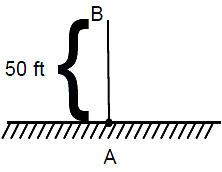
$A$ balloon starting from rest is ascending from the ground with a uniform acceleration of $4 \ ft/sec^2$. At the end of $5 \ sec$, a stone is dropped from it. If $T$ is the time taken for the stone to reach the ground and $H$ is the height of the balloon when the stone reaches the ground, then:
A
$T = 5/2 \ sec$
B
$H = 112.5 \ ft$
C
$T = 5 \ sec$
D
$H = 225 \ ft$
Solution
(A) $1$. Initial motion of the balloon: $u = 0$, $a = 4 \ ft/sec^2$, $t = 5 \ sec$.
Height of the balloon at $t = 5 \ sec$: $h_0 = ut + \frac{1}{2}at^2 = 0 + \frac{1}{2} \times 4 \times 5^2 = 50 \ ft$.
Velocity of the balloon at $t = 5 \ sec$: $v_0 = u + at = 0 + 4 \times 5 = 20 \ ft/sec$.
$2$. Motion of the stone after being dropped: The stone has an initial upward velocity $v_0 = 20 \ ft/sec$ and acceleration $g = -32 \ ft/sec^2$.
Using $s = ut + \frac{1}{2}at^2$ for the stone to reach the ground $(s = -50 \ ft)$:
$-50 = 20T + \frac{1}{2}(-32)T^2$
$-50 = 20T - 16T^2$ $\Rightarrow 16T^2 - 20T - 50 = 0$ $\Rightarrow 8T^2 - 10T - 25 = 0$.
Solving for $T$: $T = \frac{10 \pm \sqrt{100 - 4(8)(-25)}}{2(8)} = \frac{10 \pm \sqrt{900}}{16} = \frac{10 \pm 30}{16}$.
Since $T > 0$, $T = \frac{40}{16} = 2.5 \ sec = 5/2 \ sec$.
$3$. Height of the balloon when the stone reaches the ground: The balloon continues to ascend with $a = 4 \ ft/sec^2$ for an additional $T = 2.5 \ sec$.
$H = h_0 + v_0 T + \frac{1}{2}aT^2 = 50 + 20(2.5) + \frac{1}{2}(4)(2.5)^2 = 50 + 50 + 12.5 = 112.5 \ ft$.
Height of the balloon at $t = 5 \ sec$: $h_0 = ut + \frac{1}{2}at^2 = 0 + \frac{1}{2} \times 4 \times 5^2 = 50 \ ft$.
Velocity of the balloon at $t = 5 \ sec$: $v_0 = u + at = 0 + 4 \times 5 = 20 \ ft/sec$.
$2$. Motion of the stone after being dropped: The stone has an initial upward velocity $v_0 = 20 \ ft/sec$ and acceleration $g = -32 \ ft/sec^2$.
Using $s = ut + \frac{1}{2}at^2$ for the stone to reach the ground $(s = -50 \ ft)$:
$-50 = 20T + \frac{1}{2}(-32)T^2$
$-50 = 20T - 16T^2$ $\Rightarrow 16T^2 - 20T - 50 = 0$ $\Rightarrow 8T^2 - 10T - 25 = 0$.
Solving for $T$: $T = \frac{10 \pm \sqrt{100 - 4(8)(-25)}}{2(8)} = \frac{10 \pm \sqrt{900}}{16} = \frac{10 \pm 30}{16}$.
Since $T > 0$, $T = \frac{40}{16} = 2.5 \ sec = 5/2 \ sec$.
$3$. Height of the balloon when the stone reaches the ground: The balloon continues to ascend with $a = 4 \ ft/sec^2$ for an additional $T = 2.5 \ sec$.
$H = h_0 + v_0 T + \frac{1}{2}aT^2 = 50 + 20(2.5) + \frac{1}{2}(4)(2.5)^2 = 50 + 50 + 12.5 = 112.5 \ ft$.
0 likes
View Solution364
DifficultMCQ
The total cost $C(x)$ in Rupees, associated with the production of $x$ units of an item is given by $C(x) = 0.05x^3 - 0.2x^2 + 3x + 500$. The marginal cost, where $x = 3$ is $\rule{1cm}{0.15mm}$ (in Rupees).
A
$3.15$
B
$30.15$
C
$3.015$
D
$30.015$
Solution
(A) The marginal cost function $MC$ is the derivative of the cost function $C(x)$ with respect to $x$.
$MC = \frac{dC}{dx} = \frac{d}{dx}(0.05x^3 - 0.2x^2 + 3x + 500)$.
Applying the power rule, we get $MC = 0.15x^2 - 0.4x + 3$.
To find the marginal cost at $x = 3$, we substitute $x = 3$ into the $MC$ function:
$MC(3) = 0.15(3)^2 - 0.4(3) + 3$.
$MC(3) = 0.15(9) - 1.2 + 3$.
$MC(3) = 1.35 - 1.2 + 3$.
$MC(3) = 0.15 + 3 = 3.15$.
Thus, the marginal cost at $x = 3$ is $3.15$ Rupees.
$MC = \frac{dC}{dx} = \frac{d}{dx}(0.05x^3 - 0.2x^2 + 3x + 500)$.
Applying the power rule, we get $MC = 0.15x^2 - 0.4x + 3$.
To find the marginal cost at $x = 3$, we substitute $x = 3$ into the $MC$ function:
$MC(3) = 0.15(3)^2 - 0.4(3) + 3$.
$MC(3) = 0.15(9) - 1.2 + 3$.
$MC(3) = 1.35 - 1.2 + 3$.
$MC(3) = 0.15 + 3 = 3.15$.
Thus, the marginal cost at $x = 3$ is $3.15$ Rupees.
0 likes
View Solution365
DifficultMCQ
The total revenue in Rupees received from the sale of $x$ units of a product is given by $R(x) = 3x^2 + 36x + 5$. The marginal revenue, when $x = 15$ is . . . . . . .
A
$96$
B
$116$
C
$90$
D
$126$
Solution
(D) Marginal Revenue $(MR)$ is defined as the derivative of the total revenue function $R(x)$ with respect to $x$.
$MR = \frac{dR}{dx} = \frac{d}{dx}(3x^2 + 36x + 5)$
Applying the power rule of differentiation:
$MR = 6x + 36$
Now, substitute $x = 15$ into the expression for $MR$:
$MR = 6(15) + 36$
$MR = 90 + 36 = 126$
Therefore, the marginal revenue when $x = 15$ is $126$.
$MR = \frac{dR}{dx} = \frac{d}{dx}(3x^2 + 36x + 5)$
Applying the power rule of differentiation:
$MR = 6x + 36$
Now, substitute $x = 15$ into the expression for $MR$:
$MR = 6(15) + 36$
$MR = 90 + 36 = 126$
Therefore, the marginal revenue when $x = 15$ is $126$.
0 likes
View Solution366
DifficultMCQ
$A$ point on the parabola $y^2 = \frac{36}{5}x$ at which the ordinate increases at thrice the rate of the abscissa is:
A
$(6/5, 1/5)$
B
$(1/5, 6/5)$
C
$(5, 6)$
D
$(3/5, 9/5)$
Solution
(B) Given the parabola equation: $y^2 = \frac{36}{5}x$.
Differentiating both sides with respect to time $t$: $2y \frac{dy}{dt} = \frac{36}{5} \frac{dx}{dt}$.
We are given that the ordinate $(y)$ increases at thrice the rate of the abscissa $(x)$, so $\frac{dy}{dt} = 3 \frac{dx}{dt}$.
Substituting this into the differentiated equation: $2y(3 \frac{dx}{dt}) = \frac{36}{5} \frac{dx}{dt}$.
Assuming $\frac{dx}{dt} \neq 0$, we get $6y = \frac{36}{5}$, which simplifies to $y = \frac{6}{5}$.
Now, substitute $y = \frac{6}{5}$ into the original parabola equation: $(\frac{6}{5})^2 = \frac{36}{5}x$.
$\frac{36}{25} = \frac{36}{5}x$.
Solving for $x$: $x = \frac{36}{25} \times \frac{5}{36} = \frac{1}{5}$.
Thus, the required point is $(1/5, 6/5)$.
Differentiating both sides with respect to time $t$: $2y \frac{dy}{dt} = \frac{36}{5} \frac{dx}{dt}$.
We are given that the ordinate $(y)$ increases at thrice the rate of the abscissa $(x)$, so $\frac{dy}{dt} = 3 \frac{dx}{dt}$.
Substituting this into the differentiated equation: $2y(3 \frac{dx}{dt}) = \frac{36}{5} \frac{dx}{dt}$.
Assuming $\frac{dx}{dt} \neq 0$, we get $6y = \frac{36}{5}$, which simplifies to $y = \frac{6}{5}$.
Now, substitute $y = \frac{6}{5}$ into the original parabola equation: $(\frac{6}{5})^2 = \frac{36}{5}x$.
$\frac{36}{25} = \frac{36}{5}x$.
Solving for $x$: $x = \frac{36}{25} \times \frac{5}{36} = \frac{1}{5}$.
Thus, the required point is $(1/5, 6/5)$.
0 likes
View Solution367
DifficultMCQ
If a spherical balloon has a variable diameter $d = 3x + \frac{9}{2}$ units, then the rate of change of its volume $V$ with respect to $x$ is:
A
$\frac{27\pi}{4}(2x + 3)^2$
B
$\frac{2\pi}{3}(2x + 3)^2$
C
$\frac{27\pi}{8}(2x + 3)^2$
D
$\frac{27\pi}{2}(2x + 3)^2$
Solution
(C) The diameter of the sphere is $d = 3x + \frac{9}{2} = \frac{3}{2}(2x + 3)$.
The radius $r$ is $\frac{d}{2} = \frac{3}{4}(2x + 3)$.
The volume $V$ of a sphere is $V = \frac{4}{3}\pi r^3$.
Substituting $r$, we get $V = \frac{4}{3}\pi \left[ \frac{3}{4}(2x + 3) \right]^3 = \frac{4}{3}\pi \cdot \frac{27}{64}(2x + 3)^3 = \frac{9\pi}{16}(2x + 3)^3$.
Differentiating $V$ with respect to $x$ using the chain rule:
$\frac{dV}{dx} = \frac{9\pi}{16} \cdot 3(2x + 3)^2 \cdot \frac{d}{dx}(2x + 3) = \frac{27\pi}{16}(2x + 3)^2 \cdot 2 = \frac{27\pi}{8}(2x + 3)^2$.
The radius $r$ is $\frac{d}{2} = \frac{3}{4}(2x + 3)$.
The volume $V$ of a sphere is $V = \frac{4}{3}\pi r^3$.
Substituting $r$, we get $V = \frac{4}{3}\pi \left[ \frac{3}{4}(2x + 3) \right]^3 = \frac{4}{3}\pi \cdot \frac{27}{64}(2x + 3)^3 = \frac{9\pi}{16}(2x + 3)^3$.
Differentiating $V$ with respect to $x$ using the chain rule:
$\frac{dV}{dx} = \frac{9\pi}{16} \cdot 3(2x + 3)^2 \cdot \frac{d}{dx}(2x + 3) = \frac{27\pi}{16}(2x + 3)^2 \cdot 2 = \frac{27\pi}{8}(2x + 3)^2$.
0 likes
View Solution368
DifficultMCQ
The surface area of a spherical ball is increasing at the rate of $4\pi \text{ cm}^2/\text{s}$. The rate at which the radius is increasing when the surface area is $16\pi \text{ cm}^2$ is (in $\text{ cm/s}$)
A
$0.5$
B
$0.25$
C
$0.125$
D
$1$
Solution
(B) Let the surface area be $S = 4\pi r^2$, where $r$ is the radius.
Differentiating with respect to time $t$, we get $\frac{dS}{dt} = 8\pi r \frac{dr}{dt}$.
Given $\frac{dS}{dt} = 4\pi \text{ cm}^2/\text{s}$.
When $S = 16\pi \text{ cm}^2$, we have $4\pi r^2 = 16\pi$, which implies $r^2 = 4$, so $r = 2 \text{ cm}$.
Substituting these values into the derivative equation: $4\pi = 8\pi(2) \frac{dr}{dt}$.
$4\pi = 16\pi \frac{dr}{dt}$.
$\frac{dr}{dt} = \frac{4\pi}{16\pi} = 0.25 \text{ cm/s}$.
Differentiating with respect to time $t$, we get $\frac{dS}{dt} = 8\pi r \frac{dr}{dt}$.
Given $\frac{dS}{dt} = 4\pi \text{ cm}^2/\text{s}$.
When $S = 16\pi \text{ cm}^2$, we have $4\pi r^2 = 16\pi$, which implies $r^2 = 4$, so $r = 2 \text{ cm}$.
Substituting these values into the derivative equation: $4\pi = 8\pi(2) \frac{dr}{dt}$.
$4\pi = 16\pi \frac{dr}{dt}$.
$\frac{dr}{dt} = \frac{4\pi}{16\pi} = 0.25 \text{ cm/s}$.
0 likes
View Solution369
DifficultMCQ
$A$ triangle has two fixed vertices $A(a, 0)$ and $B(0, b)$. Let its third vertex $C$ move along the line $x = y$. If $s$ is the area of triangle $ABC$, then $\frac{ds}{dx} =$
A
$a + b$
B
$-\frac{a + b}{2}$
C
$\frac{a - b}{2}$
D
$\frac{a + b}{2}$
Solution
(D) The area $s$ of a triangle with vertices $(x_1, y_1)$, $(x_2, y_2)$, and $(x_3, y_3)$ is given by $s = \frac{1}{2} |x_1(y_2 - y_3) + x_2(y_3 - y_1) + x_3(y_1 - y_2)|$.
Given vertices $A(a, 0)$, $B(0, b)$, and $C(x, x)$, we have:
$s = \frac{1}{2} |a(b - x) + 0(x - 0) + x(0 - b)|$
$s = \frac{1}{2} |ab - ax - bx| = \frac{1}{2} |ab - x(a + b)|$.
Since $s$ is the absolute value, $s = \pm \frac{1}{2} (ab - x(a + b))$.
Differentiating with respect to $x$:
$\frac{ds}{dx} = \pm \frac{1}{2} (-(a + b)) = \mp \frac{a + b}{2}$.
Given the options, the magnitude is $\frac{a + b}{2}$.
Given vertices $A(a, 0)$, $B(0, b)$, and $C(x, x)$, we have:
$s = \frac{1}{2} |a(b - x) + 0(x - 0) + x(0 - b)|$
$s = \frac{1}{2} |ab - ax - bx| = \frac{1}{2} |ab - x(a + b)|$.
Since $s$ is the absolute value, $s = \pm \frac{1}{2} (ab - x(a + b))$.
Differentiating with respect to $x$:
$\frac{ds}{dx} = \pm \frac{1}{2} (-(a + b)) = \mp \frac{a + b}{2}$.
Given the options, the magnitude is $\frac{a + b}{2}$.
0 likes
View Solution370
DifficultMCQ
$A$ spherical snowball is melting such that its volume is decreasing at the rate of $8 \text{ cm}^3/\text{s}$. Find the rate of change of the radius when the radius is $2 \text{ cm}$.
A
The radius is increasing at the rate of $\frac{1}{2\pi} \text{ cm/s}$
B
The radius is decreasing at the rate of $\frac{1}{2\pi} \text{ cm/s}$
C
The radius is increasing at the rate of $\frac{1}{\pi} \text{ cm/s}$
D
The radius is decreasing at the rate of $\frac{1}{\pi} \text{ cm/s}$
Solution
(B) The volume of a sphere is $V = \frac{4}{3}\pi r^3$.
Differentiating with respect to time $t$, we get $\frac{dV}{dt} = 4\pi r^2 \frac{dr}{dt}$.
Given $\frac{dV}{dt} = -8 \text{ cm}^3/\text{s}$ (since volume is decreasing) and $r = 2 \text{ cm}$.
Substituting the values: $-8 = 4\pi(2)^2 \frac{dr}{dt}$.
$-8 = 16\pi \frac{dr}{dt}$.
$\frac{dr}{dt} = -\frac{8}{16\pi} = -\frac{1}{2\pi} \text{ cm/s}$.
The negative sign indicates that the radius is decreasing at the rate of $\frac{1}{2\pi} \text{ cm/s}$.
Differentiating with respect to time $t$, we get $\frac{dV}{dt} = 4\pi r^2 \frac{dr}{dt}$.
Given $\frac{dV}{dt} = -8 \text{ cm}^3/\text{s}$ (since volume is decreasing) and $r = 2 \text{ cm}$.
Substituting the values: $-8 = 4\pi(2)^2 \frac{dr}{dt}$.
$-8 = 16\pi \frac{dr}{dt}$.
$\frac{dr}{dt} = -\frac{8}{16\pi} = -\frac{1}{2\pi} \text{ cm/s}$.
The negative sign indicates that the radius is decreasing at the rate of $\frac{1}{2\pi} \text{ cm/s}$.
0 likes
View Solution371
DifficultMCQ
If the side of an equilateral triangle increases at the rate of $\sqrt{3} \text{ cm/sec}$, then the rate of change of its area when the side is $12 \text{ cm}$ is
A
$18 \text{ cm}^2/\text{sec}$
B
$10 \text{ cm}^2/\text{sec}$
C
$12 \text{ cm}^2/\text{sec}$
D
$3\sqrt{3} \text{ cm}^2/\text{sec}$
Solution
(A) Let the side of the equilateral triangle be $x$.
The area $A$ of an equilateral triangle is given by $A = \frac{\sqrt{3}}{4} x^2$.
Differentiating both sides with respect to time $t$, we get $\frac{dA}{dt} = \frac{\sqrt{3}}{4} \cdot 2x \cdot \frac{dx}{dt} = \frac{\sqrt{3}}{2} x \frac{dx}{dt}$.
Given $\frac{dx}{dt} = \sqrt{3} \text{ cm/sec}$ and $x = 12 \text{ cm}$.
Substituting these values, $\frac{dA}{dt} = \frac{\sqrt{3}}{2} (12) (\sqrt{3}) = 6 \times 3 = 18 \text{ cm}^2/\text{sec}$.
The area $A$ of an equilateral triangle is given by $A = \frac{\sqrt{3}}{4} x^2$.
Differentiating both sides with respect to time $t$, we get $\frac{dA}{dt} = \frac{\sqrt{3}}{4} \cdot 2x \cdot \frac{dx}{dt} = \frac{\sqrt{3}}{2} x \frac{dx}{dt}$.
Given $\frac{dx}{dt} = \sqrt{3} \text{ cm/sec}$ and $x = 12 \text{ cm}$.
Substituting these values, $\frac{dA}{dt} = \frac{\sqrt{3}}{2} (12) (\sqrt{3}) = 6 \times 3 = 18 \text{ cm}^2/\text{sec}$.
0 likes
View Solution372
DifficultMCQ
If a particle moves such that the displacement $s$ is proportional to the square of the velocity $v$, then its acceleration $a$ is
A
proportional to $s^2$
B
proportional to $1/s$
C
proportional to $1/s^2$
D
a constant
Solution
(D) Given that $s \propto v^2$, we can write $s = kv^2$, where $k$ is a constant.
Rearranging for velocity, $v^2 = s/k$, which implies $v = \frac{1}{\sqrt{k}} s^{1/2}$.
Acceleration $a$ is given by $a = v \frac{dv}{ds}$.
Differentiating $v = \frac{1}{\sqrt{k}} s^{1/2}$ with respect to $s$, we get $\frac{dv}{ds} = \frac{1}{\sqrt{k}} \cdot \frac{1}{2} s^{-1/2}$.
Substituting these into the acceleration formula: $a = (\frac{1}{\sqrt{k}} s^{1/2}) \cdot (\frac{1}{2\sqrt{k}} s^{-1/2})$.
Simplifying, $a = \frac{1}{2k} \cdot s^{1/2 - 1/2} = \frac{1}{2k}$.
Since $k$ is a constant, $a$ is a constant.
Rearranging for velocity, $v^2 = s/k$, which implies $v = \frac{1}{\sqrt{k}} s^{1/2}$.
Acceleration $a$ is given by $a = v \frac{dv}{ds}$.
Differentiating $v = \frac{1}{\sqrt{k}} s^{1/2}$ with respect to $s$, we get $\frac{dv}{ds} = \frac{1}{\sqrt{k}} \cdot \frac{1}{2} s^{-1/2}$.
Substituting these into the acceleration formula: $a = (\frac{1}{\sqrt{k}} s^{1/2}) \cdot (\frac{1}{2\sqrt{k}} s^{-1/2})$.
Simplifying, $a = \frac{1}{2k} \cdot s^{1/2 - 1/2} = \frac{1}{2k}$.
Since $k$ is a constant, $a$ is a constant.
0 likes
View Solution373
DifficultMCQ
$A$ particle is fired straight up from the ground. Its height in feet after $t$ seconds is given by $s(t) = 128t - 16t^2$. The velocity of the particle when it hits the ground is...
A
$-128 \text{ ft/sec}$
B
$128 \text{ ft/sec}$
C
$0 \text{ ft/sec}$
D
$256 \text{ ft/sec}$
Solution
(A) The particle hits the ground when the height $s(t) = 0$.
$128t - 16t^2 = 0 \implies 16t(8 - t) = 0$.
Since $t > 0$, the particle hits the ground at $t = 8 \text{ s}$.
The velocity $v(t)$ is the derivative of the position function $s(t)$ with respect to time $t$: $v(t) = s'(t) = \frac{d}{dt}(128t - 16t^2) = 128 - 32t$.
Substituting $t = 8$ into the velocity equation: $v(8) = 128 - 32(8) = 128 - 256 = -128 \text{ ft/sec}$.
$128t - 16t^2 = 0 \implies 16t(8 - t) = 0$.
Since $t > 0$, the particle hits the ground at $t = 8 \text{ s}$.
The velocity $v(t)$ is the derivative of the position function $s(t)$ with respect to time $t$: $v(t) = s'(t) = \frac{d}{dt}(128t - 16t^2) = 128 - 32t$.
Substituting $t = 8$ into the velocity equation: $v(8) = 128 - 32(8) = 128 - 256 = -128 \text{ ft/sec}$.
0 likes
View Solution374
DifficultMCQ
If the rate of increase of the surface area of a spherical balloon is $5 \text{ cm}^2/\text{sec}$ and the rate of increase of its volume is $10 \text{ cm}^3/\text{sec}$, then the radius of the balloon at that instant is... (in $\text{ cm}$)
A
$3$
B
$5$
C
$6$
D
$4$
Solution
(D) Let $r$ be the radius of the spherical balloon.
Surface area $S = 4\pi r^2$, so $\frac{dS}{dt} = 8\pi r \frac{dr}{dt} = 5$.
Volume $V = \frac{4}{3}\pi r^3$, so $\frac{dV}{dt} = 4\pi r^2 \frac{dr}{dt} = 10$.
Dividing the volume rate equation by the surface area rate equation:
$\frac{4\pi r^2 \frac{dr}{dt}}{8\pi r \frac{dr}{dt}} = \frac{10}{5}$.
$\frac{r}{2} = 2$.
$r = 4 \text{ cm}$.
Surface area $S = 4\pi r^2$, so $\frac{dS}{dt} = 8\pi r \frac{dr}{dt} = 5$.
Volume $V = \frac{4}{3}\pi r^3$, so $\frac{dV}{dt} = 4\pi r^2 \frac{dr}{dt} = 10$.
Dividing the volume rate equation by the surface area rate equation:
$\frac{4\pi r^2 \frac{dr}{dt}}{8\pi r \frac{dr}{dt}} = \frac{10}{5}$.
$\frac{r}{2} = 2$.
$r = 4 \text{ cm}$.
0 likes
View Solution375
DifficultMCQ
$A$ spherical iron ball of radius $10 \text{ cm}$ is coated with a layer of ice of uniform thickness that melts at a rate of $50 \text{ cm}^3/\text{min}$. When the thickness of ice is $5 \text{ cm}$, the rate at which the thickness of ice decreases is...
A
$\frac{1}{18\pi} \text{ cm/min}$
B
$\frac{1}{36\pi} \text{ cm/min}$
C
$\frac{5}{6\pi} \text{ cm/min}$
D
$\frac{1}{54\pi} \text{ cm/min}$
Solution
(A) Let $x$ be the thickness of the ice layer. The total radius of the ball including the ice is $R = 10 + x$.
The volume of the ice layer is $V = \frac{4}{3}\pi(10+x)^3 - \frac{4}{3}\pi(10)^3$.
Differentiating with respect to time $t$, we get $\frac{dV}{dt} = 4\pi(10+x)^2 \frac{dx}{dt}$.
Given $\frac{dV}{dt} = -50 \text{ cm}^3/\text{min}$ (since it melts) and $x = 5 \text{ cm}$.
Substituting these values: $-50 = 4\pi(10+5)^2 \frac{dx}{dt}$.
$-50 = 4\pi(15)^2 \frac{dx}{dt} \implies -50 = 4\pi(225) \frac{dx}{dt}$.
$-50 = 900\pi \frac{dx}{dt} \implies \frac{dx}{dt} = -\frac{50}{900\pi} = -\frac{1}{18\pi} \text{ cm/min}$.
Thus, the rate at which the thickness decreases is $\frac{1}{18\pi} \text{ cm/min}$.
The volume of the ice layer is $V = \frac{4}{3}\pi(10+x)^3 - \frac{4}{3}\pi(10)^3$.
Differentiating with respect to time $t$, we get $\frac{dV}{dt} = 4\pi(10+x)^2 \frac{dx}{dt}$.
Given $\frac{dV}{dt} = -50 \text{ cm}^3/\text{min}$ (since it melts) and $x = 5 \text{ cm}$.
Substituting these values: $-50 = 4\pi(10+5)^2 \frac{dx}{dt}$.
$-50 = 4\pi(15)^2 \frac{dx}{dt} \implies -50 = 4\pi(225) \frac{dx}{dt}$.
$-50 = 900\pi \frac{dx}{dt} \implies \frac{dx}{dt} = -\frac{50}{900\pi} = -\frac{1}{18\pi} \text{ cm/min}$.
Thus, the rate at which the thickness decreases is $\frac{1}{18\pi} \text{ cm/min}$.
0 likes
View Solution376
DifficultMCQ
An aeroplane at an altitude of $1 \text{ km}$ is flying horizontally at $600 \text{ km/hr}$, passes directly over an observer. The rate at which it is approaching the observer when it is $1250 \text{ meters}$ away from him is........ (in $\text{ km/hr}$)
A
$360$
B
$430$
C
$600$
D
$250$
Solution
(A) Let $x$ be the horizontal distance and $z$ be the straight-line distance from the observer to the aeroplane.
Given altitude $h = 1 \text{ km}$. By Pythagoras theorem, $z^2 = x^2 + h^2$, so $z^2 = x^2 + 1^2$.
Differentiating with respect to time $t$: $2z \frac{dz}{dt} = 2x \frac{dx}{dt} \implies z \frac{dz}{dt} = x \frac{dx}{dt}$.
Given $z = 1250 \text{ m} = 1.25 \text{ km}$ and $\frac{dx}{dt} = 600 \text{ km/hr}$.
Calculate $x$ when $z = 1.25 \text{ km}$: $x = \sqrt{z^2 - 1^2} = \sqrt{1.25^2 - 1^2} = \sqrt{1.5625 - 1} = \sqrt{0.5625} = 0.75 \text{ km}$.
Substitute values into the derivative equation: $1.25 \frac{dz}{dt} = 0.75 \times 600$.
$\frac{dz}{dt} = \frac{450}{1.25} = 360 \text{ km/hr}$.
Given altitude $h = 1 \text{ km}$. By Pythagoras theorem, $z^2 = x^2 + h^2$, so $z^2 = x^2 + 1^2$.
Differentiating with respect to time $t$: $2z \frac{dz}{dt} = 2x \frac{dx}{dt} \implies z \frac{dz}{dt} = x \frac{dx}{dt}$.
Given $z = 1250 \text{ m} = 1.25 \text{ km}$ and $\frac{dx}{dt} = 600 \text{ km/hr}$.
Calculate $x$ when $z = 1.25 \text{ km}$: $x = \sqrt{z^2 - 1^2} = \sqrt{1.25^2 - 1^2} = \sqrt{1.5625 - 1} = \sqrt{0.5625} = 0.75 \text{ km}$.
Substitute values into the derivative equation: $1.25 \frac{dz}{dt} = 0.75 \times 600$.
$\frac{dz}{dt} = \frac{450}{1.25} = 360 \text{ km/hr}$.
0 likes
View Solution377
DifficultMCQ
In a Maha Kumbh, a drone camera is moving along the curve $3y = x^3 - 3$. The camera captures high-quality pictures when the $y$-coordinate changes $9$ times as fast as the $x$-coordinate. Which of the following is a precise position of the drone at that instant?
A
$(-3, -8)$
B
$(3, -8)$
C
$(3, 8)$
D
$(-3, 8)$
Solution
(C) Given the equation of the path: $3y = x^3 - 3$.
Differentiating both sides with respect to time $t$: $3 \frac{dy}{dt} = 3x^2 \frac{dx}{dt}$.
Given the condition: $\frac{dy}{dt} = 9 \frac{dx}{dt}$.
Substituting the condition into the differentiated equation: $3(9 \frac{dx}{dt}) = 3x^2 \frac{dx}{dt}$.
This simplifies to $27 \frac{dx}{dt} = 3x^2 \frac{dx}{dt}$, which implies $x^2 = 9$, so $x = \pm 3$.
If $x = 3$, then $3y = (3)^3 - 3 = 27 - 3 = 24$, so $y = 8$. The point is $(3, 8)$.
If $x = -3$, then $3y = (-3)^3 - 3 = -27 - 3 = -30$, so $y = -10$. The point is $(-3, -10)$.
Comparing with the given options, $(3, 8)$ is the correct position.
Differentiating both sides with respect to time $t$: $3 \frac{dy}{dt} = 3x^2 \frac{dx}{dt}$.
Given the condition: $\frac{dy}{dt} = 9 \frac{dx}{dt}$.
Substituting the condition into the differentiated equation: $3(9 \frac{dx}{dt}) = 3x^2 \frac{dx}{dt}$.
This simplifies to $27 \frac{dx}{dt} = 3x^2 \frac{dx}{dt}$, which implies $x^2 = 9$, so $x = \pm 3$.
If $x = 3$, then $3y = (3)^3 - 3 = 27 - 3 = 24$, so $y = 8$. The point is $(3, 8)$.
If $x = -3$, then $3y = (-3)^3 - 3 = -27 - 3 = -30$, so $y = -10$. The point is $(-3, -10)$.
Comparing with the given options, $(3, 8)$ is the correct position.
0 likes
View SolutionApplications of Derivatives — Rate of Change of Quantities · Frequently Asked Questions
1Are these Applications of Derivatives questions useful for JEE and NEET?
Yes. All questions in this section are mapped to JEE Main and NEET exam patterns. Previous year questions from JEE Main, NEET, GUJCET and state-level exams are included with full solutions.
2Can I switch to Hindi or Gujarati for these questions?
Yes. Use the language tabs in the hero section or the sidebar to view the same questions and solutions in English, Hindi or Gujarati.
3How do I generate a question paper from this subtopic?
Use the Vedclass Exam Paper Generator — select the chapter and subtopic, set difficulty, and generate Sets A, B, C, D automatically. First 3 chapters of every subject are free.
Vedclass Products
For Students
Vedclass Test Series
Mock tests in real JEE/NEET style with performance analysis. 5-day free trial.
Start Free TrialFor Teachers
Exam Paper Generator
Generate Set A/B/C/D papers from this chapter in 2 minutes. 3 chapters free.
Try FreeFor Institutes
Online Exam Module
Live online exams with unlimited students, 360° analytics & white-label branding.
See DemoFor Teachers & Institutes
Generate a Applications of Derivatives Exam Paper in 2 Minutes
Select subtopic & difficulty — Sets A, B, C, D auto-generated with No Repeat logic.
First 3 chapters of every subject are free — no payment required.