
A English
Bohr's Model of Hydrogen Atom Questions in English
Class 12 Physics · Atoms · Bohr's Model of Hydrogen Atom
600+
Questions
English
Language
100%
With Solutions
Showing 50 of 600 questions in English
551
DifficultMCQ
The radius of the first orbit of hydrogen is $r_{H}$,and the energy in the ground state is $-13.6 \text{ eV}$. Considering a $\mu^{-}$-particle with a mass $207 m_e$ revolving around a proton as in a hydrogen atom,the energy and radius of the proton and $\mu^{-}$-combination respectively in the first orbit are (assume the nucleus to be stationary):
A
$-13.6 \times 207 \text{ eV}, \frac{r_{H}}{207}$
B
$-207 \times 13.6 \text{ eV}, 207 r_{H}$
C
$-\frac{13.6}{207} \text{ eV}, \frac{r_{H}}{207}$
D
$-\frac{13.6}{207} \text{ eV}, 207 r_{H}$
Solution
(A) The total energy of the $n$-th orbit is given by $E_n = -\frac{m e^4}{8 \varepsilon_0^2 h^2 n^2}$.
Since $E_n \propto m$,the ratio of the energy of the $\mu^{-}$-system to the hydrogen atom is $\frac{E_{\mu}}{E_e} = \frac{m_{\mu}}{m_e} = 207$.
Thus,$E_{\mu} = 207 \times E_e = 207 \times (-13.6 \text{ eV}) = -13.6 \times 207 \text{ eV}$.
The radius of the $n$-th orbit is given by $r_n = \frac{\varepsilon_0 h^2 n^2}{\pi m e^2}$.
Since $r_n \propto \frac{1}{m}$,the ratio of the radius of the $\mu^{-}$-system to the hydrogen atom is $\frac{r_{\mu}}{r_H} = \frac{m_e}{m_{\mu}} = \frac{1}{207}$.
Thus,$r_{\mu} = \frac{r_H}{207}$.
Since $E_n \propto m$,the ratio of the energy of the $\mu^{-}$-system to the hydrogen atom is $\frac{E_{\mu}}{E_e} = \frac{m_{\mu}}{m_e} = 207$.
Thus,$E_{\mu} = 207 \times E_e = 207 \times (-13.6 \text{ eV}) = -13.6 \times 207 \text{ eV}$.
The radius of the $n$-th orbit is given by $r_n = \frac{\varepsilon_0 h^2 n^2}{\pi m e^2}$.
Since $r_n \propto \frac{1}{m}$,the ratio of the radius of the $\mu^{-}$-system to the hydrogen atom is $\frac{r_{\mu}}{r_H} = \frac{m_e}{m_{\mu}} = \frac{1}{207}$.
Thus,$r_{\mu} = \frac{r_H}{207}$.
0 likes
View Solution552
MediumMCQ
The potential energy of an electron in an orbit of a hydrogen atom is $-6.8 \text{ eV}$. The de Broglie wavelength of the electron in this orbit is (where $r_0$ is the Bohr radius).
A
$2 \pi r_0$
B
$4 \pi r_0$
C
$\pi r_0$
D
$3 \pi r_0$
Solution
(B) The potential energy $U$ of an electron in the $n^{th}$ orbit of a hydrogen atom is given by $U = -27.2 / n^2 \text{ eV}$.
Given $U = -6.8 \text{ eV}$,we have $-27.2 / n^2 = -6.8$,which implies $n^2 = 27.2 / 6.8 = 4$,so $n = 2$.
The radius of the $n^{th}$ orbit is given by $r_n = n^2 r_0$. For $n = 2$,$r_2 = 2^2 r_0 = 4 r_0$.
According to Bohr's quantization condition,the circumference of the orbit is an integer multiple of the de Broglie wavelength: $2 \pi r_n = n \lambda$.
Substituting the values,$2 \pi (4 r_0) = 2 \lambda$.
Solving for $\lambda$,we get $\lambda = (8 \pi r_0) / 2 = 4 \pi r_0$.
Given $U = -6.8 \text{ eV}$,we have $-27.2 / n^2 = -6.8$,which implies $n^2 = 27.2 / 6.8 = 4$,so $n = 2$.
The radius of the $n^{th}$ orbit is given by $r_n = n^2 r_0$. For $n = 2$,$r_2 = 2^2 r_0 = 4 r_0$.
According to Bohr's quantization condition,the circumference of the orbit is an integer multiple of the de Broglie wavelength: $2 \pi r_n = n \lambda$.
Substituting the values,$2 \pi (4 r_0) = 2 \lambda$.
Solving for $\lambda$,we get $\lambda = (8 \pi r_0) / 2 = 4 \pi r_0$.
0 likes
View Solution553
EasyMCQ
The de-Broglie wavelength of the electron in the first Bohr orbit of the hydrogen atom is
A
equal to the diameter of the first orbit
B
equal to the circumference of the first orbit
C
equal to the half circumference of the first orbit
D
independent of the size of the first orbit
Solution
(B) According to the de-Broglie hypothesis,a revolving electron in a circular orbit exhibits wave nature.
For a stable circular orbit,the circumference of the orbit must be an integral multiple of the de-Broglie wavelength,which is given by the condition:
$2 \pi r_n = n \lambda$
where $r_n$ is the radius of the $n$th orbit,$n$ is the principal quantum number,and $\lambda$ is the de-Broglie wavelength.
For the first Bohr orbit,$n = 1$.
Substituting $n = 1$ into the equation,we get:
$2 \pi r_1 = 1 \cdot \lambda$
$\lambda = 2 \pi r_1$
Thus,the de-Broglie wavelength of the electron in the first Bohr orbit is equal to the circumference of the first orbit.
For a stable circular orbit,the circumference of the orbit must be an integral multiple of the de-Broglie wavelength,which is given by the condition:
$2 \pi r_n = n \lambda$
where $r_n$ is the radius of the $n$th orbit,$n$ is the principal quantum number,and $\lambda$ is the de-Broglie wavelength.
For the first Bohr orbit,$n = 1$.
Substituting $n = 1$ into the equation,we get:
$2 \pi r_1 = 1 \cdot \lambda$
$\lambda = 2 \pi r_1$
Thus,the de-Broglie wavelength of the electron in the first Bohr orbit is equal to the circumference of the first orbit.
0 likes
View Solution554
EasyMCQ
$A$ hydrogen atom in the ground state absorbs $\Delta E$ amount of energy. If the orbital angular momentum of the electron is increased by $\frac{h}{2 \pi}$ ($h=$ Planck constant), then the magnitude of $\Delta E$ is (in $eV$)
A
$12.09$
B
$12.75$
C
$10.2$
D
$13.6$
Solution
(C) The orbital angular momentum of an electron in a hydrogen atom is given by $L = \frac{nh}{2 \pi}$.
Initially, the electron is in the ground state, so $n_1 = 1$. The initial angular momentum is $L_1 = \frac{1 \cdot h}{2 \pi} = \frac{h}{2 \pi}$.
After absorbing energy $\Delta E$, the angular momentum increases by $\frac{h}{2 \pi}$.
Thus, the new angular momentum is $L_2 = L_1 + \frac{h}{2 \pi} = \frac{h}{2 \pi} + \frac{h}{2 \pi} = \frac{2h}{2 \pi} = \frac{2h}{2 \pi}$.
Comparing this with $L = \frac{nh}{2 \pi}$, we find the new principal quantum number is $n_2 = 2$.
The energy of an electron in the $n$-th state is given by $E_n = -\frac{13.6 \ eV}{n^2}$.
For $n_1 = 1$, $E_1 = -13.6 \ eV$.
For $n_2 = 2$, $E_2 = -\frac{13.6 \ eV}{2^2} = -\frac{13.6 \ eV}{4} = -3.4 \ eV$.
The energy absorbed is $\Delta E = E_2 - E_1 = -3.4 \ eV - (-13.6 \ eV) = 10.2 \ eV$.
Initially, the electron is in the ground state, so $n_1 = 1$. The initial angular momentum is $L_1 = \frac{1 \cdot h}{2 \pi} = \frac{h}{2 \pi}$.
After absorbing energy $\Delta E$, the angular momentum increases by $\frac{h}{2 \pi}$.
Thus, the new angular momentum is $L_2 = L_1 + \frac{h}{2 \pi} = \frac{h}{2 \pi} + \frac{h}{2 \pi} = \frac{2h}{2 \pi} = \frac{2h}{2 \pi}$.
Comparing this with $L = \frac{nh}{2 \pi}$, we find the new principal quantum number is $n_2 = 2$.
The energy of an electron in the $n$-th state is given by $E_n = -\frac{13.6 \ eV}{n^2}$.
For $n_1 = 1$, $E_1 = -13.6 \ eV$.
For $n_2 = 2$, $E_2 = -\frac{13.6 \ eV}{2^2} = -\frac{13.6 \ eV}{4} = -3.4 \ eV$.
The energy absorbed is $\Delta E = E_2 - E_1 = -3.4 \ eV - (-13.6 \ eV) = 10.2 \ eV$.
0 likes
View Solution555
EasyMCQ
If the electron in a hydrogen atom jumps from an orbit with level $n_1=2$ to an orbit with level $n_2=1$, the emitted radiation has a wavelength given by
A
$\lambda = 5 / (3R)$
B
$\lambda = 4 / (3R)$
C
$\lambda = R / 4$
D
$\lambda = 3R / 4$
Solution
(B) The Rydberg formula for the wavelength of emitted radiation is given by $\frac{1}{\lambda} = R \left( \frac{1}{n_f^2} - \frac{1}{n_i^2} \right)$.
Here, the electron jumps from $n_i = 2$ to $n_f = 1$.
Substituting the values: $\frac{1}{\lambda} = R \left( \frac{1}{1^2} - \frac{1}{2^2} \right)$.
$\frac{1}{\lambda} = R \left( 1 - \frac{1}{4} \right) = R \left( \frac{3}{4} \right)$.
Therefore, $\lambda = \frac{4}{3R}$.
Here, the electron jumps from $n_i = 2$ to $n_f = 1$.
Substituting the values: $\frac{1}{\lambda} = R \left( \frac{1}{1^2} - \frac{1}{2^2} \right)$.
$\frac{1}{\lambda} = R \left( 1 - \frac{1}{4} \right) = R \left( \frac{3}{4} \right)$.
Therefore, $\lambda = \frac{4}{3R}$.
0 likes
View Solution556
MediumMCQ
Suppose in a hypothetical world, the angular momentum is quantized to be even integral multiples of $\frac{h}{2 \pi}$. According to Bohr's model, what will be the largest possible wavelength emitted by hydrogen atoms in the visible range in this world (in $\text{ nm}$)? (Consider $hc = 1242 \text{ eV-nm}$)
A
$153$
B
$409$
C
$121$
D
$487$
Solution
(D) In the given hypothetical world, the angular momentum is $L = 2n' \frac{h}{2\pi} = n' \frac{h}{\pi}$, where $n' = 1, 2, 3, \dots$.
Comparing this with the standard Bohr quantization $L = n \frac{h}{2\pi}$, we see that the allowed orbits correspond to $n = 2n'$.
The energy of an orbit is $E_n = -\frac{13.6}{n^2} \text{ eV}$. Substituting $n = 2n'$, we get $E_{n'} = -\frac{13.6}{(2n')^2} = -\frac{13.6}{4n'^2} = -\frac{3.4}{n'^2} \text{ eV}$.
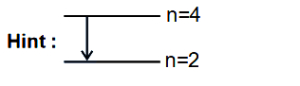
For the visible range, the transition must end at the first excited state of this system. The ground state is $n'=1$ $(n=2)$, and the first excited state is $n'=2$ $(n=4)$.
The transition for the largest wavelength (smallest energy) in the visible range is from $n'=2$ to $n'=1$.
The energy difference is $\Delta E = E_2 - E_1 = -\frac{3.4}{2^2} - (-\frac{3.4}{1^2}) = -0.85 + 3.4 = 2.55 \text{ eV}$.
The wavelength is $\lambda = \frac{hc}{\Delta E} = \frac{1242 \text{ eV-nm}}{2.55 \text{ eV}} \approx 487 \text{ nm}$.
Comparing this with the standard Bohr quantization $L = n \frac{h}{2\pi}$, we see that the allowed orbits correspond to $n = 2n'$.
The energy of an orbit is $E_n = -\frac{13.6}{n^2} \text{ eV}$. Substituting $n = 2n'$, we get $E_{n'} = -\frac{13.6}{(2n')^2} = -\frac{13.6}{4n'^2} = -\frac{3.4}{n'^2} \text{ eV}$.
For the visible range, the transition must end at the first excited state of this system. The ground state is $n'=1$ $(n=2)$, and the first excited state is $n'=2$ $(n=4)$.
The transition for the largest wavelength (smallest energy) in the visible range is from $n'=2$ to $n'=1$.
The energy difference is $\Delta E = E_2 - E_1 = -\frac{3.4}{2^2} - (-\frac{3.4}{1^2}) = -0.85 + 3.4 = 2.55 \text{ eV}$.
The wavelength is $\lambda = \frac{hc}{\Delta E} = \frac{1242 \text{ eV-nm}}{2.55 \text{ eV}} \approx 487 \text{ nm}$.
0 likes
View Solution557
DifficultMCQ
$A$ sample of hydrogen atoms in its ground state is radiated with photons of $10.2 eV$ energy. The radiation emitted from the sample is absorbed by excited ionized $He^{+}$ ions. Which of the following statement$(s)$ is/are true?
A
$He^{+}$ electron moves from $n=2$ to $n=4$
B
In the $He^{+}$ emission spectra, there will be $6$ lines
C
Smallest wavelength of $He^{+}$ spectrum is obtained when transition takes place from $n=4$ to $n=3$
D
$He^{+}$ electron moves from $n=2$ to $n=3$
Solution
(A, B) The energy required for a transition in $He^{+}$ is given by $E = 13.6 \times Z^2 \left( \frac{1}{n_1^2} - \frac{1}{n_2^2} \right)$. For $He^{+}$, $Z=2$, so $E = 13.6 \times 4 \left( \frac{1}{n_1^2} - \frac{1}{n_2^2} \right) = 54.4 \left( \frac{1}{n_1^2} - \frac{1}{n_2^2} \right) eV$.
For a transition from $n=2$ to $n=4$, $E = 54.4 \left( \frac{1}{4} - \frac{1}{16} \right) = 54.4 \left( \frac{3}{16} \right) = 10.2 eV$.
Since the incident photon energy is $10.2 eV$, the $He^{+}$ electron can be excited from $n=2$ to $n=4$.
Once in the $n=4$ state, the number of spectral lines emitted is given by $\frac{n(n-1)}{2} = \frac{4(4-1)}{2} = 6$.
Therefore, statements $A$ and $B$ are correct.
For a transition from $n=2$ to $n=4$, $E = 54.4 \left( \frac{1}{4} - \frac{1}{16} \right) = 54.4 \left( \frac{3}{16} \right) = 10.2 eV$.
Since the incident photon energy is $10.2 eV$, the $He^{+}$ electron can be excited from $n=2$ to $n=4$.
Once in the $n=4$ state, the number of spectral lines emitted is given by $\frac{n(n-1)}{2} = \frac{4(4-1)}{2} = 6$.
Therefore, statements $A$ and $B$ are correct.
0 likes
View Solution558
EasyMCQ
Let $r, v, E$ be the radius of orbit, speed of electron, and total energy of electron respectively in a $H$-atom. Which of the following quantities, according to Bohr theory, is proportional to the quantum number $n$?
A
$vr$
B
$rE$
C
$\frac{r}{E}$
D
$\frac{r}{v}$
Solution
(A) According to Bohr's postulate of quantization of angular momentum, the angular momentum $L$ is given by:
$L = mvr = \frac{nh}{2\pi}$
From this equation, we can express the quantum number $n$ as:
$n = \frac{2\pi m}{h} \cdot (vr)$
Since $m$, $h$, and $\pi$ are constants, we have:
$n \propto vr$
Therefore, the quantity $vr$ is proportional to the quantum number $n$.
$L = mvr = \frac{nh}{2\pi}$
From this equation, we can express the quantum number $n$ as:
$n = \frac{2\pi m}{h} \cdot (vr)$
Since $m$, $h$, and $\pi$ are constants, we have:
$n \propto vr$
Therefore, the quantity $vr$ is proportional to the quantum number $n$.
0 likes
View Solution559
EasyMCQ
To which of the following is the angular velocity of the electron in the $n$-th Bohr orbit proportional?
A
$n^{2}$
B
$\frac{1}{n^{2}}$
C
$\frac{1}{n^{3/2}}$
D
$\frac{1}{n^{3}}$
Solution
(D) According to the Bohr's atomic model, the angular momentum $L$ is given by:
$L = mvr = \frac{nh}{2\pi} \dots (i)$
Since angular velocity $\omega = \frac{v}{r}$, we have $v = r\omega$.
Substituting $v = r\omega$ into equation $(i)$:
$m(r\omega)r = \frac{nh}{2\pi} \Rightarrow m\omega r^2 = \frac{nh}{2\pi} \Rightarrow \omega = \frac{nh}{2\pi mr^2} \dots (ii)$
The radius of the electron in the $n$-th orbit is given by:
$r = \frac{n^2 h^2 \epsilon_0}{\pi m Z e^2} \dots (iii)$
Substituting the expression for $r$ from equation $(iii)$ into equation $(ii)$:
$\omega = \frac{nh}{2\pi m} \left( \frac{\pi m Z e^2}{n^2 h^2 \epsilon_0} \right)^2$
$\omega = \frac{nh}{2\pi m} \cdot \frac{\pi^2 m^2 Z^2 e^4}{n^4 h^4 \epsilon_0^2}$
$\omega = \frac{\pi m Z^2 e^4}{2 h^3 \epsilon_0^2} \cdot \frac{1}{n^3}$
Therefore, $\omega \propto \frac{1}{n^3}$.
$L = mvr = \frac{nh}{2\pi} \dots (i)$
Since angular velocity $\omega = \frac{v}{r}$, we have $v = r\omega$.
Substituting $v = r\omega$ into equation $(i)$:
$m(r\omega)r = \frac{nh}{2\pi} \Rightarrow m\omega r^2 = \frac{nh}{2\pi} \Rightarrow \omega = \frac{nh}{2\pi mr^2} \dots (ii)$
The radius of the electron in the $n$-th orbit is given by:
$r = \frac{n^2 h^2 \epsilon_0}{\pi m Z e^2} \dots (iii)$
Substituting the expression for $r$ from equation $(iii)$ into equation $(ii)$:
$\omega = \frac{nh}{2\pi m} \left( \frac{\pi m Z e^2}{n^2 h^2 \epsilon_0} \right)^2$
$\omega = \frac{nh}{2\pi m} \cdot \frac{\pi^2 m^2 Z^2 e^4}{n^4 h^4 \epsilon_0^2}$
$\omega = \frac{\pi m Z^2 e^4}{2 h^3 \epsilon_0^2} \cdot \frac{1}{n^3}$
Therefore, $\omega \propto \frac{1}{n^3}$.
0 likes
View Solution560
EasyMCQ
How is the linear velocity $v$ of an electron in a $Bohr$ orbit related to its principal quantum number $n$?
A
$v \propto \frac{1}{n}$
B
$v \propto \frac{1}{n^{2}}$
C
$v \propto \frac{1}{\sqrt{n}}$
D
$v \propto n$
Solution
(A) The linear velocity $v$ of an electron in the $n^{th}$ orbit of a hydrogen-like atom is given by the formula:
$v = \frac{Z e^2}{2 \epsilon_0 n h}$
Where $Z$ is the atomic number, $e$ is the charge of the electron, $\epsilon_0$ is the permittivity of free space, $n$ is the principal quantum number, and $h$ is Planck's constant.
From this expression, it is clear that all terms except $n$ are constants for a given atom.
Therefore, the relationship is $v \propto \frac{1}{n}$.
$v = \frac{Z e^2}{2 \epsilon_0 n h}$
Where $Z$ is the atomic number, $e$ is the charge of the electron, $\epsilon_0$ is the permittivity of free space, $n$ is the principal quantum number, and $h$ is Planck's constant.
From this expression, it is clear that all terms except $n$ are constants for a given atom.
Therefore, the relationship is $v \propto \frac{1}{n}$.
0 likes
View Solution561
MediumMCQ
Let $v_{n}$ and $E_{n}$ be the respective speed and energy of an electron in the $n$th orbit of radius $r_{n}$, in a hydrogen atom, as predicted by Bohr's model. Then:
A
plot of $\frac{E_{n} r_{n}}{E_{1} r_{1}}$ as a function of $n$ is a straight line of slope $0$
B
plot of $\frac{r_{n} v_{n}}{r_{1} v_{1}}$ as a function of $n$ is a straight line of slope $1$
C
plot of $\ln \left(\frac{r_{n}}{r_{1}}\right)$ as a function of $\ln (n)$ is a straight line of slope $2$
D
plot of $\ln \left(\frac{r_{n} E_{1}}{E_{n} r_{1}}\right)$ as a function of $\ln (n)$ is a straight line of slope $4$
Solution
(A-D) According to Bohr's model for a hydrogen atom:
$v_{n} \propto \frac{1}{n}$
$E_{n} \propto \frac{1}{n^{2}}$
$r_{n} \propto n^{2}$
For option $A$: $\frac{E_{n} r_{n}}{E_{1} r_{1}} \propto \frac{(1/n^{2}) \cdot n^{2}}{1} = 1$. This is a constant, so the slope is $0$.
For option $B$: $\frac{r_{n} v_{n}}{r_{1} v_{1}} \propto \frac{n^{2} \cdot (1/n)}{1} = n$. This is a straight line with slope $1$.
For option $C$: $\frac{r_{n}}{r_{1}} = n^{2}$. Taking natural log on both sides: $\ln \left(\frac{r_{n}}{r_{1}}\right) = 2 \ln(n)$. This is a straight line with slope $2$.
For option $D$: $\frac{r_{n}}{E_{n}} \propto \frac{n^{2}}{1/n^{2}} = n^{4}$. Thus, $\frac{r_{n} E_{1}}{E_{n} r_{1}} = n^{4}$. Taking natural log: $\ln \left(\frac{r_{n} E_{1}}{E_{n} r_{1}}\right) = 4 \ln(n)$. This is a straight line with slope $4$.
All options $A, B, C,$ and $D$ are mathematically correct based on Bohr's model.
$v_{n} \propto \frac{1}{n}$
$E_{n} \propto \frac{1}{n^{2}}$
$r_{n} \propto n^{2}$
For option $A$: $\frac{E_{n} r_{n}}{E_{1} r_{1}} \propto \frac{(1/n^{2}) \cdot n^{2}}{1} = 1$. This is a constant, so the slope is $0$.
For option $B$: $\frac{r_{n} v_{n}}{r_{1} v_{1}} \propto \frac{n^{2} \cdot (1/n)}{1} = n$. This is a straight line with slope $1$.
For option $C$: $\frac{r_{n}}{r_{1}} = n^{2}$. Taking natural log on both sides: $\ln \left(\frac{r_{n}}{r_{1}}\right) = 2 \ln(n)$. This is a straight line with slope $2$.
For option $D$: $\frac{r_{n}}{E_{n}} \propto \frac{n^{2}}{1/n^{2}} = n^{4}$. Thus, $\frac{r_{n} E_{1}}{E_{n} r_{1}} = n^{4}$. Taking natural log: $\ln \left(\frac{r_{n} E_{1}}{E_{n} r_{1}}\right) = 4 \ln(n)$. This is a straight line with slope $4$.
All options $A, B, C,$ and $D$ are mathematically correct based on Bohr's model.
0 likes
View Solution562
EasyMCQ
The number of de-Broglie wavelengths contained in the second Bohr orbit of a hydrogen atom is
A
$1$
B
$2$
C
$3$
D
$4$
Solution
(B) According to Bohr's quantization condition, the angular momentum of an electron in an orbit is given by $L = mvr = \frac{nh}{2\pi}$.
From the de-Broglie hypothesis, the wavelength of an electron is $\lambda = \frac{h}{mv}$.
Substituting $mv = \frac{h}{\lambda}$ into the quantization condition, we get $\frac{h}{\lambda} r = \frac{nh}{2\pi}$.
This simplifies to $2\pi r = n\lambda$, where $2\pi r$ is the circumference of the $n^{th}$ orbit.
For the second Bohr orbit, $n = 2$.
Therefore, the circumference of the second orbit is $2\pi r = 2\lambda$.
This implies that the number of de-Broglie wavelengths contained in the second Bohr orbit is $2$.
From the de-Broglie hypothesis, the wavelength of an electron is $\lambda = \frac{h}{mv}$.
Substituting $mv = \frac{h}{\lambda}$ into the quantization condition, we get $\frac{h}{\lambda} r = \frac{nh}{2\pi}$.
This simplifies to $2\pi r = n\lambda$, where $2\pi r$ is the circumference of the $n^{th}$ orbit.
For the second Bohr orbit, $n = 2$.
Therefore, the circumference of the second orbit is $2\pi r = 2\lambda$.
This implies that the number of de-Broglie wavelengths contained in the second Bohr orbit is $2$.
0 likes
View Solution563
DifficultMCQ
$A$ photon of wavelength $300 \ nm$ interacts with a stationary hydrogen atom in the ground state. During the interaction, the whole energy of the photon is transferred to the electron of the atom. State which possibility is correct. (Consider, Planck constant $= 4 \times 10^{-15} \ eV \cdot s$, velocity of light $= 3 \times 10^{8} \ m/s$, ionisation energy of hydrogen $= 13.6 \ eV$)
A
Electron will be knocked out of the atom
B
Electron will go to any excited state of the atom
C
Electron will go only to first excited state of the atom
D
Electron will keep orbiting in the ground state of the atom
Solution
(D) The energy of the photon is given by $E = \frac{hc}{\lambda}$.
Substituting the given values:
$E = \frac{4 \times 10^{-15} \ eV \cdot s \times 3 \times 10^{8} \ m/s}{300 \times 10^{-9} \ m} = \frac{12 \times 10^{-7}}{300 \times 10^{-9}} \ eV = \frac{1200}{300} \ eV = 4 \ eV$.
The energy required to excite a hydrogen atom from the ground state $(n=1)$ to the first excited state $(n=2)$ is $\Delta E = 13.6 \ eV \times (1 - \frac{1}{4}) = 13.6 \times 0.75 = 10.2 \ eV$.
Since the energy of the photon $(4 \ eV)$ is less than the energy required for the first excitation $(10.2 \ eV)$ and also less than the ionization energy $(13.6 \ eV)$, the electron cannot absorb this energy to transition to a higher state.
Therefore, the electron will remain in the ground state.
Substituting the given values:
$E = \frac{4 \times 10^{-15} \ eV \cdot s \times 3 \times 10^{8} \ m/s}{300 \times 10^{-9} \ m} = \frac{12 \times 10^{-7}}{300 \times 10^{-9}} \ eV = \frac{1200}{300} \ eV = 4 \ eV$.
The energy required to excite a hydrogen atom from the ground state $(n=1)$ to the first excited state $(n=2)$ is $\Delta E = 13.6 \ eV \times (1 - \frac{1}{4}) = 13.6 \times 0.75 = 10.2 \ eV$.
Since the energy of the photon $(4 \ eV)$ is less than the energy required for the first excitation $(10.2 \ eV)$ and also less than the ionization energy $(13.6 \ eV)$, the electron cannot absorb this energy to transition to a higher state.
Therefore, the electron will remain in the ground state.
0 likes
View Solution564
MediumMCQ
Two electrons are moving in orbits of two hydrogen-like atoms with speeds $3 \times 10^5 \ m/s$ and $2.5 \times 10^5 \ m/s$ respectively. If the radii of these orbits are nearly the same, then the possible order of energy states are . . . . . . respectively.
A
$6$ and $5$
B
$9$ and $8$
C
$8$ and $10$
D
$10$ and $12$
Solution
(A) For a hydrogen-like atom, the velocity of an electron in the $n^{th}$ orbit is given by $v \propto \frac{Z}{n}$.
The radius of the $n^{th}$ orbit is given by $r \propto \frac{n^2}{Z}$.
From these two relations, we can write $r \propto \frac{n}{v}$ (since $Z \propto \frac{n}{v} \cdot n = \frac{n^2}{r}$, substituting $Z$ into the velocity relation).
Given that the radii are nearly the same $(r_1 \approx r_2)$, we have $\frac{n_1}{v_1} = \frac{n_2}{v_2}$.
Therefore, $\frac{n_1}{n_2} = \frac{v_1}{v_2} = \frac{3 \times 10^5}{2.5 \times 10^5} = \frac{3}{2.5} = \frac{6}{5}$.
Thus, the possible order of energy states ($n_1$ and $n_2$) is $6$ and $5$.
The radius of the $n^{th}$ orbit is given by $r \propto \frac{n^2}{Z}$.
From these two relations, we can write $r \propto \frac{n}{v}$ (since $Z \propto \frac{n}{v} \cdot n = \frac{n^2}{r}$, substituting $Z$ into the velocity relation).
Given that the radii are nearly the same $(r_1 \approx r_2)$, we have $\frac{n_1}{v_1} = \frac{n_2}{v_2}$.
Therefore, $\frac{n_1}{n_2} = \frac{v_1}{v_2} = \frac{3 \times 10^5}{2.5 \times 10^5} = \frac{3}{2.5} = \frac{6}{5}$.
Thus, the possible order of energy states ($n_1$ and $n_2$) is $6$ and $5$.
0 likes
View Solution565
MediumMCQ
The energy of an electron in an orbit of the Bohr's atom is $-0.04 E_0 \text{ eV}$, where $E_0$ is the ground state energy. If $L$ is the angular momentum of the electron in this orbit and $h$ is the Planck's constant, then $\frac{2 \pi L}{h}$ is . . . . . . :
A
$2$
B
$4$
C
$5$
D
$6$
Solution
(C) According to Bohr's postulate, the angular momentum $L$ of an electron in an orbit is given by $L = \frac{nh}{2\pi}$, where $n$ is the principal quantum number.
Rearranging this, we get $\frac{2\pi L}{h} = n$.
The energy of an electron in the $n^{th}$ orbit is given by $E_n = -\frac{E_0}{n^2}$, where $E_0$ is the magnitude of the ground state energy.
Given that $E_n = -0.04 E_0$, we have $-\frac{E_0}{n^2} = -0.04 E_0$.
Dividing both sides by $-E_0$, we get $\frac{1}{n^2} = 0.04$.
$n^2 = \frac{1}{0.04} = \frac{100}{4} = 25$.
Therefore, $n = 5$.
Since $\frac{2\pi L}{h} = n$, the value is $5$.
Rearranging this, we get $\frac{2\pi L}{h} = n$.
The energy of an electron in the $n^{th}$ orbit is given by $E_n = -\frac{E_0}{n^2}$, where $E_0$ is the magnitude of the ground state energy.
Given that $E_n = -0.04 E_0$, we have $-\frac{E_0}{n^2} = -0.04 E_0$.
Dividing both sides by $-E_0$, we get $\frac{1}{n^2} = 0.04$.
$n^2 = \frac{1}{0.04} = \frac{100}{4} = 25$.
Therefore, $n = 5$.
Since $\frac{2\pi L}{h} = n$, the value is $5$.
0 likes
View Solution566
MediumMCQ
According to Bohr's model, the orbital angular momentum of an electron in the third excited state is . . . . . . $[h = 6.63 \times 10^{-34} \text{ Js}]$
A
$4.22 \times 10^{-34} \text{ kg m}^2\text{s}^{-1}$
B
$12.350 \times 10^{-34} \text{ kg m}^2\text{s}^{-1}$
C
$1.625 \times 10^{-26} \text{ erg-s}$
D
$6.63 \times 10^{-34} \text{ kg m}^2\text{s}^{-1}$
Solution
(A) According to Bohr's model, the orbital angular momentum $L$ is given by the formula $L = n \frac{h}{2\pi}$.
The ground state corresponds to $n = 1$.
The first excited state is $n = 2$, the second excited state is $n = 3$, and the third excited state is $n = 4$.
Substituting $n = 4$ into the formula:
$L = 4 \times \frac{h}{2\pi} = 2 \times \frac{h}{\pi}$.
Given $h = 6.63 \times 10^{-34} \text{ Js}$ and $\pi \approx 3.14$:
$L = 2 \times \frac{6.63 \times 10^{-34}}{3.14} \approx 2 \times 2.111 \times 10^{-34} = 4.222 \times 10^{-34} \text{ kg m}^2\text{s}^{-1}$.
The ground state corresponds to $n = 1$.
The first excited state is $n = 2$, the second excited state is $n = 3$, and the third excited state is $n = 4$.
Substituting $n = 4$ into the formula:
$L = 4 \times \frac{h}{2\pi} = 2 \times \frac{h}{\pi}$.
Given $h = 6.63 \times 10^{-34} \text{ Js}$ and $\pi \approx 3.14$:
$L = 2 \times \frac{6.63 \times 10^{-34}}{3.14} \approx 2 \times 2.111 \times 10^{-34} = 4.222 \times 10^{-34} \text{ kg m}^2\text{s}^{-1}$.
0 likes
View Solution567
MediumMCQ
$13.6 \text{ eV}$ energy is required to separate a hydrogen atom into a proton and an electron. If the orbital radius of an electron in a hydrogen atom is $5.3 \times 10^{-11} \text{ m}$, then the velocity of the electron is . . . . . . .
A
$6.25 \times 10^7 \text{ ms}^{-1}$
B
$1.36 \times 10^5 \text{ ms}^{-1}$
C
$2.4 \times 10^8 \text{ ms}^{-1}$
D
$2.2 \times 10^6 \text{ ms}^{-1}$
Solution
(D) For a hydrogen atom in the ground state $(n=1)$, Bohr's quantization condition for angular momentum is given by $mvr = \frac{nh}{2\pi}$.
Here, $m$ is the mass of the electron $(9.1 \times 10^{-31} \text{ kg})$, $v$ is the velocity, $r$ is the orbital radius $(5.3 \times 10^{-11} \text{ m})$, and $h$ is Planck's constant $(6.63 \times 10^{-34} \text{ Js})$.
Rearranging the formula for velocity $v$, we get $v = \frac{h}{2\pi mr}$.
Substituting the values: $v = \frac{6.63 \times 10^{-34}}{2 \times 3.14159 \times 9.1 \times 10^{-31} \times 5.3 \times 10^{-11}}$.
Calculating this, $v \approx 2.18 \times 10^6 \text{ ms}^{-1}$.
Rounding to two significant figures, we get $v \approx 2.2 \times 10^6 \text{ ms}^{-1}$.
Here, $m$ is the mass of the electron $(9.1 \times 10^{-31} \text{ kg})$, $v$ is the velocity, $r$ is the orbital radius $(5.3 \times 10^{-11} \text{ m})$, and $h$ is Planck's constant $(6.63 \times 10^{-34} \text{ Js})$.
Rearranging the formula for velocity $v$, we get $v = \frac{h}{2\pi mr}$.
Substituting the values: $v = \frac{6.63 \times 10^{-34}}{2 \times 3.14159 \times 9.1 \times 10^{-31} \times 5.3 \times 10^{-11}}$.
Calculating this, $v \approx 2.18 \times 10^6 \text{ ms}^{-1}$.
Rounding to two significant figures, we get $v \approx 2.2 \times 10^6 \text{ ms}^{-1}$.
0 likes
View Solution568
MediumMCQ
The ground state energy of a hydrogen atom is $-13.6 \text{ eV}$. The potential and kinetic energies of the electron in this state are . . . . . . .
A
$-13.6 \text{ eV}, -27.2 \text{ eV}$
B
$-27.2 \text{ eV}, -13.6 \text{ eV}$
C
$-27.2 \text{ eV}, +13.6 \text{ eV}$
D
$-13.6 \text{ eV}, +27.2 \text{ eV}$
Solution
(C) In the Bohr model, the Total Energy $(TE)$ of an electron in the ground state is $-13.6 \text{ eV}$.
Kinetic Energy $(KE)$ is given by the relation $KE = -TE$. Therefore, $KE = -(-13.6 \text{ eV}) = +13.6 \text{ eV}$.
Potential Energy $(PE)$ is given by the relation $PE = 2 \times TE$. Therefore, $PE = 2 \times (-13.6 \text{ eV}) = -27.2 \text{ eV}$.
Thus, the potential energy is $-27.2 \text{ eV}$ and the kinetic energy is $+13.6 \text{ eV}$.
Kinetic Energy $(KE)$ is given by the relation $KE = -TE$. Therefore, $KE = -(-13.6 \text{ eV}) = +13.6 \text{ eV}$.
Potential Energy $(PE)$ is given by the relation $PE = 2 \times TE$. Therefore, $PE = 2 \times (-13.6 \text{ eV}) = -27.2 \text{ eV}$.
Thus, the potential energy is $-27.2 \text{ eV}$ and the kinetic energy is $+13.6 \text{ eV}$.
0 likes
View Solution569
MediumMCQ
The ground state energy of a hydrogen atom is $-13.6 \text{ eV}$. What is the ratio of the kinetic energy to the potential energy of the electron in this state?
A
$-\frac{1}{2}$
B
$\frac{1}{2}$
C
$-1$
D
$-2$
Solution
(A) In a hydrogen-like atom, the total energy $E$ of an electron is related to its kinetic energy $K$ and potential energy $U$ by the following relations:
$E = -K$
$U = 2E$
Given that the total energy $E = -13.6 \text{ eV}$, we can find $K$ and $U$:
$K = -E = -(-13.6 \text{ eV}) = 13.6 \text{ eV}$
$U = 2E = 2 \times (-13.6 \text{ eV}) = -27.2 \text{ eV}$
The ratio of kinetic energy to potential energy is $\frac{K}{U} = \frac{13.6 \text{ eV}}{-27.2 \text{ eV}} = -\frac{1}{2}$.
Thus, the correct option is $A$.
$E = -K$
$U = 2E$
Given that the total energy $E = -13.6 \text{ eV}$, we can find $K$ and $U$:
$K = -E = -(-13.6 \text{ eV}) = 13.6 \text{ eV}$
$U = 2E = 2 \times (-13.6 \text{ eV}) = -27.2 \text{ eV}$
The ratio of kinetic energy to potential energy is $\frac{K}{U} = \frac{13.6 \text{ eV}}{-27.2 \text{ eV}} = -\frac{1}{2}$.
Thus, the correct option is $A$.
0 likes
View Solution570
MediumMCQ
The radius of the innermost electron orbit of a hydrogen atom is $5.3 \times 10^{-11} \text{ m}$. What is the radius of the $n = 3$ orbit?
A
$1.59 \times 10^{-10} \text{ m}$
B
$1.06 \times 10^{-10} \text{ m}$
C
$1.43 \times 10^{-9} \text{ m}$
D
$4.77 \times 10^{-10} \text{ m}$
Solution
(D) The radius of the $n$-th orbit in a hydrogen atom is given by the formula $r_n = n^2 r_1$, where $r_1$ is the radius of the first orbit (Bohr radius).
Given $r_1 = 5.3 \times 10^{-11} \text{ m}$ and $n = 3$.
Substituting these values into the formula:
$r_3 = 3^2 \times (5.3 \times 10^{-11} \text{ m})$
$r_3 = 9 \times 5.3 \times 10^{-11} \text{ m}$
$r_3 = 47.7 \times 10^{-11} \text{ m}$
$r_3 = 4.77 \times 10^{-10} \text{ m}$.
Thus, the radius of the $n = 3$ orbit is $4.77 \times 10^{-10} \text{ m}$.
Therefore, the correct option is $D$.
Given $r_1 = 5.3 \times 10^{-11} \text{ m}$ and $n = 3$.
Substituting these values into the formula:
$r_3 = 3^2 \times (5.3 \times 10^{-11} \text{ m})$
$r_3 = 9 \times 5.3 \times 10^{-11} \text{ m}$
$r_3 = 47.7 \times 10^{-11} \text{ m}$
$r_3 = 4.77 \times 10^{-10} \text{ m}$.
Thus, the radius of the $n = 3$ orbit is $4.77 \times 10^{-10} \text{ m}$.
Therefore, the correct option is $D$.
0 likes
View Solution571
DifficultMCQ
Angular momentum of an electron in a hydrogen atom is $\frac{3h}{\pi}$, then the energy of the electron is . . . . . . eV.
A
-$1.51$
B
-$0.85$
C
-$0.38$
D
-$0.28$
Solution
(C) According to Bohr's quantization condition, the angular momentum $L$ of an electron in an orbit is given by $L = \frac{nh}{2\pi}$.
Given that $L = \frac{3h}{\pi}$, we equate the two expressions: $\frac{nh}{2\pi} = \frac{3h}{\pi}$.
Solving for $n$, we get $n = 6$.
The energy of an electron in the $n^{th}$ orbit of a hydrogen atom is given by the formula $E_n = -\frac{13.6}{n^2} \text{ eV}$.
Substituting $n = 6$ into the formula: $E_6 = -\frac{13.6}{6^2} = -\frac{13.6}{36}$.
Calculating the value: $E_6 \approx -0.377 \text{ eV}$, which rounds to $-0.38 \text{ eV}$.
Given that $L = \frac{3h}{\pi}$, we equate the two expressions: $\frac{nh}{2\pi} = \frac{3h}{\pi}$.
Solving for $n$, we get $n = 6$.
The energy of an electron in the $n^{th}$ orbit of a hydrogen atom is given by the formula $E_n = -\frac{13.6}{n^2} \text{ eV}$.
Substituting $n = 6$ into the formula: $E_6 = -\frac{13.6}{6^2} = -\frac{13.6}{36}$.
Calculating the value: $E_6 \approx -0.377 \text{ eV}$, which rounds to $-0.38 \text{ eV}$.
0 likes
View Solution572
DifficultMCQ
In the hydrogen atom, the electron makes a transition from the higher orbit $(i)$ to a lower orbit $(f)$. The ratio of the radius of the orbits is given by $r_i : r_f = 16 : 4$. The wavelength of the photon emitted due to this transition is . . . . . . nm. (Given Rydberg constant $R = 1.0973 \times 10^7 \text{ m}^{-1}$)
A
$121$
B
$242$
C
$486$
D
$974$
Solution
(C) The radius of the $n$-th orbit in a hydrogen atom is given by $r_n = a_0 n^2$, where $a_0$ is the Bohr radius.
Therefore, the ratio of the radii is $r_i / r_f = n_i^2 / n_f^2 = 16 / 4 = 4$.
Taking the square root, we get $n_i / n_f = 2$, which implies $n_i = 2n_f$.
For the simplest transition, we take $n_f = 2$ and $n_i = 4$.
Using the Rydberg formula for the wavelength $\lambda$:
$1/\lambda = R(1/n_f^2 - 1/n_i^2)$
$1/\lambda = R(1/2^2 - 1/4^2) = R(1/4 - 1/16) = R(3/16)$.
Substituting $R = 1.0973 \times 10^7 \text{ m}^{-1}$:
$1/\lambda = 1.0973 \times 10^7 \times (3/16) \approx 0.20574 \times 10^7 \text{ m}^{-1}$.
$\lambda = 1 / (0.20574 \times 10^7) \approx 4.86 \times 10^{-7} \text{ m} = 486 \text{ nm}$.
Therefore, the ratio of the radii is $r_i / r_f = n_i^2 / n_f^2 = 16 / 4 = 4$.
Taking the square root, we get $n_i / n_f = 2$, which implies $n_i = 2n_f$.
For the simplest transition, we take $n_f = 2$ and $n_i = 4$.
Using the Rydberg formula for the wavelength $\lambda$:
$1/\lambda = R(1/n_f^2 - 1/n_i^2)$
$1/\lambda = R(1/2^2 - 1/4^2) = R(1/4 - 1/16) = R(3/16)$.
Substituting $R = 1.0973 \times 10^7 \text{ m}^{-1}$:
$1/\lambda = 1.0973 \times 10^7 \times (3/16) \approx 0.20574 \times 10^7 \text{ m}^{-1}$.
$\lambda = 1 / (0.20574 \times 10^7) \approx 4.86 \times 10^{-7} \text{ m} = 486 \text{ nm}$.
0 likes
View Solution573
DifficultMCQ
Using Bohr's model, calculate the ratio of the magnetic fields generated due to the motion of the electrons in the $2^{nd}$ and $4^{th}$ orbits of hydrogen atom. (in $32$ : $1$)
A
$8$
B
$16$
C
$32$
D
$64$
Solution
(C) The magnetic field $B$ at the center of the orbit due to an electron moving in a circular path is given by $B = \frac{\mu_0 I}{2r}$.
The current $I$ is given by $I = \frac{ev}{2\pi r}$, where $e$ is the charge of the electron, $v$ is the velocity, and $r$ is the radius.
According to Bohr's model, $v \propto \frac{1}{n}$ and $r \propto n^2$.
Substituting these into the expression for current: $I \propto \frac{1/n}{n^2} = \frac{1}{n^3}$.
Now, substituting $I$ and $r$ into the expression for $B$: $B \propto \frac{I}{r} \propto \frac{1/n^3}{n^2} = \frac{1}{n^5}$.
Therefore, the ratio of the magnetic fields for the $2^{nd}$ and $4^{th}$ orbits is $\frac{B_2}{B_4} = \left( \frac{4}{2} \right)^5 = 2^5 = 32$.
Thus, the ratio is $32:1$.
The current $I$ is given by $I = \frac{ev}{2\pi r}$, where $e$ is the charge of the electron, $v$ is the velocity, and $r$ is the radius.
According to Bohr's model, $v \propto \frac{1}{n}$ and $r \propto n^2$.
Substituting these into the expression for current: $I \propto \frac{1/n}{n^2} = \frac{1}{n^3}$.
Now, substituting $I$ and $r$ into the expression for $B$: $B \propto \frac{I}{r} \propto \frac{1/n^3}{n^2} = \frac{1}{n^5}$.
Therefore, the ratio of the magnetic fields for the $2^{nd}$ and $4^{th}$ orbits is $\frac{B_2}{B_4} = \left( \frac{4}{2} \right)^5 = 2^5 = 32$.
Thus, the ratio is $32:1$.
0 likes
View Solution574
MediumMCQ
In the first excited state of a hydrogen atom, the energy of its electron is $-3.4 \text{ eV}$. The radial distance of the electron from the hydrogen nucleus in this case is approximately: (Take $1 \text{ eV} = 1.6 \times 10^{-19} \text{ J}$, $e = 1.6 \times 10^{-19} \text{ C}$ and $\frac{1}{4\pi\epsilon_0} = 9 \times 10^9 \text{ N m}^2/\text{C}^2$)
A
$2.1 \times 10^{-8} \text{ m}$
B
$2.1 \times 10^{-10} \text{ m}$
C
$2.1 \times 10^{-11} \text{ m}$
D
$2.1 \times 10^{-9} \text{ m}$
Solution
(B) For a hydrogen atom, the radius of the $n^{th}$ orbit is given by the formula $r_n = a_0 \times n^2$, where $a_0 = 0.529 \text{ Å}$ is the Bohr radius.
For the first excited state, the principal quantum number is $n = 2$.
Substituting the value of $n$ into the formula, we get $r_2 = 0.529 \times (2)^2 \text{ Å}$.
$r_2 = 0.529 \times 4 \text{ Å} = 2.116 \text{ Å}$.
Since $1 \text{ Å} = 10^{-10} \text{ m}$, we have $r_2 = 2.116 \times 10^{-10} \text{ m}$.
Rounding to two significant figures, the radial distance is approximately $2.1 \times 10^{-10} \text{ m}$.
For the first excited state, the principal quantum number is $n = 2$.
Substituting the value of $n$ into the formula, we get $r_2 = 0.529 \times (2)^2 \text{ Å}$.
$r_2 = 0.529 \times 4 \text{ Å} = 2.116 \text{ Å}$.
Since $1 \text{ Å} = 10^{-10} \text{ m}$, we have $r_2 = 2.116 \times 10^{-10} \text{ m}$.
Rounding to two significant figures, the radial distance is approximately $2.1 \times 10^{-10} \text{ m}$.
0 likes
View Solution575
DifficultMCQ
Consider that an electron is revolving in an excited state of Hydrogen atom with velocity $\sqrt{25.6} \times 10^5 \text{ m s}^{-1}$. The radius of the orbit is $x \times 10^{-9} \text{ m}$. The value of $x$ is : [Take the mass of electron to be $9 \times 10^{-31} \text{ kg}$, charge of electron = $-1.6 \times 10^{-19} \text{ C}$ and $\frac{1}{4\pi \epsilon_0} = 9 \times 10^9 \text{ N m}^2 \text{ C}^{-2}$]
A
$4$
B
$3$
C
$2$
D
$1$
Solution
(D) According to Bohr's theory, for an electron in a hydrogen atom, the electrostatic force provides the necessary centripetal force:
$\frac{1}{4\pi \epsilon_0} \frac{e^2}{r^2} = \frac{m v^2}{r}$
Rearranging for radius $r$:
$r = \frac{1}{4\pi \epsilon_0} \frac{e^2}{m v^2}$
Given values:
$v = \sqrt{25.6} \times 10^5 \text{ m s}^{-1} \implies v^2 = 25.6 \times 10^{10} \text{ m}^2 \text{ s}^{-2}$
$m = 9 \times 10^{-31} \text{ kg}$
$e = 1.6 \times 10^{-19} \text{ C}$
$\frac{1}{4\pi \epsilon_0} = 9 \times 10^9 \text{ N m}^2 \text{ C}^{-2}$
Substituting these values:
$r = \frac{9 \times 10^9 \times (1.6 \times 10^{-19})^2}{9 \times 10^{-31} \times 25.6 \times 10^{10}}$
$r = \frac{9 \times 10^9 \times 2.56 \times 10^{-38}}{9 \times 25.6 \times 10^{-21}}$
$r = \frac{2.56 \times 10^{-29}}{25.6 \times 10^{-21}} = 0.1 \times 10^{-8} \text{ m} = 1 \times 10^{-9} \text{ m}$
Comparing with $x \times 10^{-9} \text{ m}$, we get $x = 1$.
$\frac{1}{4\pi \epsilon_0} \frac{e^2}{r^2} = \frac{m v^2}{r}$
Rearranging for radius $r$:
$r = \frac{1}{4\pi \epsilon_0} \frac{e^2}{m v^2}$
Given values:
$v = \sqrt{25.6} \times 10^5 \text{ m s}^{-1} \implies v^2 = 25.6 \times 10^{10} \text{ m}^2 \text{ s}^{-2}$
$m = 9 \times 10^{-31} \text{ kg}$
$e = 1.6 \times 10^{-19} \text{ C}$
$\frac{1}{4\pi \epsilon_0} = 9 \times 10^9 \text{ N m}^2 \text{ C}^{-2}$
Substituting these values:
$r = \frac{9 \times 10^9 \times (1.6 \times 10^{-19})^2}{9 \times 10^{-31} \times 25.6 \times 10^{10}}$
$r = \frac{9 \times 10^9 \times 2.56 \times 10^{-38}}{9 \times 25.6 \times 10^{-21}}$
$r = \frac{2.56 \times 10^{-29}}{25.6 \times 10^{-21}} = 0.1 \times 10^{-8} \text{ m} = 1 \times 10^{-9} \text{ m}$
Comparing with $x \times 10^{-9} \text{ m}$, we get $x = 1$.
0 likes
View Solution576
DifficultMCQ
The de Broglie wavelength of the electron in the ground state is $\lambda_1$ and that in the $n = 3$ level is $\lambda_3$. Then $\lambda_3$ is given by:
A
$\frac{\lambda_1}{3}$
B
$\frac{\lambda_1}{2}$
C
$2\lambda_1$
D
$3\lambda_1$
Solution
(D) According to the Bohr model, the radius of the $n^{th}$ orbit is given by $r_n = n^2 a_0$, where $a_0$ is the Bohr radius.
The circumference of the $n^{th}$ orbit is $2\pi r_n = 2\pi n^2 a_0$.
According to the de Broglie hypothesis, the condition for a stable orbit is $n\lambda = 2\pi r_n$.
Substituting the expression for $r_n$, we get $n\lambda_n = 2\pi n^2 a_0$, which simplifies to $\lambda_n = 2\pi n a_0$.
For the ground state $(n = 1)$, $\lambda_1 = 2\pi(1)a_0 = 2\pi a_0$.
For the $n = 3$ level, $\lambda_3 = 2\pi(3)a_0 = 3(2\pi a_0) = 3\lambda_1$.
Therefore, $\lambda_3 = 3\lambda_1$.
The circumference of the $n^{th}$ orbit is $2\pi r_n = 2\pi n^2 a_0$.
According to the de Broglie hypothesis, the condition for a stable orbit is $n\lambda = 2\pi r_n$.
Substituting the expression for $r_n$, we get $n\lambda_n = 2\pi n^2 a_0$, which simplifies to $\lambda_n = 2\pi n a_0$.
For the ground state $(n = 1)$, $\lambda_1 = 2\pi(1)a_0 = 2\pi a_0$.
For the $n = 3$ level, $\lambda_3 = 2\pi(3)a_0 = 3(2\pi a_0) = 3\lambda_1$.
Therefore, $\lambda_3 = 3\lambda_1$.
0 likes
View Solution577
DifficultMCQ
The wavelength of the radiation emitted is $\lambda_0$ when an electron jumps from the second excited state to the first excited state of a hydrogen atom. If the electron jumps from the third excited state to the second orbit of the hydrogen atom, the wavelength of the radiation emitted will be $(20\lambda_0/x)$. The value of $x$ is
A
$17$
B
$21$
C
$27$
D
$29$
Solution
(C) The Rydberg formula for the wavelength of emitted radiation is given by: $\frac{1}{\lambda} = R \left( \frac{1}{n_f^2} - \frac{1}{n_i^2} \right)$.
For the first case: The electron jumps from the second excited state $(n_i = 3)$ to the first excited state $(n_f = 2)$.
$\frac{1}{\lambda_0} = R \left( \frac{1}{2^2} - \frac{1}{3^2} \right) = R \left( \frac{1}{4} - \frac{1}{9} \right) = R \left( \frac{5}{36} \right)$.
So, $\lambda_0 = \frac{36}{5R}$.
For the second case: The electron jumps from the third excited state $(n_i = 4)$ to the second orbit $(n_f = 2)$.
$\frac{1}{\lambda} = R \left( \frac{1}{2^2} - \frac{1}{4^2} \right) = R \left( \frac{1}{4} - \frac{1}{16} \right) = R \left( \frac{3}{16} \right)$.
So, $\lambda = \frac{16}{3R}$.
Now, express $\lambda$ in terms of $\lambda_0$:
$\lambda = \frac{16}{3R} = \frac{16}{3} \times \frac{5\lambda_0}{36} = \frac{80\lambda_0}{108} = \frac{20\lambda_0}{27}$.
Comparing this with the given expression $\frac{20\lambda_0}{x}$, we get $x = 27$.
For the first case: The electron jumps from the second excited state $(n_i = 3)$ to the first excited state $(n_f = 2)$.
$\frac{1}{\lambda_0} = R \left( \frac{1}{2^2} - \frac{1}{3^2} \right) = R \left( \frac{1}{4} - \frac{1}{9} \right) = R \left( \frac{5}{36} \right)$.
So, $\lambda_0 = \frac{36}{5R}$.
For the second case: The electron jumps from the third excited state $(n_i = 4)$ to the second orbit $(n_f = 2)$.
$\frac{1}{\lambda} = R \left( \frac{1}{2^2} - \frac{1}{4^2} \right) = R \left( \frac{1}{4} - \frac{1}{16} \right) = R \left( \frac{3}{16} \right)$.
So, $\lambda = \frac{16}{3R}$.
Now, express $\lambda$ in terms of $\lambda_0$:
$\lambda = \frac{16}{3R} = \frac{16}{3} \times \frac{5\lambda_0}{36} = \frac{80\lambda_0}{108} = \frac{20\lambda_0}{27}$.
Comparing this with the given expression $\frac{20\lambda_0}{x}$, we get $x = 27$.
0 likes
View Solution578
DifficultMCQ
An electron in the hydrogen atom jumps from $n^{th}$ energy state to the ground state. The wavelength so emitted illuminates a photosensitive material having work function $2.65 \text{ eV}$. If the maximum kinetic energy of the emitted photoelectrons is $10.1 \text{ eV}$, then the value of '$n$' is
A
$2$
B
$3$
C
$4$
D
$5$
Solution
(C) The energy of the emitted photon $(E)$ is given by the sum of the work function $(\phi)$ and the maximum kinetic energy $(K_{max})$:
$E = \phi + K_{max} = 2.65 \text{ eV} + 10.1 \text{ eV} = 12.75 \text{ eV}$.
In a hydrogen atom, the energy of an electron in the $n^{th}$ state is $E_n = -13.6 / n^2 \text{ eV}$.
The energy of the photon emitted when jumping from state $n$ to the ground state $(n=1)$ is:
$E = E_n - E_1 = -13.6 / n^2 - (-13.6 / 1^2) = 13.6 (1 - 1/n^2) \text{ eV}$.
Equating the two expressions:
$12.75 = 13.6 (1 - 1/n^2)$
$12.75 / 13.6 = 1 - 1/n^2$
$0.9375 = 1 - 1/n^2$
$1/n^2 = 1 - 0.9375 = 0.0625$
$n^2 = 1 / 0.0625 = 16$
$n = 4$.
$E = \phi + K_{max} = 2.65 \text{ eV} + 10.1 \text{ eV} = 12.75 \text{ eV}$.
In a hydrogen atom, the energy of an electron in the $n^{th}$ state is $E_n = -13.6 / n^2 \text{ eV}$.
The energy of the photon emitted when jumping from state $n$ to the ground state $(n=1)$ is:
$E = E_n - E_1 = -13.6 / n^2 - (-13.6 / 1^2) = 13.6 (1 - 1/n^2) \text{ eV}$.
Equating the two expressions:
$12.75 = 13.6 (1 - 1/n^2)$
$12.75 / 13.6 = 1 - 1/n^2$
$0.9375 = 1 - 1/n^2$
$1/n^2 = 1 - 0.9375 = 0.0625$
$n^2 = 1 / 0.0625 = 16$
$n = 4$.
0 likes
View Solution579
DifficultMCQ
The number of revolutions per second made by an electron in the first Bohr orbit of a hydrogen atom is ($h$ = Planck's constant, $m$ = mass of electron, $r$ = radius of the orbit).
A
$h / 4\pi^2mr^2$
B
$h / 4\pi^2mr$
C
$h / 4\pi mr$
D
$h / 4\pi^2m^2r^2$
Solution
(A) According to Bohr's quantization postulate, the angular momentum $L$ of an electron in an orbit is given by $L = mvr = nh / 2\pi$.
For the first orbit, $n = 1$, so $mvr = h / 2\pi$.
The velocity $v$ is given by $v = h / (2\pi mr)$.
The number of revolutions per second $f$ is the frequency, which is defined as $f = v / (2\pi r)$.
Substituting the value of $v$ into the frequency formula: $f = (h / 2\pi mr) / (2\pi r) = h / 4\pi^2mr^2$.
Thus, the correct option is $A$.
For the first orbit, $n = 1$, so $mvr = h / 2\pi$.
The velocity $v$ is given by $v = h / (2\pi mr)$.
The number of revolutions per second $f$ is the frequency, which is defined as $f = v / (2\pi r)$.
Substituting the value of $v$ into the frequency formula: $f = (h / 2\pi mr) / (2\pi r) = h / 4\pi^2mr^2$.
Thus, the correct option is $A$.
0 likes
View Solution580
MediumMCQ
The kinetic energy of the electron in an orbit of radius $r$ in a hydrogen atom is proportional to ($e$ = electronic charge).
A
$e^2/2r^2$
B
$e^2/r$
C
$e^2/2r$
D
$e^2/r^2$
Solution
(B) In a hydrogen atom, the electrostatic force of attraction between the nucleus (charge $+e$) and the electron (charge $-e$) provides the necessary centripetal force for the electron to move in a circular orbit of radius $r$.
According to Coulomb's law, the electrostatic force is $F = \frac{1}{4\pi\epsilon_0} \frac{e^2}{r^2}$.
The centripetal force required for circular motion is $F = \frac{mv^2}{r}$.
Equating these two forces: $\frac{mv^2}{r} = \frac{1}{4\pi\epsilon_0} \frac{e^2}{r^2}$.
Multiplying both sides by $r/2$, we get $\frac{1}{2}mv^2 = \frac{1}{4\pi\epsilon_0} \frac{e^2}{2r}$.
The kinetic energy $K$ is given by $K = \frac{1}{2}mv^2 = \frac{e^2}{8\pi\epsilon_0 r}$.
Since $e$, $\pi$, and $\epsilon_0$ are constants, the kinetic energy $K$ is proportional to $e^2/r$.
According to Coulomb's law, the electrostatic force is $F = \frac{1}{4\pi\epsilon_0} \frac{e^2}{r^2}$.
The centripetal force required for circular motion is $F = \frac{mv^2}{r}$.
Equating these two forces: $\frac{mv^2}{r} = \frac{1}{4\pi\epsilon_0} \frac{e^2}{r^2}$.
Multiplying both sides by $r/2$, we get $\frac{1}{2}mv^2 = \frac{1}{4\pi\epsilon_0} \frac{e^2}{2r}$.
The kinetic energy $K$ is given by $K = \frac{1}{2}mv^2 = \frac{e^2}{8\pi\epsilon_0 r}$.
Since $e$, $\pi$, and $\epsilon_0$ are constants, the kinetic energy $K$ is proportional to $e^2/r$.
0 likes
View Solution581
DifficultMCQ
In Bohr's theory of the hydrogen atom,'$r$' is the radius of the orbit,'$V$' is the speed of the electron, and '$E$' is the total energy of the electron. Which of the following physical quantities is inversely proportional to the principal quantum number '$n$'?
A
$1/Vr$
B
$Vr$
C
$V^2r$
D
$Vr^2$
Solution
(A) According to Bohr's theory for a hydrogen atom:
$1$. The radius of the $n^{th}$ orbit is given by $r_n \propto n^2$.
$2$. The speed of the electron in the $n^{th}$ orbit is given by $V_n \propto 1/n$.
Now, let us analyze the product $Vr$:
$Vr \propto (1/n) \times n^2 = n$.
This is directly proportional to $n$.
Let us analyze $1/Vr$:
$1/Vr \propto 1/n$.
Thus, the quantity $1/Vr$ is inversely proportional to the principal quantum number '$n$'.
$1$. The radius of the $n^{th}$ orbit is given by $r_n \propto n^2$.
$2$. The speed of the electron in the $n^{th}$ orbit is given by $V_n \propto 1/n$.
Now, let us analyze the product $Vr$:
$Vr \propto (1/n) \times n^2 = n$.
This is directly proportional to $n$.
Let us analyze $1/Vr$:
$1/Vr \propto 1/n$.
Thus, the quantity $1/Vr$ is inversely proportional to the principal quantum number '$n$'.
0 likes
View Solution582
DifficultMCQ
An electron is revolving in a circular orbit of radius '$r$' in a hydrogen atom. Using Bohr's theory, the angular momentum of the electron is (where '$M$' = magnetic dipole moment,'$m$' = mass of electron,'$e$' = charge of electron).
A
$2mM/e$
B
$mM/e$
C
$e/2mM$
D
$e/mM$
Solution
(A) The magnetic dipole moment '$M$' of an electron revolving in a circular orbit of radius '$r$' with velocity '$v$' is given by $M = IA$, where '$I$' is the current and '$A$' is the area of the orbit.
$I = e/T = ev / (2\pi r)$
$A = \pi r^2$
So, $M = (ev / 2\pi r) \times \pi r^2 = evr / 2$.
The angular momentum '$L$' of the electron is $L = mvr$.
From the expression for '$M$',we have $M = (e/2m) \times (mvr) = (e/2m) \times L$.
Rearranging for '$L$',we get $L = 2mM / e$.
$I = e/T = ev / (2\pi r)$
$A = \pi r^2$
So, $M = (ev / 2\pi r) \times \pi r^2 = evr / 2$.
The angular momentum '$L$' of the electron is $L = mvr$.
From the expression for '$M$',we have $M = (e/2m) \times (mvr) = (e/2m) \times L$.
Rearranging for '$L$',we get $L = 2mM / e$.
0 likes
View Solution583
DifficultMCQ
The ratio of centripetal acceleration for an electron revolving in $3^{rd}$ and $5^{th}$ Bohr orbit of hydrogen atom is
A
$25 : 9$
B
$125 : 27$
C
$625 : 81$
D
$3 : 1$
Solution
(C) The centripetal acceleration $a_c$ of an electron in a Bohr orbit is given by $a_c = \frac{v^2}{r}$.
For a hydrogen atom, the velocity $v$ in the $n^{th}$ orbit is proportional to $\frac{1}{n}$ $(v \propto \frac{1}{n})$ and the radius $r$ is proportional to $n^2$ $(r \propto n^2)$.
Substituting these into the formula for centripetal acceleration:
$a_c \propto \frac{(1/n)^2}{n^2} = \frac{1/n^2}{n^2} = \frac{1}{n^4}$.
Therefore, the ratio of centripetal acceleration for the $3^{rd}$ and $5^{th}$ orbits is:
$\frac{a_3}{a_5} = \frac{n_5^4}{n_3^4} = \left(\frac{5}{3}\right)^4 = \frac{625}{81}$.
Thus, the ratio is $625 : 81$.
For a hydrogen atom, the velocity $v$ in the $n^{th}$ orbit is proportional to $\frac{1}{n}$ $(v \propto \frac{1}{n})$ and the radius $r$ is proportional to $n^2$ $(r \propto n^2)$.
Substituting these into the formula for centripetal acceleration:
$a_c \propto \frac{(1/n)^2}{n^2} = \frac{1/n^2}{n^2} = \frac{1}{n^4}$.
Therefore, the ratio of centripetal acceleration for the $3^{rd}$ and $5^{th}$ orbits is:
$\frac{a_3}{a_5} = \frac{n_5^4}{n_3^4} = \left(\frac{5}{3}\right)^4 = \frac{625}{81}$.
Thus, the ratio is $625 : 81$.
0 likes
View Solution584
DifficultMCQ
If $E$ and $L$ denote the magnitude of total energy and angular momentum of a revolving electron in the $n^{th}$ Bohr orbit, then:
A
$E \propto L$
B
$E \propto L^{-1}$
C
$E \propto L^{-2}$
D
$E \propto L^2$
Solution
(C) In the Bohr model of the hydrogen atom, the total energy $E$ of an electron in the $n^{th}$ orbit is given by $E = -\frac{13.6}{n^2} \text{ eV}$.
This implies $E \propto n^{-2}$.
The angular momentum $L$ of an electron in the $n^{th}$ orbit is given by $L = \frac{nh}{2\pi}$.
This implies $L \propto n$, or $n \propto L$.
Substituting $n \propto L$ into the energy relation $E \propto n^{-2}$, we get $E \propto (L)^{-2}$, which means $E \propto L^{-2}$.
This implies $E \propto n^{-2}$.
The angular momentum $L$ of an electron in the $n^{th}$ orbit is given by $L = \frac{nh}{2\pi}$.
This implies $L \propto n$, or $n \propto L$.
Substituting $n \propto L$ into the energy relation $E \propto n^{-2}$, we get $E \propto (L)^{-2}$, which means $E \propto L^{-2}$.
0 likes
View Solution585
MediumMCQ
When the electron orbiting in a hydrogen atom in its ground state moves to the third excited state, the de-Broglie wavelength associated with it
A
will decrease
B
will increase
C
will remain same
D
will be zero
Solution
(B) The de-Broglie wavelength $\lambda$ associated with an electron in the $n^{th}$ orbit of a hydrogen atom is given by the relation $\lambda = \frac{h}{p} = \frac{2\pi r_n}{n}$, where $r_n$ is the radius of the $n^{th}$ orbit.
Since $r_n \propto n^2$, we have $\lambda \propto \frac{n^2}{n} = n$.
In the ground state, $n_1 = 1$.
The third excited state corresponds to $n_2 = 4$.
Since $n_2 > n_1$, the de-Broglie wavelength $\lambda$ increases as the electron moves to a higher energy state.
Since $r_n \propto n^2$, we have $\lambda \propto \frac{n^2}{n} = n$.
In the ground state, $n_1 = 1$.
The third excited state corresponds to $n_2 = 4$.
Since $n_2 > n_1$, the de-Broglie wavelength $\lambda$ increases as the electron moves to a higher energy state.
0 likes
View Solution586
MediumMCQ
In the hydrogen atom, the radii of the first four Bohr orbits are related as:
A
$1 : 4 : 9 : 16$
B
$1 : 2 : 3 : 4$
C
$1/1 : 1/4 : 1/9 : 1/16$
D
$1 : 8 : 27 : 64$
Solution
(A) The radius of the $n^{th}$ Bohr orbit in a hydrogen atom is given by the formula:
$r_n = n^2 a_0$
where $n$ is the principal quantum number $(n = 1, 2, 3, 4, ...)$ and $a_0$ is the Bohr radius.
For the first four orbits:
For $n = 1$, $r_1 = 1^2 a_0 = 1 a_0$
For $n = 2$, $r_2 = 2^2 a_0 = 4 a_0$
For $n = 3$, $r_3 = 3^2 a_0 = 9 a_0$
For $n = 4$, $r_4 = 4^2 a_0 = 16 a_0$
Thus, the ratio of the radii is $r_1 : r_2 : r_3 : r_4 = 1 : 4 : 9 : 16$.
$r_n = n^2 a_0$
where $n$ is the principal quantum number $(n = 1, 2, 3, 4, ...)$ and $a_0$ is the Bohr radius.
For the first four orbits:
For $n = 1$, $r_1 = 1^2 a_0 = 1 a_0$
For $n = 2$, $r_2 = 2^2 a_0 = 4 a_0$
For $n = 3$, $r_3 = 3^2 a_0 = 9 a_0$
For $n = 4$, $r_4 = 4^2 a_0 = 16 a_0$
Thus, the ratio of the radii is $r_1 : r_2 : r_3 : r_4 = 1 : 4 : 9 : 16$.
0 likes
View Solution587
DifficultMCQ
Using Bohr's atomic model, the orbital period of an electron in a hydrogen atom in the $n^{th}$ orbit is ($\epsilon_0$ = permittivity of free space, $h$ = Planck's constant, $m$ = mass of electron, $e$ = electronic charge).
A
$\frac{4\epsilon_0^2n^3h^3}{me^4}$
B
$\frac{2\epsilon_0^2n^3h^3}{me^2}$
C
$\frac{4\epsilon_0^2n^2h^3}{me^2}$
D
$\frac{2\epsilon_0n^3h^3}{me^4}$
Solution
(A) According to Bohr's model, the radius of the $n^{th}$ orbit is given by $r_n = \frac{n^2h^2\epsilon_0}{\pi me^2}$.
The velocity of the electron in the $n^{th}$ orbit is given by $v_n = \frac{e^2}{2\epsilon_0nh}$.
The orbital period $T$ is the time taken to complete one revolution, which is $T = \frac{2\pi r_n}{v_n}$.
Substituting the expressions for $r_n$ and $v_n$:
$T = \frac{2\pi (\frac{n^2h^2\epsilon_0}{\pi me^2})}{(\frac{e^2}{2\epsilon_0nh})}$
$T = \frac{2n^2h^2\epsilon_0}{me^2} \times \frac{2\epsilon_0nh}{e^2}$
$T = \frac{4\epsilon_0^2n^3h^3}{me^4}$.
Thus, the correct option is $A$.
The velocity of the electron in the $n^{th}$ orbit is given by $v_n = \frac{e^2}{2\epsilon_0nh}$.
The orbital period $T$ is the time taken to complete one revolution, which is $T = \frac{2\pi r_n}{v_n}$.
Substituting the expressions for $r_n$ and $v_n$:
$T = \frac{2\pi (\frac{n^2h^2\epsilon_0}{\pi me^2})}{(\frac{e^2}{2\epsilon_0nh})}$
$T = \frac{2n^2h^2\epsilon_0}{me^2} \times \frac{2\epsilon_0nh}{e^2}$
$T = \frac{4\epsilon_0^2n^3h^3}{me^4}$.
Thus, the correct option is $A$.
0 likes
View Solution588
MediumMCQ
The force acting on the electron in a hydrogen atom (Bohr's theory) is related to the principal quantum number $n$ as:
A
$n^4$
B
$n^{-4}$
C
$n^2$
D
$n^{-2}$
Solution
(B) According to Bohr's theory, the electrostatic force $F$ between the nucleus and the electron is given by Coulomb's law: $F = \frac{1}{4\pi\epsilon_0} \frac{Ze^2}{r^2}$.
In Bohr's model, the radius of the $n^{th}$ orbit is proportional to $n^2$, i.e.,$r \propto n^2$.
Substituting this into the force equation: $F \propto \frac{1}{r^2} \propto \frac{1}{(n^2)^2} = \frac{1}{n^4}$.
Therefore, $F \propto n^{-4}$.
In Bohr's model, the radius of the $n^{th}$ orbit is proportional to $n^2$, i.e.,$r \propto n^2$.
Substituting this into the force equation: $F \propto \frac{1}{r^2} \propto \frac{1}{(n^2)^2} = \frac{1}{n^4}$.
Therefore, $F \propto n^{-4}$.
0 likes
View Solution589
MediumMCQ
The orbital magnetic moment $(m_{orb})$ of a revolving electron around the nucleus varies with the principal quantum number $(n)$ as
A
$m_{orb} \propto n^2$
B
$m_{orb} \propto n$
C
$m_{orb} \propto 1/n^2$
D
$m_{orb} \propto 1/n$
Solution
(B) The orbital magnetic moment $(m_{orb})$ of an electron revolving in an orbit is given by the formula: $m_{orb} = \frac{e}{2m_e} L$, where $L$ is the orbital angular momentum.
According to Bohr's quantization condition, the orbital angular momentum of an electron in the $n^{th}$ orbit is given by $L = \frac{nh}{2\pi}$.
Substituting this value into the expression for $m_{orb}$, we get: $m_{orb} = \frac{e}{2m_e} \times \frac{nh}{2\pi}$.
Since $e$, $m_e$, $h$, and $\pi$ are constants, we can see that $m_{orb} \propto n$.
Therefore, the orbital magnetic moment is directly proportional to the principal quantum number $n$.
According to Bohr's quantization condition, the orbital angular momentum of an electron in the $n^{th}$ orbit is given by $L = \frac{nh}{2\pi}$.
Substituting this value into the expression for $m_{orb}$, we get: $m_{orb} = \frac{e}{2m_e} \times \frac{nh}{2\pi}$.
Since $e$, $m_e$, $h$, and $\pi$ are constants, we can see that $m_{orb} \propto n$.
Therefore, the orbital magnetic moment is directly proportional to the principal quantum number $n$.
0 likes
View Solution590
DifficultMCQ
In Bohr's atomic model, the energy of the electron is $E$ in the second orbit of a hydrogen atom. The energy of the electron in the third orbit of a helium atom $(Z = 2)$ will be:
A
$16E/3$
B
$16E/9$
C
$4E/3$
D
$4E/9$
Solution
(B) The energy of an electron in the $n^{th}$ orbit of a hydrogen-like atom is given by the formula: $E_n = -13.6 \times \frac{Z^2}{n^2} \text{ eV}$.
For the second orbit of a hydrogen atom $(Z=1, n=2)$: $E = -13.6 \times \frac{1^2}{2^2} = -13.6 \times \frac{1}{4} \text{ eV}$.
Thus, $-13.6 \text{ eV} = 4E$.
For the third orbit of a helium atom $(Z=2, n=3)$: $E' = -13.6 \times \frac{2^2}{3^2} = -13.6 \times \frac{4}{9} \text{ eV}$.
Substituting $-13.6 = 4E$ into the equation for $E'$:
$E' = (4E) \times \frac{4}{9} = \frac{16E}{9}$.
For the second orbit of a hydrogen atom $(Z=1, n=2)$: $E = -13.6 \times \frac{1^2}{2^2} = -13.6 \times \frac{1}{4} \text{ eV}$.
Thus, $-13.6 \text{ eV} = 4E$.
For the third orbit of a helium atom $(Z=2, n=3)$: $E' = -13.6 \times \frac{2^2}{3^2} = -13.6 \times \frac{4}{9} \text{ eV}$.
Substituting $-13.6 = 4E$ into the equation for $E'$:
$E' = (4E) \times \frac{4}{9} = \frac{16E}{9}$.
0 likes
View Solution591
MediumMCQ
The angular momentum of the electron in the third Bohr orbit of a hydrogen atom is $l$. What is its angular momentum in the fourth Bohr orbit?
A
$4l$
B
$(5/4)l$
C
$(4/3)l$
D
$(3/2)l$
Solution
(C) According to Bohr's quantization postulate, the angular momentum $L$ of an electron in an orbit with quantum number $n$ is given by $L = n(h / 2\pi)$.
For the third Bohr orbit $(n_1 = 3)$, the angular momentum is $l = 3(h / 2\pi)$.
For the fourth Bohr orbit $(n_2 = 4)$, the angular momentum is $L' = 4(h / 2\pi)$.
Dividing the two expressions: $L' / l = (4(h / 2\pi)) / (3(h / 2\pi)) = 4/3$.
Therefore, $L' = (4/3)l$.
For the third Bohr orbit $(n_1 = 3)$, the angular momentum is $l = 3(h / 2\pi)$.
For the fourth Bohr orbit $(n_2 = 4)$, the angular momentum is $L' = 4(h / 2\pi)$.
Dividing the two expressions: $L' / l = (4(h / 2\pi)) / (3(h / 2\pi)) = 4/3$.
Therefore, $L' = (4/3)l$.
0 likes
View Solution592
MediumMCQ
The triply ionized beryllium $(Be^{3+})$ has the same electron orbital radius as that of the ground state of hydrogen. Hence, the energy state of triply ionized beryllium is (Given $Z = 4$ for beryllium)
A
$n = 4$
B
$n = 3$
C
$n = 2$
D
$n = 1$
Solution
(C) The radius of an electron in a hydrogen-like atom is given by the formula $r_n = a_0 \frac{n^2}{Z}$, where $a_0$ is the Bohr radius, $n$ is the principal quantum number, and $Z$ is the atomic number.
For the ground state of hydrogen, $n_H = 1$ and $Z_H = 1$. Thus, $r_H = a_0 \frac{1^2}{1} = a_0$.
For triply ionized beryllium $(Be^{3+})$, $Z_{Be} = 4$. Let the energy state be $n_{Be}$. The radius is $r_{Be} = a_0 \frac{n_{Be}^2}{4}$.
Given that $r_{Be} = r_H$, we have $a_0 \frac{n_{Be}^2}{4} = a_0$.
This simplifies to $\frac{n_{Be}^2}{4} = 1$, which means $n_{Be}^2 = 4$.
Therefore, $n_{Be} = 2$.
For the ground state of hydrogen, $n_H = 1$ and $Z_H = 1$. Thus, $r_H = a_0 \frac{1^2}{1} = a_0$.
For triply ionized beryllium $(Be^{3+})$, $Z_{Be} = 4$. Let the energy state be $n_{Be}$. The radius is $r_{Be} = a_0 \frac{n_{Be}^2}{4}$.
Given that $r_{Be} = r_H$, we have $a_0 \frac{n_{Be}^2}{4} = a_0$.
This simplifies to $\frac{n_{Be}^2}{4} = 1$, which means $n_{Be}^2 = 4$.
Therefore, $n_{Be} = 2$.
0 likes
View Solution593
DifficultMCQ
If the difference between $(n + 1)^{th}$ Bohr radius and $n^{th}$ Bohr radius is equal to the $(n - 1)^{th}$ Bohr radius, then the value of $n$ is:
A
$4$
B
$3$
C
$2$
D
$1$
Solution
(A) The Bohr radius for the $n^{th}$ orbit is given by $r_n = a_0 n^2$, where $a_0$ is the Bohr radius constant.
Given the condition: $r_{n+1} - r_n = r_{n-1}$.
Substituting the formula: $a_0(n+1)^2 - a_0 n^2 = a_0(n-1)^2$.
Dividing by $a_0$: $(n+1)^2 - n^2 = (n-1)^2$.
Expanding the terms: $(n^2 + 2n + 1) - n^2 = n^2 - 2n + 1$.
Simplifying: $2n + 1 = n^2 - 2n + 1$.
Rearranging the equation: $n^2 - 4n = 0$.
Factoring: $n(n - 4) = 0$.
Since $n$ represents the orbit number, $n$ must be greater than $1$ for the $(n-1)^{th}$ orbit to exist. Thus, $n = 4$.
Given the condition: $r_{n+1} - r_n = r_{n-1}$.
Substituting the formula: $a_0(n+1)^2 - a_0 n^2 = a_0(n-1)^2$.
Dividing by $a_0$: $(n+1)^2 - n^2 = (n-1)^2$.
Expanding the terms: $(n^2 + 2n + 1) - n^2 = n^2 - 2n + 1$.
Simplifying: $2n + 1 = n^2 - 2n + 1$.
Rearranging the equation: $n^2 - 4n = 0$.
Factoring: $n(n - 4) = 0$.
Since $n$ represents the orbit number, $n$ must be greater than $1$ for the $(n-1)^{th}$ orbit to exist. Thus, $n = 4$.
0 likes
View Solution594
MediumMCQ
The magnetic moment of an electron due to its orbital motion is proportional to ($n$ = principal quantum number).
A
$n$
B
$n^2$
C
$1/n$
D
$1/n^2$
Solution
(A) According to Bohr's theory, the orbital angular momentum $L$ of an electron in the $n^{th}$ orbit is given by $L = \frac{nh}{2\pi}$.
The magnetic moment $\mu_l$ associated with the orbital motion of an electron is given by $\mu_l = \frac{e}{2m} L$.
Substituting the value of $L$, we get $\mu_l = \frac{e}{2m} \left( \frac{nh}{2\pi} \right)$.
Since $e$, $m$, $h$, and $\pi$ are constants, we can see that $\mu_l \propto n$.
Therefore, the magnetic moment is proportional to the principal quantum number $n$.
The magnetic moment $\mu_l$ associated with the orbital motion of an electron is given by $\mu_l = \frac{e}{2m} L$.
Substituting the value of $L$, we get $\mu_l = \frac{e}{2m} \left( \frac{nh}{2\pi} \right)$.
Since $e$, $m$, $h$, and $\pi$ are constants, we can see that $\mu_l \propto n$.
Therefore, the magnetic moment is proportional to the principal quantum number $n$.
0 likes
View Solution595
MediumMCQ
The de-Broglie wavelength of an electron moving in the $n^{th}$ Bohr orbit of radius $r$ is
A
$n\pi r$
B
$nr/\pi$
C
$2\pi r/n$
D
$nr/2\pi$
Solution
(C) According to Bohr's quantization condition, the angular momentum of an electron in the $n^{th}$ orbit is given by $mvr = \frac{nh}{2\pi}$.
From the de-Broglie relation, the wavelength $\lambda$ is given by $\lambda = \frac{h}{mv}$.
Rearranging the Bohr quantization condition, we get $mv = \frac{nh}{2\pi r}$.
Substituting this into the de-Broglie wavelength formula: $\lambda = \frac{h}{(nh / 2\pi r)}$.
Simplifying the expression, we get $\lambda = \frac{2\pi r}{n}$.
From the de-Broglie relation, the wavelength $\lambda$ is given by $\lambda = \frac{h}{mv}$.
Rearranging the Bohr quantization condition, we get $mv = \frac{nh}{2\pi r}$.
Substituting this into the de-Broglie wavelength formula: $\lambda = \frac{h}{(nh / 2\pi r)}$.
Simplifying the expression, we get $\lambda = \frac{2\pi r}{n}$.
0 likes
View Solution596
DifficultMCQ
The angular momentum of an electron in Bohr's hydrogen atom having energy $(-0.544) \text{ eV}$ is ($h$ = Planck's constant)
A
$h/\pi$
B
$3h/\pi$
C
$5h/2\pi$
D
$7h/2\pi$
Solution
(C) The energy of an electron in the $n^{th}$ orbit of a hydrogen atom is given by the formula: $E_n = -13.6/n^2 \text{ eV}$.
Given $E_n = -0.544 \text{ eV}$.
So, $-13.6/n^2 = -0.544$.
$n^2 = 13.6 / 0.544 = 25$.
Therefore, $n = 5$.
The angular momentum $(L)$ of an electron in the $n^{th}$ orbit is given by Bohr's quantization condition: $L = nh/2\pi$.
Substituting $n = 5$, we get $L = 5h/2\pi$.
Given $E_n = -0.544 \text{ eV}$.
So, $-13.6/n^2 = -0.544$.
$n^2 = 13.6 / 0.544 = 25$.
Therefore, $n = 5$.
The angular momentum $(L)$ of an electron in the $n^{th}$ orbit is given by Bohr's quantization condition: $L = nh/2\pi$.
Substituting $n = 5$, we get $L = 5h/2\pi$.
0 likes
View Solution597
EasyMCQ
Which of the following is an integral multiple of $h/2\pi$ in Bohr's model of a hydrogen atom?
A
Radius of an atom
B
Kinetic energy
C
Potential energy
D
Angular momentum
Solution
(D) According to Bohr's postulate for the hydrogen atom, an electron can revolve only in those orbits for which its angular momentum $(L)$ is an integral multiple of $h/2\pi$.
This is expressed by the quantization condition: $L = n(h/2\pi)$, where $n = 1, 2, 3, ...$ is the principal quantum number, and $h$ is Planck's constant.
Therefore, the angular momentum is the quantity that is an integral multiple of $h/2\pi$.
This is expressed by the quantization condition: $L = n(h/2\pi)$, where $n = 1, 2, 3, ...$ is the principal quantum number, and $h$ is Planck's constant.
Therefore, the angular momentum is the quantity that is an integral multiple of $h/2\pi$.
0 likes
View Solution598
MediumMCQ
The kinetic energy of the electron in an orbit of radius $r$ in a hydrogen atom is proportional to ($e$ = electronic charge).
A
$e^2/2r^2$
B
$e^2/r^2$
C
$e^2/2r$
D
$e^2/4r$
Solution
(C) In a hydrogen atom, the electrostatic force of attraction between the nucleus (charge $+e$) and the electron (charge $-e$) provides the necessary centripetal force for the electron to move in a circular orbit of radius $r$.
According to Coulomb's law, the electrostatic force is $F = \frac{1}{4\pi\epsilon_0} \frac{e^2}{r^2}$.
The centripetal force required for circular motion is $F = \frac{mv^2}{r}$.
Equating these, we get $\frac{mv^2}{r} = \frac{1}{4\pi\epsilon_0} \frac{e^2}{r^2}$.
Multiplying both sides by $r/2$, we get $\frac{1}{2}mv^2 = \frac{1}{4\pi\epsilon_0} \frac{e^2}{2r}$.
The kinetic energy $(K.E.)$ is given by $K.E. = \frac{1}{2}mv^2 = \frac{e^2}{8\pi\epsilon_0 r}$.
Since $\epsilon_0$ is a constant, the kinetic energy is proportional to $e^2/r$.
According to Coulomb's law, the electrostatic force is $F = \frac{1}{4\pi\epsilon_0} \frac{e^2}{r^2}$.
The centripetal force required for circular motion is $F = \frac{mv^2}{r}$.
Equating these, we get $\frac{mv^2}{r} = \frac{1}{4\pi\epsilon_0} \frac{e^2}{r^2}$.
Multiplying both sides by $r/2$, we get $\frac{1}{2}mv^2 = \frac{1}{4\pi\epsilon_0} \frac{e^2}{2r}$.
The kinetic energy $(K.E.)$ is given by $K.E. = \frac{1}{2}mv^2 = \frac{e^2}{8\pi\epsilon_0 r}$.
Since $\epsilon_0$ is a constant, the kinetic energy is proportional to $e^2/r$.
0 likes
View Solution599
MediumMCQ
The radius of the first orbit in a hydrogen atom is $5.3 \times 10^{-11} \text{ m}$. The kinetic energy $E_K$, potential energy $E_P$, and total energy $E_T$ of the electron in the first orbit are:
A
$E_K = - 13.6 \text{ eV}, E_P = 27.2 \text{ eV}, E_T = 13.6 \text{ eV}$
B
$E_K = 13.6 \text{ eV}, E_P = - 27.2 \text{ eV}, E_T = - 13.6 \text{ eV}$
C
$E_K = - 27.2 \text{ eV}, E_P = - 13.6 \text{ eV}, E_T = 13.6 \text{ eV}$
D
$E_K = 13.6 \text{ eV}, E_P = - 6.8 \text{ eV}, E_T = - 13.6 \text{ eV}$
Solution
(B) For a hydrogen atom in the first orbit $(n=1)$:
$1$. The total energy is given by $E_T = -13.6 \text{ eV}$.
$2$. The kinetic energy is related to the total energy by $E_K = -E_T$, therefore $E_K = -(-13.6 \text{ eV}) = 13.6 \text{ eV}$.
$3$. The potential energy is related to the total energy by $E_P = 2E_T$, therefore $E_P = 2 \times (-13.6 \text{ eV}) = -27.2 \text{ eV}$.
$1$. The total energy is given by $E_T = -13.6 \text{ eV}$.
$2$. The kinetic energy is related to the total energy by $E_K = -E_T$, therefore $E_K = -(-13.6 \text{ eV}) = 13.6 \text{ eV}$.
$3$. The potential energy is related to the total energy by $E_P = 2E_T$, therefore $E_P = 2 \times (-13.6 \text{ eV}) = -27.2 \text{ eV}$.
0 likes
View Solution600
EasyMCQ
Bohr’s second postulate implies the quantisation of:
A
Charge of an electron
B
Energy of an electron
C
Angular momentum of an electron
D
Radiated energy by an electron
Solution
(C) Bohr's second postulate states that an electron can revolve only in those orbits for which its angular momentum $L$ is an integral multiple of $\frac{h}{2\pi}$.
Mathematically, $L = n \frac{h}{2\pi}$, where $n = 1, 2, 3, ...$ is the principal quantum number and $h$ is Planck's constant.
This condition is known as the quantisation of angular momentum.
Mathematically, $L = n \frac{h}{2\pi}$, where $n = 1, 2, 3, ...$ is the principal quantum number and $h$ is Planck's constant.
This condition is known as the quantisation of angular momentum.
0 likes
View SolutionAtoms — Bohr's Model of Hydrogen Atom · Frequently Asked Questions
1Are these Atoms questions useful for JEE and NEET?
Yes. All questions in this section are mapped to JEE Main and NEET exam patterns. Previous year questions from JEE Main, NEET, GUJCET and state-level exams are included with full solutions.
2Can I switch to Hindi or Gujarati for these questions?
Yes. Use the language tabs in the hero section or the sidebar to view the same questions and solutions in English, Hindi or Gujarati.
3How do I generate a question paper from this subtopic?
Use the Vedclass Exam Paper Generator — select the chapter and subtopic, set difficulty, and generate Sets A, B, C, D automatically. First 3 chapters of every subject are free.
Vedclass Products
For Students
Vedclass Test Series
Mock tests in real JEE/NEET style with performance analysis. 5-day free trial.
Start Free TrialFor Teachers
Exam Paper Generator
Generate Set A/B/C/D papers from this chapter in 2 minutes. 3 chapters free.
Try FreeFor Institutes
Online Exam Module
Live online exams with unlimited students, 360° analytics & white-label branding.
See DemoFor Teachers & Institutes
Generate a Atoms Exam Paper in 2 Minutes
Select subtopic & difficulty — Sets A, B, C, D auto-generated with No Repeat logic.
First 3 chapters of every subject are free — no payment required.