
Class 11PhysicsSystem of Particles and Rotational MotionMix Example - System of Particles and Rotational Motion
Difficult$A$ rod is hinged at its centre and rotated by applying a constant torque starting from rest. The power developed by the external torque as a function of time is:
- A
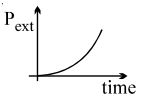
- B
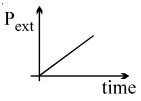
- C
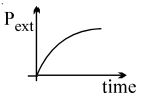
- D
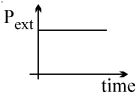
Explore More
Similar Questions
$A$,$B$,and $C$ are a disc,a solid sphere,and a spherical shell respectively,with the same radii $(R)$ and masses $(M)$. These bodies are placed as shown in the figure. The moment of inertia of the given system about the axis $PQ$ is $\frac{x}{15} I$,where $I$ is the moment of inertia of the disc about its diameter. The value of $x$ is . . . . . . .
DifficultJEE MAIN 2025
View SolutionAccording to the parallel axis theorem,$I = I_{cm} + Mx^2$. What will be the graph between $I$ and $x$?
Medium
View SolutionFill in the blanks:
$(1)$ In rotational motion,the role played by ............ is analogous to the role played by mass in linear motion.
$(2)$ For a rigid body in rotational motion,if a particle at a distance of $10 \ cm$ from the fixed axis of rotation has an angular velocity of $10 \ rad/s$,then the linear velocity of a particle at a distance of $5 \ cm$ from the axis of rotation is ............
$(3)$ The $SI$ unit $J \cdot s^{-2}$ is the unit of the physical quantity ............
$(4)$ The condition for a body to roll without slipping down an inclined plane with friction is ............
$(1)$ In rotational motion,the role played by ............ is analogous to the role played by mass in linear motion.
$(2)$ For a rigid body in rotational motion,if a particle at a distance of $10 \ cm$ from the fixed axis of rotation has an angular velocity of $10 \ rad/s$,then the linear velocity of a particle at a distance of $5 \ cm$ from the axis of rotation is ............
$(3)$ The $SI$ unit $J \cdot s^{-2}$ is the unit of the physical quantity ............
$(4)$ The condition for a body to roll without slipping down an inclined plane with friction is ............
Medium
View Solution$A$ uniform rod is fixed to a rotating turntable so that its lower end is on the axis of the turntable and it makes an angle of $20^o$ to the vertical. (The rod is thus rotating with uniform angular velocity about a vertical axis passing through one end.) If the turntable is rotating clockwise as seen from above,what is the direction of the rod's angular momentum vector (calculated about its lower end)?
Difficult
View SolutionThe figure shows a system consisting of $(i)$ a ring of outer radius $3R$ rolling clockwise without slipping on a horizontal surface with angular speed $\omega$ and $(ii)$ an inner disc of radius $2R$ rotating anti-clockwise with angular speed $\omega/2$. The ring and disc are separated by frictionless ball bearings. The system is in the $x-z$ plane. The point $P$ on the inner disc is at distance $R$ from the origin,where $OP$ makes an angle of $30^{\circ}$ with the horizontal. Then with respect to the horizontal surface,
$(A)$ the point $O$ has linear velocity $3R\omega\hat{i}$.
$(B)$ the point $P$ has a linear velocity $\frac{11}{4}R\omega\hat{i} + \frac{\sqrt{3}}{4}R\omega\hat{k}$.
$(C)$ the point $P$ has linear velocity $\frac{13}{4}R\omega\hat{i} - \frac{\sqrt{3}}{4}R\omega\hat{k}$.
$(D)$ The point $P$ has a linear velocity $(3 - \frac{\sqrt{3}}{4})R\omega\hat{i} + \frac{1}{4}R\omega\hat{k}$.
$(A)$ the point $O$ has linear velocity $3R\omega\hat{i}$.
$(B)$ the point $P$ has a linear velocity $\frac{11}{4}R\omega\hat{i} + \frac{\sqrt{3}}{4}R\omega\hat{k}$.
$(C)$ the point $P$ has linear velocity $\frac{13}{4}R\omega\hat{i} - \frac{\sqrt{3}}{4}R\omega\hat{k}$.
$(D)$ The point $P$ has a linear velocity $(3 - \frac{\sqrt{3}}{4})R\omega\hat{i} + \frac{1}{4}R\omega\hat{k}$.
Vedclass Products
For Students
Vedclass Test Series
Mock tests in real JEE/NEET style with performance analysis. 5-day free trial.
Start Free TrialFor Teachers
Exam Paper Generator
Generate Set A/B/C/D exam papers from 7.5L+ questions in 2 minutes. 3 chapters free.
Try FreeFor Institutes
Online Exam Module
Live online exams with unlimited students, 360° analytics & white-label branding.
See Demo