
An ideal gas goes through a reversible cycle $a \to b \to c \to d$ and has the $V - T$ diagram shown below. Processes $d \to a$ and $b \to c$ are adiabatic. The corresponding $P - V$ diagram for the process is (all figures are schematic and not drawn to scale):
- A
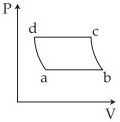
- B
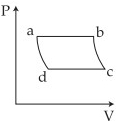
- C
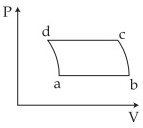
- D
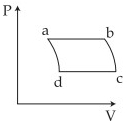
Explore More
Similar Questions
Column-$I$ shows graphs of thermodynamic processes, and column-$II$ contains information about various thermodynamic variables. Match column-$I$ with the information in column-$II$.
Column-$I$ Column-$II$ $(A)$ $PV$ vs $V$ (Isothermal expansion) $(P)$ $W$ > 0 $(B)$ $P$ vs $T$ (Isochoric heating) $(Q)$ $W$ < 0 $(C)$ $P$ vs $V$ (Isobaric expansion) $(R)$ $\Delta Q$ > 0 $(D)$ $V$ vs $T$ (Isobaric compression) $(S)$ $\Delta U$ > 0 $(T)$ $\Delta U$ < 0
| Column-$I$ | Column-$II$ |
| $(A)$ $PV$ vs $V$ (Isothermal expansion) | $(P)$ $W$ > 0 |
| $(B)$ $P$ vs $T$ (Isochoric heating) | $(Q)$ $W$ < 0 |
| $(C)$ $P$ vs $V$ (Isobaric expansion) | $(R)$ $\Delta Q$ > 0 |
| $(D)$ $V$ vs $T$ (Isobaric compression) | $(S)$ $\Delta U$ > 0 |
| $(T)$ $\Delta U$ < 0 |
Medium
View SolutionTwo identical vessels $A$ and $B$ contain equal amounts of an ideal monoatomic gas. The piston of $A$ is fixed,while the piston of $B$ is free to move. The same amount of heat $\Delta Q$ is absorbed by both $A$ and $B$. If the internal energy of $B$ increases by $100 \, J$,what is the change in the internal energy of $A$ (in $, J$)?
$A$ cyclic process $ABCD$ is shown in the given $P-V$ diagram. Which of the following diagrams represents the same process in a $P-T$ graph?
DifficultAP EAMCET 2006
View SolutionMatch List-$I$ with List-$II$.
List-$I$ List-$II$ $(A)$ Isothermal $(I)$ $\Delta W = 0$ $(B)$ Adiabatic $(II)$ $\Delta Q = 0$ $(C)$ Isobaric $(III)$ $\Delta U \neq 0$ $(D)$ Isochoric $(IV)$ $\Delta U = 0$
Choose the correct answer from the options given below:
| List-$I$ | List-$II$ |
| $(A)$ Isothermal | $(I)$ $\Delta W = 0$ |
| $(B)$ Adiabatic | $(II)$ $\Delta Q = 0$ |
| $(C)$ Isobaric | $(III)$ $\Delta U \neq 0$ |
| $(D)$ Isochoric | $(IV)$ $\Delta U = 0$ |
Choose the correct answer from the options given below:
Select the correct statement for work, heat, and change in internal energy.
Easy
View SolutionVedclass Products
For Students
Vedclass Test Series
Mock tests in real JEE/NEET style with performance analysis. 5-day free trial.
Start Free TrialFor Teachers
Exam Paper Generator
Generate Set A/B/C/D exam papers from 7.5L+ questions in 2 minutes. 3 chapters free.
Try FreeFor Institutes
Online Exam Module
Live online exams with unlimited students, 360° analytics & white-label branding.
See Demo