
Current flows through uniform,square frames as shown. In which case is the magnetic field at the centre of the frame not zero?
- A
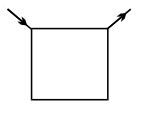
- B
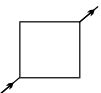
- C
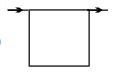
- D
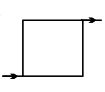
Explore More
Similar Questions
Two parallel beams of electrons moving in the same direction produce a mutual force:
Easy
View SolutionWhich of the following statements is correct?
Medium
View SolutionWhen a proton is released from rest in a room,it starts with an initial acceleration $a_0$ towards west. When it is projected towards north with a speed $v_0$,it moves with an initial acceleration $3a_0$ towards west. The electric and magnetic fields in the room are
MediumAIPMT 2013
View SolutionSix point charges,each of magnitude $q$,are arranged in different manners as shown in the image. In each case,a point $M$ and a line $PQ$ passing through $M$ are shown. Let $E$ be the electric field and $V$ be the electric potential at $M$ (potential at infinity is zero) due to the given charge distribution when it is at rest. Now,the whole system is set into rotation with a constant angular velocity about the line $PQ$. Let $B$ be the magnetic field at $M$ and $\mu$ be the magnetic moment of the system in this condition. Assume each rotating charge to be equivalent to a steady current. Match the conditions in Column $I$ with the configurations in Column $II$.
Column $I$ Column $II$ $(A)$ $E=0$ $(p)$ Charges at corners of a regular hexagon. $M$ is the centre. $PQ$ is perpendicular to the plane. $(B)$ $V \neq 0$ $(q)$ Charges on a line perpendicular to $PQ$ at equal intervals. $M$ is the mid-point. $(C)$ $B=0$ $(r)$ Charges on two coplanar concentric rings. $M$ is the common centre. $PQ$ is perpendicular to the plane. $(D)$ $\mu \neq 0$ $(s)$ Charges at corners and mid-points of a rectangle. $M$ is the centre. $PQ$ is parallel to the longer sides. $(t)$ Charges on two coplanar,identical rings. $M$ is the mid-point between centres. $PQ$ is perpendicular to the line joining centres.
| Column $I$ | Column $II$ |
| $(A)$ $E=0$ | $(p)$ Charges at corners of a regular hexagon. $M$ is the centre. $PQ$ is perpendicular to the plane. |
| $(B)$ $V \neq 0$ | $(q)$ Charges on a line perpendicular to $PQ$ at equal intervals. $M$ is the mid-point. |
| $(C)$ $B=0$ | $(r)$ Charges on two coplanar concentric rings. $M$ is the common centre. $PQ$ is perpendicular to the plane. |
| $(D)$ $\mu \neq 0$ | $(s)$ Charges at corners and mid-points of a rectangle. $M$ is the centre. $PQ$ is parallel to the longer sides. |
| $(t)$ Charges on two coplanar,identical rings. $M$ is the mid-point between centres. $PQ$ is perpendicular to the line joining centres. |
DifficultIIT 2009
View Solution$A$ charged particle of mass $m$ and charge $q$ moving under the influence of a uniform electric field $E\hat{i}$ and a uniform magnetic field $B\hat{k}$ follows a trajectory from point $P$ to $Q$ as shown in the figure. The velocities at $P$ and $Q$ are respectively $v\hat{i}$ and $-2v\hat{j}$. Which of the following statements $(A, B, C, D)$ are correct? (Trajectory shown is schematic and not to scale)
$(A)$ $E = \frac{3}{4}\left(\frac{mv^{2}}{qa}\right)$
$(B)$ Rate of work done by the electric field at $P$ is $\frac{3}{4}\left(\frac{mv^{3}}{a}\right)$
$(C)$ Rate of work done by both the fields at $Q$ is zero
$(D)$ The difference between the magnitude of angular momentum of the particle at $P$ and $Q$ is $2mav$.
$(A)$ $E = \frac{3}{4}\left(\frac{mv^{2}}{qa}\right)$
$(B)$ Rate of work done by the electric field at $P$ is $\frac{3}{4}\left(\frac{mv^{3}}{a}\right)$
$(C)$ Rate of work done by both the fields at $Q$ is zero
$(D)$ The difference between the magnitude of angular momentum of the particle at $P$ and $Q$ is $2mav$.
DifficultJEE MAIN 2020
View SolutionVedclass Products
For Students
Vedclass Test Series
Mock tests in real JEE/NEET style with performance analysis. 5-day free trial.
Start Free TrialFor Teachers
Exam Paper Generator
Generate Set A/B/C/D exam papers from 7.5L+ questions in 2 minutes. 3 chapters free.
Try FreeFor Institutes
Online Exam Module
Live online exams with unlimited students, 360° analytics & white-label branding.
See Demo