
A English
Properties of Amines Questions in English
Class 12 Chemistry · Amines · Properties of Amines
1225+
Questions
English
Language
100%
With Solutions
Showing 25 of 1225 questions in English
1201
MediumMCQ
What is the correct order of basic strength in substituted amines in an aqueous solution?
A
$NH_3 > C_2H_5NH_2 > (C_2H_5)_3 N > (C_2H_5)_2 NH$
B
$(C_2H_5)_3 N > (C_2H_5)_2 NH > C_2H_5NH_2 > NH_3$
C
$(C_2H_5)_2 NH > (C_2H_5)_3 N > C_2H_5NH_2 > NH_3$
D
$NH_3 > C_2H_5NH_2 > (C_2H_5)_2 NH > (C_2H_5)_3 N$
Solution
(C) In an aqueous solution, the basic strength of ethyl-substituted amines is determined by the interplay of three factors: the inductive effect ($+I$ effect), the solvation effect (hydrogen bonding), and steric hindrance.
For ethyl-substituted amines, the secondary amine $(2^\circ)$ is the most basic due to the optimal balance of these factors.
The tertiary amine $(3^\circ)$ is less basic than the secondary amine due to steric hindrance, but more basic than the primary amine $(1^\circ)$.
Thus, the correct order of basic strength is $(C_2H_5)_2 NH > (C_2H_5)_3 N > C_2H_5NH_2 > NH_3$.
For ethyl-substituted amines, the secondary amine $(2^\circ)$ is the most basic due to the optimal balance of these factors.
The tertiary amine $(3^\circ)$ is less basic than the secondary amine due to steric hindrance, but more basic than the primary amine $(1^\circ)$.
Thus, the correct order of basic strength is $(C_2H_5)_2 NH > (C_2H_5)_3 N > C_2H_5NH_2 > NH_3$.
0 likes
View Solution1202
DifficultMCQ
What will be the name of the product formed upon the ammonolysis of benzyl chloride followed by the reaction of the resulting amine with two moles of $CH_3Cl$?
A
$N$, $N$-dimethylphenylmethanamine
B
$N$, $N$-diphenylmethanamine
C
$N$, $N$-diphenylethanamine
D
$N$-methyl, $N$-phenylmethanamine
Solution
(A) $1$. Ammonolysis of benzyl chloride $(C_6H_5CH_2Cl)$ involves the nucleophilic substitution of the chlorine atom by an ammonia molecule, resulting in the formation of benzylamine $(C_6H_5CH_2NH_2)$.
$2$. Benzylamine is a primary amine. When it reacts with two moles of methyl chloride $(CH_3Cl)$, the two hydrogen atoms attached to the nitrogen atom are replaced by two methyl groups through nucleophilic substitution.
$3$. The final product formed is $C_6H_5CH_2N(CH_3)_2$.
$4$. According to $IUPAC$ nomenclature, this compound is named $N$, $N$-dimethylphenylmethanamine.
$2$. Benzylamine is a primary amine. When it reacts with two moles of methyl chloride $(CH_3Cl)$, the two hydrogen atoms attached to the nitrogen atom are replaced by two methyl groups through nucleophilic substitution.
$3$. The final product formed is $C_6H_5CH_2N(CH_3)_2$.
$4$. According to $IUPAC$ nomenclature, this compound is named $N$, $N$-dimethylphenylmethanamine.
0 likes
View Solution1203
MediumMCQ
Which of the following statements is true for Benzenediazonium fluoroborate?
A
When heated with $NaNO_2$ in the presence of $Cu$, it gives aniline.
B
On heating, it does not decompose to yield fluorobenzene.
C
It is water-insoluble and stable at room temperature.
D
It is water-soluble and unstable at room temperature.
Solution
(C) Benzenediazonium fluoroborate $(C_6H_5N_2^+BF_4^-)$ is unique among diazonium salts because it is water-insoluble and relatively stable at room temperature, which allows it to be dried and stored.
Upon heating, it undergoes thermal decomposition to yield fluorobenzene, a process known as the Schiemann reaction.
Upon heating, it undergoes thermal decomposition to yield fluorobenzene, a process known as the Schiemann reaction.
0 likes
View Solution1204
MediumMCQ
Which statements are True? $A$. In Hoffmann bromamide degradation, $4$ moles of $NaOH$ and $1$ mole of $Br_{2}$ are consumed per mole of an amide. $B$. Hoffmann bromamide reaction is not given by alkyl amides. $C$. Primary amines can be synthesized by Hoffmann bromamide degradation. $D$. Secondary amide on reaction with $Br_{2}$ and $NaOH$ will give secondary amine. $E$. The by-products of Hoffmann degradation are $Na_{2}CO_{3}$, $NaBr$ and $H_{2}O$. Choose the correct answer from the options given below:
A
$A, C$ and $E$ only
B
$B, C$ and $D$ only
C
$C$ and $E$ only
D
$C, D$ and $E$ only
Solution
(A) The chemical equation for the Hoffmann bromamide degradation reaction is: $RCONH_{2} + Br_{2} + 4NaOH \rightarrow RNH_{2} + Na_{2}CO_{3} + 2NaBr + 2H_{2}O$.
$(A)$ is correct because the stoichiometry of the reaction requires $4$ moles of $NaOH$ and $1$ mole of $Br_{2}$ for every mole of primary amide.
$(B)$ is false because alkyl amides (primary amides) readily undergo this reaction.
$(C)$ is correct because this reaction is a standard laboratory method for the synthesis of primary amines.
$(D)$ is false because secondary amides $(RCONHR')$ lack the necessary $-NH_{2}$ group required for the rearrangement mechanism.
$(E)$ is correct because the by-products formed are indeed $Na_{2}CO_{3}$, $NaBr$, and $H_{2}O$.
$(A)$ is correct because the stoichiometry of the reaction requires $4$ moles of $NaOH$ and $1$ mole of $Br_{2}$ for every mole of primary amide.
$(B)$ is false because alkyl amides (primary amides) readily undergo this reaction.
$(C)$ is correct because this reaction is a standard laboratory method for the synthesis of primary amines.
$(D)$ is false because secondary amides $(RCONHR')$ lack the necessary $-NH_{2}$ group required for the rearrangement mechanism.
$(E)$ is correct because the by-products formed are indeed $Na_{2}CO_{3}$, $NaBr$, and $H_{2}O$.
0 likes
View Solution1205
DifficultMCQ
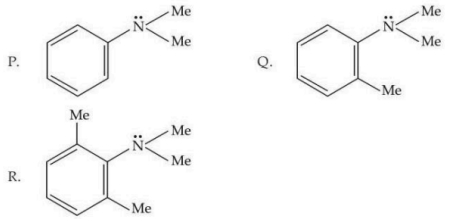
Consider the three aromatic molecules ($P$, $Q$ and $R$) whose structures are given below. The correct order regarding the reactivity of these compounds with $Ph-N\equiv N^{(+)}Cl^{(-)}$ under optimum but slightly acidic medium is:
A
$P > Q > R$
B
$R > P > Q$
C
$R > Q > P$
D
$P > R > Q$
Solution
(A) The reaction is an electrophilic aromatic substitution (diazo coupling).
The reactivity is determined by the electron density on the aromatic ring, which is enhanced by electron-donating groups like $-N(Me)_2$.
Steric hindrance at the ortho position to the $-N(Me)_2$ group significantly reduces the reactivity by preventing the approach of the electrophile.
Molecule $P$ has no ortho substituents, molecule $Q$ has one ortho methyl group, and molecule $R$ has two ortho methyl groups.
Therefore, the steric hindrance increases in the order $P < Q < R$, which means the reactivity decreases in the order $P > Q > R$.
Wait, let us re-evaluate: $P$ has no ortho substituents, $Q$ has one ortho methyl group, and $R$ has two ortho methyl groups. The reactivity order is $P > Q > R$.
The reactivity is determined by the electron density on the aromatic ring, which is enhanced by electron-donating groups like $-N(Me)_2$.
Steric hindrance at the ortho position to the $-N(Me)_2$ group significantly reduces the reactivity by preventing the approach of the electrophile.
Molecule $P$ has no ortho substituents, molecule $Q$ has one ortho methyl group, and molecule $R$ has two ortho methyl groups.
Therefore, the steric hindrance increases in the order $P < Q < R$, which means the reactivity decreases in the order $P > Q > R$.
Wait, let us re-evaluate: $P$ has no ortho substituents, $Q$ has one ortho methyl group, and $R$ has two ortho methyl groups. The reactivity order is $P > Q > R$.
0 likes
View Solution1206
DifficultMCQ
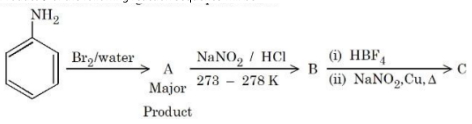
The product $C$ of the following reaction sequence is:
A
$1,3,5-$Tribromobenzene
B
$1,2,3-$Tribromobenzene
C
$1,2,4-$Tribromobenzene
D
$1,3,5-$Tribromo$-2-$nitrobenzene
Solution
(D) $1$. Aniline reacts with $Br_2/H_2O$ to form $2,4,6$-tribromoaniline as the major product $(A)$.
$2$. $2,4,6$-tribromoaniline reacts with $NaNO_2/HCl$ at $273-278 \ K$ to form the diazonium salt, $2,4,6$-tribromobenzenediazonium chloride $(B)$.
$3$. The reaction of the diazonium salt with $HBF_4$ followed by $NaNO_2/Cu, \Delta$ is a variation of the Balz-Schiemann or Sandmeyer-type reaction where the diazonium group $(-N_2^+Cl^-)$ is replaced by a nitro group $(-NO_2)$.
$4$. Thus, the final product $C$ is $1,3,5$-tribromo$-2-$nitrobenzene.
$2$. $2,4,6$-tribromoaniline reacts with $NaNO_2/HCl$ at $273-278 \ K$ to form the diazonium salt, $2,4,6$-tribromobenzenediazonium chloride $(B)$.
$3$. The reaction of the diazonium salt with $HBF_4$ followed by $NaNO_2/Cu, \Delta$ is a variation of the Balz-Schiemann or Sandmeyer-type reaction where the diazonium group $(-N_2^+Cl^-)$ is replaced by a nitro group $(-NO_2)$.
$4$. Thus, the final product $C$ is $1,3,5$-tribromo$-2-$nitrobenzene.
0 likes
View Solution1207
MediumMCQ
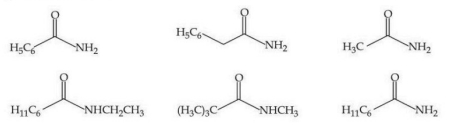
The number of compounds from the following which can undergo reaction with $Br_2/KOH$ (alcoholic) to give respective products, and these respective products can also be obtained separately by the Gabriel phthalimide synthesis, is:
A
$5$
B
$4$
C
$3$
D
$6$
Solution
(B) The Hoffmann bromamide degradation reaction $(Br_2/KOH)$ is specific to primary amides $(R-CONH_2)$, converting them into primary amines $(R-NH_2)$.
Gabriel phthalimide synthesis is also used for the preparation of primary amines $(R-NH_2)$ from primary alkyl halides $(R-X)$.
Therefore, we need to identify the number of primary amides $(R-CONH_2)$ in the given set.
Let's analyze the structures provided in the image:
$1$. $C_6H_5CONH_2$ (Benzamide) - Primary amide.
$2$. $C_6H_5CH_2CONH_2$ ($2$-Phenylacetamide) - Primary amide.
$3$. $CH_3CONH_2$ (Acetamide) - Primary amide.
$4$. $C_6H_{11}CONHCH_2CH_3$ - Secondary amide (Does not undergo Hoffmann degradation).
$5$. $(CH_3)_3CCONHCH_3$ - Secondary amide (Does not undergo Hoffmann degradation).
$6$. $C_6H_{11}CONH_2$ (Cyclohexanecarboxamide) - Primary amide.
Counting the primary amides, we have compounds $1$, $2$, $3$, and $6$.
Thus, there are $4$ such compounds.
Gabriel phthalimide synthesis is also used for the preparation of primary amines $(R-NH_2)$ from primary alkyl halides $(R-X)$.
Therefore, we need to identify the number of primary amides $(R-CONH_2)$ in the given set.
Let's analyze the structures provided in the image:
$1$. $C_6H_5CONH_2$ (Benzamide) - Primary amide.
$2$. $C_6H_5CH_2CONH_2$ ($2$-Phenylacetamide) - Primary amide.
$3$. $CH_3CONH_2$ (Acetamide) - Primary amide.
$4$. $C_6H_{11}CONHCH_2CH_3$ - Secondary amide (Does not undergo Hoffmann degradation).
$5$. $(CH_3)_3CCONHCH_3$ - Secondary amide (Does not undergo Hoffmann degradation).
$6$. $C_6H_{11}CONH_2$ (Cyclohexanecarboxamide) - Primary amide.
Counting the primary amides, we have compounds $1$, $2$, $3$, and $6$.
Thus, there are $4$ such compounds.
0 likes
View Solution1208
MediumMCQ
Given below are two statements:
Statement $I$: Heating benzamide with bromine in an ethanolic solution of sodium hydroxide will give benzylamine.
Statement $II$: Nitration of aniline with $HNO_3/H_2SO_4$ at $288 \ K$ produces $m$-nitroaniline in higher amount than $o$-nitroaniline (pH adjusted).
Statement $I$: Heating benzamide with bromine in an ethanolic solution of sodium hydroxide will give benzylamine.
Statement $II$: Nitration of aniline with $HNO_3/H_2SO_4$ at $288 \ K$ produces $m$-nitroaniline in higher amount than $o$-nitroaniline (pH adjusted).
A
Both Statement $I$ and Statement $II$ are true
B
Both Statement $I$ and Statement $II$ are false
C
Statement $I$ is true but Statement $II$ is false
D
Statement $I$ is false but Statement $II$ is true
Solution
(D) Statement $I$ is false: The reaction of benzamide with $Br_2$ and $NaOH$ (Hofmann bromamide degradation) produces aniline, not benzylamine.
Statement $II$ is true: In the strong acidic medium of nitration $(H_2SO_4)$, aniline gets protonated to form anilinium ion $(-NH_3^+)$, which is meta-directing. Hence, $m$-nitroaniline is formed in a significant amount due to the deactivating and meta-directing nature of the $-NH_3^+$ group.
Statement $II$ is true: In the strong acidic medium of nitration $(H_2SO_4)$, aniline gets protonated to form anilinium ion $(-NH_3^+)$, which is meta-directing. Hence, $m$-nitroaniline is formed in a significant amount due to the deactivating and meta-directing nature of the $-NH_3^+$ group.
0 likes
View Solution1209
MediumMCQ
The strongest conjugate acid will result from:
A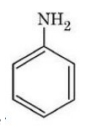
B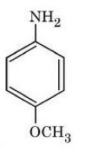
C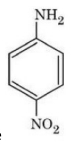
D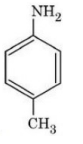
Solution
(C) conjugate acid is formed by the protonation of a base. $A$ stronger conjugate acid is formed from a weaker base.
Among the given substituted anilines, the base strength depends on the electron-donating or electron-withdrawing nature of the substituents.
The $-NO_2$ group in $4$-nitroaniline is a strong electron-withdrawing group via resonance and induction, which significantly reduces the availability of the lone pair on the nitrogen atom, thus making it the weakest base.
Since the strength of a conjugate acid is inversely proportional to the strength of its parent base, the protonated form of $4$-nitroaniline is the strongest conjugate acid.
Among the given substituted anilines, the base strength depends on the electron-donating or electron-withdrawing nature of the substituents.
The $-NO_2$ group in $4$-nitroaniline is a strong electron-withdrawing group via resonance and induction, which significantly reduces the availability of the lone pair on the nitrogen atom, thus making it the weakest base.
Since the strength of a conjugate acid is inversely proportional to the strength of its parent base, the protonated form of $4$-nitroaniline is the strongest conjugate acid.
0 likes
View Solution1210
MediumMCQ
Arrange the following compounds according to increasing order of boiling points: $n-C_4H_9OH$ $(A)$, $n-C_4H_9NH_2$ $(B)$, $n-C_4H_{10}$ $(C)$, and $C_2H_5NHC_2H_5$ $(D)$.
A
$C < B < A < D$
B
$D < C < B < A$
C
$C < D < B < A$
D
$D < B < A < C$
Solution
(C) The boiling point of a compound depends on the strength of intermolecular forces.
$n-C_4H_{10}$ $(C)$ is an alkane and possesses only weak van der Waals forces, resulting in the lowest boiling point.
$C_2H_5NHC_2H_5$ $(D)$ is a secondary amine; it exhibits hydrogen bonding, but the extent is less than that of a primary amine due to steric hindrance.
$n-C_4H_9NH_2$ $(B)$ is a primary amine, which has stronger hydrogen bonding compared to the secondary amine $(D)$.
$n-C_4H_9OH$ $(A)$ is an alcohol, which forms the strongest hydrogen bonds due to the high electronegativity of oxygen compared to nitrogen, resulting in the highest boiling point.
Therefore, the increasing order of boiling points is $C < D < B < A$.
$n-C_4H_{10}$ $(C)$ is an alkane and possesses only weak van der Waals forces, resulting in the lowest boiling point.
$C_2H_5NHC_2H_5$ $(D)$ is a secondary amine; it exhibits hydrogen bonding, but the extent is less than that of a primary amine due to steric hindrance.
$n-C_4H_9NH_2$ $(B)$ is a primary amine, which has stronger hydrogen bonding compared to the secondary amine $(D)$.
$n-C_4H_9OH$ $(A)$ is an alcohol, which forms the strongest hydrogen bonds due to the high electronegativity of oxygen compared to nitrogen, resulting in the highest boiling point.
Therefore, the increasing order of boiling points is $C < D < B < A$.
0 likes
View Solution1211
DifficultMCQ
Consider the following sequence of reactions. The percentage of nitrogen in the yellow product $(X)$ formed is . . . . . . %. (Nearest Integer) (Given Molar mass in g mol$^{-1}$ $H$:$1$, $C$:$12$, $N$:$14$)

A
$21$
B
$28$
C
$30$
D
$32$
Solution
(A) The reaction sequence involves the acid-catalyzed rearrangement of diazoaminobenzene to $p$-aminoazobenzene.
$1$. The starting material is diazoaminobenzene $(C_{12}H_{11}N_3)$.
$2$. Upon treatment with $HCl$ and aniline, it undergoes a rearrangement reaction known as the diazoamino-to-aminoazo rearrangement.
$3$. The yellow product $(X)$ formed is $p$-aminoazobenzene, which has the chemical formula $C_{12}H_{11}N_3$.
$4$. The molar mass of $C_{12}H_{11}N_3$ is $(12 \times 12) + (11 \times 1) + (3 \times 14) = 144 + 11 + 42 = 197$ g/mol.
$5$. The percentage of nitrogen in the product is $\frac{\text{Total mass of N}}{\text{Molar mass of X}} \times 100 = \frac{42}{197} \times 100 \approx 21.32\%$.
$6$. Rounding to the nearest integer, we get $21\%$.
$1$. The starting material is diazoaminobenzene $(C_{12}H_{11}N_3)$.
$2$. Upon treatment with $HCl$ and aniline, it undergoes a rearrangement reaction known as the diazoamino-to-aminoazo rearrangement.
$3$. The yellow product $(X)$ formed is $p$-aminoazobenzene, which has the chemical formula $C_{12}H_{11}N_3$.
$4$. The molar mass of $C_{12}H_{11}N_3$ is $(12 \times 12) + (11 \times 1) + (3 \times 14) = 144 + 11 + 42 = 197$ g/mol.
$5$. The percentage of nitrogen in the product is $\frac{\text{Total mass of N}}{\text{Molar mass of X}} \times 100 = \frac{42}{197} \times 100 \approx 21.32\%$.
$6$. Rounding to the nearest integer, we get $21\%$.
0 likes
View Solution1212
MediumMCQ
The following two reactions give the same foul-smelling product $Z$. $C_2H_5Cl \xrightarrow{X} Z$ and $C_2H_5CONH_2 \xrightarrow{Br_2, NaOH} Y \xrightarrow{CHCl_3/ethanolic KOH, \Delta} Z$. $X$ and $Z$, respectively, are:
A
$X = AgCN; Z = C_2H_5CN$
B
$X = AgCN; Z = C_2H_5NC$
C
$X = KCN; Z = C_2H_5CN$
D
$X = KCN; Z = C_2H_5NC$
Solution
(B) Reaction $1$: $C_2H_5Cl + AgCN \rightarrow C_2H_5NC$ (Ethyl isocyanide, which is a foul-smelling compound).
Reaction $2$: This involves the Hofmann bromamide degradation followed by the carbylamine reaction.
Step $1$: $C_2H_5CONH_2 \xrightarrow{Br_2, NaOH} C_2H_5NH_2$ ($Y$ is ethylamine).
Step $2$: $C_2H_5NH_2 + CHCl_3 + 3KOH \xrightarrow{\Delta} C_2H_5NC + 3KCl + 3H_2O$ (Carbylamine reaction).
Thus, $Z$ is ethyl isocyanide $(C_2H_5NC)$ and $X$ is $AgCN$.
Reaction $2$: This involves the Hofmann bromamide degradation followed by the carbylamine reaction.
Step $1$: $C_2H_5CONH_2 \xrightarrow{Br_2, NaOH} C_2H_5NH_2$ ($Y$ is ethylamine).
Step $2$: $C_2H_5NH_2 + CHCl_3 + 3KOH \xrightarrow{\Delta} C_2H_5NC + 3KCl + 3H_2O$ (Carbylamine reaction).
Thus, $Z$ is ethyl isocyanide $(C_2H_5NC)$ and $X$ is $AgCN$.
0 likes
View Solution1213
MediumMCQ
Identify the different types of bonds present in quaternary ammonium salts.
A
Covalent
B
Ionic
C
Covalent and co-ordinate
D
Covalent, co-ordinate and ionic
Solution
(D) $1$. Quaternary ammonium salts have the general formula $[R_4N]^+X^-$.
$2$. The four $C-N$ bonds are covalent bonds.
$3$. One of these $C-N$ bonds is formed by the donation of a lone pair from the nitrogen atom to the fourth alkyl group, which is a coordinate (dative) bond.
$4$. The electrostatic attraction between the quaternary ammonium cation $[R_4N]^+$ and the anion $X^-$ constitutes an ionic bond.
$5$. Therefore, all three types of bonds are present.
$2$. The four $C-N$ bonds are covalent bonds.
$3$. One of these $C-N$ bonds is formed by the donation of a lone pair from the nitrogen atom to the fourth alkyl group, which is a coordinate (dative) bond.
$4$. The electrostatic attraction between the quaternary ammonium cation $[R_4N]^+$ and the anion $X^-$ constitutes an ionic bond.
$5$. Therefore, all three types of bonds are present.
0 likes
View Solution1214
MediumMCQ
Which of the following amines does $NOT$ form an alkyl isocyanide when heated with alcoholic $KOH$ and chloroform $(CHCl_3)$?
A
Methanamine
B
Propan$-2-$amine
C
$N, N-Diethylethanamine$
D
Ethanamine
Solution
(C) $1$. The reaction described is the Carbylamine reaction.
$2$. Primary amines $(R-NH_2)$ react with chloroform $(CHCl_3)$ and alcoholic $KOH$ to form alkyl isocyanides (carbylamines), which have a foul smell.
$3$. Secondary $(R_2NH)$ and tertiary $(R_3N)$ amines do not undergo the Carbylamine reaction.
$4$. Methanamine $(CH_3NH_2)$, Propan$-2-$amine $(CH_3CH(NH_2)CH_3)$, and Ethanamine $(CH_3CH_2NH_2)$ are primary amines.
$5$. $N, N-Diethylethanamine$ $((C_2H_5)_3N)$ is a tertiary amine and therefore does not give this test.
$2$. Primary amines $(R-NH_2)$ react with chloroform $(CHCl_3)$ and alcoholic $KOH$ to form alkyl isocyanides (carbylamines), which have a foul smell.
$3$. Secondary $(R_2NH)$ and tertiary $(R_3N)$ amines do not undergo the Carbylamine reaction.
$4$. Methanamine $(CH_3NH_2)$, Propan$-2-$amine $(CH_3CH(NH_2)CH_3)$, and Ethanamine $(CH_3CH_2NH_2)$ are primary amines.
$5$. $N, N-Diethylethanamine$ $((C_2H_5)_3N)$ is a tertiary amine and therefore does not give this test.
0 likes
View Solution1215
MediumMCQ
Which of the following amines, when heated with ethanolic $KOH$ and chloroform $(CHCl_3)$, does $NOT$ produce a foul smell?
A
Benzenamine
B
$N, N - \text{Dimethylaniline}$
C
Propan$-2-$amine
D
Phenylmethanamine
Solution
(B) $1$. The reaction of primary amines with ethanolic $KOH$ and $CHCl_3$ is known as the Carbylamine reaction.
$2$. This reaction produces isocyanides (carbylamines), which have a characteristic foul smell.
$3$. Secondary and tertiary amines do not undergo the Carbylamine reaction because they lack the necessary hydrogen atoms on the nitrogen to form the isocyanide group.
$4$. Benzenamine $(C_6H_5NH_2)$, Propan$-2-$amine $(CH_3CH(NH_2)CH_3)$, and Phenylmethanamine $(C_6H_5CH_2NH_2)$ are primary amines and will give the test.
$5$. $N, N - \text{Dimethylaniline}$ is a tertiary amine $(C_6H_5N(CH_3)_2)$ and will not produce a foul smell.
$2$. This reaction produces isocyanides (carbylamines), which have a characteristic foul smell.
$3$. Secondary and tertiary amines do not undergo the Carbylamine reaction because they lack the necessary hydrogen atoms on the nitrogen to form the isocyanide group.
$4$. Benzenamine $(C_6H_5NH_2)$, Propan$-2-$amine $(CH_3CH(NH_2)CH_3)$, and Phenylmethanamine $(C_6H_5CH_2NH_2)$ are primary amines and will give the test.
$5$. $N, N - \text{Dimethylaniline}$ is a tertiary amine $(C_6H_5N(CH_3)_2)$ and will not produce a foul smell.
0 likes
View Solution1216
MediumMCQ
Which of the following statements is $NOT$ correct?
A
$\text{Primary amines show intermolecular hydrogen bonds.}$
B
$\text{Tertiary butylamine is a primary amine.}$
C
$\text{Tertiary amines do not show intermolecular hydrogen bonds.}$
D
$\text{iso-propylamine is a secondary amine.}$
Solution
(D) Step $1$: Analyze the structure of amines. Primary amines $(R-NH_2)$ have two hydrogen atoms attached to the nitrogen, allowing for intermolecular hydrogen bonding.
Step $2$: Tertiary amines $(R_3N)$ have no hydrogen atoms attached to the nitrogen, so they cannot form intermolecular hydrogen bonds.
Step $3$: Tertiary butylamine is $(CH_3)_3C-NH_2$, which is a primary amine because the nitrogen is attached to only one carbon atom.
Step $4$: iso-propylamine is $(CH_3)_2CH-NH_2$, which is a primary amine because the nitrogen is attached to only one carbon atom. Therefore, the statement that iso-propylamine is a secondary amine is incorrect.
Step $2$: Tertiary amines $(R_3N)$ have no hydrogen atoms attached to the nitrogen, so they cannot form intermolecular hydrogen bonds.
Step $3$: Tertiary butylamine is $(CH_3)_3C-NH_2$, which is a primary amine because the nitrogen is attached to only one carbon atom.
Step $4$: iso-propylamine is $(CH_3)_2CH-NH_2$, which is a primary amine because the nitrogen is attached to only one carbon atom. Therefore, the statement that iso-propylamine is a secondary amine is incorrect.
0 likes
View Solution1217
MediumMCQ
Tertiary amines have the lowest boiling points among isomeric amines because,
A
They possess polar $N-C$ bonds
B
They possess inter-molecular dipole-dipole attraction forces
C
They possess inter-molecular $H$-bonding
D
They do not possess inter-molecular $H$-bonding
Solution
(D) $1$. Primary $(R-NH_2)$ and secondary $(R_2NH)$ amines contain $N-H$ bonds, which allow for inter-molecular hydrogen bonding.
$2$. Tertiary amines $(R_3N)$ do not have any hydrogen atoms attached to the nitrogen atom.
$3$. Due to the absence of $N-H$ bonds, tertiary amines cannot form inter-molecular hydrogen bonds.
$4$. Consequently, they have weaker inter-molecular forces compared to primary and secondary amines, resulting in lower boiling points.
$2$. Tertiary amines $(R_3N)$ do not have any hydrogen atoms attached to the nitrogen atom.
$3$. Due to the absence of $N-H$ bonds, tertiary amines cannot form inter-molecular hydrogen bonds.
$4$. Consequently, they have weaker inter-molecular forces compared to primary and secondary amines, resulting in lower boiling points.
0 likes
View Solution1218
MediumMCQ
Identify the correct decreasing order of the basic strength of the following amines in the aqueous phase: $CH_3NH_2$, $(CH_3)_2NH$, $C_6H_5NH_2$, and $NH_3$.
A
$CH_3NH_2 > (CH_3)_2NH > C_6H_5NH_2 > NH_3$
B
$(CH_3)_2NH > CH_3NH_2 > NH_3 > C_6H_5NH_2$
C
$NH_3 > CH_3NH_2 > (CH_3)_2NH > C_6H_5NH_2$
D
$C_6H_5NH_2 > (CH_3)_2NH > CH_3NH_2 > NH_3$
Solution
(B) Step $1$: In the aqueous phase, the basicity of aliphatic amines depends on the combined effect of the inductive effect $(+I)$, solvation effect, and steric hindrance.
Step $2$: For methyl-substituted amines, the order is $(CH_3)_2NH > CH_3NH_2 > NH_3$.
Step $3$: $C_6H_5NH_2$ (aniline) is the least basic because the lone pair on the nitrogen atom is involved in resonance with the benzene ring, making it less available for protonation.
Step $4$: Combining these, the decreasing order of basic strength is $(CH_3)_2NH > CH_3NH_2 > NH_3 > C_6H_5NH_2$.
Step $2$: For methyl-substituted amines, the order is $(CH_3)_2NH > CH_3NH_2 > NH_3$.
Step $3$: $C_6H_5NH_2$ (aniline) is the least basic because the lone pair on the nitrogen atom is involved in resonance with the benzene ring, making it less available for protonation.
Step $4$: Combining these, the decreasing order of basic strength is $(CH_3)_2NH > CH_3NH_2 > NH_3 > C_6H_5NH_2$.
0 likes
View Solution1219
DifficultMCQ
Identify the major product obtained when ethyl amine $(CH_3CH_2NH_2)$ is reacted with an excess of methyl iodide $(CH_3I)$?
A
$\text{Tetramethylammonium iodide}$
B
$\text{Ethyltrimethylammonium iodide}$
C
$\text{Ethyldimethylamine}$
D
$\text{Ethylmethylamine}$
Solution
(B) $1$. Ethyl amine $(CH_3CH_2NH_2)$ reacts with excess methyl iodide $(CH_3I)$ via nucleophilic substitution ($S_N2$ reactions).
$2$. The primary amine reacts to form a secondary amine: $CH_3CH_2NH_2 + CH_3I \rightarrow CH_3CH_2NH(CH_3) + HI$.
$3$. The secondary amine reacts further to form a tertiary amine: $CH_3CH_2NH(CH_3) + CH_3I \rightarrow CH_3CH_2N(CH_3)_2 + HI$.
$4$. The tertiary amine reacts with the remaining excess methyl iodide to form a quaternary ammonium salt: $CH_3CH_2N(CH_3)_2 + CH_3I \rightarrow [CH_3CH_2N(CH_3)_3]^+I^-$.
$5$. The final product is ethyltrimethylammonium iodide.
$2$. The primary amine reacts to form a secondary amine: $CH_3CH_2NH_2 + CH_3I \rightarrow CH_3CH_2NH(CH_3) + HI$.
$3$. The secondary amine reacts further to form a tertiary amine: $CH_3CH_2NH(CH_3) + CH_3I \rightarrow CH_3CH_2N(CH_3)_2 + HI$.
$4$. The tertiary amine reacts with the remaining excess methyl iodide to form a quaternary ammonium salt: $CH_3CH_2N(CH_3)_2 + CH_3I \rightarrow [CH_3CH_2N(CH_3)_3]^+I^-$.
$5$. The final product is ethyltrimethylammonium iodide.
0 likes
View Solution1220
MediumMCQ
Which of the following amines, when heated with ethanolic $KOH$ and chloroform, forms an aryl isocyanide?
A
$\text{Benzenamine}$
B
$N-\text{methylaniline}$
C
$N,N-\text{Dimethylaniline}$
D
$\text{Ethylethanamine}$
Solution
(A) $1$. The reaction described is the carbylamine reaction, which is a characteristic test for primary $(1^\circ)$ amines.
$2$. In this reaction, a primary amine reacts with chloroform $(CHCl_3)$ and alcoholic potassium hydroxide $(KOH)$ to form an isocyanide (carbylamine), which has a foul smell.
$3$. Among the given options, $\text{Benzenamine}$ (aniline, $C_6H_5NH_2$) is a primary aromatic amine.
$4$. $N-\text{methylaniline}$ and $N,N-\text{Dimethylaniline}$ are secondary and tertiary amines, respectively, and do not undergo the carbylamine reaction.
$5$. $\text{Ethylethanamine}$ (diethylamine) is a secondary aliphatic amine and also does not undergo this reaction.
$6$. Therefore, $\text{Benzenamine}$ is the correct answer.
$2$. In this reaction, a primary amine reacts with chloroform $(CHCl_3)$ and alcoholic potassium hydroxide $(KOH)$ to form an isocyanide (carbylamine), which has a foul smell.
$3$. Among the given options, $\text{Benzenamine}$ (aniline, $C_6H_5NH_2$) is a primary aromatic amine.
$4$. $N-\text{methylaniline}$ and $N,N-\text{Dimethylaniline}$ are secondary and tertiary amines, respectively, and do not undergo the carbylamine reaction.
$5$. $\text{Ethylethanamine}$ (diethylamine) is a secondary aliphatic amine and also does not undergo this reaction.
$6$. Therefore, $\text{Benzenamine}$ is the correct answer.
0 likes
View Solution1221
DifficultMCQ
Which of the following statements is $NOT$ correct regarding Hofmann's exhaustive alkylation?
A
$\text{In this, quaternary ammonium salts are obtained.}$
B
$\text{Two moles of alkyl halide when heated with one mole of primary amine form tetraalkyl ammonium halide.}$
C
$\text{Depending on the quantity of alkyl halides treated with primary amine, a mixture of secondary and tertiary amines is obtained.}$
D
$\text{The reaction is carried out in the presence of } \text{NaHCO}_3.$
Solution
(B) Step $1$: Hofmann's exhaustive alkylation involves the reaction of a primary amine with an excess of alkyl halide to form a mixture of secondary amine, tertiary amine, and finally a quaternary ammonium salt.
Step $2$: Option $(A)$ is correct as the final product is a quaternary ammonium salt.
Step $3$: Option $(B)$ is incorrect because the reaction of $1 \text{ mole}$ of primary amine with $2 \text{ moles}$ of alkyl halide produces a tertiary amine, not a tetraalkyl ammonium halide. Tetraalkyl ammonium halide requires $4 \text{ moles}$ of alkyl halide.
Step $4$: Option $(C)$ is correct as the product distribution depends on the molar ratio of reactants.
Step $5$: Option $(D)$ is correct as the reaction releases $HX$, which is neutralized by a base like $\text{NaHCO}_3$ or excess amine to drive the reaction forward.
Step $2$: Option $(A)$ is correct as the final product is a quaternary ammonium salt.
Step $3$: Option $(B)$ is incorrect because the reaction of $1 \text{ mole}$ of primary amine with $2 \text{ moles}$ of alkyl halide produces a tertiary amine, not a tetraalkyl ammonium halide. Tetraalkyl ammonium halide requires $4 \text{ moles}$ of alkyl halide.
Step $4$: Option $(C)$ is correct as the product distribution depends on the molar ratio of reactants.
Step $5$: Option $(D)$ is correct as the reaction releases $HX$, which is neutralized by a base like $\text{NaHCO}_3$ or excess amine to drive the reaction forward.
0 likes
View Solution1222
MediumMCQ
Which of the following compounds is obtained when propionamide is treated with $Br_2$ and concentrated aqueous $KOH$ solution?
A
$CH_3CH_2CH_2COOH$
B
$CH_3COCH_3$
C
$CH_3CH_2NH_2$
D
$CH_3CH_2Br$
Solution
(C) The reaction of an amide with $Br_2$ and aqueous $KOH$ is known as the $Hofmann$ bromamide degradation reaction.
In this reaction, the amide group $(-CONH_2)$ is converted into a primary amine $(-NH_2)$ with the loss of one carbon atom.
Propionamide is $CH_3CH_2CONH_2$.
Reaction: $CH_3CH_2CONH_2 + Br_2 + 4KOH \rightarrow CH_3CH_2NH_2 + K_2CO_3 + 2KBr + 2H_2O$.
The product obtained is ethylamine $(CH_3CH_2NH_2)$.
In this reaction, the amide group $(-CONH_2)$ is converted into a primary amine $(-NH_2)$ with the loss of one carbon atom.
Propionamide is $CH_3CH_2CONH_2$.
Reaction: $CH_3CH_2CONH_2 + Br_2 + 4KOH \rightarrow CH_3CH_2NH_2 + K_2CO_3 + 2KBr + 2H_2O$.
The product obtained is ethylamine $(CH_3CH_2NH_2)$.
0 likes
View Solution1223
DifficultMCQ
Identify the substrate '$A$' in the following reaction: $A \xrightarrow[ii) \Delta]{i) \text{Moist } Ag_2O} CH_3CH_2N(CH_3)_2 + CH_2 = CH_2 + H_2O$
A
$CH_3CH_2N^+(CH_3)_3 X^-$
B
$(CH_3CH_2)_2N^+(CH_3)_2 X^-$
C
$CH_3CH_2N^+(CH_3)_3 OH^-$
D
$(CH_3CH_2)_2N^+(CH_3)_2 OH^-$
Solution
(A) $1$. The reaction is the Hofmann elimination of a quaternary ammonium salt.
$2$. Step $(i)$ involves the exchange of the halide ion with the hydroxide ion using moist $Ag_2O$ $(AgOH)$, forming the quaternary ammonium hydroxide: $A + AgOH \rightarrow [CH_3CH_2N^+(CH_3)_3]OH^- + AgX$.
$3$. Step (ii) is the thermal decomposition (Hofmann elimination) of the hydroxide. According to the Hofmann rule, the less substituted alkene is formed. Here, $CH_2=CH_2$ (ethene) is formed from the ethyl group, and the remaining part is $CH_3CH_2N(CH_3)_2$.
$4$. Thus, the substrate '$A$' must be $Ethyltrimethylammonium$ halide.
$2$. Step $(i)$ involves the exchange of the halide ion with the hydroxide ion using moist $Ag_2O$ $(AgOH)$, forming the quaternary ammonium hydroxide: $A + AgOH \rightarrow [CH_3CH_2N^+(CH_3)_3]OH^- + AgX$.
$3$. Step (ii) is the thermal decomposition (Hofmann elimination) of the hydroxide. According to the Hofmann rule, the less substituted alkene is formed. Here, $CH_2=CH_2$ (ethene) is formed from the ethyl group, and the remaining part is $CH_3CH_2N(CH_3)_2$.
$4$. Thus, the substrate '$A$' must be $Ethyltrimethylammonium$ halide.
0 likes
View Solution1224
MediumMCQ
Nitration of aniline in a strong acidic medium gives a significant amount of $m$-nitroaniline because:
A
In electrophilic substitution reactions, the amino group is meta-directing.
B
In a strong acidic medium, aniline is present as the anilinium ion.
C
The $-NH_2$ group always directs to the meta position.
D
$m$-nitroaniline has a higher molar mass than $o$- and $p$-nitroanilines.
Solution
(B) $1$. In a strong acidic medium, the lone pair of electrons on the nitrogen atom of aniline is protonated by the acid.
$2$. This results in the formation of the anilinium ion $(-NH_3^+)$.
$3$. The $-NH_3^+$ group is strongly electron-withdrawing due to its positive charge and exerts a $-I$ effect.
$4$. Consequently, it deactivates the benzene ring and directs the incoming electrophile to the meta position.
$2$. This results in the formation of the anilinium ion $(-NH_3^+)$.
$3$. The $-NH_3^+$ group is strongly electron-withdrawing due to its positive charge and exerts a $-I$ effect.
$4$. Consequently, it deactivates the benzene ring and directs the incoming electrophile to the meta position.
0 likes
View Solution1225
MediumMCQ
The basic strength of alkylamines in the aqueous phase is not decided by . . . . . . .
A
Inductive effect
B
Solvation effect
C
Steric hindrance
D
Hyperconjugation effect
Solution
(D) Step $1$: The basic strength of alkylamines in the aqueous phase depends on three main factors: inductive effect, solvation effect, and steric hindrance.
Step $2$: The inductive effect ($+I$ effect) increases the electron density on the nitrogen atom, making it more basic.
Step $3$: The solvation effect (stabilization of the conjugate acid by hydrogen bonding with water) stabilizes the cation; more substituted amines have less hydrogen bonding.
Step $4$: Steric hindrance (crowding around the nitrogen atom) hinders the approach of the proton.
Step $5$: Hyperconjugation effect does not play a significant role in determining the basicity of alkylamines in the aqueous phase. Therefore, the correct option is $D$.
Step $2$: The inductive effect ($+I$ effect) increases the electron density on the nitrogen atom, making it more basic.
Step $3$: The solvation effect (stabilization of the conjugate acid by hydrogen bonding with water) stabilizes the cation; more substituted amines have less hydrogen bonding.
Step $4$: Steric hindrance (crowding around the nitrogen atom) hinders the approach of the proton.
Step $5$: Hyperconjugation effect does not play a significant role in determining the basicity of alkylamines in the aqueous phase. Therefore, the correct option is $D$.
0 likes
View SolutionAmines — Properties of Amines · Frequently Asked Questions
1Are these Amines questions useful for JEE and NEET?
Yes. All questions in this section are mapped to JEE Main and NEET exam patterns. Previous year questions from JEE Main, NEET, GUJCET and state-level exams are included with full solutions.
2Can I switch to Hindi or Gujarati for these questions?
Yes. Use the language tabs in the hero section or the sidebar to view the same questions and solutions in English, Hindi or Gujarati.
3How do I generate a question paper from this subtopic?
Use the Vedclass Exam Paper Generator — select the chapter and subtopic, set difficulty, and generate Sets A, B, C, D automatically. First 3 chapters of every subject are free.
Vedclass Products
For Students
Vedclass Test Series
Mock tests in real JEE/NEET style with performance analysis. 5-day free trial.
Start Free TrialFor Teachers
Exam Paper Generator
Generate Set A/B/C/D papers from this chapter in 2 minutes. 3 chapters free.
Try FreeFor Institutes
Online Exam Module
Live online exams with unlimited students, 360° analytics & white-label branding.
See DemoFor Teachers & Institutes
Generate a Amines Exam Paper in 2 Minutes
Select subtopic & difficulty — Sets A, B, C, D auto-generated with No Repeat logic.
First 3 chapters of every subject are free — no payment required.